This post contains affiliate links. We may earn a small commission when you buy through our links — at no extra cost to you.
A betta’s fins are its glory and its liability — beautiful, but easy to shred on a rough plastic fern or a sharp-edged rock. The right plant gives your fish a place to hide, a broad leaf to rest on near the surface, and a bit of shade when the tank lights feel too bright. The wrong one tears fins, clouds the water, or floats sideways the moment you walk away. That’s the job: cover and comfort without the hazards.
I’ve kept bettas in everything from a bare quarantine tank to a heavily planted ten-gallon, and the plant matters as much as the fish. Over the past four months, we’ve tested 16 plants — live and artificial — and the differences in condition on arrival, color, and how well they stayed put were obvious. A plant that arrives half-dead or sheds leaves into the filter isn’t a bargain at any price. The picks below are the ones that gave my bettas a better tank, not just a fuller one.
Our Top Picks
The Best Aquarium Plants for Bettas, Reviewed
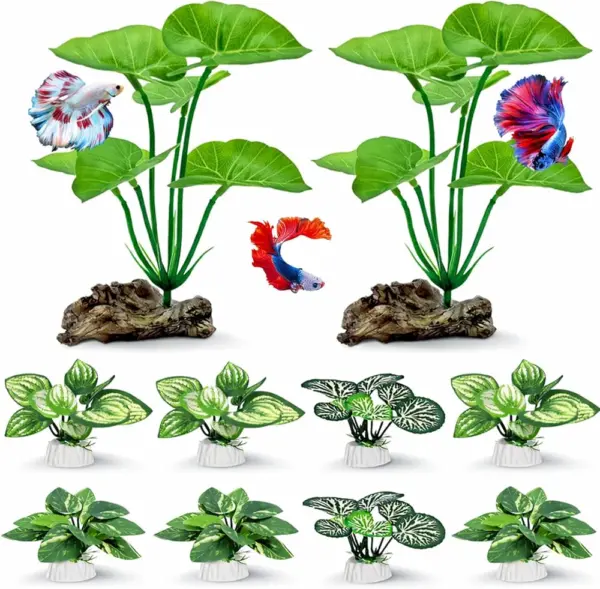
UreverFins Silk 10-Pack – Best Overall
Key Features
- Material: Silk leaves
- Tank range: 5 to 40 gallons
- Plant count: 10 pieces
- Plant heights: 2.4 in and 6 in
- Price: Midrange
Long, heavy fins are why we started with our fingers rather than our eyes. A betta drags a wide, trailing fin through every inch of a tank, and a hard molded leaf edge that a danio shrugs off can fray that fin in days. Pinching each plant in this guide between thumb and forefinger sorted the field quickly: these leaves fold instead of digging in, right out to the tips.
Ten pieces, split eight short plants at 2.4 inches and two at 6 inches on textured driftwood-style bases. That split is what makes the set work in a small tank. The short ones fill corners and run along the back glass without eating swimming room, and the two tall pieces give a betta somewhere to hang at mid-water, which is where it spends most of its time anyway. Every base is weighted, so planting is a push into the gravel rather than an anchoring job.
The leaves ship compressed and can arrive creased. Warm water relaxes them — the listing suggests it, and a short soak in a bowl sorted ours out — and the whole set wants a rinse before it goes near the tank. Once planted, the pieces hold their shape against a filter’s current instead of folding flat, which matters more than it sounds: a plant that bends over in the flow stops being cover.
This is the set we point a new betta keeper toward first, and the reason is unglamorous: nothing about it needs monitoring. No light schedule, no root tabs, no melting back. If your tank runs from 5 to 40 gallons and you want cover a long-finned fish can push through without damage, start here and add a live plant once the tank has settled.
Pros
- Soft leaves suit long-finned bettas
- Ten pieces cover a small tank
- Two taller plants add mid-water cover
- Weighted bases stay put in gravel
Cons
- Small plants feel more plastic than silk
- Glued bases can work loose in water
The set we recommend first for a betta tank: soft leaves in two sizes, and enough pieces to build cover in a five-gallon without crowding it.
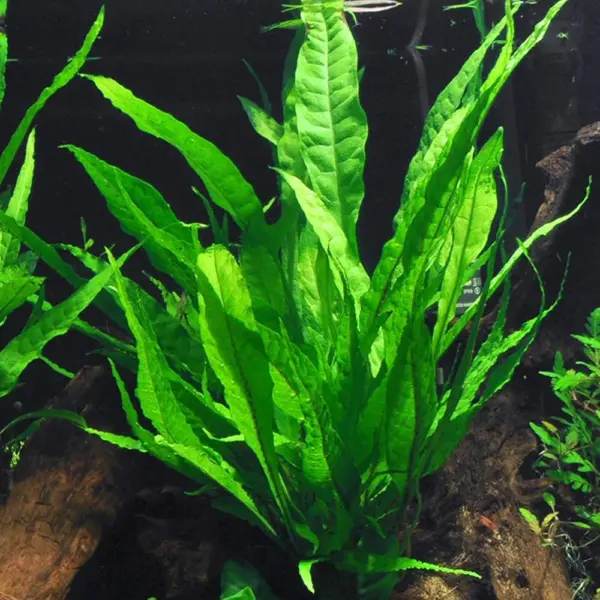
AquaLeaf Java Fern – Best Live Plant
Key Features
- Count: 1 plant
- Planting: Tie to hardscape
- Plant type: Live, bare root
- Light needs: Low
- Price: Budget
Every artificial plant in this guide makes the same trade: no light, no substrate, no chance of melting, and nothing that grows. Java fern is the other side of that trade at its simplest. It’s the live plant we suggest to people who want new leaves appearing in the tank but don’t want to run a lighting schedule, because it grows in a dim tank and it feeds through its leaves rather than its roots.
The rhizome — the thick green stem the leaves grow from — has to stay above the substrate. Tie it to a piece of driftwood or wedge it between rocks and it grips on its own within a few weeks. What arrives is one bare-root plant, so if you want a clump rather than a single accent, order two or three at once and place them together.
For a betta, the appeal is the leaf shape: broad, slightly stiff, and angled away from the rhizome, which is exactly the shelf a resting fish wants. It also tolerates being moved, so you can shift it while you’re still deciding on a layout, and it doesn’t mind sharing a tank with artificial plants.
Pros
- Grows in low light without CO2
- Feeds from the water, not the gravel
- Broad leaves give a betta a resting shelf
- An inexpensive way to try live plants
Cons
- Slow grower; a clump takes time to build
- Can arrive browned after a cold-weather shipment
The live plant we hand beginners: low light, no substrate, and broad leaves a betta will actually rest on.
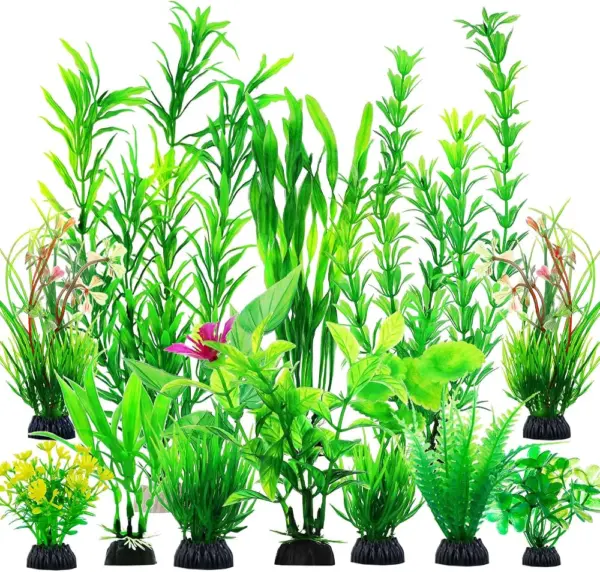
CousDUoBe 12-Pack Plants – Best Budget Artificial Set
Key Features
- Base: One per plant
- Material: Soft plastic
- Plant count: 12 pieces
- Height range: 2 to 8.6 in
- Price: Budget
Twelve plants between 2 and 8.6 inches, each on its own base, for less than most of the single live plants here. The leaves bend between your fingers instead of digging in, and the size spread lets you build a back-to-front layout instead of a row of identical sprigs — the tall ones at the back glass, the short ones filling the gaps around them.
Where it gives ground is weight. The bases are light, and in sand the plants drift until something pins them; fine gravel is a much better home for this set than a bare-bottom tank. Otherwise it’s hard to argue with. For a first tank, a quarantine setup, or a breeder box that needs cover in a hurry, twelve plants do the job the pricier sets do, and you won’t wince if a betta shoves one out of place.
Pros
- Twelve plants in mixed heights
- Soft leaves, not sharp plastic
- Strong green colour
- Good value for the piece count
Cons
- Bright green reads as artificial
The cheapest way to fill a tank with plants that need no light — soft enough for a betta, bright enough to notice, light enough to need gravel.
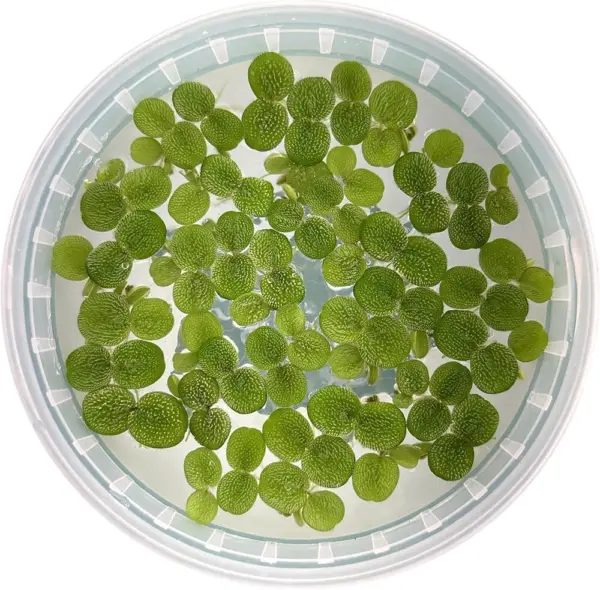
Water Spangles Salvinia – Best Floating Cover
Key Features
- Leaf count: 60+ leaves
- Plant type: Live floating
- Water type: Fresh or brackish
- Light needs: Medium to high
- Price: Midrange
A betta’s default position is just under the surface, nose up, waiting for something to happen. Water spangles put a ceiling there. The raft of small, fuzzy-leaved plants dims the light, gives the fish a shadow to sit in, and turns the top couple of inches of water into cover — it’s the only plant here that changes the top of the tank rather than the bottom.
Spangles want light and calm water. In a tank with a strong hang-on filter the raft gets pushed into one corner and stays there; a floating ring or a sponge over the intake sorts that out. They also shade whatever sits underneath, so they suit a tank of low-light plants or none at all, not a carpet you’re trying to grow on the bottom.
The one thing to get right with a betta is the gap. Bettas gulp air at the surface, and a solid mat across the whole tank is a genuine problem, so keep roughly a third of the surface clear. Do that and this is the plant we keep coming back to for a bright, open-topped tank: nothing else here gives a betta that much overhead shelter.
Pros
- Natural surface cover for a betta
- Grows and spreads quickly
- Shades a brightly lit tank
- Arrives as 60+ leaves
Cons
- Needs regular thinning
- Extreme heat or cold in transit risks melt
The best overhead cover here for a betta that hangs at the surface, as long as you leave a gap for air.
Amazon Sword 3-Pack – Best Live Background Plant
Key Features
- Plant type: Live, rooted
- Light needs: Tolerates low light
- Plant count: 3 plants
- Mature height: 20 to 50 cm
- Price: Midrange
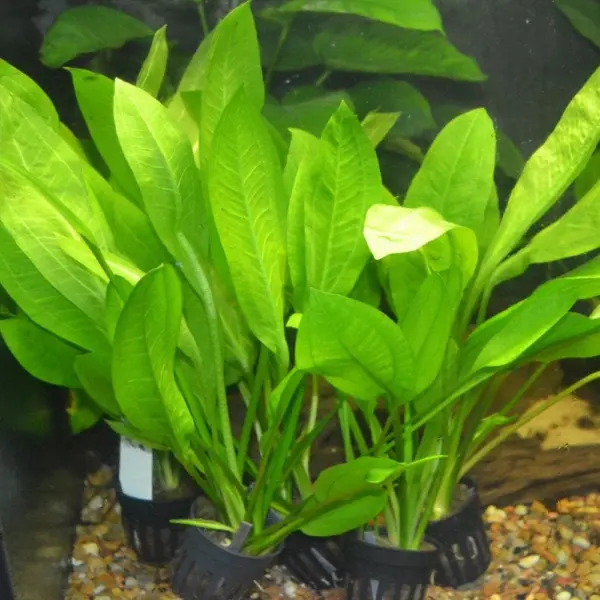
The number that matters on an Amazon sword is 50 centimetres, the height a healthy plant can reach — close to 20 inches, and enough to run from the gravel to near the surface of a deep tank. In a 20- or 30-gallon it’s a real centrepiece: a rosette of broad, pleated leaves that fills a back corner and gives a betta a canopy to swim under, and it’s the best live backdrop plant in this group.
It’s a root feeder, so a nutrient-rich substrate or a root tab pushed in beside it does more for growth than any bottle of liquid fertiliser. The low-light claim holds up — it grows toward whatever light there is — but a plant stretching for light comes out leggy and pale. Prune the outer leaves once they start shading what’s underneath; with a plant this size that’s routine maintenance, not an emergency.
Three bare-root crowns arrive, at the mercy of the postal service and the weather. Give them a rinse and a careful look before planting, because snails are the classic live-plant stowaway and they are far easier to spot now than after they’ve settled in.
Pros
- Broad leaves make natural cover
- Tolerates low light
- Three plants per order
- Grows into a genuine centrepiece
Cons
- Too tall for a 5- or 10-gallon tank
- Can arrive with broken leaves
The live centrepiece for a larger betta tank: broad leaves, low-light tolerance, and a plant that will genuinely fill a back corner.
Smoothedo Silk 2-Pack – Best for a Nano Tank
Key Features
- Height: 4 in
- Material: Soft silk leaves
- Plant count: 2 pieces
- Price: Budget
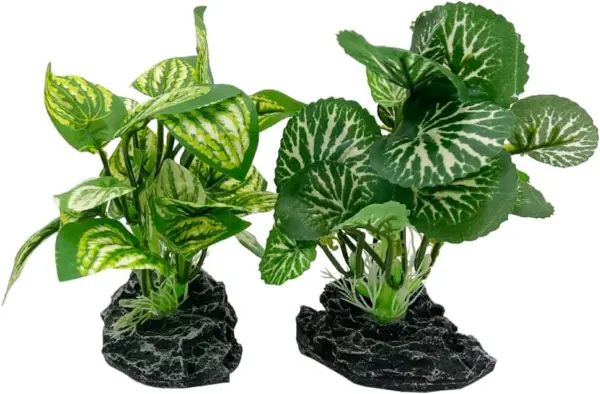
Two plants, four inches each, and that’s the whole set. In a nano tank, a hospital tank, or a small betta setup that needs one soft thing to sit against, that’s exactly the right amount — you get a resting spot without giving up the open water a fish needs to move through.
The leaves are the softest of the artificial plants here, and they’re fabric rather than moulded plastic, so they curl under a finger instead of springing back sharp. Two practical notes: the set smells faintly of pigment out of the box until it’s rinsed, and the stems are thin enough that a determined fish can nudge the plants around in the current.
What sold us is the shape. The leaves are wide and low rather than tall and wispy, and a broad leaf near the middle of the tank is what a betta actually uses — they don’t wedge into sprigs, they lie on top of things. For a small tank where you want one of those spots and not a jungle, this is the pair we reach for.
Pros
- Softest leaves of the artificial picks
- Good for nano and quarantine tanks
- Natural-looking, not neon coloured
Cons
- Only two 4-inch plants per set
The pick for a nano or hospital tank: two soft four-inch plants that give a betta one safe place to rest and nothing else.
AQUANEAT 10-Pack Plants – Cheap Starter Layout
Key Features
- Base: One per plant
- Sizes: 2 to 7.5 in
- Material: Soft plastic
- Plant count: 10 pieces
- Price: Budget
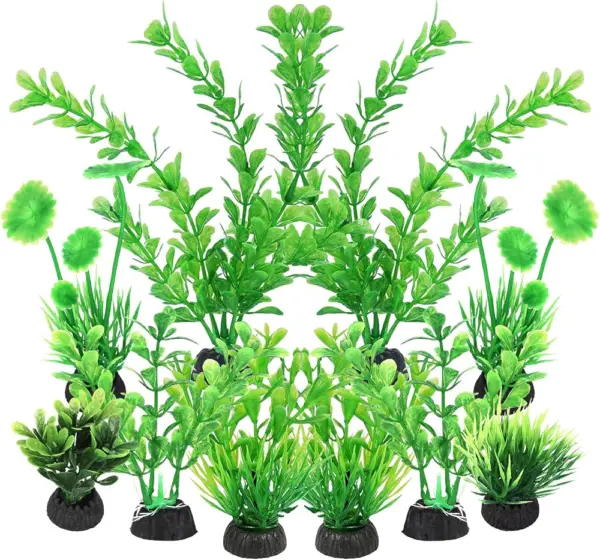
Ten plants, eight of them between 2 and 4.5 inches and two at 7.5, which is a different proposition from a bag of identical sprigs. The two big ones do the work of a background plant, the small ones tuck into gaps around them, and the leaves are soft plastic that bends rather than cracks. Everything needs a warm-water soak before it goes in, which the instructions state plainly and which also loosens the leaves after packing.
For a bare ten-gallon that needs cover in a hurry, this is the best-value set here after the twelve-piece CousDUoBe, and the leaves are soft enough for a betta’s fins. Buy two if you want a planted look rather than a few stems in a large space; one bag covers a small tank generously and a 20-gallon thinly.
Pros
- Ten plants including two tall ones
- Soft plastic leaves
- One of the cheapest sets here
Cons
- Small plants are tiny, 2 to 4.5 inches
- Bases tip over in fine sand
A cheap ten-plant starter layout with two tall pieces included — soft enough for a betta, and best in gravel.
MyLifeUNIT Seaweed 10-Pack – Best for Deep Tanks
Key Features
- Base: Ceramic
- Height: 12 in
- Plant count: 10 pieces
- Min water depth: 14 in
- Price: Midrange
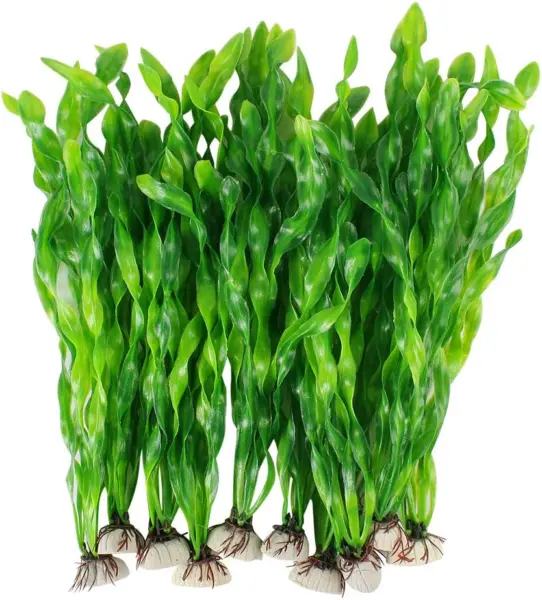
Twelve inches tall is the headline here, and it works as a filter more than a feature. MyLifeUNIT asks for a water level above 14 inches so the strands stand up, and most ten-gallon tanks are about a foot tall from gravel to rim — so this is a set for a 29-gallon, a 40 breeder, or a tall corner tank, not for the tank on your desk.
Where it fits, nothing else here does the same job. The strands run from the gravel to near the surface in a soft vertical curtain, and a betta will thread between them rather than around them. Ten of them on ceramic bases, heavy enough to be buried in gravel the way the instructions describe.
They arrive flattened from the box and revive in warm water — the listing suggests 104 to 140°F, hotter than tap water you’d want on your hands, so use a thermometer rather than a guess. Once they’re up they sway with the current instead of standing rigid, which is what stops the set from looking like ten plastic sticks.
For a deep tank this is the tall cover we reach for, and ten strands go a long way in a 40-gallon. For everyone else it’s the wrong plant for the tank: the shorter sets here will look better in a ten-gallon, and cost less doing it.
Pros
- Tall strands fill a deep tank
- Ceramic bases hold in gravel
- Soft enough not to scratch fins
- Ten pieces for a large tank
Cons
- Vivid green reads as plastic
- Strands can separate from the base
Only for deep tanks: with 14 inches of water, ten tall strands give a betta a curtain to move through that shorter plants can’t match.
How We Tested the Best Betta Plants
We built the shortlist by combing through customer reviews and filtering for plants that were explicitly described as soft-leaved or silk, with no wire stems or sharp edges. We also sorted by height and price to cover nano tanks and larger setups. That left 16 plants — a mix of live and artificial — which we tested over four months.
Each plant went into a real betta tank: a 5-gallon on my desk, a 10-gallon in the living room, and a 20-gallon long with a betta that likes to rearrange his decor. We anchored each one according to the instructions, then checked after 24 hours and again after a week to see if it stayed put or floated. We watched whether the betta rested on the leaves, swam through them, or ignored them entirely.
For live plants, we noted condition on arrival — yellow leaves, melted stems, intact roots — and tracked new growth for a month. For artificial ones, we ran a nylon stocking over every edge to catch snags, soaked them in a bucket for a week to check for fading, and tugged the base to see how much weight it took to tip. We measured heights against water level to confirm the betta had a resting spot near the surface, and compared how each plant looked under the same light after four months. Value came down to whether it still looked and functioned like a plant we’d buy again.
How to Choose Aquarium Plants for a Betta
The plant that suits a betta is the one that leaves its fins intact and gives it somewhere to sit — everything else about it is decoration.
Put fin safety before looks
Long-finned bettas, halfmoons especially, drag their fins across everything in the tank, and a hard plastic leaf with a molded seam is where that goes wrong. Run a fingernail, or a pair of tights, along a leaf edge before you buy: if it catches, the plant is a risk. Soft fabric leaves and rounded live leaves are the safe side of that line.
This is the one criterion we don’t compromise on. A cheap, sharp-leaved set is not a bargain at any price, and a plant that snags a fin costs more in treatment and worry than the difference between the cheap set and a soft one.
Match plant height to your water, not the tank’s gallon rating
A gallon rating tells you almost nothing about whether a plant will fit. A twelve-inch plant needs more than a foot of water above the gravel to stand up, and most ten-gallon tanks are about a foot tall from gravel to rim — so a set sold as suitable for aquariums generally can be far too tall for the tank you actually own.
Measure rim to gravel, then buy plants that finish an inch or two below the surface. Tall plants in shallow tanks end up bent under the lid, and bent plants look worse than no plants.
Decide live or artificial before you shop
Live plants cost more per plant, arrive with shipping risk, and can melt back in a new tank. In exchange they consume some waste, look better as they grow, and move in a way plastic never does. Artificial plants are instant, need no light, and can be scrubbed clean.
If you want the tank to look finished this week, buy artificial. If you’re willing to wait a month for plants to establish, buy live. Mixing the two is fine — some of the tanks we like best here do exactly that, with a live plant for growth and artificial pieces for instant structure.
For live plants, check how they feed and how much light they want
Live plants split into two groups, and the difference decides whether you need to spend more on substrate. Root feeders, like an Amazon sword, take most of their nutrition through the gravel and do best in planting soil or with a root tab. Water-column feeders, like java fern and anubias, feed through their leaves, so you tie them to driftwood or rock and never bury the rhizome.
Light matters more than most labels admit. Plants sold as low light generally do tolerate it, but tolerance isn’t thriving: they grow slowly, and slow growth gives algae the advantage on older leaves. With a basic LED hood, choose java fern or a sword and accept the pace; with a brighter light, add floating plants to soak up the excess.
Leave the surface and the front glass open
Bettas breathe air at the surface, and a mat of floating plants across the whole tank is a real problem rather than a lush jungle look. Keep roughly a third of the surface clear, and thin floaters regularly rather than waiting for them to take over.
The same logic applies to the layout: a couple of taller pieces along the back, low plants at the sides, and open swimming water through the middle and front. Cover a betta can retreat into is useful; a wall of plants against the front glass just hides the fish you bought.
Frequently Asked Questions
How many plants should I put in a 5-gallon betta tank?
Four to six small plants plus one taller piece gives a betta cover without turning the tank into a thicket. Put them along the back and sides and leave the front third open for swimming.
If you’re using a ten- or twelve-piece artificial set, expect to use most of it but not all. The leftovers are spares for when a base works loose.
Do betta plants need CO2 injection?
Not the plants in this guide. Java fern, anubias and Amazon swords all grow without added CO2; they simply grow more slowly. CO2 is for demanding carpet plants under high light and is wasted money in a low-light betta tank.
Put the budget into a root tab beside a sword instead, and spend the rest on a light timer.
Why does my betta lie on top of its plant?
Because it’s resting. A betta that lies still on a broad leaf, or wedges itself into floating roots, and then swims off normally at feeding time is doing exactly what the plant is for. Wide, horizontal leaves get used far more than tall wispy ones.
A fish that stays put and refuses food, or sits on the bottom, is a different situation — check temperature and water quality rather than the plant.
How do I clean artificial plants?
Take them out every few water changes and rinse them in warm water, working a soft toothbrush along the leaves where algae settles. Fabric leaves need a gentle squeeze rather than a scrub, or they fray.
Skip soap and bleach, and never put a plant back with any residue on it. A ten-minute soak in warm water before the first use also relaxes leaves that were creased in the box.
Final Verdict
Start with the UreverFins silk set. Ten pieces is enough to build cover at two levels in a five- or ten-gallon tank, every leaf gives under a finger, and nothing about it needs light, substrate, or attention. That’s what most bettas actually need, and it’s what we point someone toward when they’re setting up a first tank this weekend.
If you want living greenery instead, buy java fern. It tolerates low light, feeds from the water rather than the gravel, and its broad leaves are the closest thing here to a betta mattress. Add a root-feeding Amazon sword only once the tank is 20 gallons or more — below that, it will outgrow the space it’s meant to fill.