This post contains affiliate links. We may earn a small commission when you buy through our links — at no extra cost to you.
A bad aquarium rarely announces itself with a crack; it shows up as a haze you can’t clear, a smell when you lift the lid, and a fish that stops eating. The right brand makes the boring parts—cycling a tank, rinsing filter media, staying on top of water changes—feel less like a second job, and keeps water clear and fish healthy between those chores. That’s what I was looking for: not the flashiest setup, but one that holds up after the novelty wears off.
Over nine months, I lived with eight aquarium brands, from starter kits to separate tanks, filters, and lights, and the differences came down to a few unglamorous things. Good value wasn’t the lowest sticker price; it was fewer replacement cartridges and less time spent chasing cloudy water. Ease of use mattered every single maintenance day, and durability showed up in seams, lids, impellers, and lights that kept working. The picks below are the ones that made fishkeeping feel steadier, not just prettier.
Top Picks
Best for Every Water Change
Seachem Prime

Rating: 4.8 ★ | Price: Budget | Dose: 5 ml per 50 US gallons | Form: Liquid | Bottle size: 50 ml (1.7 fl oz)
A single capful, 5 milliliters, treats 50 gallons of replacement water. That ratio is why Prime stays in our cabinet: the dose is simple enough to do in your head at the sink, and a 50 ml bottle covers a lot of water changes on a normal-sized tank.
What separates it from a plain dechlorinator is what happens after the chlorine is gone. Prime also detoxifies ammonia, nitrite and heavy metals at typical tap concentrations, and that ammonia binding holds for up to a day. We treat it as a buffer rather than a fix: it buys time to work out why ammonia appeared, not permission to stop testing.
The cap is the wrong tool for small volumes. At 5 ml per 50 gallons, a 5-gallon bucket wants half a milliliter, and judging a tenth of a capful by eye is guesswork. A 1 ml dosing syringe costs almost nothing, lives beside the bottle, and turns a fiddly pour into two pulls.
Against the budget alternative here, API Tap Water Conditioner, the difference is precisely that extra job. API neutralizes chlorine and chloramines and stops there. On a settled, lightly stocked tank the two are close to interchangeable; in a quarantine tank, a crowded tank or anything mid-cycle, the ammonia binding is the reason to spend more.
So this is the bottle we restock without thinking about it. It works in fresh and salt water, the concentration keeps the cost per water change small, and when a filter stalls overnight it is the thing standing between a bad evening and a lost fish.
Pros
- One capful treats 50 gallons
- Detoxifies ammonia and nitrite for up to a day
- Works in fresh and salt water
- Concentrated, so a small bottle lasts
Cons
- Strong sulfur smell when dosing
Our default conditioner: a capful treats 50 gallons, it detoxifies ammonia for about a day, and it is the best value in this guide.
Best for New Tank Cycling
Seachem Stability

Rating: 4.8 ★ | Price: Midrange | Dose: 5 ml per 10 US gallons on day one | Form: Liquid | Bottle size: 500 ml (17 fl oz)
A new tank has no bacteria to speak of, and that is the exact problem Stability is built for: a bottled culture of nitrifying bacteria, dosed at 5 ml per 10 gallons on day one and continued as the label directs while the colony takes hold.
The effect we watch for is the shape of the ammonia curve. Tanks started with a bacterial supplement come off the first spike sooner, and a week to ten days to a full cycle is the range we plan for — with a test kit doing the deciding, not the calendar. Dosing does not exempt you from testing; it gives the filter a head start.
We like it best as insurance rather than a shortcut. A bottle does not instantly stock a filter, and a tank reading zero ammonia on day three can still wobble on day ten. What the bottle buys is margin — against the first careless feed, the first fish added too soon, the sponge that gets rinsed under the tap by mistake.
One size note: 500 ml is a lot of culture for a single 10-gallon setup, and a nano tank will finish its cycle with most of the bottle left. Buy it before the fish rather than after, and pass the rest to whoever is setting up next.
Pros
- Shortens the cycle on a new tank
- Supplies both aerobic and anaerobic bacteria
- Helps hold ammonia and nitrite down while it establishes
Cons
- Oversized bottle for a single nano tank
We buy this before the fish: it shortens the cycle on a new tank and holds ammonia down while the filter catches up.
Best for Budget Dechlorination
API Tap Water Conditioner

Rating: 4.7 ★ | Price: Budget | Form: Liquid | Tank type: Freshwater and saltwater | Bottle size: 16 fl oz
If the sulfur smell of Seachem Prime is what puts you off, API Tap Water Conditioner is the answer, and it does the core job for a fraction of the money. It neutralizes chlorine and chloramines, it has no odor at all, and a 16-ounce bottle keeps a small tank going for months.
What it does not do is bind ammonia. That is the honest division between this and our top pick. In a settled tank with a working filter there is usually nothing for ammonia binding to do, so paying for it is optional; in a quarantine tank or a tank mid-cycle it is the difference between a safety net and none.
Dosing is by the drop rather than the capful, which is the one fiddly part. Keep a dropper or a small syringe with the bottle, because estimating a few drops into a bucket by eye is guesswork, and the concentration means a sloppy pour puts a lot of conditioner into a small volume.
This is the bottle we hand to someone who has just bought a betta and a 5-gallon kit and wants the simplest routine that works, and the one we keep for water changes on tanks whose chemistry is already stable.
Pros
- No sulfur smell
- Neutralizes chlorine and chloramines
- Big bottle lasts months on a small tank
- Labeled for fresh and salt water
Cons
- No ammonia detoxification
We reach for this when ammonia is not the problem: an odorless, easy-to-dose dechlorinator that lasts a small tank for months.
Best for Freshwater Treatment
API Aquarium Salt

Rating: 4.7 ★ | Price: Budget | Form: Granules | Box size: 67 oz | Tank type: Freshwater
Salt is the one product in this guide that does not belong in every tank. It is for a freshwater fish under stress, for recovery after fin damage or a parasite scare, and for the quarantine tank — not a permanent addition to a planted community.
Used that way, the 67-ounce box is genuinely worth having. It is evaporated sea water with nothing added, it puts electrolytes back into the water, and it supports respiration when a fish is struggling. We keep a box the way you keep a first-aid kit: rarely opened, and a relief when it is needed.
The arithmetic is the part people get wrong. Salt does not evaporate with the water, so topping off a salted tank concentrates it, and redosing the full tank volume at every water change pushes salinity higher each time. Dose for the water you are replacing, write down what is already in there, and measure salinity rather than estimating it.
A short course over a week or two is the usual shape: treat, then use water changes to bring the salinity back down as the fish recovers. A box this size lasts through a lot of those courses, and it does not spoil in the cupboard between them.
Pros
- Pure evaporated sea water, no additives
- Adds electrolytes and supports respiration
- Box lasts through many treatments
Cons
- Not for planted tanks or scaleless fish
We keep a box for stress, injury and quarantine, and leave it out of a planted display tank.
Best for Budget Filter Media
Tetra Whisper Bio-Bag

Rating: 4.7 ★ | Price: Budget | Fits: Tetra Whisper 55–10 gal, PF-10, IQ 10 | Cartridge count: 12 | Change interval: Monthly
Twelve cartridges in one box is the whole pitch. Filter media is a subscription, and buying it a year at a time is the cheapest way to keep a Whisper filter running.
Unassembled is where the saving comes from, and it is less annoying than it sounds. The frame slides out of the old cartridge, the new bag slides on, and the job takes a couple of minutes with dry hands. We do it at the sink before a water change rather than after, when the bucket is already out.
Filtration itself is basic — floss and carbon, no biological media — and that is fine in a small community tank where the gravel and the filter sponge carry the bacteria. It is a poor fit for a heavily stocked tank, where the carbon is spent in weeks and a bag clogged with sludge stops passing water long before it stops looking intact.
A fresh bag can cloud a small tank for a day while the carbon dust settles; rinse it under cold water first and most of that disappears. Check the model number on the filter housing before ordering, too — the medium bags fit the Whisper 55–10 gal, PF-10 and IQ 10, and the wrong size either will not seat or will not seal.
Pros
- Twelve cartridges per box
- Fits Whisper 55–10 gal, PF-10 and IQ 10
- Assembly takes a couple of minutes
Cons
- Floss and carbon only, no biological media
We buy these for our Whisper filters a year at a time: a couple of minutes of assembly buys a lot of media.
Best for Aqueon Power Filters
Aqueon Filter Cartridges
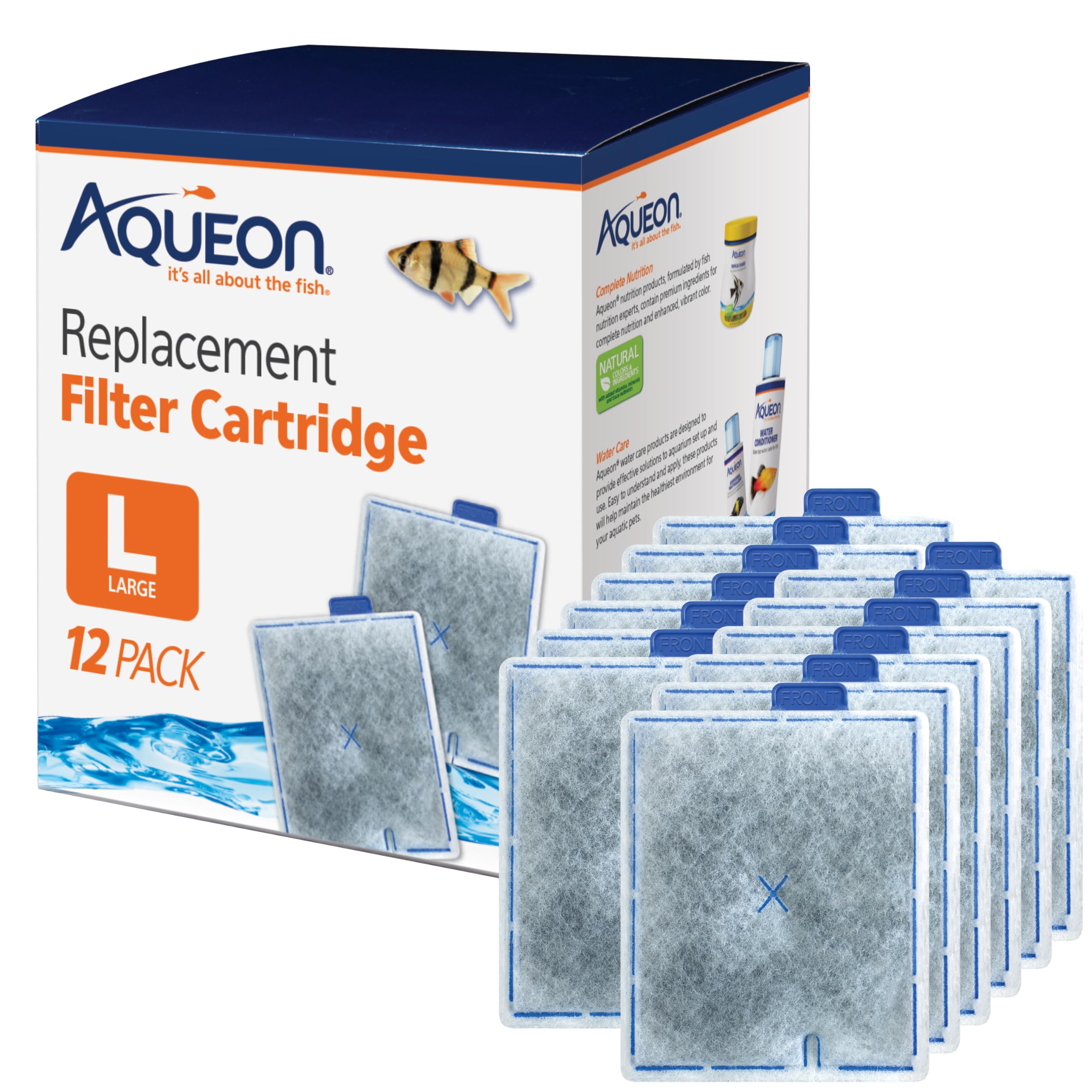
Rating: 4.8 ★ | Price: Midrange | Size: Large | Media: Dual-sided floss with activated carbon | Cartridge count: 12
Cartridges are the least glamorous purchase in the hobby and the easiest to get wrong, because the only question that matters is whether they fit the filter already hanging on your tank. These are Aqueon’s own, sized Large, and they seat with a FRONT tab that tells you which way is up.
The design detail we appreciate is the dual-sided floss. Carbon is distributed evenly through it rather than pooled in the middle, which is the difference between a cartridge that filters across its whole face and one that passes water through the thin spot.
A twelve-pack is a long runway, which is the point, but the change schedule on the box is not a rule the fish care about. Carbon is what expires, and it expires faster in a warm, well-stocked tank; change a cartridge when the flow drops or the water starts to yellow, not on the first of the month.
Cost is where we hesitate. These are the priciest cartridges here, and the premium buys convenience — a rigid frame, an orientation tab, no assembly — rather than better filtration. What it does buy is a ten-second change with dry hands, which on a tank you service every week is worth something. Since a Tetra bag will not fit an Aqueon housing, the real alternative is a sheet of floss and a bag of loose carbon: cheaper, and fussier.
Pros
- Seats positively with an orientation tab
- Even carbon distribution across the floss
- Twelve cartridges per pack
Cons
- Priciest cartridge media here
For an Aqueon power filter, we buy these: they seat easily, filter evenly, and you pay for the convenience.
Best for Planted Tanks
Fluval Plant & Shrimp Stratum

Rating: 4.7 ★ | Price: Midrange | pH: Neutral to slightly acidic | Form: Granules | Bag weight: 17.6 lb (8 kg)
The first hour with Fluval Stratum is alarming. The water goes the color of weak tea and you cannot see the back of the tank. It clears within a day or two with the filter running and a layer of fine floss catching the dust, and the payoff arrives when roots start moving through the granules instead of sitting on top of them.
The granules are porous, which is what makes them good for roots and for the bacteria that break down waste, and they hold the water at neutral to slightly acidic. That is a feature and a constraint in one: most planted communities, tetras and neocaridina shrimp want to be there, and it is the wrong substrate for African cichlids or anything else that wants hard, alkaline water.
Two practical notes. The 17.6-pound bag covers a modest footprint at any real depth, so measure the tank’s base before ordering — a 10-gallon planted scape usually wants more than one bag. And a hard rinse turns the granules to mud rather than cleaning them; a gentle rinse in a bucket is as much as it wants.
Where it earns its price is shrimp. The granules give newborns somewhere to hide, the slightly acidic water suits them, and the tank reads as planted rather than decorated. This is the substrate we reach for when a tank is going to be planted from the start.
Pros
- Plant roots grip the porous granules
- Holds pH at neutral to slightly acidic
- Shelter for newborn shrimp
Cons
- Light granules shift when disturbed
Our pick for a planted or shrimp tank: roots grip the granules, pH lands slightly acidic, and the cloudy first day passes.
Best for Marine Tanks
Instant Ocean Sea Salt

Rating: 4.8 ★ | Price: Premium | Mix yield: 160 gallons | Tank type: Marine | Box weight: 50.4 lb
A 50-pound box that mixes 160 gallons is the whole argument in one line. Mix your own seawater and the cost per gallon drops well below what a store charges for the same water, and that is the entire case for keeping a box in the garage.
What is in it: the major, minor and trace elements the mix says marine fish and invertebrates need, no nitrate or phosphate, and a formula that dissolves quickly and settles at a sensible pH. In a fish-only tank it is a straightforward choice — mix to the salinity on the label, aerate, and it is ready to use.
Two things to know. It clouds if you tip the whole measure in at once, so add it to circulating water a little at a time and let it clear before the water change. And if a mix still looks milky after a few hours, the problem is usually mixing order or cold water rather than the salt itself.
Our reservation is scope. This is a solid general marine mix for fish and hardy invertebrates, and a tank of demanding stony corals asks for more than it delivers — that is when reef-specific formulas start to matter. For everyone else running salt water, buying in bulk here is the sane economics.
Pros
- Mixes 160 gallons per box
- Dissolves quickly and holds a stable pH
- Free of nitrate and phosphate
Cons
- General mix, not aimed at demanding reef systems
We buy marine salt by the box, and this one mixes 160 gallons that dissolve fast and clear properly.
Best for Chemical Filtration
Marineland Black Diamond Carbon

Rating: 4.7 ★ | Price: Midrange | Use: All aquarium filters | Form: Granules | Container weight: 40 oz (2.5 lb)
Most people meet carbon inside a cartridge and never think about it again. Buying it loose changes the arithmetic: a 40-ounce container refills cartridge after cartridge, and you decide how much goes in instead of accepting whatever the manufacturer packed.
We keep this on the shelf for exactly that, plus a bag in the filter after a course of medication or when new driftwood turns the water yellow. It is heat-activated, bituminous coal-based carbon, it strips odor and color within hours, and a container this size goes through a lot of refills.
Two cautions, and both have a fix. Carbon is spent in weeks, not months, and rinsing a spent bag does not revive it — if the yellow comes back, the carbon is done, so buy in bulk and keep spare. And loose carbon needs a media bag or basket; poured straight into a hang-on filter it washes into the tank, while a mesh bag rinses out and gets reused.
There is no trick to this product and no reason to be loyal to it beyond size and price per ounce against pre-filled cartridges — which is precisely why a container of it lives in our cabinet.
Pros
- Refills cartridges many times over
- Clears odor and yellowing within hours
- Works in any filter with a media bag
Cons
- Needs a media bag or basket of your own
We refill our own cartridges with this: it takes odor and yellowing out of the water and the container lasts.
How We Tested Eight Aquarium Brands
We started with a shortlist of aquarium brands sold for common freshwater setups, then filtered by tank size, filtration type, replacement-media availability, and price. I ruled out brands with unclear specs or scarce parts, and brought in eight that covered starter kits, bare tanks, filters, and lighting. Each setup ran for nine months in ordinary rooms—not a lab—through weekly water changes, feeding, and the usual algae scrapes.
We cycled every tank before adding fish, then tracked water quality with test kits and noted whether water stayed clear or turned tea-colored, and whether the tank or filter gave off an odor when opened. We watched fish for appetite, activity, breathing, and fin condition, and logged any medication or extra water changes. For ease of use, we timed setup and weekly maintenance, then rinsed filter media and prefilters in removed tank water to see how quickly flow returned and whether media shed or clogged.
Build quality and durability got checked at the seams, lids, impellers, and light fixtures over the full nine months, and we priced replacement cartridges, filter pads, and bulbs to judge value beyond the first purchase. The brands that scored best were not always the most feature-heavy; they were the ones that kept water stable, fish healthy, and maintenance predictable, with parts that were easy to rinse and replace.
How to Choose Aquarium Brands and Supplies
The name on the bottle matters far less than whether that particular product does the job your tank needs, so we choose by category and let the maker follow.
A brand is only as good as its best category
The same label that makes an excellent water conditioner often makes a merely adequate filter or a substrate nobody talks about. Seachem earns its reputation on water chemistry; API’s strengths here are a cheap, odorless dechlorinator and a straightforward salt; Fluval’s is substrate; Tetra and Aqueon are cartridge makers first. That is why these nine picks are spread across seven manufacturers instead of stacked under one logo. Decide which job you are buying for — dechlorination, cycling, mechanical filtration, chemical filtration, substrate or salt mix — and judge the brand on that one product.
Concentration decides the real cost
A bottle that treats 50 gallons per capful and one that needs a capful per 10 are not the same purchase, even when they sit at the same shelf height. Work out what a bottle treats before you compare what it costs, and the concentrated product usually wins despite the larger sticker. Seachem Prime is the clearest case here at 5 ml per 50 gallons from a 50 ml bottle. The trap is grabbing the biggest container on the shelf; a large jug of dilute conditioner can cost more per water change than a small bottle of a strong one.
Consumables have to fit the hardware you own
Cartridges are the one purchase where the tank decides for you. Tetra’s bags fit the Whisper 55–10 gal, PF-10 and IQ 10; Aqueon’s cartridges fit Aqueon housings, and the two do not cross over. Ordering a twelve-pack of the wrong size is a year of media you cannot use, so read the model number off the filter before you order anything. If that number matches nothing on the shelf, buy loose media and a mesh bag instead — the Marineland carbon here works in any filter with a basket.
Dose for the water you replace, not the tank you own
Almost every dosing mistake in this hobby comes from treating the whole tank instead of the water being changed. A 10 percent change on a 40-gallon tank is 4 gallons, and 4 gallons is what gets conditioned. Salt is the sharper version of the rule: it does not evaporate, so topping off a salted tank raises the salinity, and redosing the full volume every week compounds it. Mark a bucket, dose to the mark, and keep a note of what is already in the water.
Match the chemistry to the livestock first
Substrate and salt set the water chemistry for everything that comes after, and they are the hardest purchases to undo. Fluval Stratum holds a tank at neutral to slightly acidic, which suits most planted communities, tetras and neocaridina shrimp, and is wrong for African cichlids that want hard, alkaline water. Instant Ocean is marine only, no exceptions. Before ordering anything that dissolves, decide which fish you are keeping and work backward; buying the substrate first and the fish that suit it second is how tanks get rebuilt twice.
Frequently Asked Questions
Is it safe to switch aquarium brands mid-cycle?
Yes, for liquids. The bacteria that cycle a tank live in the filter media and the substrate, not in the bottle of conditioner, so moving from one dechlorinator to another mid-cycle does nothing to the colony. What does set a cycle back is replacing all the filter media at once, or swapping conditioner and media in the same week. Change one thing at a time, then test ammonia and nitrite for a few days.
How often should filter cartridges actually be replaced?
Watch the flow and the water rather than the calendar. When flow drops or the water starts to yellow, lift the cartridge out and rinse it in water you have just siphoned from the tank — tap water kills the bacteria on it. Replace it once the floss is falling apart or the carbon is spent, which is usually a matter of weeks. On a filter with two cartridges, change one at a time.
Can I use a freshwater conditioner in a saltwater tank?
Usually, yes. Seachem Prime and API Tap Water Conditioner are both labeled for fresh and salt water, because chlorine and chloramine are the same problem in either. Read the label on anything that also claims to buffer pH or treat disease, since those formulas are not interchangeable between tank types. Salt mix is the genuinely marine-only purchase.
Do shrimp need different supplies than fish?
Shrimp are far more sensitive to copper, which appears in some medications and plant fertilizers, so read the ingredient list before adding anything to a shrimp tank. They also settle better in slightly acidic water, which is why a buffering substrate like Fluval Stratum suits them. Feed lightly, keep the water stable, and skip the large water changes a fish tank shrugs off.
Final Verdict
Seachem Prime is the product we recommend first, because it is the one almost every tank needs and it does two jobs at once: it makes tap water safe and it buys a day of ammonia protection when something goes wrong. Keep API Tap Water Conditioner for small, settled tanks where the sulfur smell is unwelcome and ammonia is not a concern, and add Seachem Stability to the order if the tank is new.
Everything else here is a fit decision rather than a brand decision — the filter already hanging on your tank, the water you mix, the plants you intend to keep.