This post contains affiliate links. We may earn a small commission when you buy through our links — at no extra cost to you.
Water changes are the part of fishkeeping nobody photographs. A siphon is the thing that decides whether that weekly 25 percent is a ten-minute chore or a wrestling match with a hose that keeps losing its pull — and a bad one leaves you sucking up gravel, re-priming every thirty seconds, or mopping tank water off the rug.
I’ve kept tanks on and off for close to a decade, and I’ve never met a siphon that was genuinely fun to use — but the good ones start pulling on the first or second try and keep pulling until you decide to stop. We put 14 of them through four months of real maintenance in tanks from a 10-gallon betta setup to a 55-gallon community tank, and the differences came down to details the box never mentions. One piece of advice before you shop: a wider hose drains faster, but it pulls harder, so in a tank with sand or light gravel it will swallow substrate. The picks below cover both sides of that tradeoff.
Our Top Picks
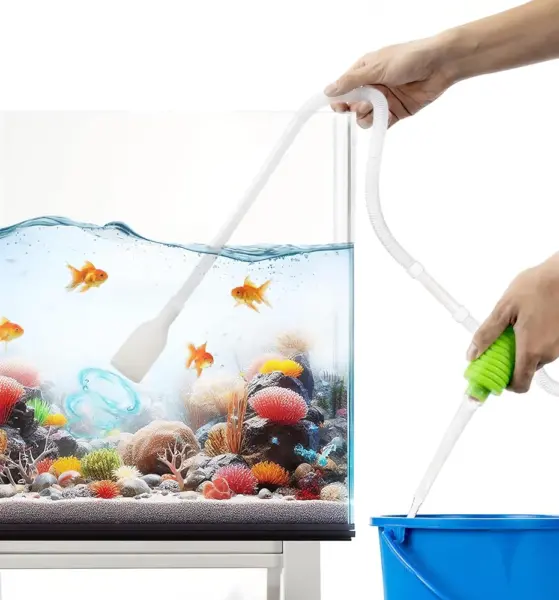
The Best Aquarium Siphons, Reviewed
Python No Spill Clean and Fill – Best Overall
Key Features
- Method: Faucet-powered drain and fill
- Gravel tube: 10 in
- Hose length: 25 ft
- Faucet adapter: Brass adapter included
- Price: Premium
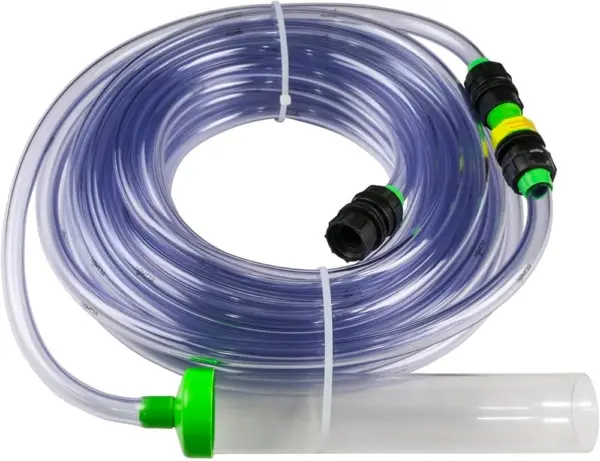
The 25-foot hose is the first thing you notice, and it is the reason this Python system changes the job: one end goes to a faucet, the gravel tube goes in the tank, and tap pressure pulls dirty water out and pushes clean water back. There are no buckets to fill, lift, or spill.
For a large tank, that is the difference between maintenance you postpone and maintenance you do. We think it earns the top spot here because it brings the useful parts together in one kit: a 10-inch gravel tube long enough to work a real substrate, enough hose to reach a sink across a room, and a brass faucet adapter that feels more substantial than the plastic fittings on some rivals. The same line drains and refills, so we can move slowly over the gravel and then change the water without swapping equipment.
The catch is that the system only works where you can reach a threaded faucet, and we check the connection before opening the tap. The 10-inch tube is the detail that makes the cleaning half feel less like a token add-on; it gives us enough reach to work deeper gravel without burying an arm.
Pros
- Drains and refills without buckets
- 10-inch gravel tube reaches deep substrate
- Brass faucet adapter and secure fittings
- Works in freshwater and saltwater
Cons
- Uses a steady flow of tap water while draining
For large tanks, the Python No Spill is our first recommendation: the 25-foot hose, 10-inch gravel tube, and faucet-powered drain-and-refill turn water changes into a one-person job without buckets.
hygger Bucket-Free Water Change Kit – Best Bucket-Free Alternative
Key Features
- Method: Faucet-powered drain and fill
- Hose length: 25 ft
- Flow control: On/off valve
- Faucet adapters: Three metal adapters
- Price: Midrange
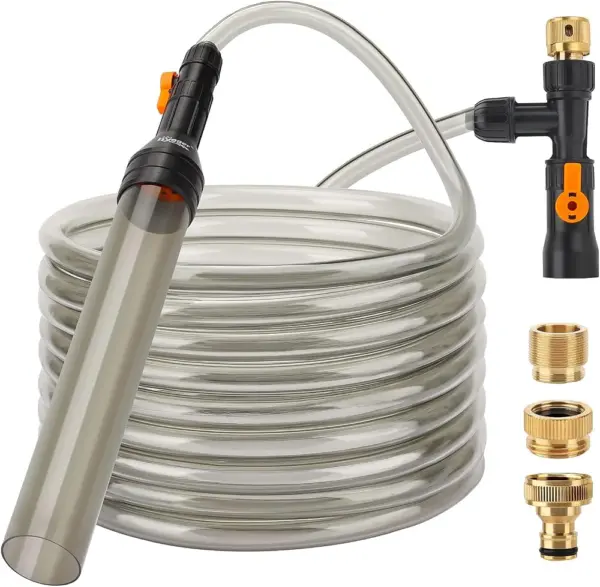
Where the Python kit leans on a brass adapter and a long track record, the hygger water changer makes its case with a set of metal faucet fittings and a shutoff valve. That matters if your sink has one of the common thread sizes but you have been burned by plastic adapters that cross-thread or seep under pressure. The kit includes adapters for three thread sizes, a 25-foot hose, and a gravel tube.
We found the valve especially useful during a water change: it lets us stop the flow at the hose instead of running back to the faucet with wet hands. Draining and refilling through the same line also keeps a mid-size tank from turning into a bucket parade. The gravel tube does the job on loose debris, although it is not the tool for a deep, densely packed substrate.
Against the top pick, this one feels more like a kit built around the faucet connection than around the gravel tube. The metal fittings are the reason to choose it, and the lower price makes that easier to justify. If your tap is the awkward part of the job, start here; if you need to clean a heavily stocked large tank, the Python’s longer gravel tube and bigger water-change role still make it the safer default.
Pros
- Metal adapters fit three faucet thread sizes
- On/off valve controls flow at the hose
- 25-foot hose drains and fills
Cons
- Thin hose can kink under vacuum
We reach for the hygger kit when the faucet is the fiddly part: metal adapters and an on/off valve make it a more secure bucket-free setup than plastic fittings, for less than our top pick.
Tetra Water Cleaner – Best Budget Manual Siphon
Key Features
- Method: Manual bucket siphon
- Included: Gravel siphon and bucket clip
- Tank size: Up to 55 gal
- Start method: Priming bulb
- Price: Budget
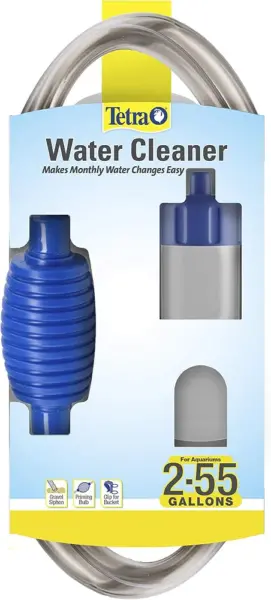
A priming bulb and a bucket clip do not sound like much, but they are exactly what makes the Tetra Water Cleaner a sensible budget siphon for tanks up to 55 gallons. The bulb starts the flow after a few squeezes, and the clip holds the drain hose inside the bucket so it does not flip out when the water picks up speed.
For a 20- or 40-gallon tank, that is a calmer routine than lifting a full bucket to pour into another container. The gravel tube is narrow enough to steer between plants, and the whole kit stores as a short tube and a coil of hose. We like that there is nothing to plug in and no faucet adapter to lose.
The narrow tube is also why this is not the fastest choice for a heavily stocked 55-gallon tank. It asks for a slow pass over the substrate, and the bucket has to sit lower than the tank for gravity to do its work. We treat it as a first siphon or a spare, not the centerpiece of a big-tank routine.
What keeps it in the bag is the bucket clip. It is a small piece of plastic, but it holds the drain end where you put it, which is more than some pricier-looking siphons manage.
Pros
- Priming bulb starts the siphon quickly
- Bucket clip holds the drain hose in place
- Narrow tube steers between plants
Cons
- Priming pump can separate over time
The Tetra Water Cleaner earns its place as our budget manual pick for 20- to 55-gallon tanks, provided you accept a slower pass and a lightly built pump.
Python Pro Clean-Mini – Best for Nano Tanks
Key Features
- Hose length: 6 ft
- Tube length: 6 in
- Tube diameter: 1 in
- Price: Budget
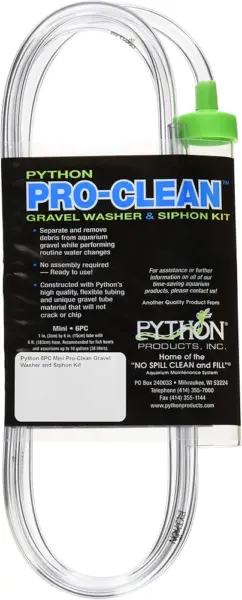
The Python Pro Clean-Mini is a gravity-fed tube-and-hose siphon, not a bulb-primed kit, and the flow is deliberately slow. That is either the point or the dealbreaker, depending on the tank in front of you. The tube measures 1 inch by 6 inches, and the hose runs 6 feet.
In a nano tank, the narrow tube is the feature we appreciate most. It lets us work between stems and around shrimp without the sudden pull of a wider vacuum, and the short hose is easy to manage over a bucket. The slower flow gives us time to lift the tube before it takes more water than we intended.
The trade-off is scale. Draining even a few gallons takes patience, and on a 20-gallon tank this becomes a spot-cleaning tool rather than a full water-change system. If you already own a bucket and only need to tidy the substrate, that is a fair exchange; if you are changing half the water every week, it will feel like a bottleneck.
We keep coming back to it for planted bowls and betta tanks because the small tube gives us control that the bigger siphons cannot. It is not the one to buy for a 55-gallon community tank, but for a desktop setup it earns its place as the delicate option.
Pros
- 1-inch tube works around nano plants and shrimp
- Slow flow gives control in small tanks
- Only 6 feet of hose to manage
Cons
- Six-foot hose limits bucket placement
Nano tanks are where we keep the Python Pro Clean-Mini: its 1-inch tube and gentle flow give you control around plants and shrimp that a full-size vacuum takes away.
Luigi’s Fish Tank Cleaner – Best for Quick Small-Tank Changes
Key Features
- Method: Manual bucket siphon
- Drain rate: 30 L in about 5 min
- Start method: Hand pump
- Livestock guard: Attached filter
- Price: Budget
The filter on the end of Luigi’s gravel tube is the detail that makes this hand-pump siphon worth considering for shrimp and small fish. It is a simple manual tool: squeeze the bulb to start the flow, then move the tube over the substrate while the dirty water runs into a bucket. It is rated for about 30 liters in five minutes, which suits a small or mid-size tank rather than a big community setup.
What we like is the control. The hand pump starts with a few squeezes, and the flow is gentle enough to work around plants without tearing them up. The filter screen is the real differentiator; it keeps small livestock and plant bits out of the hose, which is the sort of thing you only appreciate after you have had to fish a shrimp out of a bucket.
This is a bucket siphon, not a faucet changer, so the bucket still has to be lower than the tank and close enough for the hose. That is the right trade for a 10- or 20-gallon tank where the siphon comes out weekly; for a big tank, the bucket becomes the bottleneck.
For a quarantine tank or a child’s betta setup, the combination of a gentle start and a screened intake is more useful than a fancy faucet adapter. The screened intake is the reason we keep it in the small-tank drawer rather than passing it along.
Pros
- Screened intake protects small livestock
- Hand pump starts without mouth priming
- Clears about 30 liters in five minutes
Cons
- Plastic pump and check valve feel lightly made
Luigi’s hand-pump siphon is the one we grab for quick small-tank changes, when a screened intake and simple priming beat a bulky bucket-free system.
enomol 30ft Water Changer – Best for Long Hose Runs
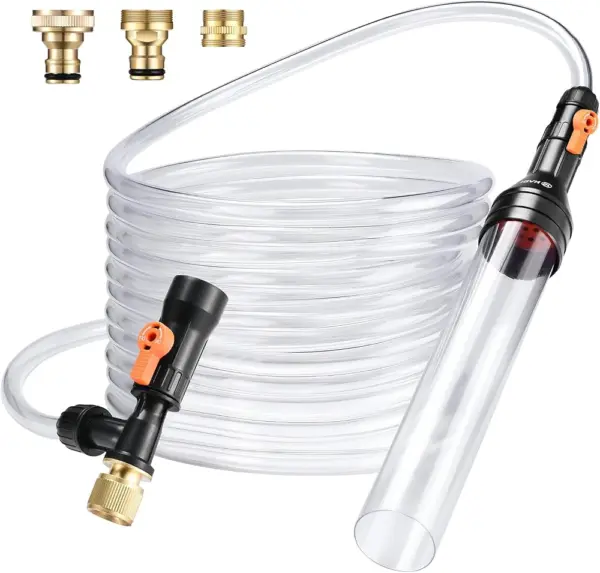
Key Features
- Method: Faucet-powered drain and fill
- Gravel tube: 16.5 in
- Hose length: 30 ft
- Faucet adapters: Four thread sizes
- Price: Midrange
If the sink is in one room and the tanks are in another, the 30-foot hose on the enomol changer is the reason to look at it. That extra reach lets you leave the bucket out of the equation and work from a tap that is not right beside the tank.
We think that reach is the product’s whole case. The kit uses tap pressure to drain and fill, includes a 16.5-inch gravel tube, and comes with four faucet adapters to cover common thread sizes. For a fish room or a tank across a hallway, the extra five feet over a standard 25-foot kit can be the difference between a workable routine and another bucket.
The long hose also asks for a little discipline: keep the run as straight as you can and check the adapter before you turn the tap. The 16.5-inch tube is long enough that you need to keep it moving rather than park it in one spot, especially in a deep tank.
What sold us was the combination of reach and a gravel tube long enough to work the bottom of a deep tank without submerging an arm. It is not the siphon for a single nano tank, but for someone moving between several tanks it solves a problem the shorter kits leave you to solve with extra hose and more buckets.
Pros
- 30-foot hose reaches across rooms
- 16.5-inch gravel tube reaches deep tanks
- Four faucet adapters cover common threads
Cons
- Needs decent tap pressure for strong suction
- Plastic housing can crack at connections
When the sink and tank sit far apart, the enomol changer is our long-reach answer; its 30-foot hose and 16.5-inch gravel tube go where shorter kits cannot.
boxtech Aquarium Siphon – Best for Deep Tanks
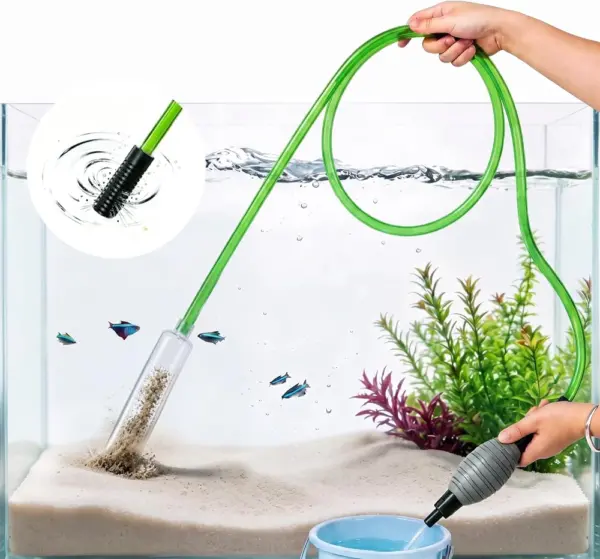
Key Features
- Valve: Anti-backflow valve
- Method: Manual bucket siphon
- Hose setup: 72.4 in soft hose and two 11 in hard pipes
- Start method: Hand pump
- Price: Midrange
The two rigid extension pipes are what make the boxtech siphon feel different from the usual coil of clear hose. They let you reach the bottom of a deep tank without putting an arm in the water, and the soft hose gives you enough length to reach a bucket on the floor.
The kit is built around a hand pump and an anti-backflow valve. We found the pump easy enough to prime with a few squeezes, and the valve helps keep the water moving in one direction once the siphon is running. The gravel intake is the part that does the actual cleaning; you push it into the substrate and lift as the debris rises.
For a tall tank, this is a practical alternative to a bucket-free faucet kit. You do not need a nearby sink, and the rigid pipes keep your hands out of the tank. The rigid pipes also make it easier to clean around decorations without knocking them over.
We like the boxtech most for a deep tank in a room without a usable faucet. It asks for a bucket and a little patience with the priming, but it saves you from leaning into the tank up to your shoulder.
Pros
- Rigid pipes reach deep tanks
- Anti-backflow valve keeps flow directional
- No faucet connection needed
Cons
- Priming bulb can split with use
- Assembly instructions are vague
We like the boxtech siphon for deep tanks in rooms without a usable faucet, because its rigid extension pipes keep your arm out of the water and the bucket close.
QZQ Gravel Cleaner Kit – One-Hand Control
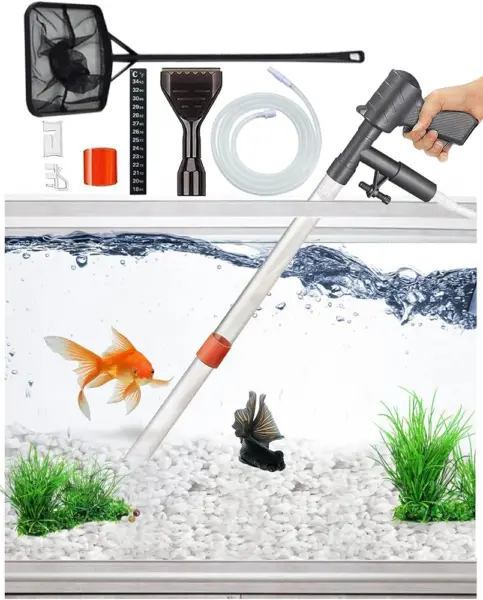
Key Features
- Power: Manual, no electricity
- Hose setup: Two water pipes with joint
- Start method: Hand-press trigger
- Price: Midrange
One-handed control sounds like a small thing until you are holding a gravel tube in one hand and trying to stop the flow with the other. The QZQ kit puts the pump in a trigger-style handle, so you can feather the suction while you steer the tube.
The kit is manual and silent, with two water pipes and a joint that let you adjust the reach. We found the trigger easier to modulate than a squeeze bulb, especially when working near a plant or a fish that does not need a sudden pull. The handle also lets you keep a thumb on the flow while you move the intake along the substrate.
As a water changer, it is a bucket tool rather than a faucet-powered system. That means no adapter puzzle, but it also means carrying the bucket. For a 20- or 40-gallon tank, the trade is reasonable; for a big tank, the bucket becomes the bottleneck.
We ended up treating the QZQ as a specialist for tanks where control matters more than speed. The trigger is the one feature that changes how the job feels, and that is enough to keep it in reach.
Pros
- Trigger feathers suction one-handed
- Manual and silent, with no adapter needed
Cons
- Trigger can stop pulling water
- Handle and hose connections can break
For planted mid-size tanks, the QZQ kit’s trigger gives us one-handed control that matters more than outright speed.
How We Picked and Tested Aquarium Siphons
We started with more than 30 siphons sold by big retailers and aquarium specialists, then narrowed the field by hose diameter, total length, priming style, and price — setting aside anything with a bulb that felt flimsy through the packaging or a hose that shipped already kinked. Fourteen made the cut, and each one lived with us for four months.
Testing happened during actual maintenance, never on a bench: weekly water changes in a 10-gallon planted betta tank, a 29-gallon community tank, and a 55-gallon tank with a deep gravel bed, plus a bare-bottom quarantine tank. We timed how long each siphon took to start from dry — counting pumps or shakes — and noted whether it held its pull through a full five-gallon bucket or stalled halfway. We watched how much gravel or sand got lifted, whether the intake clogged on plant matter, and how precisely we could steer around fry and shrimp.
After every change we rinsed the hose and checked how much debris clung to the inside walls and how easily the bulb drained and dried. Durability got tested the hard way: bulbs squeezed hundreds of times, hoses coiled and uncoiled and left in a warm garage, one unit dropped on tile. We recorded kinks that stayed kinks, cracks where hose meets plastic, and any drop in suction over the months. Size was judged against real buckets and real stands — whether the hose reached the floor from a tank on a cabinet, whether the clip held a rim of average thickness, and how much water we wasted getting the flow started.
How to Choose an Aquarium Siphon
The best aquarium siphon is the one that makes your normal water change short enough to repeat, so start with the tank and the sink, not the longest feature list.
Start with tank size and tube diameter
A 1-inch tube belongs on a nano tank or a planted bowl, where a slow pull gives you time to work around shrimp and delicate stems. A 10-inch gravel tube on a 55-gallon tank does the opposite: it covers substrate quickly and keeps you from spending an hour hovering over one corner. Match the tube to the job, then check hose length against the distance from tank to bucket or sink. A short hose is fine for a bucket at your feet; it is a nuisance across a room.
Choose bucket-free or bucket-and-gravity
Faucet-powered changers drain and refill through a hose, so you skip the lifting. They need a threaded faucet, a secure adapter, and enough tap pressure to drive the flow. We treat the faucet adapter as part of the purchase, not an afterthought; the metal fittings on the hygger kit and the brass adapter on the Python matter more than the hose itself. A manual siphon needs only gravity and a bucket, which makes it simpler anywhere but adds lifting. If stairs or back trouble are part of your routine, pay for the faucet system; if you change a small tank weekly, a bucket siphon is often easier.
Judge suction by the whole setup
Suction is not a single number you can compare across products. It depends on the height the water must climb, the faucet pressure, the hose length, and whether air is leaking at a connection. A long hose that reaches across the room can still feel weak if the tap is slow or the adapter is loose. Before blaming the siphon, check the adapter, shorten the run, and keep the hose as straight as you can. For a gravity siphon, the bucket must sit lower than the tank; for a faucet-powered one, the tap does the work.
Plan for cleaning, storage, and replacement parts
Gravel tubes and hoses need rinsing after use, and a hose that stays coiled wet will smell like a pond. We rinse the tube, check the intake screen for trapped debris, and hang the hose straight or coil it loosely. The parts that fail first are usually the pump bulb, the valve, or the hose at a connection, so choose a kit with fittings you can inspect and replace. A cheap siphon that splits in a season is not a bargain if it spills tank water on the floor. Store the tube off the floor so it does not collect dust between changes.
Frequently Asked Questions
Can I use an aquarium siphon on sand?
Yes, but use a gentler pull than on gravel. Keep the intake just above the sand and pinch the hose or use the valve to slow the flow; lifting a cloud of sand into the hose is the usual mistake. A narrow tube gives you more control, which is why the Python Pro Clean-Mini suits a nano sand bed better than a wide gravel vacuum.
Do I need to treat tap water before refilling?
Yes. Tap water can contain chlorine or chloramine, so dose a dechlorinator for the volume of new water before it goes into the tank. A bucket-free changer makes this easy to forget because the refill happens at the faucet; treat the replacement water or add conditioner to the tank before refilling, following the product label.
How do I stop the siphon before the bucket overflows?
Lift the gravel tube above the waterline or close the valve on a faucet-powered kit; either breaks the flow. Keep the drain hose clipped inside the bucket so it cannot flip out, and use a bucket you can see into. If your kit has no valve, kink the hose gently or raise the tube.
Final Verdict
The Python No Spill Clean and Fill is the one we recommend first for mid-size and large tanks. Its 25-foot hose, 10-inch gravel tube, and faucet-powered drain-and-refill turn a bucket-heavy chore into a routine you can finish in one pass, and the brass adapter gives the connection a more solid feel than the budget kits.
If your faucet is the sticking point, step to the hygger kit for its metal fittings; for a nano tank, the Python Pro Clean-Mini gives you the control the big tubes take away.