This post contains affiliate links. We may earn a small commission when you buy through our links — at no extra cost to you.
Many aquarium siphons promise mess-free water changes but deliver cracked adapters or weak suction within weeks. The difference often comes down to matching the system to your tank size and faucet setup — not just price.
A 25-foot hose attached to a faucet can turn a 30-minute chore into a 10-minute hands-off process, but only if the adapters seal properly and the hose doesn’t kink. On smaller tanks, a manual siphon with a reliable bulb start is simpler and wastes less water.
Choosing between metal and plastic connectors is a real trade-off: metal lasts longer but adds cost, while plastic can crack mid-change. The right pick balances longevity with the demands of your specific aquarium.
Top Picks
Best for Large Tanks
Python 25ft Water Changer

Rating: 4.6 ★ | Price: Premium | Hose Length: 25 ft | Gravel Tube: 10-inch | Build Material: Plastic and vinyl
The 25-foot hose reaches from most sinks to tanks up to 100 gallons, letting you drain and refill without hauling buckets. The brass adapter connects to standard faucet threads, creating suction that pulls water out and gravel debris up the tube.
Best suited for owners of 20–100 gallon tanks who want a fast, no-mess water change routine. The long hose and strong suction are overkill for smaller setups. Note that some faucets with non-standard threads may need an additional adapter — the included brass adapter fits most but not all.
Pros
- Effortless water changes without hauling buckets
- Simple 5-minute setup connects to most faucets
- Cleans gravel thoroughly without stirring up fish
Cons
- May need a separate adapter for faucets with unusual threading
For medium to large tank owners who prioritize speed and cleanliness during water changes, this system is the right call. Just check your faucet type first.
Best for Small Tanks
TERA PUMP Gravel Cleaner

Rating: 4.2 ★ | Price: Budget | Hose Length: 5.5 ft | Gravel Tube: Two nozzles included | Build Material: Plastic, BPA-free
The TERA PUMP gravel cleaner delivers 1.5 GPM flow with a squeeze-bulb start and two nozzle choices, making it straightforward to use on 10–20 gallon tanks. The 5.5-foot hose is short, so the bucket must sit close or elevated — a limitation for tanks on tall stands. This works best for aquarists with low stands or those who don’t mind a nearby bucket.
Pros
- Easy priming squeeze bulb delivers strong suction quickly.
- Cleans gravel effectively in 10–20 gallon tanks.
- Affordable price point for a functional manual siphon.
Cons
- Flow control clip may be absent from the package, requiring manual flow adjustment.
- Short 5.5-foot hose means the bucket must be placed close to the tank, awkward with taller stands.
For 10–20 gallon tanks with low stands, this manual siphon offers strong suction and easy starting at a budget-friendly price.
Best for Large Tanks
GADFISH 30ft Water Changer

Rating: 4.4 ★ | Price: Mid-Range | Hose Length: 30 ft | Gravel Tube: 14.5-inch with filter | Build Material: Metal and plastic
The GADFISH gravel vacuum uses all-metal faucet adapters where competitors use plastic, eliminating the crack-prone joint that often ends a water changer’s life. The 30-foot hose covers 50–125 gallon tanks comfortably. Flow is slightly slower than the top pick’s wider hose, so drainage takes a bit longer — acceptable for owners who prioritize build quality over speed. This is the right fit for large-tank keepers who want a mid-range tool that won’t let them down at the faucet, even if it means a few extra minutes per water change.
Pros
- All-metal faucet adapters resist cracking
- Simple faucet attachment gets water flowing quickly
- Covers large tanks efficiently with 30-foot hose
Cons
- Leakage can occur at adapter connections even with Teflon tape
A durable mid-range option for large-tank owners who value metal adapter construction over brand recognition.
Best for Small Tanks
Tetra Gravel Siphon

Rating: 4.5 ★ | Price: Budget | Hose Length: ~3 ft | Build Material: Plastic
Unlike some ultra-budget siphons that struggle with suction consistency, the Tetra’s bulb pump starts immediately and draws water steadily — no fussing required. The slim tube works well in 5- to 20-gallon aquariums, pulling debris from gravel without uprooting plants, and the simple design means you’re up and running in seconds, no faucet hookups needed.
First-time fish keepers with small tanks will appreciate the simplicity. The all-plastic build can develop cracks with regular use, and the tube may clog when large debris gets caught, so it’s a low-cost entry rather than a lifelong tool. Treat it accordingly, and it delivers clean gravel without overspending.
Pros
- Works well on 5–20 gallon tanks with good suction
- Simple bulb pump primes easily — no awkward shaking needed
- Budget-friendly price for basic gravel cleaning
Cons
- Tube can clog when large debris gets caught, requiring the occasional shake to clear
- Plastic components may crack with regular use, reducing longevity
If your tank is under 20 gallons and you’re willing to treat this as a replaceable tool rather than a permanent fixture, it’s the best value in manual siphons.
Best for Nano Tanks
Python Mini Siphon

Rating: 4.4 ★ | Price: Budget | Hose Length: 6 ft | Gravel Tube: 1"x6" | Build Material: Plastic
The Python Mini Siphon is purpose-built for nano aquariums up to 5 gallons, enabling careful gravel cleaning without uprooting plants. Its compact 1-inch tube and 6-foot hose make it easy to handle and store. This budget-friendly tool is ideal for betta or shrimp tank maintenance.
Pros
- Compact 1-inch tube fits 1–5 gallon tanks without disturbing delicate substrates.
- Simple gravity siphon design is easy to start and store.
Cons
- Narrow 1-inch tube may become blocked by debris or larger gravel during cleaning.
For nano tank keepers with fine substrate and light waste, this is a budget-friendly precision tool. It is not suitable for tanks over 10 gallons or heavy gravel.
Best for Medium-Large Tanks
Aqueon 25ft Water Changer

Rating: 4.4 ★ | Price: Premium | Hose Length: 25 ft | Gravel Tube: Standard | Build Material: Plastic
The Aqueon water changer handles medium to large tanks well, with quick water changes and thorough gravel vacuuming. Its plastic faucet adapter is the known weak point that can crack, which is why it sits below the top pick. It fits budget-conscious buyers willing to replace the adapter.
Pros
- Completes water changes in about 10 minutes.
- Effectively vacuums gravel debris for a thorough clean.
Cons
- The plastic faucet adapter can crack under normal use, requiring replacement.
Best for budget-conscious buyers with medium to large tanks who are comfortable with the possibility of replacing the faucet adapter.
Best for Small Tanks
Laifoo 5ft Siphon
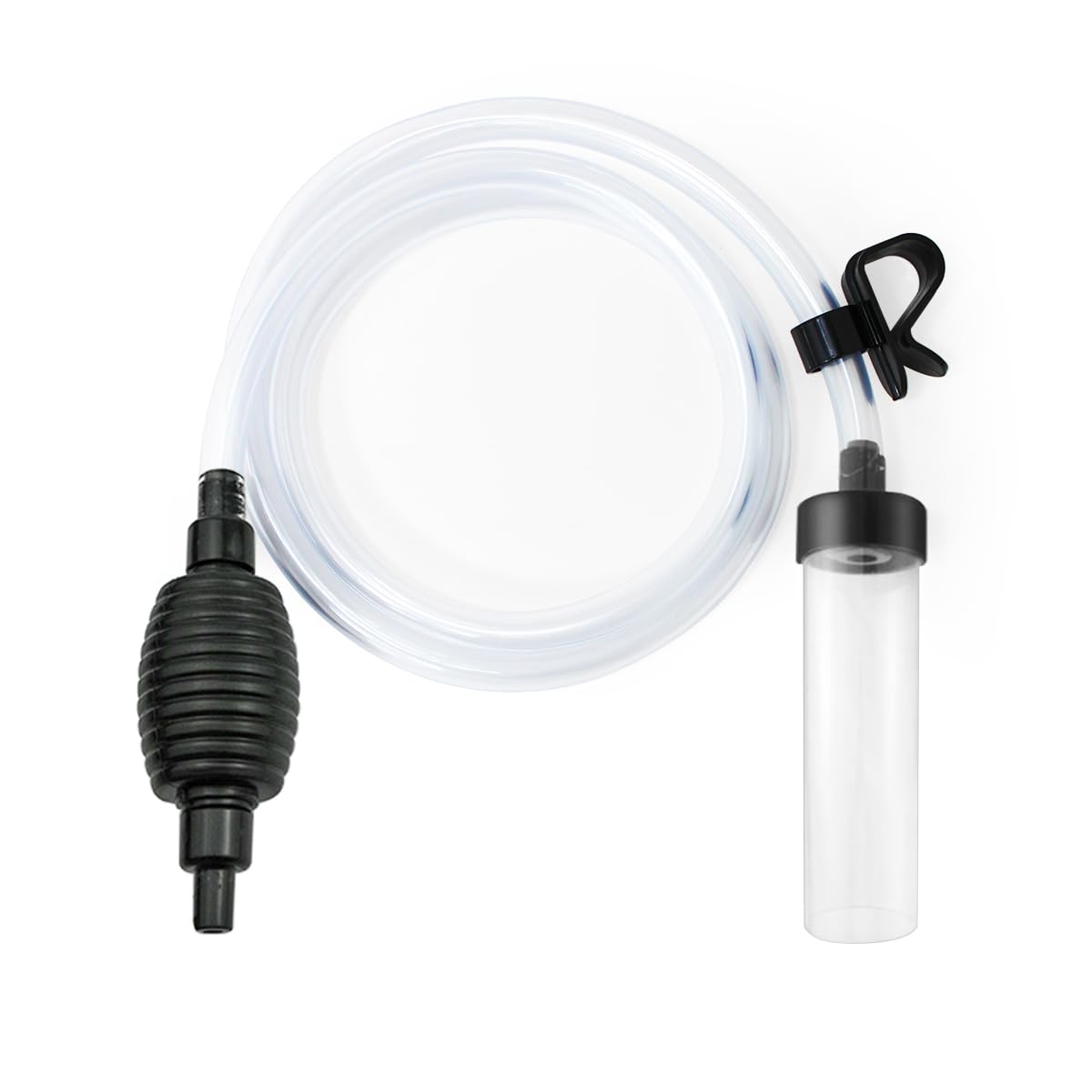
Rating: 4.4 ★ | Price: Budget | Hose Length: 5 ft | Gravel Tube: Hard plastic with filter | Build Material: Clear PVC
The squeeze bulb starts easily, and the 5-foot hose reaches into small tanks without fuss. For occasional cleaning in 5–20 gallon tanks, it removes light debris affordably. Over time, suction may weaken and seals can degrade — this works best as a backup or for light duty rather than weekly gravel cleaning.
Pros
- Easy to start with squeeze bulb — simple pumping gets water flowing quickly
- Very affordable — great value for occasional use
Cons
- Suction can weaken over time, making it less effective for deep gravel cleaning
For hobbyists needing an occasional backup siphon for small tanks, this serves its purpose at a very low cost.
Best for Medium-Large
enomol 30ft Water Changer

Rating: 4.3 ★ | Price: Mid-Range | Hose Length: 30 ft | Gravel Tube: 16.5-inch with filter | Build Material: Plastic and brass
The enomol 30ft water changer brings a long hose and a set of brass and plastic adapters to cover different faucets. Cleaning gravel and changing water without buckets is fast when water pressure is adequate. However, suction strength varies with household water pressure — low pressure may result in sluggish flow — and the plastic fittings can crack under strain. This kit suits aquarists who need a long reach and have solid home water pressure.
Pros
- 30-foot hose reaches distant sinks, eliminating bucket hauling.
- Includes multiple brass and plastic faucet adapters for varied sink types.
Cons
- Suction may be weak in homes with low water pressure, slowing water changes.
Best for owners with good water pressure who need a long hose to reach a remote sink — not a fit for low-pressure setups or small tanks.
Best for Short-Term Large
boxtech Water Changer

Rating: 4.2 ★ | Price: Mid-Range | Hose Length: ~6 ft | Gravel Tube: Two 11-inch rigid | Build Material: Flexible PVC
The boxtech water changer starts easily with a squeeze bulb and picks up debris effectively from large tanks. However, the priming bulb can lose suction after a couple of months, making it better suited for occasional or one-time cleaning tasks rather than weekly routines. For a few dollars more, the GADFISH uses metal connectors that avoid the cracking found in some plastic designs.
Pros
- Good suction and easy start – bulb primes quickly.
- Effective gravel cleaning – removes detritus from substrate.
Cons
- Hose connections may develop small leaks after repeated use.
Worth considering for one-time large tank cleaning or as a backup siphon, but not for weekly maintenance.
Best for Occasional Small
AQUANEAT Hand Pump Siphon

Rating: 4.2 ★ | Price: Budget | Hose Length: 5.25 ft | Build Material: Plastic
Starting a siphon is simple with the squeeze bulb, and the price is budget-friendly. However, the suction is too weak for gravel cleaning, making it more of a water drainer. This suits emergency water changes on small tanks but not routine gravel vacuuming.
Pros
- Squeeze-bulb design makes starting a siphon quick and easy.
- Very affordable for a hand-pump siphon.
Cons
- Hose may develop pinhole leaks over time, affecting long-term reliability.
Best as a cheap backup for emergency water changes on small tanks where gravel cleaning is not required.
How to Choose
The single most important decision is whether your tank is small enough for a manual siphon or large enough to justify a faucet-connected system, because the wrong choice wastes time or money.
Hose Length
A longer hose lets you reach further and may let you drain directly into a sink or outside. But extra length also means more water remains in the hose after use, increasing drag on the siphon and slowing flow.
For a typical living room aquarium 10–15 feet from a sink, a 25-foot hose works well. If your tank is in a basement or far corner, 30 feet or more may be necessary, but each additional 10 feet reduces suction noticeably.
Faucet Adapter Compatibility
Faucet-connected systems rely on a threaded adapter that screws onto your faucet. Many kitchen faucets have a standard aerator thread (55/64” male), but rental apartments and older homes often use non-standard sizes.
Check your faucet’s thread type before buying. If the included adapter doesn’t fit, you will need an additional universal adapter, which adds $5–10 and one more step to setup. Some systems include multiple adapters; others only one.
Gravel Tube Dimensions
The gravel tube’s diameter and length affect how much debris you lift and how fast water drains. A wider tube (1.5–2 inches) moves more water and picks up larger waste, but also drains your tank faster — which can be a problem in small tanks.
A narrow tube (1 inch or less) gives you control and is gentle on planted substrates, but clogs easily with leaves or fish waste. Match the tube width to your typical debris size and your willingness to stop and clear blockages.
Build Material
Plastic parts are lighter and cheaper, but they crack under repeated stress — especially the adapter that connects to the faucet. Metal connectors (brass or stainless steel) last almost indefinitely but add $10–15 to the cost.
For a faucet system you plan to use weekly for years, metal connectors are a worthwhile investment. For an occasional-use manual siphon, good-quality plastic is perfectly adequate as long as you handle it gently.
Flow Control Mechanism
A simple plastic clip that pinches the hose is the most common flow control — cheap but prone to slipping. A rotating valve built into the tube is more reliable and lets you stop flow instantly without bending.
Without any flow control, you must rely on lifting the hose out of the water to stop the siphon, which is messy. If you clean multiple tanks, a valve makes switching between them far cleaner.
FAQ
How do I start a siphon without sucking on the hose?
Use a product with a built-in squeeze bulb or hand pump. Squeeze the bulb a few times to pull water through the tube — no mouth contact needed. If your siphon lacks this, you can submerge the entire hose and tube in the tank, then lift one end out while keeping the other end underwater to start the flow.
Why does my aquarium siphon keep losing suction?
Air leaks are the most common cause — check that all connections are tight and free of cracks. A damaged bulb seal or a pinhole in the hose can also break the siphon. If the hose is kinked or the water level in the tank drops below the intake, suction will stop. Replace any cracked parts immediately.
Can I use a Python water changer with any faucet?
The Python includes a brass adapter that fits standard 55/64-inch male faucet threads. Many kitchen and laundry faucets work, but some require an additional adapter (usually included or available for a few dollars). If your faucet has a pull-out spray head or a non-threaded spout, this system will not work without modification.
How long should an aquarium gravel vacuum last?
A well-made manual siphon with all-plastic parts can last 1–2 years with careful handling. Faucet-connected systems with metal connectors often last 5+ years. Budget siphons under $10 often fail within weeks because of cracked tubes or failed bulbs. For regular use, spending $20–40 on a unit with metal fittings is a better long-term investment.