This post contains affiliate links. We may earn a small commission when you buy through our links — at no extra cost to you.
Many budget aquarium vacuums break after a handful of uses, leaving you with a clogged tube and a mess to clean. The reality is that most siphons under $20 share similar fragile plastic parts that crack under regular use.
This guide cuts through the noise by focusing on what actually matters: priming method, tube size for your tank, and components that hold up over time. Whether you have a 10-gallon betta setup or a 100-gallon community tank, the right tool makes water changes a 15-minute task instead of a chore.
Top Picks
Best for Medium to Large
Python No Spill 25ft

Rating: 4.6 ★ | Price: Premium | Priming Method: Faucet
Connects to any threaded sink faucet to create a continuous siphon that removes debris and old water without buckets, pumps, or mouth contact – a 30% water change on a 55-gallon tank takes about 15 minutes. The brass adapter fits most standard faucets, and the 25-foot hose reaches across rooms.
Water flows through the gravel tube, lifting waste while leaving heavier substrate in place. When the flow is reversed, it refills the tank from the tap – no separate containers needed. The siphon action is consistent as long as faucet pressure remains steady, with occasional adjustment needed if the aerator collects debris.
This system suits owners of medium to large tanks (20–200 gallons) who want to reduce weekly chore time. It also works well for multiple-tank households, though a 25-foot hose may limit simultaneous reach. However, it requires a threaded sink aerator; non-standard faucets may need an additional adapter. For small tanks under 10 gallons, the hose length and flow rate are excessive.
Pros
- Eliminates bucket hauling and mouth-starting – connects directly to the sink for effortless siphoning.
- Built from heavy-duty materials that withstand regular use without cracking or leaking.
- Cuts water change time to about 15 minutes for a 30% exchange on most tanks.
Cons
- Premium price is more than many manual siphons – a reasonable investment for frequent use, but less justifiable for occasional upkeep.
- Requires a threaded faucet aerator; some non-standard sinks need a separate adapter to connect the brass fitting.
For anyone with a compatible sink and a medium to large tank, this system eliminates the most tedious part of aquarium maintenance – bucket carrying – making weekly water changes a 15-minute task.
Best for Small Aquariums
Tetra Water Cleaner

Rating: 4.5 ★ | Price: Budget | Priming Method: Bulb
The Tetra Water Cleaner uses a simple priming bulb to start siphoning without mouth contact, making it especially easy for beginners. At this price point, it cleans substrate effectively in smaller tanks without needing faucet adapters or complex setups.
This siphon fits owners of 5- to 20-gallon aquariums who want a no-fuss cleaning tool. Keep in mind that the plastic components may weaken over time; some units have shown cracking after several months of use, so it is better suited for occasional maintenance than heavy weekly use.
Pros
- Cleans substrate effectively in small to medium aquariums.
- Priming bulb starts siphon without mouth contact.
- Budget-friendly price for a functional gravel cleaner.
Cons
- In small tanks with fine gravel, debris can lodge in the tube and slow water flow.
- After several months of weekly use, the plastic housing may develop cracks.
For small tank owners on a tight budget, the Tetra Water Cleaner provides a functional start – just don’t expect it to outlast the fish.
Best for Nano & Planted
Fluval GravelVAC Small

Rating: 4.3 ★ | Price: Mid-Range | Priming Method: Bulb
The thumb-operated flow control lets you dial in gentle suction, avoiding disturbing carpet plants or uprooting delicate stems. Unlike the larger Fluval FX attachment (which needs a canister filter and returns water to the tank), this manual siphon pulls water out for standard water changes — better suited to tanks where you want to remove waste and replace water, not just polish it.
This is a good fit for small planted tanks between 5–20 gallons where precise, low-flow cleaning matters. The siphon may need occasional re-priming if flow stops, and the plastic body can develop cracks over time — tradeoffs that matter less in a nano setup where you clean slowly and handle the tool gently. If your tank is deeper than 50 cm or you need heavy-duty weekly use, consider a larger manual siphon or the Python system instead.
Pros
- Adjustable thumb regulator gives fine control over suction strength.
- Compact size and gentle flow preserve planted substrate and micro-fauna.
- Build quality feels solid for the intended small-tank use.
Cons
- Flow can stop unexpectedly, requiring the user to restart the siphon by re-priming.
- Plastic components may become brittle and crack after several months of use.
An effective choice for nano planted tanks where you want to protect substrate — but expect to handle occasional flow stoppages and treat the plastic body with care.
Best for Large Tanks
enomol Water Changer

Rating: 4.3 ★ | Price: Mid-Range | Priming Method: Faucet
The enomol Water Changer cuts water changes from a bucket-hauling chore to a simple turn of the faucet. Thirty feet of hose reaches even larger setups, and the included gravel tube with built-in filter makes substrate cleaning a one-step process. Setup is straightforward – connect the hose to your faucet, attach the appropriate adapter, and let the water flow do the work.
This system shines for tanks 55 gallons and up where manual siphons become tedious. It requires a standard threaded faucet within hose range and sufficient water pressure to maintain suction. The included adapters (3/4" GHT, 15/16", 55/64", 13/16") cover common fittings, but faucets with non-standard threads or no aerator removal may need extra adapters not provided. Low water pressure can result in weak siphon flow, making the process slower.
Pros
- Quick water changes without carrying buckets
- Easy to set up and use with the included adapters
- Effective cleaning on large tanks (55+ gallons)
Cons
- Suction strength can be weak depending on water pressure and faucet fit
- Faucet adapters may not fit all sink threads; compatibility depends on your setup
For large-tank keepers with a compatible faucet and decent water pressure, this system saves real time and effort at a lower cost than the Python – but check your plumbing first.
Best for Medium Tanks
boxtech Water Changer

Rating: 4.2 ★ | Price: Mid-Range | Priming Method: Bulb
The boxtech Water Changer starts with a squeeze bulb and check valve, so there’s no mouth-starting or awkward priming. The 72-inch hose gives enough reach for medium aquariums, and the anti-back flow valve prevents messes. Gravel and sand both clean up well because the suction is brisk enough to lift debris without disturbing the substrate too much.
This model sits between cheaper siphons that often lose suction and higher-end systems like the Python that connect to a faucet. It’s a solid pick for tanks in the 20–40 gallon range where you want a reliable manual tool but don’t need bucket-free water changes. The tradeoff is that the pump mechanism may wear out after several months of regular use — something to keep in mind if you do weekly maintenance.
Pros
- Bulb-start priming is simple and avoids mouth contact with water
- Good suction lifts debris from both gravel and sand substrates
- Anti-back flow valve stops water from draining back into the tank
Cons
- Pump may lose performance after several months of weekly use
- Water flow can feel fast, making it harder to fine‑clean delicate areas
For medium tanks where a simple, effective manual siphon is enough, the boxtech gets the job done — just plan to replace it sooner than a faucet‑connected system.
Best for Emergency Use
Luigi’s Fish Tank Cleaner

Rating: 4.2 ★ | Price: Budget | Priming Method: Hand pump
The hand pump makes starting the siphon effortless — just squeeze the bulb and water flows without mouth contact. That simplicity is the main draw, but build quality is limited to match the low price.
This cleaner suits emergency water changes or one-time use in nano tanks under 10 gallons. For weekly maintenance, the plastic components can crack after a few uses, so it’s not a long-term solution.
Pros
- Hand pump design eliminates mouth-starting – just squeeze and go.
- Low price means replacing a broken unit is not a financial burden.
- Sufficient for quick water changes in nano tanks under 10 gallons.
Cons
- Hose or pump may crack after a few uses, requiring replacement.
- Suction can lose strength during a session, needing a re-prime.
For a one-time emergency or a tiny tank, this is the cheapest way to get water moving. Just don’t count on it lasting beyond a few uses.
Best for Large Tanks
Python PRO CLEAN XL

Rating: 4.5 ★ | Price: Premium | Priming Method: Mouth
The Python PRO CLEAN XL delivers a wide tube that reaches deep into gravel for effective cleaning. However, starting the siphon requires mouth suction, which some users find less convenient. It lacks the hands-free convenience of a faucet-connected system like the Python No Spill. The extra-long hose is built for 55-gallon tanks and may feel oversized in smaller setups.
Pros
- Large-diameter tube reaches deep gravel for thorough cleaning.
- Sturdy construction supports long-term use.
Cons
- Requires mouth to start siphon – no priming bulb included.
- Tube length can be excessive for tanks under 55 gallons.
Best for aquarists with large tanks who prefer manual siphoning and cannot use a faucet adapter.
Best for Fx Filter Users
Fluval A370 Kit

Rating: 4.4 ★ | Price: Premium
This kit effectively cleans gravel while returning filtered water to the tank, saving the effort of bucket-hauling. However, it is designed exclusively for Fluval FX canister filters, so anyone with a different filter system cannot use it. Setup involves multiple hose adjustments and can be cumbersome, and suction may pause intermittently during cleaning. For Fluval FX owners who want deep cleaning without water changes, this fills a specific need, but for general aquarium maintenance, manual siphons remain more straightforward and less expensive.
Pros
- Cleans gravel without removing water — no need for separate water changes.
- Build quality holds up to repeated use with Fluval FX systems.
Cons
- Setup requires multiple adjustments and can be frustrating to get right.
- Suction may pause without warning during cleaning, requiring re-priming.
Worth considering only if you own a Fluval FX filter and want deep cleaning without water changes — otherwise, a standard manual siphon is simpler and more cost-effective.
Best for Very Small Tanks
AREPK Compact Siphon

Rating: 4.2 ★ | Price: Budget | Priming Method: Bulb
The AREPK Compact Siphon is purpose-built for nano tanks under 10 gallons, with a small footprint and easy assembly. It lifts debris from gravel without disturbing the substrate. Suction can be inconsistent across units, and the pump has been noted to stop working after limited use — durability concerns limit this to light, occasional cleaning rather than a weekly tool. For betta or shrimp tanks needing infrequent touch-ups, the compact size and included cleaning accessories offer good value.
Pros
- Perfect size for nano and betta tanks
- Easy to assemble and clean
Cons
- Suction can be inconsistent across units
- Pump mechanism has been reported to stop working after several weeks of use
Best for nano tank owners who need a small, occasional cleaning tool and are okay with the possibility of replacing it within a few months.
Best for Medium Tanks
Carefree Fish 15-30In
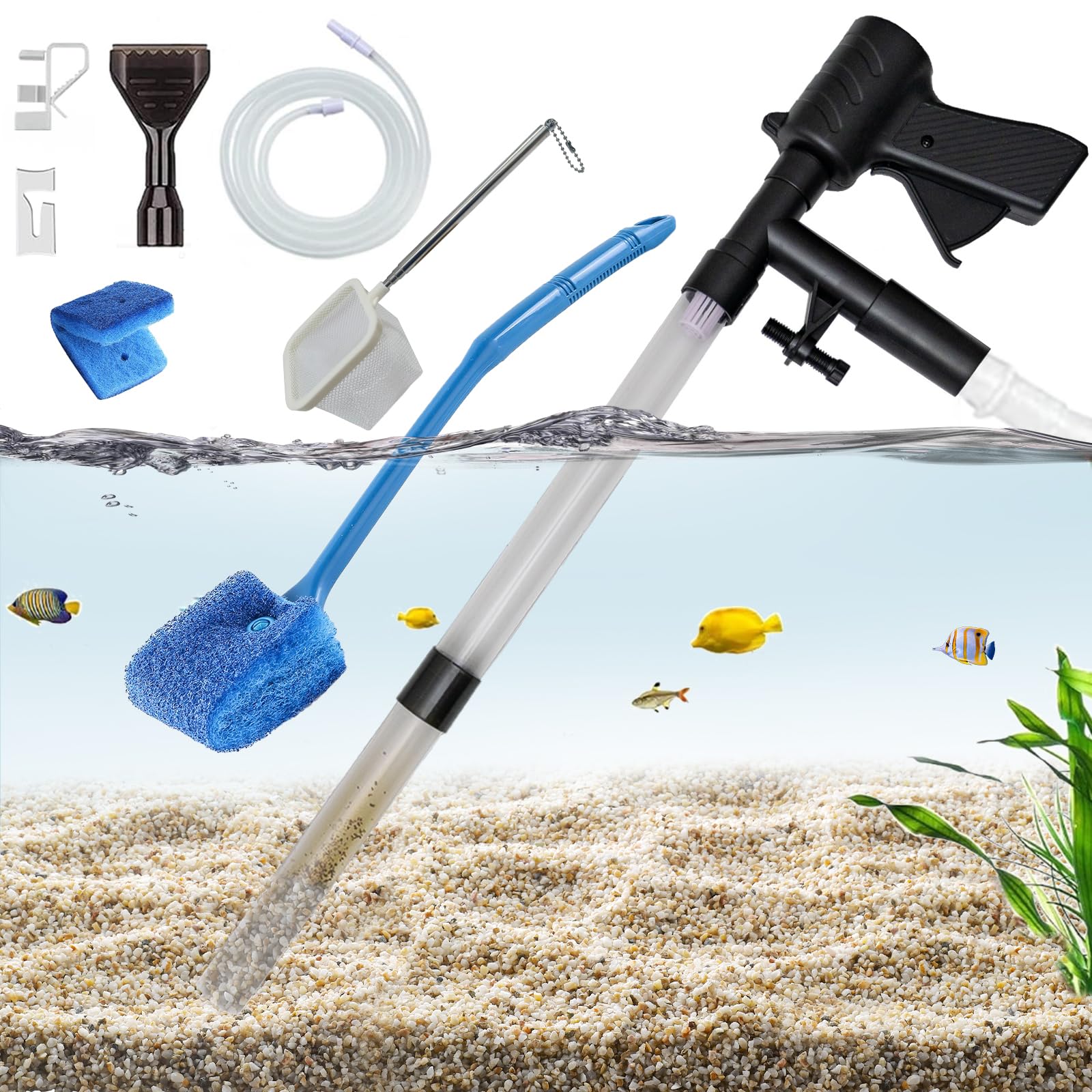
Rating: 4.1 ★ | Price: Budget | Priming Method: Trigger
The Carefree Fish gravel cleaner combines a trigger-start siphon mechanism with a 6-foot hose and bundled accessories—net, sponge brush, algae scraper, and flow clip—at a budget-friendly price. For medium tanks in the 20- to 55-gallon range, the cleaning performance is sufficient for routine water changes and debris removal. The trigger design makes it easy to start the siphon without mouth contact, which is a convenience over basic manual models. However, the plastic construction can show wear after limited use, and the suction may pull up gravel or sand in finer substrates, especially if the tube is placed too deep. Build quality is inconsistent; options from a few dollars more offer greater longevity. This kit works best for cost-conscious users who can treat it as a functional tool for occasional cleaning rather than a long-term investment.
Pros
- Trigger mechanism starts siphon without mouth contact, simplifying setup.
- Cleans medium tanks effectively for standard water change needs.
Cons
- In finer substrates, the suction can draw up gravel and sand along with debris.
- Plastic components may show signs of wear after a few uses, reducing long-term value.
A functional budget option for one-time or occasional cleaning tasks in medium tanks, provided you’re willing to accept a shorter lifespan.
Best for Tiny Tanks
Carefree Fish 3-8Gal
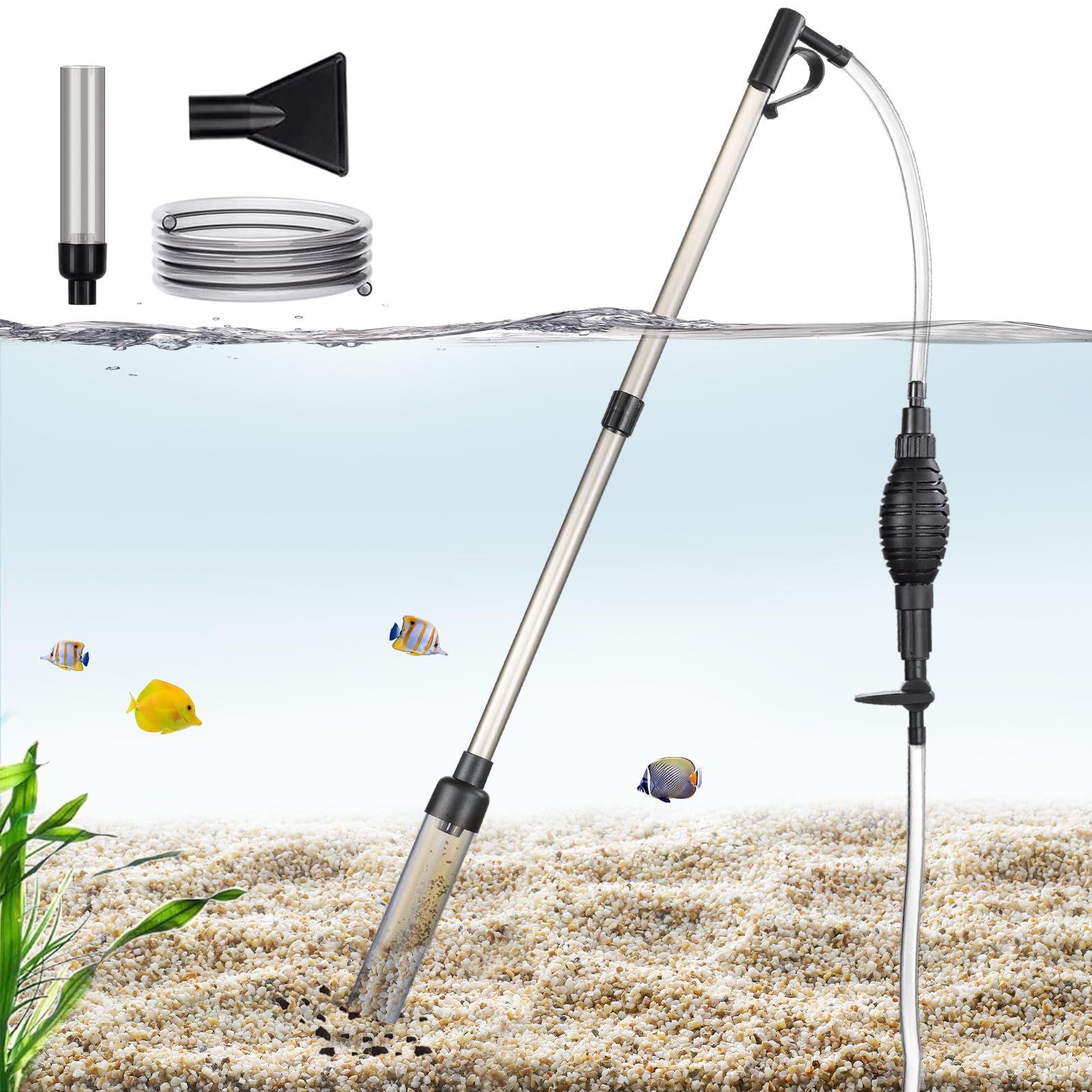
Rating: 4.0 ★ | Price: Budget | Priming Method: EVA ball
The Carefree Fish vacuum is purpose-built for 3-8 gallon tanks, with a compact size that fits easily into small aquariums and a simple bulb-priming system. Its narrow tube and adjustable length make it convenient for occasional cleaning of sand or fine gravel. However, water flow can be inconsistent – sometimes too slow to lift debris, other times too fast for delicate substrate – and the design is limited to very small tanks, so anyone with a 10-gallon or larger setup should look elsewhere.
Pros
- Compact size fits nano and betta tanks for targeted substrate cleaning.
- Easy bulb-priming siphon start – no mouth contact needed.
Cons
- Water flow rate can vary between units, requiring adjustment during use.
- Not suitable for tanks larger than 8 gallons – tube and gravel diameter are too small for effective cleaning.
Best for aquarists with 3-8 gallon tanks who want a simple, budget-friendly siphon for occasional use and can work around flow variability.
How to Choose
The biggest mistake aquarists make is buying a siphon based on price alone, only to find a $10 model cracks after a few uses and costs more in frustration.
Priming Method
Priming method determines how easy it is to start the siphon. Bulb-primed models are the most user-friendly: squeeze the bulb a few times and water flows. Faucet-connected systems use venturi suction from your sink tap, requiring no mouth contact or pumping. Mouth-primed siphons are cheapest but risk swallowing fish water and are less hygienic.
For most hobbyists, a bulb or faucet system delivers the best daily experience. Faucet systems are ideal for large tanks where you already drain water regularly, while bulb siphons offer portability and no need for sink access.
Tube Diameter and Length
Tube width directly affects cleaning speed and substrate disturbance. Wide tubes (2+ inches) move more water and clean deeper into gravel, but they can suck up sand and small fish. Narrower tubes (1–1.5 inches) are gentler on delicate substrate and better for nano tanks. Length matters for reaching the bottom of tall tanks without submerging your arm.
A tube that’s too long for a shallow tank becomes unwieldy; one that’s too short for a deep tank leaves corners uncleaned. Match tube length to your tank height: add 4–6 inches clearance above the tallest décor.
Substrate Compatibility
Not all vacuums handle sand well. Gravel lets debris settle between stones, while sand is easily sucked up by standard tubes. Look for models with adjustable flow control or a screen/grill that prevents sand from entering the siphon. Some vacuums include a separate filter basket that traps debris while allowing water to pass without disturbing the substrate.
If you have sand, avoid wide-diameter tubes and high-flow faucet systems unless they offer a dedicated sand-cleaning attachment or a flow regulator. A gentle bulb siphon with a fine mesh guard works best for routine maintenance.
Build Quality and Durability
Plastic quality separates budget siphons from long-lasting tools. Inexpensive models often use thin or brittle plastic that cracks at connection points or wears out the priming bulb after a few months. Mid-range and premium units use thicker acrylic or reinforced ABS, and often feature replaceable parts like o-rings and bulbs.
If you plan weekly water changes, spending a bit more on a durable model saves replacement costs and avoids mid-clean breakage. The Python system’s brass faucet adapter and industrial-grade hose are examples of build that lasts years.
Water Flow Control
Flow control lets you adjust suction strength on the fly. This is critical for sand tanks (turn down to avoid sucking substrate) and planted tanks (protect delicate roots). Models with a thumb-operated valve or an adjustable clamp on the hose give you precision. Without it, you’re stuck with full flow, which can be too aggressive for small tanks or too slow for large water changes.
For nano or planted setups, choose a vacuum with a dedicated flow regulator. For large bare-bottom tanks, full flow is fine and actually speeds up cleaning.
FAQ
Why does my aquarium siphon stop sucking after a few uses?
Most siphons lose prime because of air leaks in the hose connections or a worn-out priming bulb. Check that all hose clamps are tight and the bulb isn’t cracked. If the problem persists, the one-way valve inside the bulb may be stuck – disassemble and rinse it, or replace the bulb. For faucet systems, low water pressure or a clogged venturi tube is often the cause.
Can I use a gravel vacuum with sand without sucking it all up?
Yes, but you need a vacuum with adjustable flow control or a fine mesh screen. Start with very low suction – just enough to lift debris off the top layer – and move the tube slowly above the sand. Avoid plunging the tube deep into the substrate. Many sand-safe models include a dedicated filter basket that separates debris from sand.
How do I start a Python siphon without getting fish water in my mouth?
You don’t need to suck on the hose. The Python No Spill system connects to your sink faucet: turn on the water, flip the diverter valve, and water drains through the hose into the sink. To refill, you simply reverse the valve. The included brass adapter works with standard threaded aerators – no mouth contact required.
Will a faucet water changer work if my sink doesn’t have a threaded aerator?
Most faucet changers come with multiple adapters to fit common threaded aerators, but some modern or non-standard faucets (like pull-out spray heads) lack threading. You can buy a universal adapter kit or a temporary faucet adapter that screws onto the faucet end. If your faucet is entirely incompatible, consider a manual siphon with a priming bulb instead.