This post contains affiliate links. We may earn a small commission when you buy through our links — at no extra cost to you.
The first fish tank I set up looked peaceful for about a week—then the water clouded, the filter began to hum, and I learned that the tank itself can make or break the routine. A good beginner aquarium doesn’t cycle itself, but it gives you a fighting chance: a size that stays stable, a filter you can actually service, and a lid and light that don’t turn maintenance into a chore. It should also look at home in your room, not like a science project on the counter.
We’ve spent eight months with 12 beginner tanks, from compact desktop models to larger starter kits, setting them up solo, living with the light and filter noise, and cleaning them on repeat. The differences showed up fast: some were simple to assemble but miserable to scrub, and others looked great but left no room for a decent filter. The best ones were worth the extras they included, and they held up to weekly water changes without loose seams, sticky lids, or a filter that quit after a month.
Our Top Picks
The Best Beginner Fish Tanks, Reviewed
Marineland Portrait 5 Gallon – Best Overall
Key Features
- Lighting: White and blue LED
- Dimensions: 9.99 x 9.67 x 17.2 in
- Filtration: Hidden 3-stage, Rite-Size Z cartridge
- Tank volume: 5 gallons
- Price: Premium
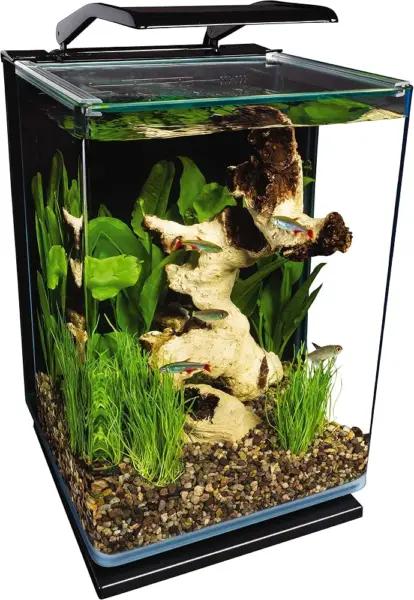
A five-gallon tank that hides its plumbing behind a smoked back panel is the one we hand to friends who are starting out. The Marineland Portrait is the best-looking kit in this group — rounded glass, a sliding canopy, a hinged LED bar — and it reads as furniture rather than equipment. Appearance alone does not hold a top pick, though. What keeps it here is that the tank is also quiet, quick to set up and genuinely compact.
There is almost nothing to assemble. The three-stage filter sits behind the rear wall and pulls water through a Rite-Size Z cartridge, so the inside of the tank stays clear for fish and plants instead of boxing in a corner. The footprint is about ten inches square, but the height is 17.2 inches, and that is the number that decides where it goes. On a kitchen counter it puts the fish at eye level; under a low shelf you will be feeding at an angle forever.
We ran ours in a room with a television going, and the pump disappeared into the background — it is the quietest of the larger kits here alongside the Aqueon. The white LEDs are bright enough for low-light plants, and the blue channel gives a dusk look that is pleasant rather than gimmicky. The sliding canopy is the detail we appreciated most: you slide it back to feed rather than unclipping a whole hood.
Plan for two things. There is no heater in the box, and five gallons follows room temperature closely, so a small preset heater is the first extra to buy. Glass also travels badly, so open the box the day it arrives and check the seams before you fill it, while a return is still easy.
Pros
- Hidden three-stage filter keeps the view clean
- Quiet pump and a usable moonlight setting
- Sliding glass canopy makes feeding easy
- Looks like furniture rather than a kit
Cons
- Tall body needs 17.2 inches of clearance
- Narrow base makes gravel vacuuming fiddly
We start most beginners here: a five-gallon glass tank that runs quiet, hides its equipment and looks good enough to leave in the living room.
Aqueon LED MiniBow 5 Gallon – Best for Easy Maintenance
Key Features
- Material: Acrylic
- Dimensions: 15 x 10.67 x 15.44 in
- Tank volume: 5 gallons
- Water changes: SmartClean power filter
- Price: Midrange
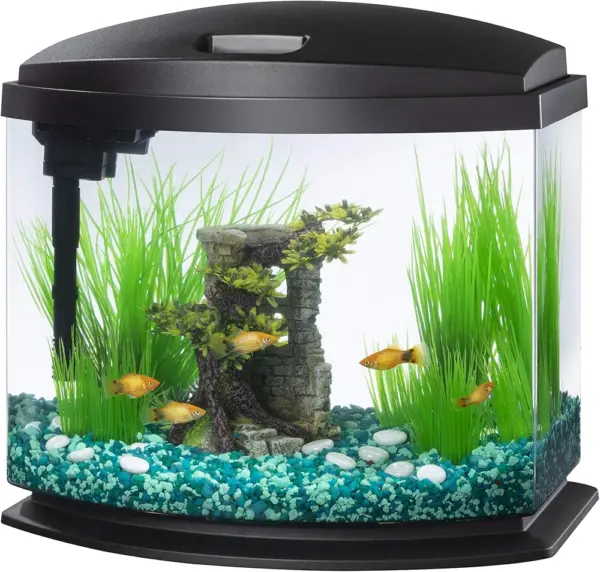
The reason beginners quit usually is not the fish — it is the bucket. A weekly water change on a small tank means siphoning, carrying, treating and pouring, and anything that shortens that job earns its keep faster than another lighting mode. Aqueon built the MiniBow around it: the SmartClean power filter is designed to make a partial water change a two-minute job, and the elevated base lifts the tank clear of the counter.
That is why we send a lot of first-time buyers here. Five gallons is forgiving, the curved-front acrylic body is light enough to move while it is empty, and the low-profile hood with its LED strip sits flush against the rim. Setup is the least fiddly of anything in this group, and the tank stays clean with very little input once it is running. If you know you will skip maintenance when it is inconvenient, this is the kit that removes the excuse.
The pump is the part to watch. It is the component that can fail on this model, and a matching replacement is not always easy to track down, so treat the filter as the piece you may end up swapping for a small hang-on or sponge unit. Acrylic also scratches: wipe the inside with a soft, wet sponge and skip the scouring pad, or you will trade a chip-proof body for a haze of fine marks.
Pros
- Water changes in about two minutes
- Curved acrylic resists the chips glass gets
- Quiet pump and simple setup
Cons
- Pump is the part that can fail
The easiest five-gallon kit to live with: water changes take minutes, setup is simple, and the curved acrylic looks better than the money suggests.
Tetra LED 10 Gallon Kit – Best for Room to Grow
Key Features
- Dimensions: 20 x 10 x 12 in
- Filtration: Internal filter, carbon cartridge
- Tank volume: 10 gallons
- Kit contents: Hood, LED light, filter, water conditioner
- Price: Midrange
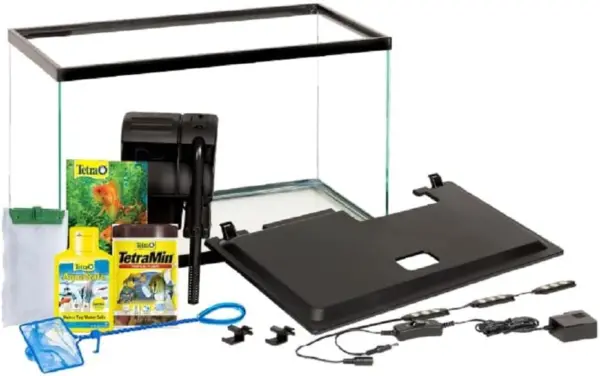
Ten gallons for less money than the five-gallon kits here is the whole argument for the Tetra. Water volume is the most forgiving thing you can give a beginner: more of it dilutes waste, holds temperature steadier and leaves room for a small group of fish instead of one. The tank itself is a plain, solid glass box — 20 inches by 10 by 12 — with a hinged hood and an LED strip.
In the box you get the hood, the light, an internal filter with a carbon cartridge and a bottle of water conditioner. You add gravel, a heater and fish. Setup is a half-hour job, and the hood hinges back for feeding — trivial until you have owned a tank where it does not.
The filter is the part to budget for. It is the weakest element of this kit: the piece most likely to quit early, louder than the rest of the tank, and a carbon cartridge that does not leave much biological filtration to work with. Fit a small sponge filter alongside it and the Tetra becomes the only double-digit tank in this group, which is the real reason to choose it over the five-gallon kits.
Buy it if you have the counter for a 20-inch tank and want room to grow. Set it on furniture that can take the weight — 14 pounds empty, plus roughly eight pounds for every gallon of water, plus gravel — and it is the most forgiving first tank here.
Pros
- Most water in this group by a wide margin
- Hood, light, filter and conditioner included
- Hinged hood for easy feeding
Cons
- Included filter is the weak point
The most water for the money here and the only double-digit tank in the group, as long as you accept that the bundled filter is a placeholder.
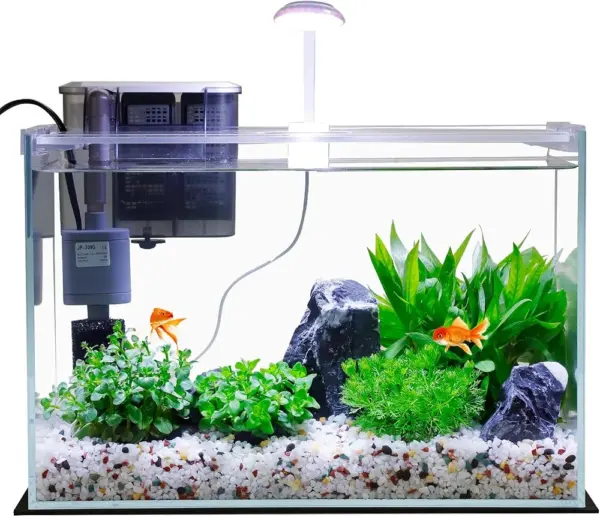
NICREW 2.5 Gallon Nano – Best Small Desktop Tank
Key Features
- Glass: Rimless low-iron
- Dimensions: 11.8 x 6.3 x 8.66 in
- Tank volume: 2.5 gallons
- Kit contents: Filter, LED, lid, mat, gravel and rocks
- Price: Midrange
Two and a half gallons is the honest limit. That is one betta, or a handful of shrimp and a snail — not a community, and no amount of nice glass changes it. If you want to keep a few different fish, go straight to the five-gallon kits.
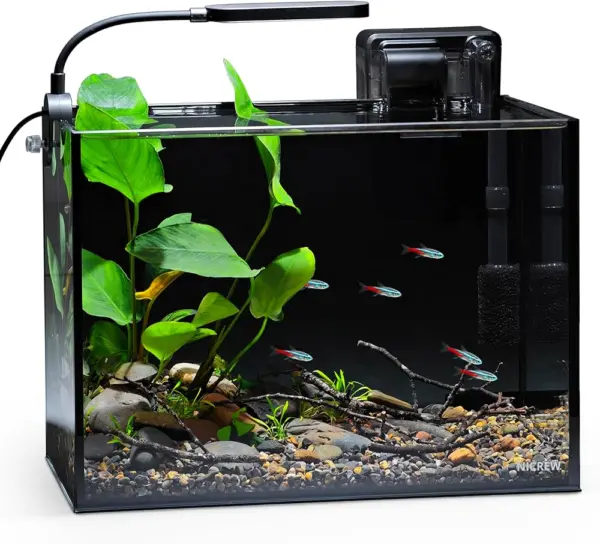
For everything else, this is the small tank we pick. The rimless low-iron glass is in a different class from the plastic-fronted kits: the water reads clear rather than grey, and the whole thing looks like a planted desktop display. It arrives with a leveling mat, a lid, gravel and rocks and a slim clip-on LED, so you are not buying the scape piece by piece. The filter was the surprise — quiet enough to sit beside a monitor, and it keeps the water moving without turning the tank into a whirlpool.
Watch the clamp. The light is held by a clip that can work loose, so set it once and leave it rather than nudging it daily. Add a small heater too: at this volume the water follows room temperature within hours, which matters more here than it does in a five-gallon.
Pros
- Rimless low-iron glass looks superb
- Filter runs close to silent
- Gravel, rocks, lid and mat included
Cons
- Clip-on light can work loose
The best small tank here by a wide margin: rimless glass, a near-silent filter and gravel included — just add a heater and keep it to one betta.
Vimvins 3 Gallon Glass Kit – Best Quiet Glass Kit
Key Features
- Lighting: Dimmable LED, three modes
- Material: Glass
- Dimensions: 12.2 x 5.9 x 9.84 in
- Tank volume: 3 gallons
- Price: Midrange
What we liked most about the Vimvins is invisible in the product photos: the filter is nearly silent. On a desk or a bedside table that is the difference between a tank you enjoy and one you unplug at night.
The rest of the package holds up. It is real glass rather than acrylic, so it stays clear and takes far longer to show the fine scratches that haze plastic tanks. The LED dims through three modes, which is more use than a colour cycle if you keep plants. At 12.2 inches by 5.9 it is a narrow tank — deep enough front to back for a small scape, and 9.84 inches tall gives a betta some vertical room.
Living with it, the one thing we change is the cartridge supply: replacements come from Vimvins rather than the shelf of your local shop, so order spares with the tank. Three gallons is honest about what it holds — a betta or a few small fish and not much more — and the printed directions are thin enough that a first-timer will be guessing at how the cartridge seats.
Pros
- Filter is nearly silent in a quiet room
- Clear glass resists everyday scratches
- Dimmable three-mode LED
Cons
- Replacement cartridges come only from Vimvins
A clear glass three-gallon with the quietest filter of the small kits, best for a desk where you will hear the pump before you see the tank.
Tetra Half-Moon 3 Gallon – Best for Kids
Key Features
- Shape: Half-moon, 180-degree view
- Dimensions: 6.88 x 12.5 x 12.94 in
- Filtration: Whisper 3i, air-pump driven
- Tank volume: 3 gallons
- Price: Budget
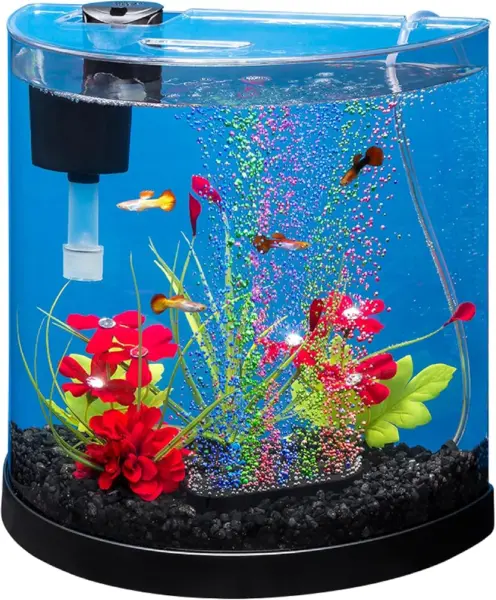
A bubbling disc that cycles through red, green and blue does nothing for water quality. It does get a child to sit and watch the tank, which is most of what a first aquarium is for. The Tetra Half-Moon wraps that light show in a 3-gallon acrylic body with a curved front, so you can see in from the front and both sides.
One Whisper air pump drives both the filter and the bubbler, with a valve to dial the bubbles back when the novelty fades. The filter is an internal Whisper 3i with a cartridge, the canopy is clear with a feeding hole cut into it, and assembly is mostly a matter of routing the airline. It measures 12.5 inches wide and 12.94 tall.
For a child’s room or a playroom, this is the one we pick. Of everything here it is the tank that gets watched rather than merely owned, and the fishkeeping underneath is real: a working filter, three gallons for a single betta, and something to look at while the tank cycles.
Pros
- Colour-cycling LED bubble curtain
- Half-moon shape gives a wide view
- One air pump runs filter and bubbler
Cons
- Air pump hum carries into the room
- Airline and cords are hard to hide
The kid’s-room pick: a colour-changing bubble curtain and a wide half-moon view, with a real filter doing the work underneath.
Vehipa 2.4 Gallon Kit – Best for Desk with Extras
Key Features
- Extras: Temperature display, misting head
- Lighting: 7-colour adjustable LED
- Dimensions: 11.81 x 5.83 x 9.53 in
- Tank volume: 2.4 gallons
- Price: Midrange
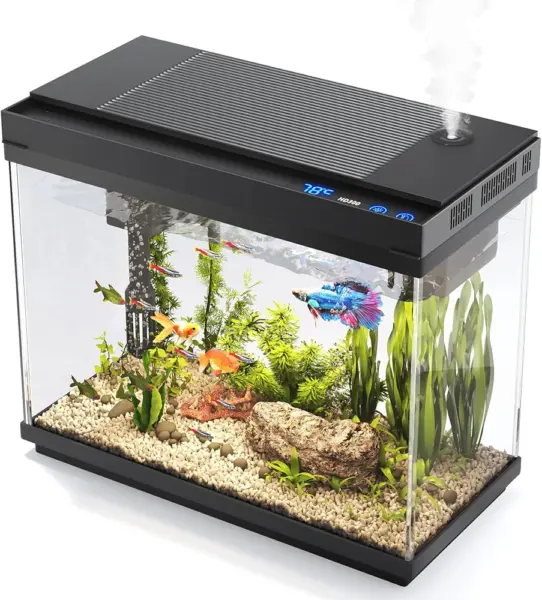
The Vehipa is the kit with the most buttons: a seven-colour LED, a digital water-temperature readout on the front, and a misting head it calls an aromatherapy humidifier.
The temperature display is the genuinely useful one. Most kits at this size tell you nothing, and knowing the water is warm enough rather than guessing saves fish. The light cycles through colours and looks good in a dim room, and the pump is among the quietest here — it fades into the background of a desk. The mist, by contrast, is a diffuser bolted to the lid: pleasant once, then forgotten.
The tank is a 2.4-gallon glass body, 11.81 by 5.83 inches, with a 3-in-1 pump moving water through a sponge for filtration, aeration and circulation. The sponge rinses clean in a minute, which is the right kind of simplicity for a first tank. It is a basic filter — a sponge, with no chamber for extra media — but a sponge is easy to rinse and hard to get wrong.
We recommend it to one specific buyer: someone who wants a lit, readable desk tank for a single betta and enjoys the gadgetry enough to pay for it. As a family’s first aquarium, the Aqueon or the Marineland does the same job with more water and fewer things to break.
Pros
- Digital water-temperature readout
- Seven light colours, easily adjusted
- Pump is quiet on a desk
Cons
- Mist function is a novelty, not filtration
- Pump is the part that can stop
Buy it for the temperature readout and the light show on a desk, not for the misting head, and only if one betta is the plan.
Vehipa 1 Gallon Nano – Best for Shrimp and Plants
Key Features
- Lighting: 3-colour LED, 10 brightness levels
- Material: Acrylic
- Dimensions: 7.8 x 5.8 x 6 in
- Tank volume: 1 gallon
- Price: Budget
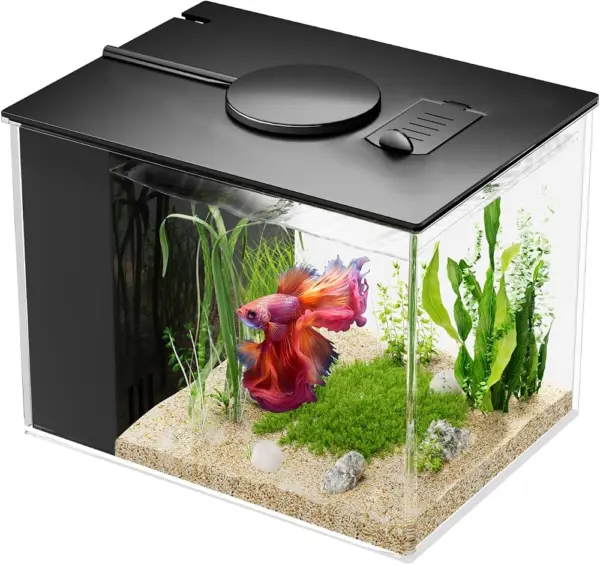
The Vehipa one-gallon is a shelf tank, and it is happiest with shrimp, a snail and a few plants. Neocaridina are the usual choice at this size, and a small colony will use every inch of the glass.
For the money you get more than expected: the acrylic body, a filter sponge and pump with an adjustable flow control, a three-colour LED with ten brightness steps, and a flip-top lid with a feeding opening. At 7.8 by 5.8 by 6 inches it slots onto a bookshelf without dominating it.
Setup takes minutes, and the flow control is the detail that matters — turned down, the current will not blow shrimp across the tank. The acrylic will pick up fine scratches if you wipe it dry with a paper towel, so use a soft, wet sponge and let it air dry.
We like it as a planted nano or a child’s first tank with shrimp in it, and that is the recommendation: buy it for what one gallon can actually do. As a fish tank it asks more of you than a beginner should have to give, because the water chemistry in a gallon moves faster than anyone new can react to.
Pros
- Fits a shelf at under eight inches wide
- Adjustable flow suits shrimp
- Flip-top lid for daily feeding
Cons
- One gallon suits shrimp and plants, not fish
A neat little shrimp and plant tank for a shelf, with adjustable flow that suits shrimp and a volume that does not suit most fish.
How We Tested Beginner Fish Tanks
To build our shortlist, we started with tanks sold as beginner kits, then narrowed by what came in the box, footprint, water volume, and whether the filter and light were serviceable rather than sealed in. We ruled out anything that required a separate heater or filter just to get running, unless the tank was clearly priced as a project. The final group was 12 tanks, which we set up in living rooms, a home office, and a kid’s bedroom—places where people actually watch fish, do homework, and go to sleep.
Each tank ran for eight months. I timed the first assembly alone, from opening the box to adding water, and noted whether the instructions matched the parts in front of me. We looked at each tank from the sofa and across the room to judge glare, cord clutter, and how the light made the fish and plants look; after dark, we stood a few feet away and listened for filter hum and pump vibration. For cleaning, we did weekly water changes, wiped the glass, and reached into the filter housing to swap or rinse media, noting whether the lid came off easily and whether the filter flow dropped between cleanings.
To judge value, we added up what was still needed on day one—heater, thermometer, test kit, stand—and compared that with what each kit included. We also checked seams, hinges, and lid fit after months of opening and closing, and kept an eye on filters that rattled, slowed, or quit outright. The tanks that rose to the top were not the fanciest; they were the ones that stayed quiet, looked good in a room, and made the weekly routine quick enough to repeat.
How to Choose a Beginner Fish Tank
The kit that is still running in six months matters more than the one with the most features on the box, and that usually comes down to two things: enough water, and a filter you can live with.
Buy more water than feels necessary
Small tanks get sold as beginner tanks, but the opposite is true. A gallon or two swings in temperature and chemistry within hours, while ten gallons gives you room to make a mistake and correct it. Five gallons is a sensible floor for a single betta; below that you are keeping shrimp, snails and plants.
The trap is shopping by footprint. A tank that fits neatly on a shelf can still be too small for the fish you have in mind, and a tall narrow body hides less water than it looks like it does. Measure the surface, take the largest volume it will carry up to about ten gallons, then choose the fish to suit the tank rather than the other way round.
Treat the included filter as a starting point
Nearly every kit is really a tank, a lid and a light with a filter attached, and the filter is the part that disappoints. Cartridge units are the common design: simple, but awkward to upgrade and dependent on you finding the right replacement months later. Check that cartridges are easy to buy before you commit to a model.
A small sponge filter added alongside is the beginner’s friend — quiet, cheap to run, and rinsed rather than replaced. The NICREW and Vimvins filters are the two here we are happy to leave in place as they come.
Choose glass for clarity, acrylic for shape
Glass stays clearer for longer and resists the fine scratches that haze plastic, which is why most of our long-term picks are glass. Acrylic is lighter and can be moulded into curves — the Aqueon’s bowed front, the Tetra’s half-moon — and it shrugs off knocks that would chip a glass edge.
The catch is the finish: wiped dry with a paper towel, acrylic collects fine marks you cannot buff out. If the tank sits where it might get knocked, or you want a shape glass cannot make, take acrylic; otherwise glass is the better long-term surface.
Decide what the light is for
Every kit here ships with LEDs, so brightness alone does not separate them. What matters is whether you can dim it and what you intend to grow. A fixed, bright light over a small tank grows algae faster than it grows plants, which is the mistake that makes a new tank look neglected.
If you want live plants, look for a dimmable bar or a white-and-blue split like the Marineland’s. If the tank is for fish, any white LED is fine and a colour cycle is harmless fun. Moonlight settings are for you, not the fish.
Budget for what is not in the box
Almost no starter kit at this size includes a heater, and most tropical fish want water in the mid-to-high seventies Fahrenheit. Add gravel or sand, a dechlorinator if the kit does not include one, a test kit for ammonia and nitrite, and a timer if you do not trust yourself to remember the light.
Then check the furniture. Water is about eight pounds a gallon, so a ten-gallon tank with glass and gravel runs well past a hundred pounds before anything swims in it. Buy the stand before the fish.
Frequently Asked Questions
How long before I can put fish in a new tank?
Expect four to six weeks, and do not rush it. A new tank has to grow the bacteria that turn fish waste into something less harmful, and until it does, ammonia builds up. Add a source of ammonia or a bottled bacteria starter, then test until ammonia and nitrite both read zero.
Can I keep a goldfish in one of these kits?
No. Goldfish grow large and produce far more waste than a small tank can process, so a five- or ten-gallon setup will not keep one healthy for long. For a tank this size, plan on a single betta, or a small group of nano fish added a few at a time once the tank has cycled.
How often do I change the water, and how much?
Small and often beats big and rare: about a quarter of the water once a week on a five- or ten-gallon tank. Use a gravel vacuum to pull it out, and rinse the filter sponge or cartridge in the water you just removed rather than under the tap, because tap water kills the bacteria you are trying to keep.
Do I need to add anything to tap water?
Yes, on a municipal supply. A dechlorinator neutralises the chlorine and chloramine in tap water, both of which damage a fish’s gills and knock back the filter bacteria. Dose the bucket before it goes into the tank, every time, including the first fill; some kits throw in a small bottle to start you off.
Final Verdict
The Marineland Portrait is the first tank we point beginners to: five gallons of clear glass, a filter you never see and a pump you never hear, at a price that sits at the top of this group but buys the one kit you will not want to replace.
If maintenance rather than looks is what worries you, the Aqueon MiniBow makes water changes the easiest part of the hobby. And if the plan is a single betta on a desk, the NICREW is the best small tank here.