This post contains affiliate links. We may earn a small commission when you buy through our links — at no extra cost to you.
Many aquarium filter media arrive with promises of pristine water, only to leave your tank cloudy or require constant replacements. The real challenge isn’t finding a single ‘best’ product—it’s understanding how mechanical, chemical, and biological media work together to maintain a stable environment.
Loose media like bulk carbon and washable floss often outperform branded cartridges in both clarity and cost, but they demand a bit of DIY effort. On the other hand, specialized resins like Purigen offer unprecedented clarity for those willing to pay more upfront.
This guide focuses on the media that actually deliver on their claims without hidden downsides like excessive dust or rapid clogging. Whether you’re cycling a new tank or fighting persistent tannins, the right combination saves money and keeps your fish healthier.
Top Picks
Best for Crystal-Clear Water
Seachem Purigen 500ml

Rating: 4.7 ★ | Price: $$$ | Media Type: Synthetic polymer resin | Filter Compatibility: All filters | Reusability: Rechargeable | Particle Size: Fine beads
Purigen strips dissolved organics and tannins from the water column more aggressively than standard carbon, clearing yellow or tea-colored water within hours. The macro-porous resin beads capture nitrogenous waste before it breaks down, reducing nitrate buildup in both freshwater and saltwater setups. Results are visible quickly, and the effect persists longer than a typical carbon charge.
The resin can be recharged several times with a bleach soak, making the per-use cost lower than disposable media over a year. This suits aquarists who prioritize water clarity and don’t mind a bit of maintenance. The tradeoff: beads are small and can escape if not contained in a fine mesh bag (sold separately), and the bleach regeneration process is messy — something to plan for, not fear.
Pros
- Clears tannins and yellowing faster than carbon, with visible results within hours
- Rechargeable with bleach, reducing long-term cost compared to disposable media
- Works effectively in both freshwater and saltwater aquariums
Cons
- Requires a fine mesh bag to keep tiny beads from escaping into the tank
- Recharging with bleach can be messy and takes planning to execute properly
For aquarists who demand glass-like water and are comfortable with periodic bleach recharging, Purigen delivers unmatched clarity with better long-term value than carbon.
Best for Biological Filtration
Fluval BioMax 500g

Rating: 4.8 ★ | Price: $$ | Media Type: Porous ceramic rings | Filter Compatibility: Fluval canisters | Reusability: Permanent | Particle Size: Large rings
Fluval BioMax’s porous ceramic rings provide a durable, long-lasting surface for beneficial bacteria colonies, making them a staple in Fluval canister setups. However, the rings may be too large for compact filter trays, and some units arrive with damaged pieces – a consideration for those with tight compartments. This media suits aquarists prioritizing biological filtration and willing to accommodate its size constraints.
Pros
- Supports healthy bacteria colonies for stable biological filtration.
- Durable ceramic rings that hold up over years of use.
Cons
- Rings may be too large for compact filter trays, and occasional damage on arrival has been reported.
For Fluval canister owners who want permanent biological media with high surface area, BioMax delivers – just confirm your filter tray dimensions before purchasing.
Best for Budget Carbon
Marineland Black Diamond 22oz

Rating: 4.7 ★ | Price: $ | Media Type: Bituminous carbon flakes | Filter Compatibility: All filters (bag) | Reusability: Disposable | Particle Size: Flakes
Marineland Black Diamond delivers the same odor and discoloration removal as name-brand cartridges but at roughly one-third the per-ounce price. The granular flakes fit any media bag, so you control how much carbon you use and when to swap it — a clear advantage over sealed cartridges.
This bulk option suits budget-minded hobbyists who don’t mind a little prep work. The fine particles can cloud the tank if not rinsed thoroughly before use, and you’ll need a media bag (sold separately). For those already refilling their own cartridges or running large tanks with frequent carbon changes, the savings add up quickly.
Pros
- Effectively removes odors, discoloration, and dissolved impurities
- Cost per ounce is among the lowest for activated carbon
- Matches the performance of pre-packaged cartridges
Cons
- Fine dust can pass through media bags and cloud water if not rinsed thoroughly
The best value for DIY carbon users who accept the extra rinse step — skip it if you want a drop-in solution.
Best for Mechanical Filtration
Aquatic Experts Floss Roll

Rating: 4.7 ★ | Price: $$ | Media Type: Dual-density polyester pad | Filter Compatibility: All filter types | Reusability: Washable | Particle Size: Fine fiber
Thick dual-density polyester floss traps fine particles effectively, polishing water noticeably clearer after installation. Unlike single-use polishing pads, this roll can be cut to size and rinsed multiple times, making it a cost-effective mechanical layer for canisters, sumps, and DIY filter builds. In heavily stocked tanks, the floss may clog faster when used alone, and some degradation after repeated washing has been noted – it works best paired with biological media for long-term stability.
Pros
- Traps fine particles and polishes water to high clarity.
- Thick material holds up to multiple rinsings, extending usable life.
- Cost-effective alternative to branded cartridges – one roll lasts months.
Cons
- In heavily stocked tanks, the floss may clog quickly if used as the sole mechanical layer; some breakdown after several rinses has been noted.
For canister and sump users who prefer reusable mechanical media, this floss delivers dependable polishing at a low cost per use.
Best for Tetra Filters
Tetra Whisper Bio-Bag 12pk
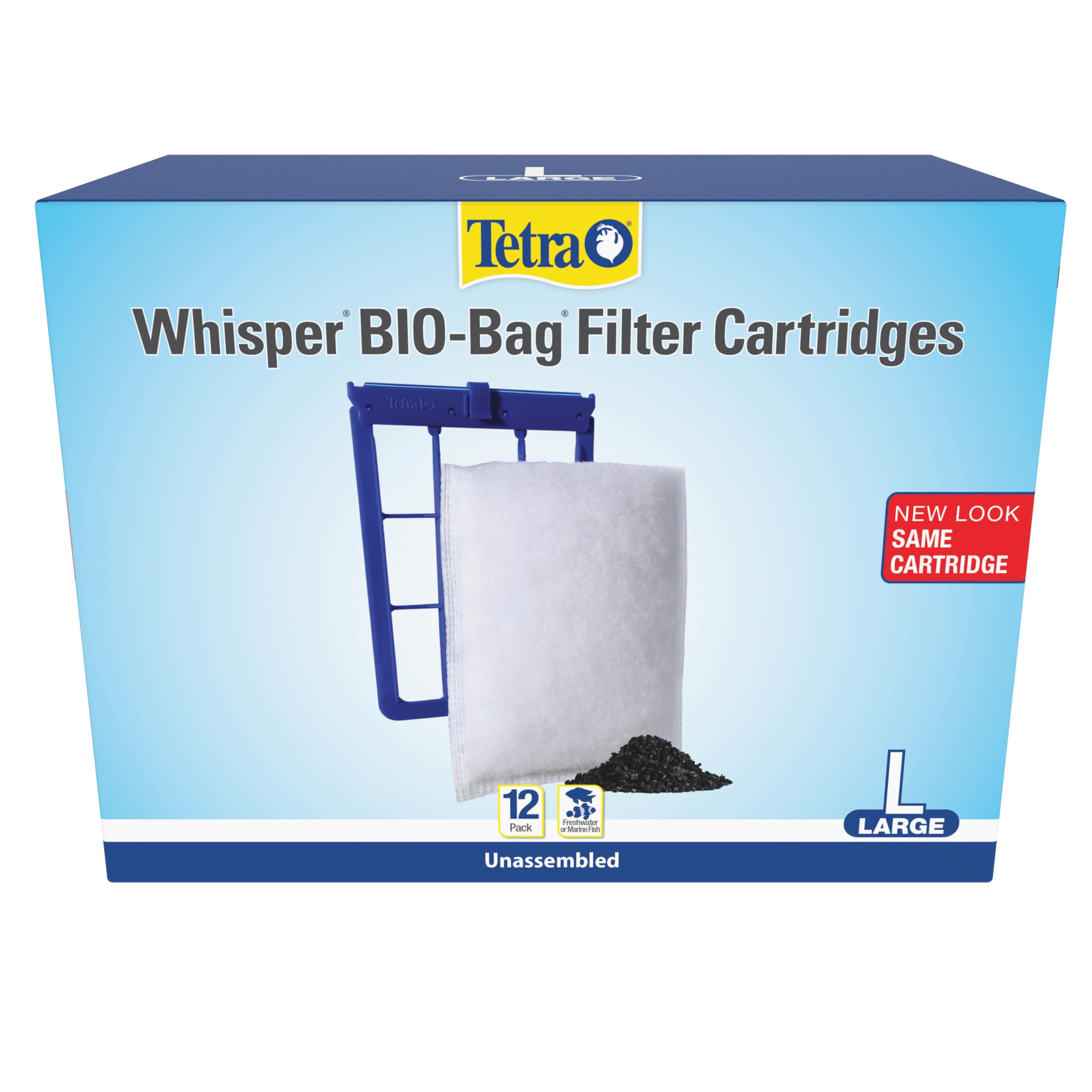
Rating: 4.7 ★ | Price: $ | Media Type: Cartridge with carbon | Filter Compatibility: Tetra Whisper | Reusability: Disposable | Particle Size: Pre-filled
Tetra’s Bio-Bag cartridges deliver consistent water clarity at a price that undercuts bulk carbon setups once you factor out bag costs. They are designed exclusively for Tetra Whisper filters (10–60 gal), so owners of other brands should look elsewhere. The carbon bags can tear when pulled out for replacement – careful removal helps, and they are not reusable.
Pros
- Cost-effective – under $1.25 per cartridge in the 12-pack.
- Keeps water clear and free of discoloration when changed regularly.
Cons
- Carbon bags may tear during removal – gentle extraction preserves them.
- Single-use design means ongoing purchases rather than rinsing and reusing.
If you own a Tetra Whisper filter and want a no-mess, drop-in solution at a low per-cartridge price, these deliver. Just be prepared for occasional torn bags and the need for regular replacements.
Best for Small Tanks
AquaClear 20 Carbon 3pk

Rating: 4.8 ★ | Price: $ | Media Type: Pre-filled carbon insert | Filter Compatibility: AquaClear 20 | Reusability: Disposable | Particle Size: Granules
These carbon inserts fit the AquaClear 20 filter precisely and produce clear water with minimal effort — no measuring, rinsing, or cutting needed. However, compatibility is limited to that single filter model, and loose carbon from a bag offers more value per ounce. Under heavy fish loads, the inserts may exhaust faster than the monthly schedule suggests, requiring more frequent swaps.
Pros
- Snug, tool-free fit in AquaClear 20 filters.
- Maintains clean, clear water in small tanks without cloudiness.
Cons
- In heavily stocked tanks, the carbon may need replacing every two weeks instead of monthly.
Best for AquaClear 20 owners who prioritize drop-in convenience over cost savings and are comfortable replacing inserts more often under heavy stocking.
Best for Freshwater Ammonia
Fluval Zeo-Carb 3x150g

Rating: 4.8 ★ | Price: $ | Media Type: Zeolite + carbon blend | Filter Compatibility: Fluval canisters | Reusability: Disposable | Particle Size: Pre-bagged
This dual-action media pairs zeolite and carbon for both ammonia control and water polishing in one bag, a cost-effective setup for freshwater Fluval canisters. However, the zeolite-heavy blend means it’s not suited for saltwater, and those seeking pure carbon filtration will need separate media. It fits best for cycling new tanks or heavily stocked freshwater setups where ammonia spikes are a concern.
Pros
- Removes ammonia and organic impurities in a single bag
- Leaves water clear and odor-free
Cons
- Not suitable for saltwater; the zeolite-dominant mix may underperform in tanks needing heavy carbon dosing
A practical pick for freshwater Fluval canister owners dealing with ammonia spikes during cycling or heavy stocking.
Best for Beginner Combo
Marineland Diamond Blend 50oz

Rating: 4.7 ★ | Price: $ | Media Type: Carbon+zeolite pellets | Filter Compatibility: All filters (bag) | Reusability: Disposable | Particle Size: Pellets
This Marineland blend offers a convenient single-bag solution for removing both impurities and ammonia in freshwater tanks. Water clarity and odor reduction are solid for the price, and the 50-ounce jar gives good value per use. The catch: the carbon-to-zeolite ratio leans heavily toward zeolite, so heavy organic loads may not get enough chemical filtration. That’s why experienced aquarists prefer buying carbon and zeolite separately for precise control.
Pros
- All-in-one bag handles ammonia and general impurities without buying separate media.
- Improves water clarity and reduces odors effectively for most freshwater setups.
Cons
- Heavy on zeolite; may not supply enough carbon for tanks with heavy organic loads.
Best for beginners setting up a simple freshwater tank who want one bag to handle ammonia and impurities. If your bioload is heavy or you need fine control over filtration, buy carbon and zeolite separately.
Best for Permanent Bio
Seachem Matrix 1L

Rating: 4.8 ★ | Price: $$ | Media Type: Porous volcanic rock | Filter Compatibility: All filters (bag) | Reusability: Permanent | Particle Size: Dusty rock
This biological media is built around porous volcanic rock that houses both aerobic and anaerobic bacteria, allowing it to reduce nitrates as the tank matures. It never needs replacing, making it a permanent investment for canister or sump setups. Dustiness straight from the bottle is a real inconvenience—thorough rinsing is required to avoid clouding the water. It also does not provide mechanical or chemical filtration, so you will need separate carbon or floss. That trade-off is easy to accept if your priority is stable, long-term biofiltration in a filter with enough space for dedicated media.
Pros
- Never needs replacement; supports beneficial bacteria indefinitely.
- Encourages denitrification, lowering nitrate levels over time.
Cons
- Dusty out of the bottle; must be rinsed thoroughly to prevent clouding the tank.
Best for hobbyists running canister or sump filters who want a set-and-forget biological medium and can manage the initial rinse—skip this if you need all-in-one filtration or lack space for separate media layers.
How to Choose
The most cost-effective filtration setup combines reusable biological media, loose carbon, and washable mechanical floss—each chosen for your tank’s specific demands.
Media Type
Mechanical media (pads, floss) trap solid waste; chemical media (carbon, zeolite) remove dissolved impurities; biological media (ceramic rings, porous rock) house beneficial bacteria that convert ammonia and nitrite. Most tanks need all three layers.
Combination products like carbon-zeolite blends simplify maintenance but limit your ability to adjust each layer independently. Separate media allow you to replace chemical media monthly while keeping biological media indefinitely.
Filter Compatibility
Cartridge-based filters require specific shapes and sizes—deviating can cause bypass and poor flow. Loose media (carbon, floss) work in any filter that accepts media bags or baskets, giving you freedom to customize.
Check your filter’s tray dimensions before buying ceramic rings or large media. A 500g bag of BioMax rings may not fit in a compact HOB filter’s basket, leading to wasted space and reduced flow.
Reusability
Biological media like Matrix and BioMax never need replacement—only rinse a portion annually to preserve bacteria. Chemical media (carbon, zeolite, Purigen) exhaust over time: carbon lasts 3–4 weeks, Purigen can be recharged with bleach up to 10 times.
Washable mechanical media (filter floss) can be rinsed several times but will eventually lose structure. Disposable cartridges offer convenience but cost significantly more per year than bulk alternatives.
Particle Size and Dustiness
Loose carbon and zeolite often release fine dust that clouds water for the first few hours. Thorough rinsing under cold water until runoff runs clear prevents this—skipping it can alarm fish and clog filters.
Pre-bagged media reduce dust but limit your ability to adjust quantity. Fine mesh bags (100–200 micron) are recommended for small-particle media like Purigen to prevent beads from escaping into the tank.
FAQ
Why is my aquarium water cloudy after adding new filter media?
Cloudiness usually comes from fine dust on loose media like carbon or zeolite. Always rinse media under running water until the runoff is clear before placing it in the filter. If clouding persists, it may be a bacterial bloom triggered by disturbance of the biological filter—wait 24–48 hours and avoid overfeeding.
Can I reuse activated carbon in my aquarium filter?
No. Activated carbon exhausts its adsorption capacity within 3–4 weeks and cannot be effectively recharged at home. Once saturated, it may leach trapped impurities back into the water. Replace with fresh carbon monthly for best results.
How often should I replace biological filter media like ceramic rings?
Biological media like ceramic rings or porous rock never need full replacement. Rinse a portion (no more than 25%) in tank water during a water change to remove debris. The bacteria colonies that perform nitrification reside on these surfaces for years if kept moist.
What’s the difference between zeolite and activated carbon for freshwater tanks?
Zeolite specifically removes ammonia by ion exchange, making it useful for new tanks or spikes. Activated carbon removes organic compounds, odors, and discoloration but does not affect ammonia. For emergency ammonia control, use zeolite; for general clarity and chemical polishing, use carbon. Never use zeolite in saltwater—it becomes ineffective.