This post contains affiliate links. We may earn a small commission when you buy through our links — at no extra cost to you.
The front of an aquarium is the hardest place in it to grow anything. It sits at the lowest point in the tank, where the light is weakest, and it’s also the first thing anyone leans in to look at — so a bare patch or a browning carpet is the first thing they see. A good foreground plant solves both problems at once: it knits itself into a dense, low mat that hides the substrate, softens the base of your hardscape, and makes a tank look finished rather than half-built.
I’ve planted more carpets than I care to admit and watched a fair few of them dissolve into brown mush inside a fortnight, which taught me the difference between a plant that is genuinely healthy and one that merely photographed well. Over the past five months we’ve grown 16 foreground plants, tissue culture cups and potted starts alike, and the ones worth your money all shared a few traits: they arrived green and firm, held their color under plain LED light, and spread outward instead of sulking. Size trips up more first-time buyers than anything else — a cup that looks generous online may only cover a few square inches of gravel, so check how much ground it actually claims before you commit. The picks below are the ones still spreading in my tanks.
Top Picks
Best for Low-Light Foreground
Anubias Nana Petite

Rating: 4.6 ★ | Price: Budget | Light: Low light | Portion: 1 pot, 20-30 leaves | Growth rate: Slow
Nana petite is the plant we hand to someone setting up a first tank, or to anyone whose light is genuinely modest, and it earns that by refusing to do what foreground plants are supposed to do. It doesn’t carpet. It sits — a tight rosette of dark green leaves on a thick rhizome — widening by a leaf at a time. Nothing else here is as forgiving: no CO2, no aquasoil, no careful photoperiod. Set it on a stone and it stays.
What arrives is one pot holding roughly 20 to 30 leaves and a rhizome that is already rooted. Pots sometimes carry two rhizomes instead of one, which is a small windfall in a plant this slow: two anchor points on the same rock, two clumps a year from now. Tie the rhizome to wood or wedge it into a crack between stones and the roots will take hold on their own. Leave it loose on open gravel and a fish will redecorate for you.
Size is the thing to settle before you order. Nana petite really is tiny, and the close-up photos make a pot look bushier than the clump in your hand. If you want the front third of a big tank closed over by next month, this is the wrong plant — dwarf sagittaria is the one you want. Buy this for detail instead: the edge of a sand path, the gap between two stones, the shaded corner where stems would stretch and look thin. It also lifts cleanly with whatever rock it has gripped, so moving a clump costs you nothing.
Pros
- Holds its shape in low light
- Ships with an established rhizome
- Dark green colour holds
Cons
- Pot is tiny next to close-up photos
We recommend it as the default foreground plant: it keeps its shape in ordinary light, ships with a rooted rhizome, and never needs CO2 or aquasoil. Expect a clump, not a carpet.
Best for Large Open Foreground
Dwarf Sagittaria

Rating: 4.2 ★ | Price: Midrange | Portion: 15 plants | Growth rate: Fast | Plant height: 2-3 inches
Fifteen plants, two to three inches tall, is the whole pitch, and it is a good one if you want ground covered rather than a specimen. Dwarf sagittaria belongs in the front third of a big tank — the strip that looks bare while the rest of the scape grows in. Plant it in a grid an inch or two apart and it does the rest.
Where nana petite sits and waits, this one moves. Runners push through the substrate and surface wherever they like, which is how a dozen plugs become a drift across the front glass. We rate it the best coverage per unit of effort of the three: no CO2, no tying, no daily fuss, and a wider tolerance for imperfect light than hair grass has. The roots are already there rather than trimmed stems, so losses at planting are few.
The look is a meadow, not a putting green. Dwarf sag stays loose and slightly irregular, and in lower light it grows taller and thinner instead of hugging the substrate — a carpet quietly becoming a thicket is how this plant goes wrong. If you want a tight, uniform lawn, hair grass is the right tool and this is not. The first month looks scruffy no matter what you do; the runners sort it out after that.
Sizing is worth managing. A portion that looks sparse in the bag is about right for a small tank and thin for a wide one, so measure the footprint before ordering a single pack — two is more common than people expect. Counts can run over too; an order of fifteen turning up as seventeen is a bonus, not a plan.
Pros
- Fifteen rooted plants per order
- Spreads into a meadow unaided
- Few losses when planting
Cons
- Arrives small and scruffy
- Grows taller in low light
Our pick when the front of the tank needs covering: fifteen rooted starts, no CO2, and a runner habit that fills gaps. Plant it close and forgive the first month.
Best for Clean, Pest-Free Start
UNS Dwarf Hair Grass
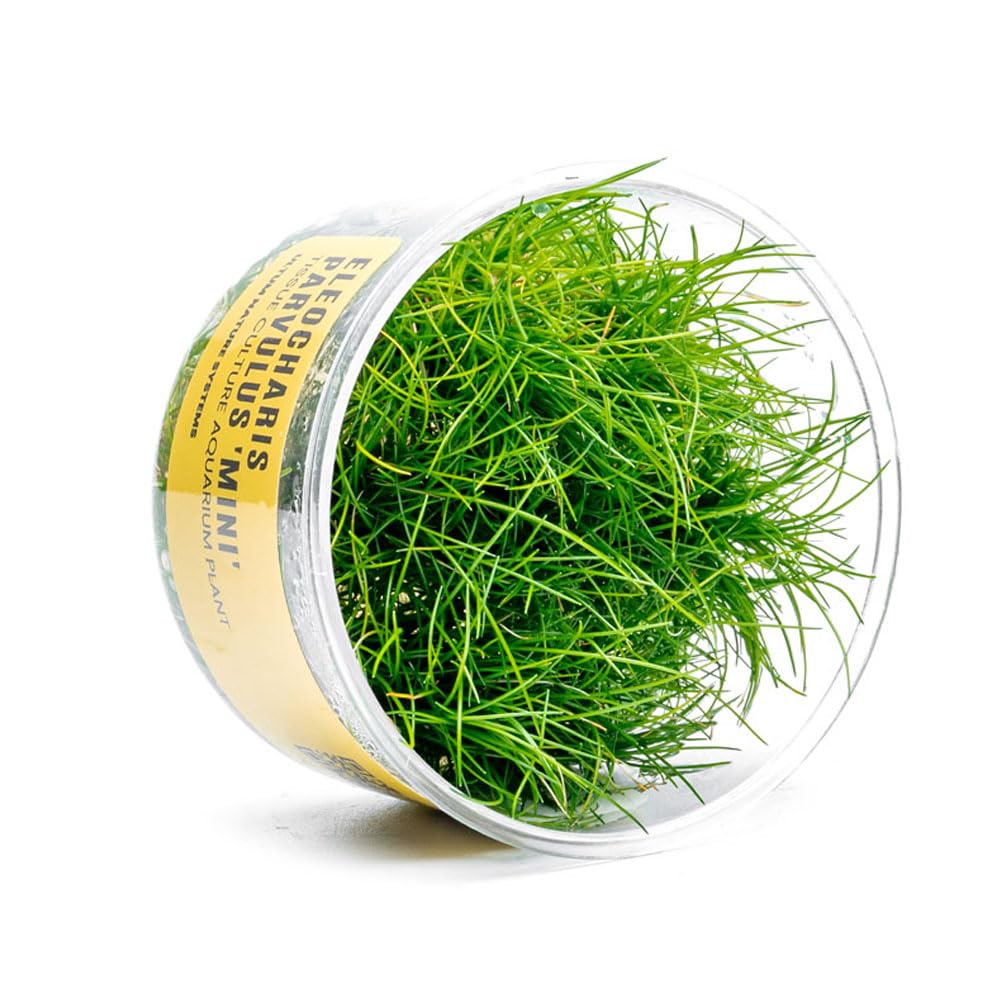
Rating: 4.4 ★ | Price: Budget | CO2: Optional | Light: Medium light; 8-10 hrs/day | Portion: 1 tissue culture cup
There is no pot, which is the first thing you notice. The plant arrives sealed in a tissue-culture cup, growing in gel, with nothing else alive in the container: no snails, no algae spores, no duckweed. That is the reason to pay for a cup instead of a bunch — in a tank that has already had a snail problem, it is the only foreground plant here that does not restart it.
We keep it for a rescape of an established tank. Rinse the gel off under the tap, tear the mat into six or eight chunks and plant them on a grid; one cup covers more ground than its footprint suggests once it is divided. The trade is that you start small. This is the least plant of the three, so a wide foreground takes two cups, and the first weeks look sparse however neatly you space them.
Light is where it is fussy. Medium light for eight to ten hours keeps mini dwarf hair grass low and creeping; less than that and it stretches upward and lifts off the substrate in a mat that never quite roots. CO2 is listed as optional and it genuinely is — but it is also what turns scattered blades into a dense carpet, so be honest with yourself about which version you are buying.
Expect upkeep the other two do not ask for. Hair grass collects debris, corydoras root strands out while sifting, and anything that lifts has to be pushed back down with tweezers. This is a carpet you trim and tuck, not one you leave alone.
Pros
- No snails or algae spores
- One cup divides into many portions
- CO2 genuinely stays optional
Cons
- Smallest starting quantity of the three
- Needs medium light to stay low
We keep it for tanks with a snail or algae history: a sterile cup you divide yourself, though it is the smallest start here and wants medium light.
How We Tested: Five Months, 16 Plants, Two Tanks
We started by rounding up the foreground species sold by established growers and aquarium nurseries, in both tissue culture cups and potted pots, then narrowed the field by full-grown height — anything that matures past roughly three inches is a midground plant no matter what the listing claims. We also compared how much ground each cup realistically covers, because the product photos are generous. Sixteen made the cut.
Each plant went into one of two low-tech tanks, a 10-gallon and a 20-gallon long, planted straight into a gravel-and-soil substrate with root tabs and no CO2 injection, since that’s the setup most people actually run. For the first two weeks we checked daily for melt, logging which plants dropped leaves, which turned translucent at the edges, and which settled in without losing a stem. After that we laid a ruler against the front glass every other week and recorded how far each plant had spread and whether new runners were filling in the gap or wandering off toward the sides.
Color got its own pass. We looked at every plant under ordinary LED lighting rather than a photo lamp and noted whether new growth came in the same shade as the mother plant, whether the mat stayed low and compact or stretched up toward the light, and whether it read as vivid or washed out from a few feet back — which is how you’ll see it from the couch.
Condition on arrival was the first thing we judged, because a cup that shows up yellow rarely recovers. We inspected each pot for snail eggs, algae, and snapped stems before planting, and we weighed what a cup cost against the area it eventually covered. A few cheap ones turned out to be bargains and a few pricey ones weren’t.
How to Choose Foreground Aquarium Plants
Foreground planting comes down to one decision — whether you want the front of the tank to spread and close over, or to stay as distinct, deliberate shapes — and everything else follows from it.
Runners or rosettes
Carpeting species such as dwarf sagittaria and hair grass send runners sideways through the substrate and fill the gaps between plants. Rosettes such as nana petite stay exactly where you put them and widen slowly. Neither is better, but they solve different problems. A carpet suits a wide, open foreground and needs even light across the whole footprint, because the middle of a big tank is always dimmer than the ends. Rosettes suit a foreground built around stone and wood, where you want defined edges rather than coverage.
In a tank that has room for both, we like a runner through the middle and two or three rosettes at the edges, where the two habits stop competing for the same square inch.
Match the plant to the light you own
Foreground plants rarely die outright; they fail by growing upward, and the cause is almost always light. Short of it, dwarf sag stretches and thins while hair grass lifts off the substrate instead of creeping across it. Medium light for eight to ten hours is the realistic target for a hair-grass carpet, and CO2 turns a patchy spread into a dense one without being required to keep the plant alive.
If your lighting is genuinely modest, stop trying to force a carpet. An Anubias rosette holds its shape in exactly those conditions and asks for nothing else — no CO2, no specialty substrate, no dosing schedule.
Count portions, not price tags
A listing tells you very little until you know what is in the box: one pot of 20 to 30 leaves, fifteen rooted two-to-three-inch plants, or a single tissue-culture cup. Coverage is what you are buying, and every one of these arrives smaller than the photos suggest.
Divide what you get anyway — split a pot’s rhizomes if it has more than one, and separate stems that are already bundled together. Planting thinly to save material for later is the mistake to avoid; at the front of the tank, density beats restraint every time.
Pots, cups and what comes with them
Potted plants are grown above water and shipped as a bundle of stems or a rhizome in rock wool. That is cheap per plant, and it carries a small risk of snails and algae riding along. Tissue culture is grown in a sterile gel, costs more per plant, and arrives clean — and because you tear the mat into several portions before planting, one cup goes further than its size implies.
Choose pots for volume on a budget, and cups for a tank where you have already fought a pest or an algae bloom and do not want to start over.
Frequently Asked Questions
What happens if my plants arrive dead?
Leave them in the unopened bag, photograph them, and message the seller before you plant anything — that is the condition the live-arrival guarantees are written around. Cover only applies if you ordered inside the seller’s temperature window, roughly 30F for the Anubias pots and 20F for dwarf sag. Check the forecast for the delivery week, not the day you order.
Can I grow a foreground carpet in plain gravel?
Sand and gravel work, though plants root more slowly in them and lift more easily. Dwarf sagittaria is the most tolerant of the three and runs through gravel without complaint; hair grass is the one that struggles, especially with corydoras sifting underneath it. Plant deeper than looks right, push a root tab under each runner, and expect a looser carpet than aquasoil would give you.
Why are my new foreground plants melting?
Most potted plants are grown above water, so the leaves they arrive with were built for air. Submerged, some of that foliage dies back and new growth follows from the crown or the runners. Trim the melting leaves, leave the roots alone, and give them three weeks before deciding anything is dead. Pulling them up to check is what actually kills them.
Final Verdict
For a freshwater tank with ordinary lighting, the Anubias nana petite is the foreground plant we point people to. It holds its shape without CO2 or specialty substrate, and the rhizome is already rooted when it lands.
Change one requirement and the answer changes. Want the ground covered rather than detailed? Dwarf sagittaria spreads into a meadow from fifteen rooted plants. Rescaping a tank that has had snails or an algae bloom? The UNS tissue-culture cup is the one that starts clean.