This post contains affiliate links. We may earn a small commission when you buy through our links — at no extra cost to you.
A beginner aquarium plant has one job nobody warns you about: surviving the switch from air to water. Most of the plants sold in those little plastic tubes were grown emersed — rooted in open air rather than submerged — and once they go under, the old leaves often melt away before new aquatic growth comes in. What you’re really shopping for is a plant that comes back from that and is still green three months later, without a CO2 kit, specialty substrate, or a chemistry degree.
Over the past seven months my team ordered 16 species — tissue-culture cups, potted bunches, and loose stems in wet bags — and grew them out in our own tanks under ordinary lights. I’ve killed my share of anubias over the years, so I’m not easily impressed. Color, plant size, and how much you actually get for the money swing wildly between a six-dollar cup and a potted bunch, and the healthiest-looking arrival isn’t always the one that takes root. The picks below earned their spot by growing, not by photographing well on day one.
Our Top Picks
The Best Beginner Aquarium Plants, Reviewed
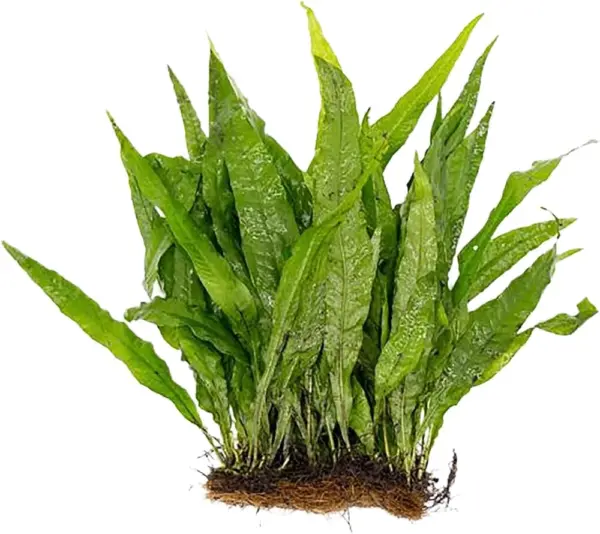
Java Fern (Bare Root) – Best Overall
Key Features
- Light: Low light
- Planting: Tie or glue to hardscape
- Supplied as: Bare root rhizome
- Stated height: 3 inches
- Price: Budget
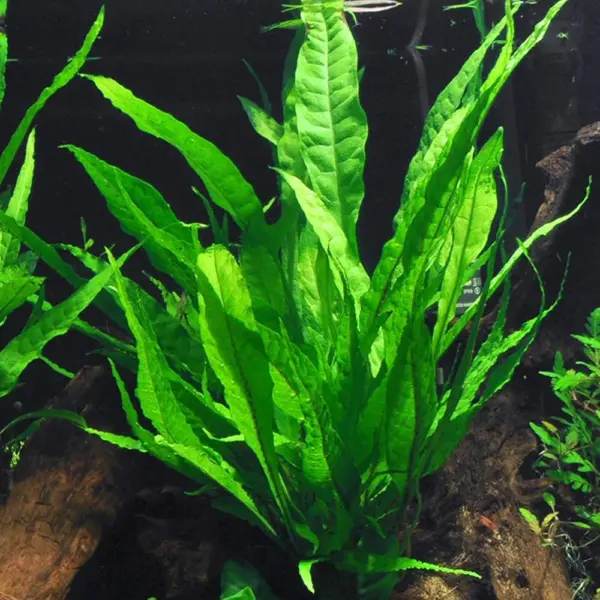
Java fern is the plant we point a total beginner toward, and the argument is practical rather than pretty. It is one of the cheapest ways into a planted tank, it needs no substrate at all, and it grows under the light that came in the box with your aquarium. You tie or glue the rhizome to a rock or a piece of driftwood and it takes over from there. Nothing gets buried, so there is nothing to rot.
The rhizome — the thick horizontal stem the leaves come off — is the part that matters. Bury it in gravel and it sulks and rots; leave it in the water and it feeds through its leaves. That is why this plant works in a bare-bottom hospital tank, in a tank with gravel that has been there for a decade, and in a shrimp cube with a thin layer of sand. The bunch arrives compact and is listed at around three inches, and it is the leaf mass that spreads rather than the height.
The first month is when beginners panic, and usually should not. Brown fuzzy patches under the older leaves are how the fern propagates, not a disease, and plantlets eventually form at the leaf tips — pinch them off and tie them somewhere else for free plants. Beyond that it forgives neglect: no fertilizer schedule, no substrate, no fuss.
The thing to plan around is arrival condition. A live plant in a bag can land brown and soft after a slow or cold trip, so order in mild weather and unpack the box the day it lands; the rhizome is worth checking before you write it off. In a ten-gallon the bunch is a centerpiece, and in a larger tank it is a detail tied to a branch, which is how we prefer it.
Pros
- Grows under low light with no substrate
- Cheapest entry point in this group
- Leaf-tip plantlets make free replacements
Cons
- Bunch size varies more than the photos suggest
Java fern is the one we tell beginners to buy first: no substrate, low light, and the smallest outlay here for a plant that keeps going.
Anubias Nana (Potted) – Best for Low Light
Key Features
- Light: Low light
- Height: 6 inches
- Placement: Midground or on wood
- Supplied as: Potted, rooted in wool
- Price: Midrange
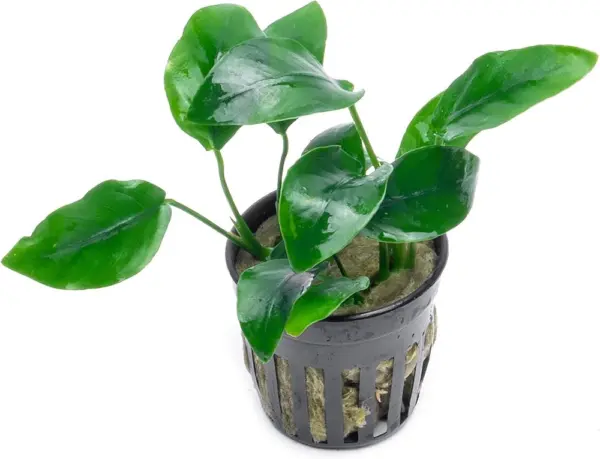
If your tank has a lid with a small LED strip and nothing else, anubias nana is the plant that stops you shopping for a new light. It is listed as low light, it does not need CO2, and it does not need a substrate. It arrives as a pot of rooted plant in wool: squeeze the pot, peel the wool back, rinse the roots, then tie or glue the rhizome to wood or stone rather than burying it.
We rate it above the ferns for a tank with fish that nibble. The leaves are thicker and stiffer than a java fern’s, the plant holds its shape instead of draping, and it comes back from being knocked about. It is also slow — genuinely slow, which reads as nothing happening for the first few weeks and then as a plant that has barely moved by spring. We like that trade. You are buying structure, not speed.
Size is a lottery: pots turn up bigger than expected about as often as smaller, and the listed six inches is a reasonable guess rather than a promise. So buy one pot, watch how it settles, then buy more — a single anubias in a big tank disappears. One more thing in its favor: pots tend to arrive clean of snails, which is not true of every bunch here.
Pros
- Low light, no CO2 and no substrate needed
- Thick leaves hold up to nippy fish
- Arrives potted and clean, easy to place
Cons
- Slow grower that looks unchanged for weeks
Buy the anubias pot if your light is dim and your fish are nippers. It is slow, sturdy, and needs nothing but something to hold on to.
Java Fern and Anubias Bundle – Best Starter Bundle
Key Features
- Light: Partial shade
- Contents: Java fern and anubias
- Plant type: Broadleaf rhizomatous
- Java fern leaves: About 6
- Price: Budget
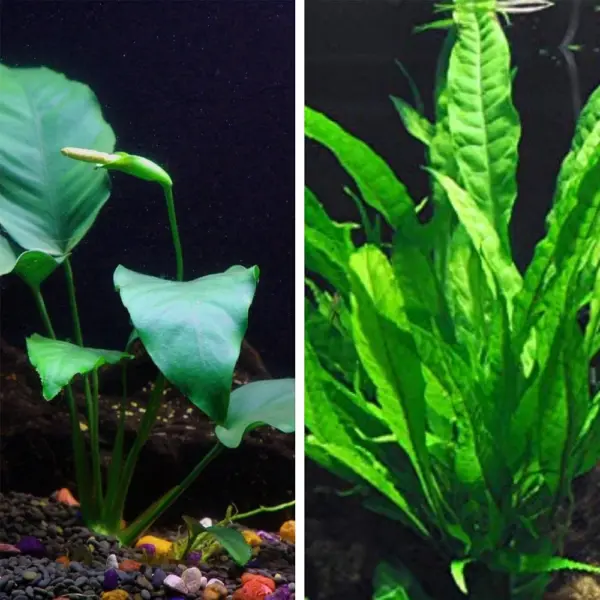
The box holds two rhizome plants: a java fern with about six leaves and an anubias, both the broadleaf kind that feed from the water. That is a sensible pairing rather than a random one — the fern gives you height and movement on a piece of wood, the anubias gives you a low, solid clump at the base of it, and neither needs gravel to survive.
Both arrive bare, so the first job is the same as it would be with either plant bought alone: tie or glue them to hardscape. Neither will plant itself, and pushing the rhizome into the gravel rots it. Budget an evening, a spool of thread and a sharp pair of scissors for trimming the damaged leaves off.
This is the pick for someone setting up a first tank who does not want three orders and three shipping charges. We like it because the pair covers the two positions most tanks actually need, and because a happy java fern throws plantlets off its leaf tips — several bunches arrive already sprouting babies, so the bundle quietly becomes more plants for nothing.
Two caveats. Root quality varies: some bunches come with a strong set of roots, others with barely any and a healthy rhizome tip, and the second kind takes longer to attach to anything. Size varies too, and a small bunch in a wide tank looks like a starter kit rather than a planting. Order two if the tank is wide.
Pros
- Two low-light species in one order
- Both attach to wood or stone
- Fern throws plantlets for free plants
Cons
- Some bunches arrive with very little root
We suggest the bundle when you want a tall plant and a low one without placing two orders; both are low light and neither needs gravel.
Amazon Sword (3 Plants) – Best Background Plant
Key Features
- Light: Low light
- Height: 20–50 cm
- Placement: Background
- Supplied as: 3 plants
- Price: Midrange
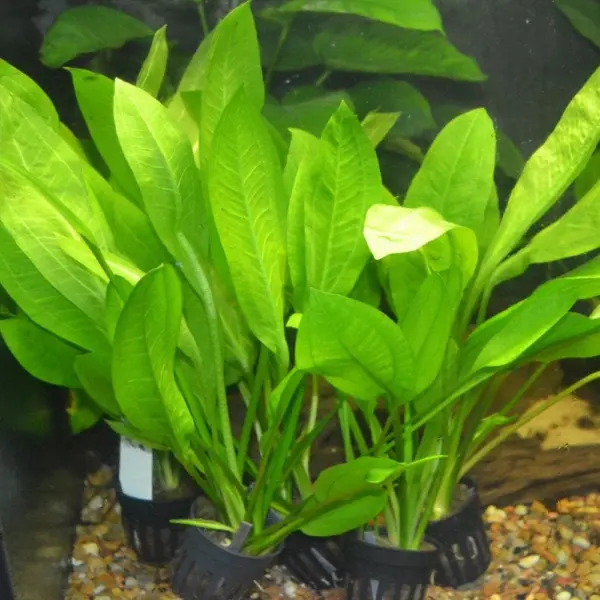
Twenty to fifty centimetres of leaf is what an Amazon sword becomes, and that number should decide where it goes before anything else does. This is a rosette for the back and the corners of a tall tank, not a middle-of-the-scene plant, and three of them in one order will fill a lot of space in a hurry.
It is also a root feeder, which is the part beginners miss. The listing says a nutritious bottom promotes growth and it means it: gravel alone will not carry a sword for long. Root tabs pushed under the plant are what keep the leaves broad and green instead of pale and pinholed, and no amount of liquid fertilizer in the water column makes up for a hungry root zone.
Light is more forgiving than the size suggests. It is listed as doing well even in poorly illuminated tanks, growing toward the light, and that matches how a sword behaves — in a dim tank it stretches upward and gets loose and leggy, which is survivable but not the point. It is a plant for a tank where the light reaches the bottom.
Two more things to plan for. It shades whatever sits downstream of it, so it wants pruning: outer leaves off at the base once it starts blocking light to its neighbors. And a settled sword eventually sends a stalk to the surface and blooms above the waterline, which is the sort of thing that turns a beginner into a hobbyist.
We recommend it for a tank with the height for it, and a beginner should order the three-pack only if the tank is genuinely tall. It is also the pick here that most rewards feeding. Skip the root tabs and you get a pale, stretched plant, so if you know you will not bother, take a fern instead.
Pros
- Fills the back of a tall tank fast
- Tolerates modest light by growing toward it
- Can send up a flowering stalk
Cons
- Needs root feeding to stay green
- Outgrows small tanks and shades plants below
For the back of a tank with the height for it, the sword earns its place: three plants, 20 to 50 cm, and forgiving light — provided you feed the roots.
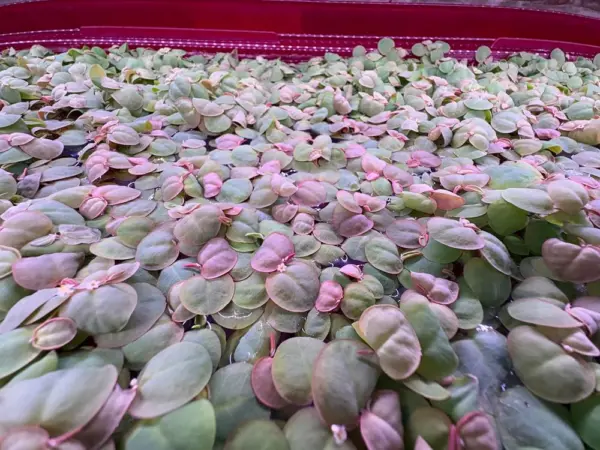
Red Root Floater – Best Floating Plant
Key Features
- Light: Moderate to high
- Leaf color: Red-purple undersides
- Water flow: Gentle, calm surface
- Supplied as: 70+ leaves in a 4 oz cup
The red root floater is the one plant here that earns its place on looks. Green leaves on top, red-purple underneath, and a tangle of red roots hanging into the water that fry and shrimp treat as cover. It arrives as 70-plus leaves in a four-ounce cup, which is enough to cover a decent patch of surface on day one and a bigger one a fortnight later.
It is not a plant for every tank, though. The listing asks for moderate to high light and gentle flow, and warns that it does badly with a lot of surface agitation. That is a real constraint: a hang-on-back filter pouring across the top will push the floaters into a corner and keep their crowns wet, and a dim lid leaves you with green plants and barely any red.
It spreads by runners and covers the surface faster than a beginner expects. Skim some out every week or two, into the bin rather than a pond, and keep a stretch of open water so the plants below still get light and the tank still breathes.
Where it suits, it is our favorite floater here: the color is the reason, and the shade it casts is a bonus in a tank with a fish that dislikes bright light. Point a sponge filter or a spray bar at the glass instead of across the surface and it does the rest.
Pros
- Red undersides give real color
- Covers surface quickly from a small cup
- Shelter for fry and small fish
Cons
- Surface agitation batters and bunches it
The floater we pick for looks: red undersides, fry cover and quick spread, as long as the surface is calm and the light is not dim.
Canton Aquatics Java Fern Mat – No-Tying Placement
Key Features
- Light: Low to moderate
- Height: 3 inches
- Water flow: Gentle
- Supplied as: Sewn onto a mat
- Price: Premium
The mat is the whole idea here. Instead of a loose bunch you have to thread onto a rock, you get java fern already sewn onto a mesh pad, and the pad simply goes down. For anyone who has looked at a spool of thread and a piece of driftwood and quietly given up, that is the difference between planting and not planting.
The plant itself is ordinary java fern: low light, feeds from the water, wants its rhizome above the gravel. Listed at about three inches, on a mat that holds it against the current instead of letting it drift into the filter intake, which is exactly what happens to a badly tied bare-root bunch. There is usually enough material on the mat to split it and start a second clump elsewhere, which softens the outlay.
That outlay is the catch. This sits well above the cost of a bare-root fern, and what you are paying for is the sewing. If you are comfortable with a needle and cotton thread, buy the cheap bunch. If you want to drop a plant in and be done, the premium is worth it here — and it is the version to hand a kid who wants to plant their own tank.
Pros
- Pre-sewn mat needs no tying
- Stays put instead of floating off
- Low light, no substrate required
Cons
- Priced well above bare-root java fern
Pay for the mat if you want a fern in the tank tonight. Nothing to tie, nothing to float away, and it holds in the filter current.
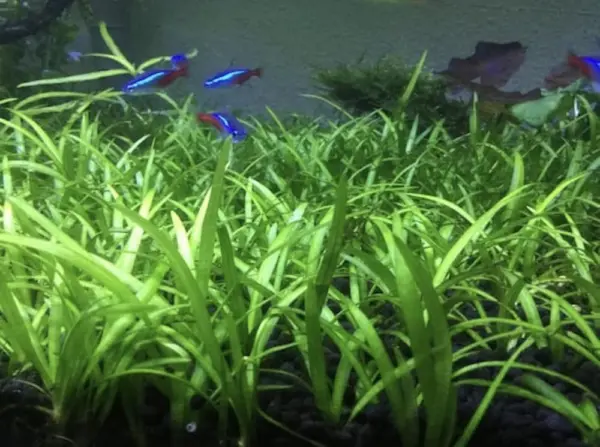
Dwarf Sagittaria (15 Plants) – Foreground Carpet
Key Features
- Species: Sagittaria subulata
- Placement: Foreground
- Supplied as: 15 plants
- Size at arrival: 2–3 inches
- Price: Midrange
Fifteen plants, two to three inches each, is what arrives — and it looks like nothing. A bag of short green blades goes into the gravel, vanishes against the substrate, and then does very little for a while. And then the runners start.
We like dwarf sag for the job most beginners actually want: a foreground that fills itself in. It spreads by sending runners sideways through the gravel, so a patch of fifteen becomes a lawn, and when it drifts somewhere you do not want it you pull the runner up and move it. It is a carpet without a high-tech setup, and it survives being replanted.
Growth is the part that gets under-credited. It is quick once rooted, it stays low, and it takes trimming without complaint. The complaints are about size on arrival and they are fair: two to three inches is what is advertised and roughly what turns up, so anyone expecting a finished carpet in the bag will be disappointed. This is a starter patch.
One practical note. It feeds through its roots the way a sword does, so a thin gravel layer and no root feeding gives you a slow, yellowing patch instead of a lawn. Push a root tab under it and then leave it alone. In a small tank it will spread as far as you let it.
Pros
- Runs into a low foreground mat
- Fifteen plantlets in one order
- Stays short at 2-3 inches
Cons
- Arrives as short plantlets, not a carpet
Dwarf sag is our foreground pick for a low-tech tank: a short starter patch that runs across the gravel and fills in on its own.
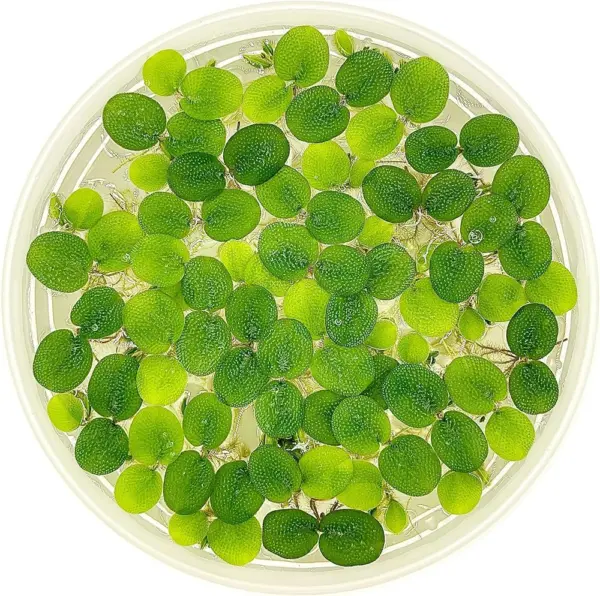
Water Spangles (Salvinia Minima) – Cheap Floating Cover
Key Features
- Type: Floating
- Light: Low to medium
- Covers: A 4-inch circle
- Supplied as: 12 plants, 60+ leaves
- Price: Budget
If the red root floater is the showy floater, water spangles are the forgiving one. Twelve plants, 60-plus leaves, enough to cover a circle about four inches across, and it asks for low to medium light rather than the higher end the red one wants. What it does need is a calm surface and a light over the tank; indoors without a grow light it sulks.
It grows quickly — a patch can double inside a couple of weeks and keep going, which is either the best thing about it or the worst, depending on how fond you are of netting. It also suits a betta or shrimp tank better than a red root floater mat does, because the leaves lie flat and the roots hang short, leaving more open water underneath.
For the least money in this group it does what a floater is supposed to do: shade, cover and a bit of green at the waterline, with an alive-on-arrival guarantee behind it. It is not the plant you buy for a show tank. It is the one you buy to find out whether floating plants work in your setup before spending more on the red ones.
Pros
- Low to medium light is enough
- Doubles within a couple of weeks
- Small outlay for a floating patch
Cons
- Needs weekly thinning once it takes
- Struggles indoors without a grow light
Water spangles are the floater we suggest when the light is modest: easy cover that doubles quickly, as long as the surface stays calm.
Tiger Lotus Bulb – Red Focal Point
Key Features
- Leaf color: Deep red
- Plant type: Nymphaea lotus bulb
- Supplied as: 1 sprouted bulb
- Price: Midrange
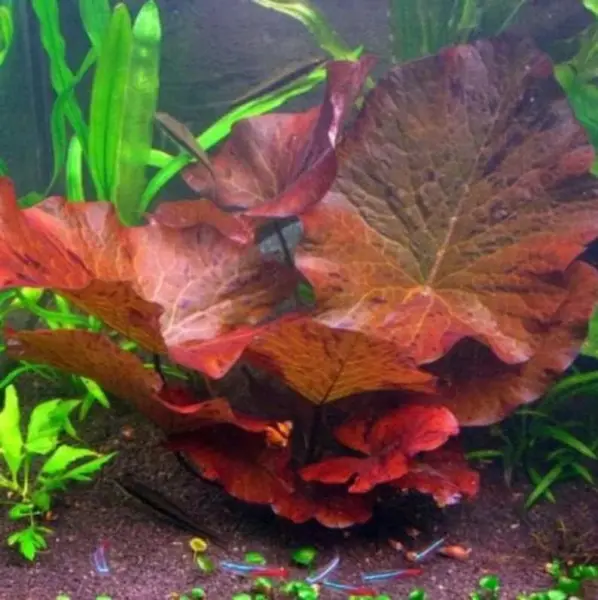
A bulb is a strange thing to buy as a plant. It arrives as a firm brown lump with a couple of small leaves already pushing out, and for the first few days it looks like something you dug up in the garden by mistake. Then it opens, and the leaves come in red — deep red under good light, olive with red speckling under less — and it starts throwing foliage toward the surface.
It is quick out of the gate, which is rare among the plants here. New leaves appear within days of going in, and the bulbs arrive already sprouted rather than dormant, so there is no long wait to find out whether you have a plant. The leaves are fragile in transit, which is why the seller ships them small, so expect a modest start rather than a centerpiece on day one.
The risk is the bulb itself. Some never take — they sit there, soften, and that is the end of it — and the plants that do take vary in final size, so the small bulb in the bag can become a substantial plant or stay a modest one. The seller backs live arrival down to around 30°F, which tells you the failure mode is understood rather than denied. Give it the midground and some room.
We keep it in the list because nothing else here gives you a genuinely red plant in a beginner tank with this little effort, and because a bulb is a small gamble rather than a commitment. If it fails, you are out one plant; if it takes, it is the thing guests ask about. Buy two if the first one matters to you.
Pros
- Red leaves within days of planting
- Arrives sprouted and pest-free
- Distinct red focal point, not a green bunch
Cons
- Some bulbs never sprout
- Final plant size varies a lot
If you want one red plant in a beginner tank, this is the bulb we name: fast leaves, deep color, and a failure risk small enough to gamble on.
How We Tested 16 Beginner Aquarium Plants
We started with what’s actually sold as beginner-friendly and cut anything that lists high light or CO2 injection as a requirement, along with bulbs you’d have to coax into sprouting. From that shortlist we ordered 16 species across three formats — tissue-culture cups, potted bunches, and loose stems — and let each shipment sit a day before unpacking so we could see how it handled the trip.
On arrival we photographed every plant under the same light so the color comparisons meant something, then counted stems, measured bunch height, and weighed what came out of the cup versus the gel it was packed in. We checked roots for brown mush, looked for snail egg clusters and algae, and noted which shipments landed with broken or yellowing leaves. Then we planted them: most went into a 10-gallon with a plain LED hood and gravel, a few into a 20-gallon with sand, and none got CO2, because that’s how a beginner actually runs a tank.
Every week for seven months we recorded what melted back, how quickly new leaves unfurled, and whether the color held once a plant was underwater rather than under a supplier’s grow lights. We also watched durability — how each one fared with a gravel vacuum dragged past its base, with being replanted after a clumsy net, and through the occasional skipped water change. At the end we weighed what we’d spent against what survived, since a cheap cup that dies in three weeks is the most expensive plant in the tank.
How to Choose Beginner Aquarium Plants
Plants fail in a first tank for three reasons — not enough light for the species, the wrong planting method, or a plant that outgrows the space — so matching those three matters far more than picking the prettiest photo.
Match the plant to the light you already own
A stock LED lid on a small tank grows ferns, anubias and most floating plants and little else, and that is fine. Buy for the light you have and add a brighter fixture later; buying a light-hungry plant first is how beginners end up with a yellowing, leggy mess and a new hobby they blame themselves for.
Floating plants complicate the arithmetic because they sit between the light and everything underneath. A thick mat of red root floater or water spangles can starve the plants below it, so keep a stretch of surface open even when the floaters are doing well.
Pick a planting method you will actually do
There are only three. Substrate plants such as Amazon swords and dwarf sag go into the gravel and feed through their roots, which means root tabs. Rhizome plants such as java fern and anubias get tied or glued to rock or wood and feed from the water. Floaters do neither.
The mistake we see most is burying a rhizome. That thick horizontal stem has to stay above the substrate or it rots, and the plant dies while looking as though it was planted correctly. If you would rather not fiddle with thread and glue, buy a plant that arrives already attached to something.
Buy for the space, not the bunch
A listing photo shows a bag; a tank shows the plant at full size. An Amazon sword reaches 20 to 50 cm and shades everything downstream of it, so it belongs at the back of a tall tank with a pair of scissors nearby. Dwarf sag arrives at 2 to 3 inches and stays low. A four-inch patch of floaters covers its own width again within weeks.
Measure the height of your water column before ordering anything tall. A plant that touches the surface in a small tank is not a failure of the plant, but it does mean the tank now has one occupant.
Expect a settling-in month
New plants lose leaves after shipping and transplanting, and that is normal rather than a death sentence — check the rhizome or the roots before throwing anything out. Rinse every bunch in a bowl, pick off snails and broken leaves, and quarantine for a couple of weeks if the tank already holds stock you care about.
Order in mild weather and be home for the delivery, so the box does not sit in a hot mailbox or on a freezing step. A plant that spends an extra day in transit is the one most likely to arrive brown.
Frequently Asked Questions
Do beginner plants need a CO2 system?
No. None of the plants here need injected CO2, and they will grow in a low-tech tank with an ordinary light and the occasional liquid fertilizer. CO2 is what makes carpeting plants knit together faster, and that is a project for a later tank.
Spend the money on a timer for your light first. A steady daily photoperiod does more for a beginner tank than gas does.
Is it safe to order live plants in cold weather?
The sellers set their own limits, and they land in a similar place: expect cancellations or plants that suffer above roughly 85 to 90°F and below roughly 30 to 38°F. Check the forecast for the delivery week, not the day you order.
Be home for the box so it does not sit on a step or in a mailbox. In a cold snap or a heatwave, wait a week.
How many plants do I need for a 10-gallon tank?
One java fern bunch on a piece of wood, one anubias pot mid-tank and a small floating patch is a full-looking ten. A dozen water spangles covers a circle about four inches across, and a 4-ounce cup of red root floater does roughly the same.
Buy fewer than you think. The floaters and the runners fill in, and open water for the fish to swim through is not a gap you failed to plant.
Can I keep these plants with a betta?
Yes, and the tank is better for it. Bettas use floating cover and broad leaves to rest on, and a fern or an anubias gives them somewhere to hang rather than cruise.
Leave part of the surface open so the fish can reach air, and put floaters where the filter current is gentle. Any snails that hitchhike in are harmless to the fish but will multiply.
Final Verdict
Start with java fern. It is the least expensive plant here, it needs no substrate, and it grows under the light that came screwed to your lid — tie it to a rock and you have a planted tank this afternoon rather than a project.
If your tank is tall and you want volume at the back, the Amazon sword is the upgrade, provided you will feed its roots. And if the surface looks empty and your filter is calm, a cup of red root floater fills it with the only real color in this group.