This post contains affiliate links. We may earn a small commission when you buy through our links — at no extra cost to you.
An aquarium kit is supposed to be the easy on-ramp: one box, one afternoon, and a calm rectangle of water on your counter. The catch is that “complete” means different things to different manufacturers — some kits skip the heater, some include a filter that turns a betta’s tank into a whirlpool, and some lights make fish look washed out. I’ve kept fish for years, and I still read the contents list before I trust a kit. A good one fixes the guesswork: it matches tank size to filter flow, gives you a lid that fits, and lets you focus on cycling the water instead of hunting for missing parts.
Over the past six months, my team and I set up and lived with 12 aquarium kits, from nano betta tanks to larger starter setups. We timed assembly, listened for filter hum in a quiet room, and checked each tank after weekly water changes. The right kit should feel complete without a second trip to the store — the picks below are the ones that came closest.
Our Top Picks
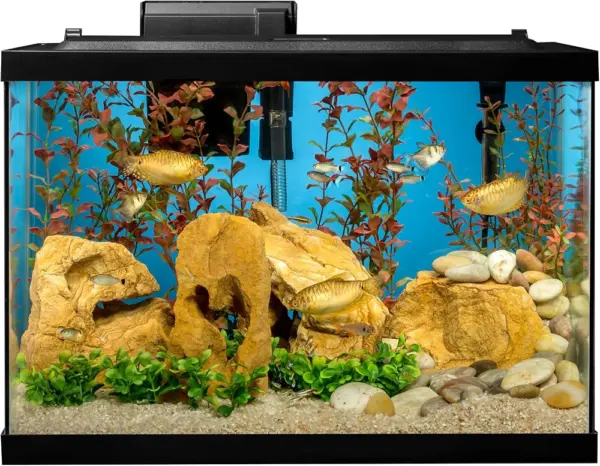
The Best Aquarium Kits, Reviewed
Aqueon 10 Gallon Starter Kit – Best Overall
Key Features
- Material: Glass
- Dimensions: 20.25 x 10.5 x 13.31 in
- Tank volume: 10 gallons
- Included equipment: LED hood, filter, preset heater, thermometer
- Price: Midrange
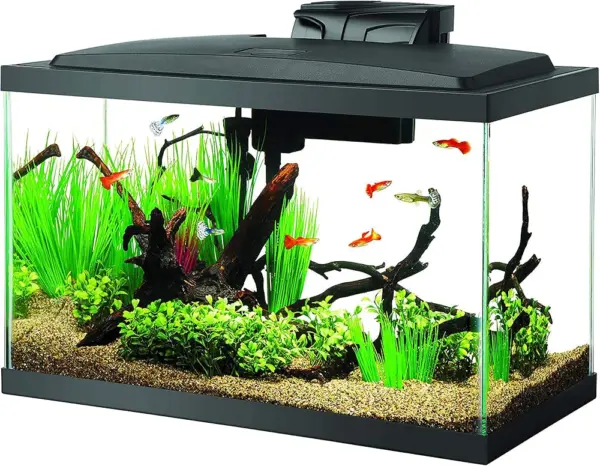
A 10-gallon glass tank, a low-profile LED hood, a QuietFlow filter, a preset heater, a thermometer, a net, and samples of food and water conditioner: the Aqueon kit arrives with the pieces a first freshwater setup actually needs. At 20.25 by 10.5 inches, the footprint fits across a dresser or a small stand without swallowing the room.
We think the heater is the detail that makes this the default here. Ten gallons is large enough to forgive a missed water change and small enough to keep where the family can see it, and the included heater removes the extra purchase that trips up so many first setups. The QuietFlow filter is easy to service, with a cartridge that lifts out without dismantling the hood. In our testing, the pieces went together without a trip to the hardware store or an improvised fix.
The filter is the part we watch in a kit this size. It is easy to service, and the flow is gentle enough for a small community, but a bedroom tank may pick up a low hum; a foam mat under the base helps. The hood is a simple plastic affair, which suits the job and keeps the light close to the water.
What it is not is a showpiece aquascaping tank. The black trim and plastic hood are practical rather than furniture, but the glass is clear and the proportions are easy to live with. The real luxury is the absence of a second shopping list: the heater, filter, hood, and even a net are already there.
Pros
- Heater, filter, hood, and thermometer included
- Ten-gallon glass tank has room to grow
- QuietFlow filter is simple to service
- Straightforward first setup
Cons
- Preset heater is not adjustable
- Hood light is basic for plants
We recommend the Aqueon 10-gallon kit as the easiest first community tank here, because the heater, filter, hood, and thermometer are already in the box.
Marineland Portrait 5 Gallon – Best Small Glass Display
Key Features
- Lighting: White and blue LEDs
- Dimensions: 9.99 x 9.67 x 17.2 in
- Filtration: Hidden 3-stage
- Tank volume: 5 gallons
- Price: Midrange
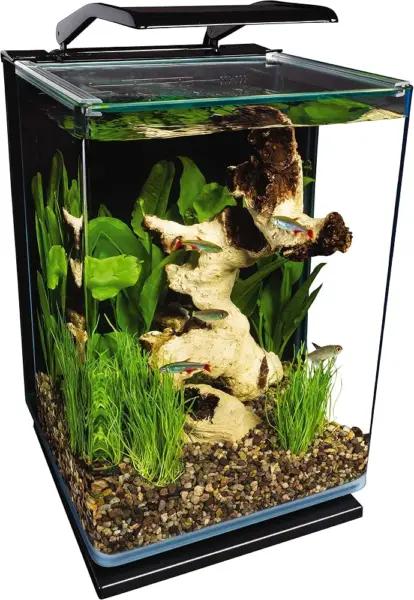
The Portrait earns its name from the shape: a tall glass tank with rounded corners, a clear canopy, and a footprint not much bigger than a sheet of paper. We like it for the small space where the tank has to look intentional, because the three-stage filter is hidden behind a back panel and the view stays clean. The 17.2-inch height gives a betta more vertical room than a low five-gallon box.
The white LEDs are bright enough for fish-only viewing, and the blue setting gives the tank a moonlit glow without turning the room blue. We noted the sliding glass canopy as a daily convenience: it opens for feeding without wrestling the whole hood off. The pump stayed quiet in our testing, which matters more in a small room than an extra lighting mode.
The narrow base is the one chore. A full-size gravel vacuum is awkward in the corners, so we used a smaller siphon and took our time. It is a fair trade for the footprint, but it is the reason this is a display for a calm fish rather than a busy community. The clear canopy is the detail we kept coming back to: it lets you see the whole tank without a plastic frame cutting across the top.
Pros
- Hidden three-stage filtration keeps the view clean
- Tall glass portrait shape suits a counter
- White and blue LEDs for day and night
- Sliding canopy makes feeding easy
Cons
- No heater included
- Lighting is modest for demanding plants
For a small glass display that hides its equipment, we choose the Marineland Portrait—just add a heater before the first cold night.
Fluval SPEC 5 Gallon – Best Premium Planted Tank
Key Features
- Lighting: 7000K LED, 821 lumens
- Dimensions: 20.5 x 7.5 x 11.6 in
- Filtration: 3-stage, 55-80 gph
- Tank volume: 5 gallons
- Price: Premium
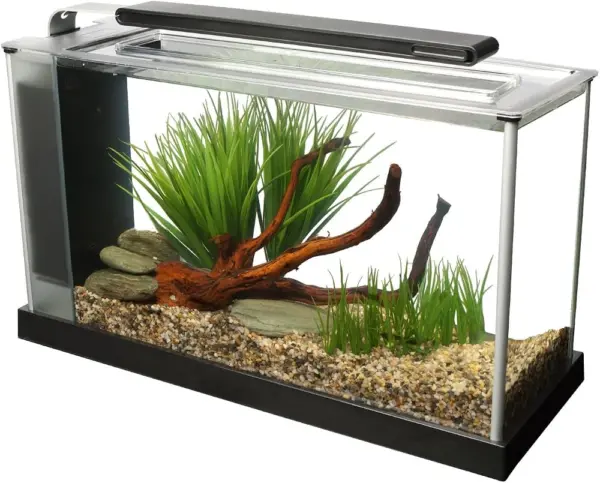
The SPEC is the kit we point to when the tank is meant to be looked at as much as the fish. It is a long, shallow five-gallon glass tank with etched glass, aluminum trim, and a black honeycomb back that hides the filter. The 37-LED, 7000K fixture is rated at 821 lumens, which is a different class of light from the basic hoods on most starter kits.
The hidden filtration is the other reason it costs more. A three-stage system with oversized media and a 55-80 gph pump gives you more to work with than a single cartridge, and the media is easier to customize. The flow is strong for five gallons; in a betta setup, aim it at the glass or add a baffle so the fish is not pushed around.
We think the SPEC is worth it for a planted aquascape or a desk tank where the equipment should disappear. It is the most polished-looking kit here, and the light is the reason: it makes green plants look green instead of yellow. The tank we kept admiring was the one with the clean front and no visible filter, and that is what the extra money buys. It is also the least forgiving on price, so it earns its spot for a specific buyer rather than as the default.
Pros
- High-output 7000K LED rated at 821 lumens
- Hidden three-stage filtration with oversized media
- Long, shallow glass footprint suits aquascaping
- Quiet pump
Cons
- No heater included
We see the Fluval SPEC as the planted-tank pick for someone who wants a strong light and hidden filtration and will pay more for the finish.
NICREW 2.5 Gallon Nano – Best Nano Desktop Tank
Key Features
- Material: Rimless glass
- Dimensions: 11.8 x 6.3 x 8.66 in
- Tank volume: 2.5 gallons
- Included equipment: Clip-on LED, slim filter, lid
- Price: Budget
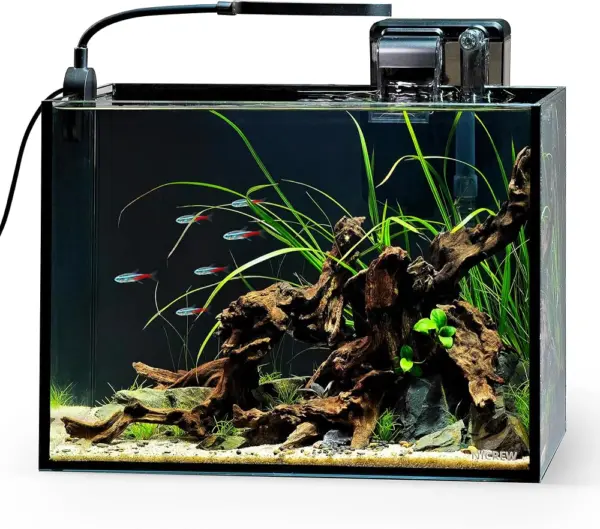
A 2.5-gallon rimless glass box with a clip-on LED and a slim filter, the NICREW is the kit we reach for when the desk is the whole display. The glass is clear enough that the aquascape does the decorating, and the footprint—11.8 by 6.3 inches—leaves room for a notebook beside it. We like that it does not look like a plastic starter tank. The 8.66-inch height keeps it below most monitor stands, so it works in a home office.
The filter is the pleasant surprise: it is quiet enough to sit through a workday, and the single-button light is the kind of control we want on a desk—no app, no remote, no manual. The light is bright enough for low-demand plants such as moss and anubias and simple to switch on and off. This is a nano for shrimp, snails, or a single betta, not a community tank, and it rewards a patient fishless cycle. The pre-glued leveling mat is a small detail we appreciated; it means the tank sits flat on a desk without a separate foam pad.
Pros
- Rimless glass with high clarity
- Quiet slim filter
- Compact desktop footprint
- Clip-on LED is simple to use
Cons
- No heater, gravel, or rock included
- Light clamp can break
Our desk-tank pick is the NICREW 2.5-gallon for its clean rimless glass and quiet filter, provided you are keeping shrimp or one betta.
Tetra 20 Gallon Complete – Best Large Starter Kit
Key Features
- Material: Glass
- Dimensions: 24.2 x 12.4 x 16.7 in
- Tank volume: 20 gallons
- Included equipment: LED hood, filter, heater
- Price: Midrange
A 20-gallon glass tank with a hinged LED hood, an internal filter, and a heater is the biggest complete kit here, and the extra water volume is the point. The 24-inch footprint gives a community room to spread out, and 20 gallons is more forgiving of a missed water change than a five-gallon cube. The kit includes decor, but gravel and fish are still yours to add.
We think this is the kit for the household that has the stand and wants room for a small community without assembling every piece separately. The heater is a genuine inclusion at this size, and the hood keeps evaporation and jumping fish contained. Assembly is straightforward: the tank, filter, heater, and decor go together without a plumbing project.
The footprint is the number to check before you fall for the volume. It measures 24.2 inches wide, and the filled tank is not a one-person lift; put it on a stand rated for the weight and leave room behind the hood for the filter and cords. A 20-gallon tank also takes longer to fill and drain, so place it near a sink or keep a longer hose.
What we keep coming back to is the volume. A 20-gallon tank gives a beginner room to make a mistake and recover, and the included heater makes the kit more useful in a cool room than the smaller tanks that leave it out. It is a lot of aquarium for the money, provided you have the floor space and a sturdy stand.
Pros
- Twenty-gallon glass tank leaves room for a community
- Heater, LED hood, filter, and decor included
- Easy assembly and complete setup
- Strong value for the volume
Cons
- Included filter can be noisy
- LED hood is basic for plants
We point larger families to the Tetra 20-gallon kit when there is room for a real stand and a community that needs swimming space.
Aqueon MiniBow 5 Gallon – Best for Easy Water Changes
Key Features
- Dimensions: 15 x 10.67 x 15.44 in
- Tank volume: 5 gallons
- Water changes: SmartClean system
- Included equipment: Hood, filter, food, conditioner
- Price: Midrange
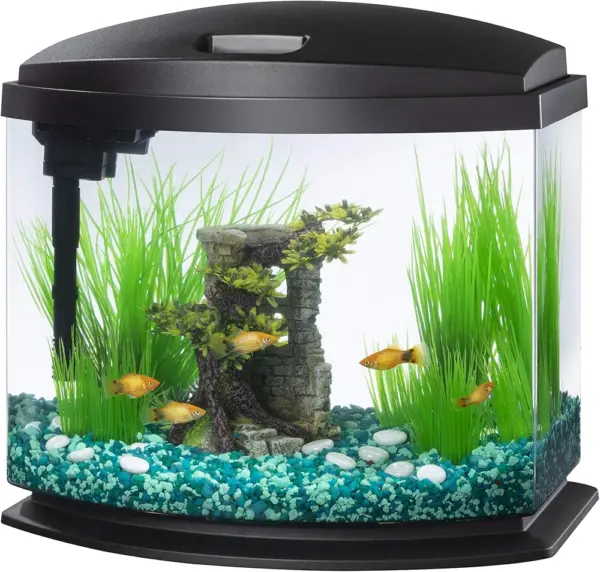
The MiniBow’s SmartClean system is the reason to look at it. The kit is designed to make a partial water change a two-minute job, and the elevated base gives the tank a finished look instead of a plastic box sitting flush on the dresser. We like that combination for a tank in a family room, where maintenance happens in the middle of everything else.
The five-gallon acrylic body is light and clear, and the kit includes the hood, power filter, cartridge, food, and water conditioner. The filter is not the gentlest; a betta may want the outflow baffled, and the tank is better for a single betta or a few small fish than a busy community. Acrylic also asks for a soft cloth, since it scratches more readily than glass.
We think the MiniBow earns its place for the person who loves the idea of a tank but dreads the bucket-and-siphon ritual. It is not a planted-tank kit, and it is not the cheapest five-gallon here, but the water-change design is a real convenience rather than a gimmick. The feeding lid is the detail that makes daily care feel easy.
Pros
- SmartClean water changes in under two minutes
- Elevated base gives a finished look
- Includes food and water conditioner
- Light, clear acrylic body
Cons
- No heater included
We like the Aqueon MiniBow for the aquarist who wants the fastest water changes and will trade some flow control for that convenience.
Tetra Cube 3 Gallon – Small Betta Cube
Key Features
- Lighting: White LED
- Dimensions: 10.31 x 11.06 x 17.5 in
- Filtration: Whisper internal filter
- Tank volume: 3 gallons
- Price: Budget
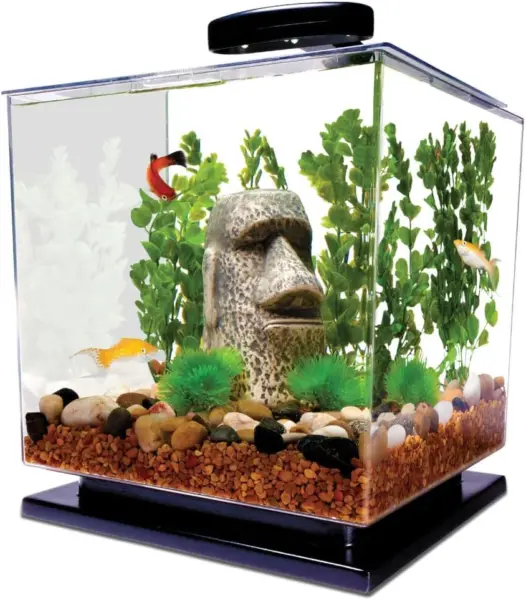
The Cube is a tall, narrow three-gallon acrylic tank on a pedestal base. At 17.5 inches high, it puts the fish at eye level on a desk without taking up much surface, and the clear canopy has a feeding hole so you are not lifting the whole top for every meal. We noticed the shape first; it looks more like a display case than a starter tank.
The white LED is a useful surprise. It is brighter and more even than the colored novelty lights on some small kits, and it makes the cube read as a proper little aquarium rather than a nightlight. The pedestal base gives it a finished look, and the clear sides keep the view open from the front and the ends.
Three gallons is a narrow brief. This is a single-betta or shrimp cube, not a community tank, and the tall shape gives a betta vertical room but not much swimming length. It suits a calm fish and an aquarist who tests water often; the water volume has little slack for overstocking or a missed change.
We think it earns a place as a desk cube for someone who wants a small, good-looking tank and accepts the maintenance. It is not the kit we choose for a child’s first community, and it is not the easiest to clean around the base. The pedestal is the detail we liked most: it makes the cube look finished instead of perched on a plastic tray.
Pros
- Bright white LED
- Tall footprint fits a desk
- Pedestal base gives it a finished look
- Clear canopy with feeding hole
Cons
- No heater included
- Filter is modest for three gallons
We keep the Tetra Cube on the list as a handsome desk tank for a single betta or shrimp, not as a first community aquarium.
How We Chose and Tested Aquarium Kits
We started by pulling together kits that were actually sold as complete systems, then narrowed the shortlist by tank volume, footprint, and what came in the box — heater, light, filter, thermometer, test kit, or none of the above. We cut anything that required a separate purchase just to run safely, and we avoided kits whose filters had no flow adjustment for smaller tanks. That left 12 kits, which we set up and ran for six months in a living room and a home office.
Setup was timed solo, with only what the manufacturer included plus a bucket and towel. We noted whether the instructions matched the parts, whether the lid and light clicked into place without wobble, and how the whole thing looked on a shelf — clean seams, even lid lines, light that flattered fish rather than tinting the room blue. For the betta-suitable kits, we watched a single betta after cycling — did it avoid the outflow, rest near the top, and have enough horizontal swimming room? We also checked lid gaps and cord cutouts for escape routes.
Once running, each kit got weekly water changes and normal feeding. We listened from three feet away in a quiet room for filter hum, rattle, or gurgle, and tracked whether that noise changed as the filter broke in. We ran lights on a timer and watched how fish colors looked, how much algae collected on the glass, and whether the lid trapped condensation. After six months, we checked seams, plastic hinges, impeller wear, and filter flow; we also priced replacement media and noted how often it needed swapping. Kits that needed constant fiddling, leaked, or felt hollow at the seams did not make the cut.
How to Choose an Aquarium Kit
The tank is the easy part to admire; the filter, heater, and light are what decide whether a kit makes fishkeeping easier or turns it into a repair project.
Start with volume and the fish you want
Choose the largest tank your space and budget allow, not the smallest that fits. A 10- or 20-gallon tank gives you more water to dilute waste and more room for a community; a 2.5- or 3-gallon nano is a betta or shrimp display and swings faster when something goes wrong. Measure the footprint and the height under any shelf. For a first community, 10 gallons is the more forgiving floor; for a single betta, five gallons is easier to keep stable than three.
Check what complete leaves out
Most kits are complete except for the heater, which is not a small omission for tropical fish. Check the included list before you buy: the Aqueon 10-gallon includes one, while the Marineland, Fluval, and NICREW kits do not. A preset heater is simpler; an adjustable one gives more control in a cool room. Budget for gravel, dechlorinator, a test kit, and a siphon, since those are often extra even when the listing says complete.
Treat the filter as the long-term cost
The included filter is the usual weak point in a starter kit. Look at the flow rate and whether replacement cartridges are easy to find; a proprietary cartridge that disappears from shelves turns a bargain into a project. Three-stage media is more flexible than a single pad, and a filter you can service without dismantling the hood is easier to live with. For a betta, choose gentle flow or a way to baffle the output.
Decide between a display light and a plant light
Colored LEDs are for the look of the tank; white LEDs are better for seeing the fish and growing low-light plants. If you want a planted aquascape, look for a high-output white light and room for substrate. The Fluval SPEC is the clear example here, while the Marineland and Tetra hoods are display lights. Start with six to eight hours on a timer; more light invites algae without helping the fish.
Plan for noise and placement
Small tanks often end up in bedrooms and offices, where a humming filter is more noticeable than it was in the store. Internal filters and air pumps are the usual culprits; a kit with a quiet pump and a solid base is worth more than an extra LED color. Put the tank on a level stand rated for the filled weight, away from direct sun and drafts. Water weighs about 8.3 pounds per gallon, so a 20-gallon setup is a two-person lift once filled.
Frequently Asked Questions
How long does it take to cycle a new aquarium before adding fish?
Plan on four to six weeks for a new filter to grow enough bacteria to handle fish waste. Test for ammonia and nitrite and wait until both read zero, then add fish a few at a time. Bottled starter bacteria can shorten the wait, but they do not replace testing.
Should I replace the filter cartridge every month?
Usually no. Rinse the cartridge or media in water you removed during a water change, not under the tap, and replace it only when it is falling apart or clogged beyond cleaning. Replacing all the media at once throws away the bacteria your tank needs. Keep a spare cartridge on hand for the day it does fail.
Can I keep a goldfish in a 10- or 20-gallon aquarium kit?
No. Common goldfish grow large and produce a lot of waste; they need a much bigger tank or pond, not a starter kit. A 10-gallon tank suits a betta or a small group of nano fish, and a 20-gallon gives a modest community room. Choose fish to fit the tank, not the other way around.
Final Verdict
We recommend the Aqueon 10-gallon starter kit as the default because it is the most complete package for a first freshwater community: glass tank, filter, heater, hood, and thermometer, with enough water volume to be forgiving. The preset heater and basic hood are the compromises, and they are easier to live with than a missing heater or a tank that is too small.
If your space is a desk, choose the NICREW for a shrimp or betta nano; if you have room for a stand and want a community, the Tetra 20 is the larger alternative. The decision turns on volume and whether a heater is in the box.