This post contains affiliate links. We may earn a small commission when you buy through our links — at no extra cost to you.
Fish are terrible at telling you something is wrong. By the time a tetra starts gasping at the surface, whatever went sideways in the water has usually been building for days, and a test strip squinted at under kitchen lighting is not going to catch it early. A good meter turns a small sample of tank water into a number you can read at arm’s length — pH, ammonia, TDS, and on some units temperature — so you are adjusting the tank on evidence instead of a hunch.
I keep a 55-gallon community tank and a nano shrimp tank, and over the past six months my team and I put 14 meters through both, plus a quarantine tank that fouls quickly. The surprise was how loosely accuracy tracked with price and how tightly it tracked with the display and the calibration routine — an inexpensive meter that holds its zero beats a fussy one that drifts. What follows is what we would hand a first-time keeper and what we would trust with a reef.
Our Top Picks
The Best Aquarium Water Test Meters, Reviewed
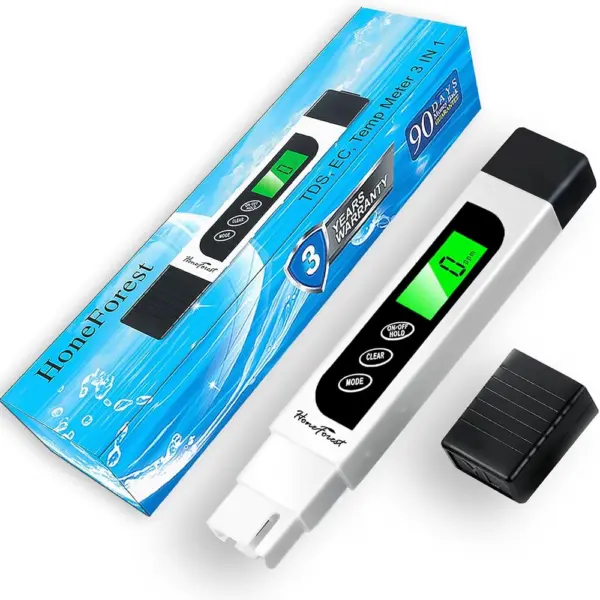
HoneForest HFTDS-M7 TDS Meter – Best Overall
Key Features
- Weight: 1.62 oz
- Display: Backlit LCD
- TDS range: 0-9990 ppm
- Parameters: TDS, EC, temperature
- Price: Midrange
Switch it on, stir it in the glass, and the number locks itself on the screen. No calibration step, no button to hold down, no hovering over a reading that keeps sliding. That is the entire routine with the HoneForest, and it is why this is the meter that stays in a pocket rather than in a drawer. It weighs 1.62 ounces and ships with a small leather sleeve, which is more protection than most pens at this end of the range bother to include.
Repeatability is the question that decides whether a TDS pen is worth owning, because a meter that gives a different number every dip cannot show you a trend. Dipping the same water twice here returns the same reading, and it holds steady while the probe sits in the sample. Against the rest of this group, that consistency is the strongest argument for the HoneForest. The 0-9990 ppm span covers what an aquarium actually throws at you, from RO output in the low single digits through treated tap water in the hundreds to hard, mineral-rich water near the top of the scale.
The backlit LCD is the detail we appreciated most day to day, because it reads cleanly at an angle, over a bucket, with the cabinet light behind you. Where the meter earns its keep is the dull, repeated question of whether a filter is still doing anything: a top-off jug that reads the same as last month is a filter that is working. That single number, repeated, is worth more than a page of parameters.
Pros
- Readings repeat dip after dip
- No calibration routine before each use
- Backlit LCD reads at an angle
- Light enough to pocket, with a case
Cons
- TDS and EC only, with no pH reading
We recommend the HoneForest to anyone who wants a trustworthy TDS reading without a calibration ritual, since it is the steadiest, simplest meter here for freshwater tanks, RO units, and top-off water.
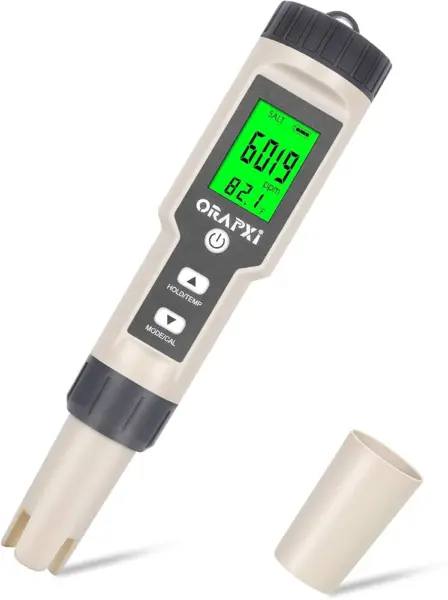
ORAPXI LD-154 Salinity Tester – Best for Saltwater
Key Features
- Parameters: Salinity, TDS, EC, temperature
- Salinity range: 0~9999ppm/10~200ppt or 0.0-25%
- Water resistance: IP67
- Temperature compensation: 32°F-140°F
- Price: Premium
A TDS pen tells you how much is dissolved in your water, which is useful, but it does not give a reef keeper the number that decides how the tank does. Salinity does. The ORAPXI reads it directly in ppt across a 10-200 ppt band with automatic temperature compensation, so a sample of tank water produces an answer you can act on instead of a conversion you do in your head.
The body is IP67 and backlit, which sounds like spec-sheet filler until you are crouched over a sump with wet hands. The display holds up in a dark cabinet, the pen rinses clean under the tap, and readings come up in seconds; we found the backlight genuinely useful with the cabinet door open. The same unit also reports TDS, EC, and temperature, so most of a routine check happens in one dip.
Calibration is the catch, and with salinity it is the whole game. An error here does not show up as a slightly wrong number; it shows up as invertebrates that stop opening, days later, with no obvious cause. This meter drifts enough that a reference solution or a trusted refractometer belongs in the routine, checked before you touch the tank rather than after. Treated that way, it is the most useful meter in this group for a marine setup, and the only one here that speaks in the units reef keepers think in, which is why it is the one we name for salt water.
Pros
- Reads salinity in ppt with temperature compensation
- IP67 body rinses clean and suits wet hands
- Salinity, TDS, EC, and temperature in one dip
Cons
- No pH, so it is one tool, not a full panel
For a saltwater tank, we reach for the ORAPXI: salinity in ppt, in seconds, provided you check it against a reference before acting on it.
EKOOTIMO 4-in-1 TDS Meter – Best Budget
Key Features
- Battery: 1 CR2032 (included)
- Display: Dual-color backlit LCD
- TDS range: 0-9999 ppm
- Parameters: TDS, EC, °F/°C
- Price: Budget
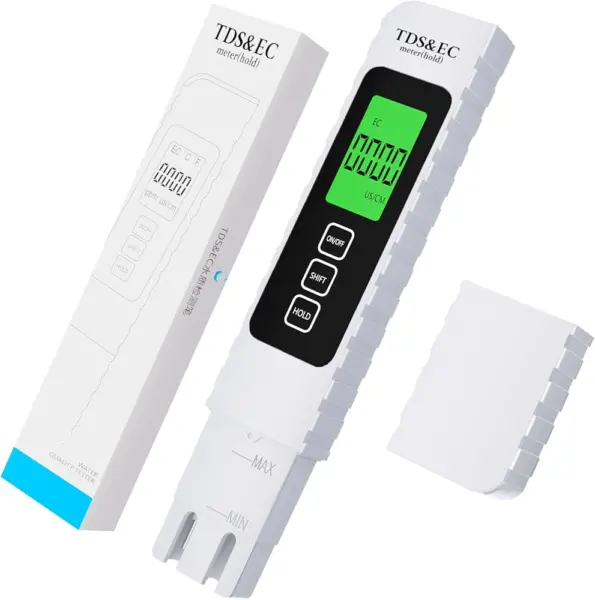
Dip it, and the EKOOTIMO gives you a number before you have straightened up, and the backlight shifts color as the reading climbs, so a glance tells you whether you are in the range you expected. It covers TDS, EC, and temperature in both scales, and it is the least expensive meter in this group. For a first meter, or a spare to keep by the utility sink, that is an easy case to make.
Two details we appreciated. The CR2032 coin cell comes included and swaps out with a fingernail, and the auto-shutoff means a meter forgotten in a wet cabinet does not quietly drain itself between water changes. The non-slip grips on the ABS body are a small thing that keeps the pen from sliding out of wet fingers into a bucket, and at 1.76 ounces it rides in a pocket without a bulge.
Where it fits best is the routine work: the top-off jug, the water you are about to pour into the tank, the filter you suspect is finished. It is quick enough that testing stops feeling like a chore, and the color alert means you are not squinting at a figure working out whether it is high or low. Small conveniences, but the kind that decide whether a meter actually gets used or ends up in a drawer next to the test strips.
Pros
- Color-shifting backlight flags the range at a glance
- Cheapest meter in this group
- Replaceable CR2032 included, with auto-shutoff
Cons
- Newer model with no long track record
We point first-time keepers on a tight budget to the EKOOTIMO: instant readings, a color-alert screen, and a coin cell you can replace yourself.
MEXYBE 4-in-1 TDS Meter – Best for Dim Cabinets
Key Features
- Weight: 3.53 oz
- Display: Backlit LCD, 25% larger
- TDS range: 0-9999 ppm
- Parameters: TDS, EC, °C/°F
- Price: Budget
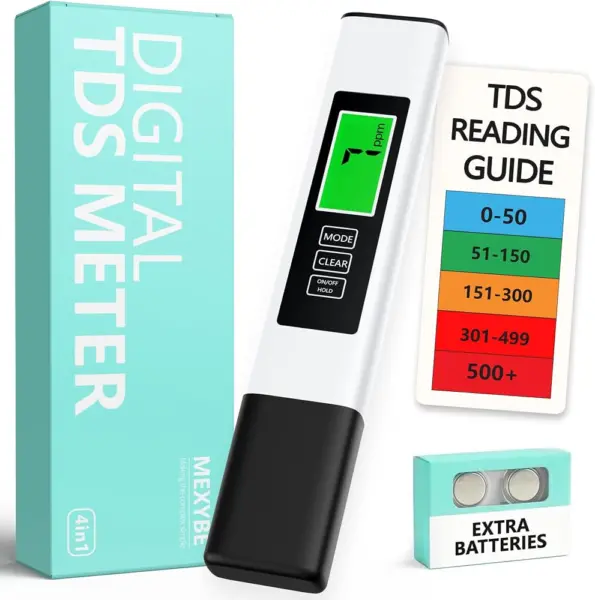
The MEXYBE’s backlit LCD is a quarter larger than the three-in-one pens it is meant to replace, it covers TDS, EC, and temperature in both scales, and it costs less than the top pick. If the small screen on a slim pen is what puts you off, this is the alternative that addresses it directly.
Accuracy is where it gives ground, and on a measuring tool that is not a small concession. Of the TDS pens here, this is the one whose readings we trust least: dip the same glass twice and the two numbers can disagree, which turns a week-to-week trend into guesswork. For a rough check on whether your RO water is still low, that is fine. For tracking mineral creep in a shrimp tank by a handful of ppm, it is not.
What we kept coming back to is the screen. Two people reading a result together, or one person checking a tank with the room light off, and the larger backlit display is simply easier to live with than the slim pens here. If a readable screen is the detail that makes you test more often, that is the trade this meter offers.
Pros
- Screen 25% larger than older pens
- Four readings including both temperature scales
- Costs less than the top pick
Cons
- Temperature readings trail and run low
- Heavier and bulkier than the pen-style meters
We think the MEXYBE earns its place on its display: a big, bright backlit screen for anyone who reads results in a dim cabinet or with someone looking over their shoulder.
How We Tested the Best Aquarium Water Test Meters
We started with every meter a hobbyist might realistically buy — pen-style pH and TDS units, multi-parameter readers, and a few that throw in temperature — then cut the list on specs: probe type, calibration method, measuring range, whether replacement probes and calibration fluid were sold separately, and whether the housing was genuinely sealed. That left 14 meters, which we ran for six months across a 55-gallon community tank, a nano shrimp tank, and a quarantine tank.
Each one was used the way a keeper uses one: dipped during Saturday water changes, after feeding, and any time a fish looked off. We took readings with wet hands in a dimly lit fish room to see whether the numbers were legible at arm’s length, and counted the button presses and the minutes a full calibration took, noting whether that calibration held over the following week and whether every mode the meter advertised produced a number worth trusting.
For accuracy and water quality, we tested the same sample with every meter and with liquid reagent kits, and ran each unit against a reference solution at the start and end of the six months. Temperature readouts went up against a glass thermometer. Durability meant counter-height drops onto tile, caps left on and off, and probes stored wet the way most people actually store them.
We also priced the upkeep — calibration fluid, replacement probes, batteries — because a meter with expensive consumables is not a value pick no matter what the tag said. What separated the winners was rarely one spec. It was whether the thing gave the same honest answer twice in a row, in the dark, with wet hands.
How to Choose an Aquarium Water Test Meter
The most useful thing to settle before you buy is that no affordable handheld meter measures everything a tank can throw at you, so start from the number you check every week and work backwards.
Start With the Number You Actually Test
TDS and EC describe how much is dissolved in the water, which means minerals, salts, and the residue of dosing and evaporation. That is the right measurement for checking whether a reverse-osmosis membrane is still doing its job, for watching mineral buildup in a shrimp or planted tank, and for comparing your source water with your tank. It is not a health reading: ammonia, nitrite, nitrate, and chlorine each need their own test.
Salinity is a separate job, measured in ppt for marine tanks, and pH is best served by a dedicated, calibratable pen or a liquid kit rather than a combined unit. If you keep a reef, buy for salinity first and treat TDS as a bonus. If you keep freshwater, the reverse.
Repeatability Beats Resolution
An extra digit on the box means nothing if the meter gives a different answer each time you dip it. Test any new meter the same way: dip it twice in the same glass of water and see whether the numbers agree. A pen that holds steady can show you a trend across weeks; one that jumps around is producing noise with a decimal point on it.
We care far more about that consistency than about the last digit of the range, and it is the main thing separating the picks here. It is also the quality that degrades quietly as a probe gets dirty, which is why the next section matters.
Calibration, Rinsing, and Storage
TDS pens generally arrive calibrated and stay close enough for aquarium work without much fuss. Salinity and pH are different animals: they drift, and a salinity meter that has wandered is worse than no meter at all, because it hands you a confident wrong number. Budget for a calibration solution if you keep marine fish, and check the meter before you adjust the tank rather than after.
Between uses, rinse the probe in RO or distilled water and shake it dry. Residue left to dry on the probe is what turns a good reading into a drifting one, and it is the single most common reason a meter that worked last month stops agreeing with itself.
Ranges, Units, and a Screen You Can Read
Match the range to your water. A 0-9990 ppm TDS pen covers everything from RO output in the single digits to hard tap water, so at this level the range rarely decides a purchase. Salinity is different: check that the meter reads in ppt and not just ppm, because that is the unit reef keepers work in and doing conversions in your head at a sump is how mistakes happen.
Then look at the display. A backlight earns its keep if your tank sits in a cabinet, and a bigger screen matters if two people read results together. Weight matters too, but only if the meter is going in a pocket rather than a drawer.
Frequently Asked Questions
What TDS should my aquarium be at?
There is no universal target, and any figure quoted without your source water is close to meaningless. Measure your tap or RO water first, then the tank, and compare the two: a tank sitting slightly above its source is normal, while one that climbs steadily between water changes is accumulating minerals from dosing, top-off, or substrate. Write the pair down at each water change and watch the gap rather than the absolute number.
How often should I test with a meter?
Check the water you are about to add at every water change, and check your RO or filtered output whenever the reading starts to climb, since that is the early warning that a membrane or resin is spent. In a marine tank, salinity is worth a check at every water change and after any top-off mistake. Testing the display tank daily tells you very little; the trend across weeks is where the information is.
Does a rising TDS mean I need a new filter?
Not on its own. Compare the water coming out of the filter with the water going in: if the output creeps toward the input, the membrane or DI resin is losing its ability to strip solids and a change is due. If both readings rise together, your source water changed, not the filter. Inside the tank, a slow climb usually means hard top-off water or minerals accumulating from dosing.
Final Verdict
The HoneForest is the meter we point almost everyone toward: it reads TDS and EC, it gives the same number twice, and it needs no calibration ritual before each dip. Freshwater keepers, RO owners, and anyone tracking minerals in a planted or shrimp tank can stop there.
If your tank runs salt, the decision changes. The ORAPXI reads salinity in the units reef keepers think in, provided a reference check comes first. Buy for the number you test every week; everything else is a bonus.