This post contains affiliate links. We may earn a small commission when you buy through our links — at no extra cost to you.
Light is the engine of a planted aquarium. It drives photosynthesis, and everything else you dose, inject, or trim gets calibrated around it, which is why the wrong fixture doesn’t fail quietly. Instead you get leggy stems, a carpet that never fills in, and algae claiming the glass within a week. I learned that the expensive way: a bargain strip turned a healthy tank cloudy green before the cycle had even finished.
The brightness figure on the box tells you almost nothing; what matters is how much usable light actually reaches the substrate, and how much of that spectrum your plants can absorb. Over the past eight months, my team and I have kept 11 fixtures running on tanks from a nano shrimp setup to a deep, CO2-injected community tank, and price turned out to be a weak predictor of which ones worked. What separated them was consistency: a timer that holds its schedule, settings that survive a power blip, and a spectrum that grows plants without feeding the algae. The picks below are the ones we’d plug in again.
Our Top Picks
The Best Lighting for Planted Aquariums, Reviewed
SEAOURA Clip-On 24/7 – Best Overall
Key Features
- CRI: 90
- Wattage: 20 W
- Fits Tanks: 12-20 in
- Lighting Control: 24/7 cycle, 10 dimming levels, 5 timer settings
- Price: Budget
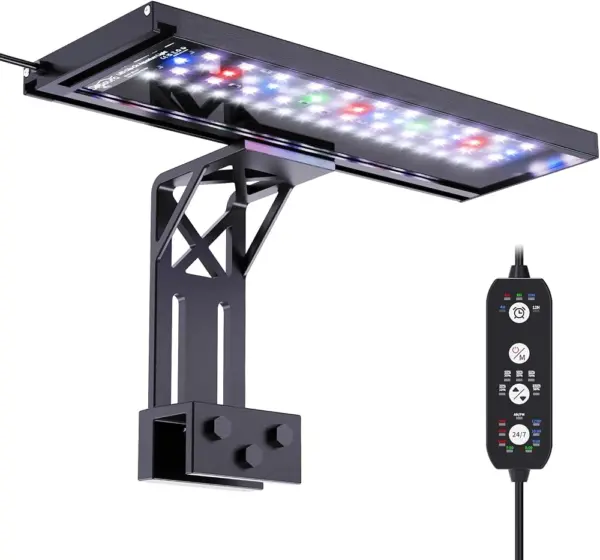
The SEAOURA’s 20-watt output and 12-to-20-inch coverage are why it is our default for a small planted tank. It pairs a full-spectrum array with a 90 CRI, ten dimming levels, five timer settings, and a 24/7 cycle. That is more control than most clip-ons here, and the practical result is that you can run a moderate midday level, soften the ramp, and bring out reds and greens without turning the tank into a light box. We also appreciate the IP68 sealing and the adjustable-height bracket; over an open aquarium, splash protection matters as much as the spectrum.
The limitation is size. At 12 to 20 inches, it is not the right light for a 24-inch 20-gallon high or a 30-inch long, and that is the main reason to look elsewhere. The slideable casing lets you shift the spread a little without moving the whole fixture, which is a small thing that makes a rimmed tank easier to live with. The 24/7 mode is the easiest path for daily use; you can leave the clock alone once it is set.
Against the Aqueon, the SEAOURA gives up a little simplicity and gains dimming, a timer, and a sealed body. Against the hygger 18W, it is the better choice for a shorter tank and the weaker one when you need 24 inches of coverage. What settles it for a small planted tank is the ability to run a moderate level and change it as the plants fill in; the extra settings earn their keep when the tank matures, not on day one.
Pros
- 20 W full-spectrum output for small planted tanks
- 90 CRI and ten dimming levels
- Five timer settings plus 24/7 cycle
- IP68-sealed body
Cons
- Timer menu takes some learning
We recommend the SEAOURA for 12-20-inch planted tanks: it gives you dimming, a 24/7 cycle, and strong color without overcomplicating the setup.
hygger 18W 24/7 – Best for 24-Inch Tanks
Key Features
- Wattage: 18 W
- LED Count: 98
- Fits Tanks: 18-24 in
- Lighting Control: 24/7 mode, 6/10/12-hour timer, 5 brightness levels
- Price: Midrange
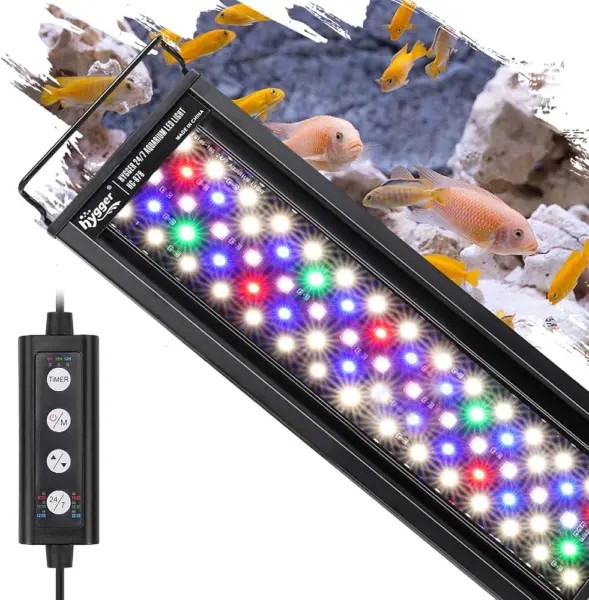
The 24/7 cycle is the center of the hygger 18W. It starts with a warm sunrise, moves into full-spectrum daylight, and finishes with a blue moonlight, all without a separate controller. For an 18-to-24-inch tank, that automatic rhythm is the feature you will notice every day, and the 98 LEDs are spread across a footprint that suits a 24-inch planted setup.
We like the five brightness levels and the three timer lengths—6, 10, or 12 hours—because they give you a way to shorten the photoperiod without giving up the sunrise and sunset. The aluminum body and two-year warranty also make this feel like a longer-term purchase than the plain plastic fixtures here. The 24/7 path is the one most people will use, and it keeps the tank on a steady rhythm without a separate outlet timer.
Where the SEAOURA is easier to fit on a shorter tank, the hygger’s extra length earns its place on a 24-inch aquarium. The 18 W output is not a blast of light; it is a sensible level for a medium planted tank, and the separate red and blue channels let you warm or cool the look. If you have a 30-inch tank, neither this nor the SEAOURA is the answer—you need a longer fixture.
Pros
- 98 LEDs spread over 18-24 inches
- 24/7 sunrise-to-moonlight cycle
- Five brightness levels and three timer lengths
- Aluminum body with two-year warranty
Cons
- Custom timer programming is fiddly
For an 18-24-inch planted tank, the hygger 18W is the bar light we recommend: 98 LEDs, a genuine 24/7 cycle, and five dimming steps.
Aqueon Clip-On Planted LED – Best Simple Setup
Key Features
- Control: 3-way soft-touch
- Tank Fit: Up to 20 gal
- LED Count: 60
- Light Output: 1,000 lumens
- Price: Midrange
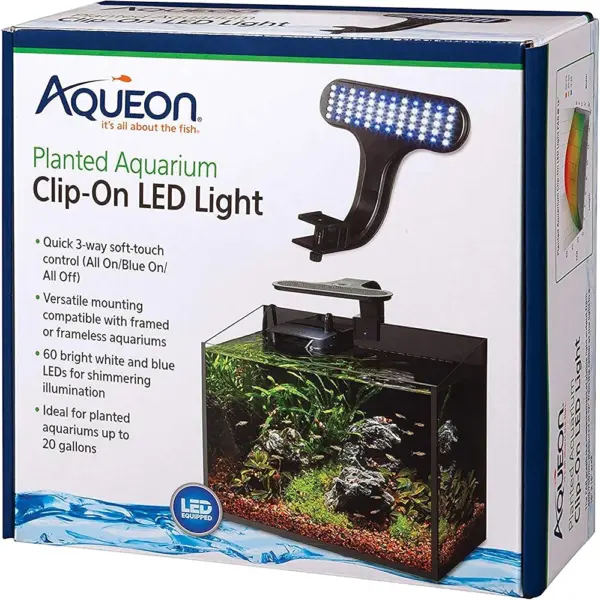
The Aqueon Clip-On is a deliberately simple fixture. Its control is a three-way soft-touch switch for all on, blue on, and all off, and the hardware is equally direct: 60 LEDs, 1,000 lumens, and a screw mount that works on framed or frameless tanks up to 20 gallons. There is no sunrise ramp or color mixing to learn. That plainness will either appeal to you or send you looking for more features.
We think the simplicity is the point. A planted tank does not need a sunrise simulation to grow well; it needs enough light and a consistent photoperiod. This fixture delivers the light, and an outlet timer handles the schedule. The fixed output is the real trade-off: you cannot dial it back for a low-light setup, which is why the SEAOURA is the more flexible choice for a tank that is still filling in.
Against the hygger 18W, the Aqueon is the simpler choice; the hygger gives you scheduling and a longer bar. Against the SEAOURA, the Aqueon gives up dimming and timer controls but keeps the installation down to one screw and one switch. The screw mount is the quiet reason it works on both framed and frameless aquariums; fewer parts to adjust means fewer things to knock out of place.
Pros
- 60 LEDs and 1,000 lumens
- Fits framed and frameless tanks
- Three-way soft-touch control
- Strong plant growth in a basic fixture
Cons
- Gets warm during long photoperiods
The Aqueon is our pick for a simple, bright clip-on over a tank up to 20 gallons; we accept the missing timer and dimmer because the mount and output are so straightforward.
hygger 14W LCD – Best for Custom Schedules
Key Features
- CRI: 89
- Wattage: 14 W
- Fits Tanks: 12-18 in
- Lighting Control: LCD controller, 8 programmable periods
- Price: Budget
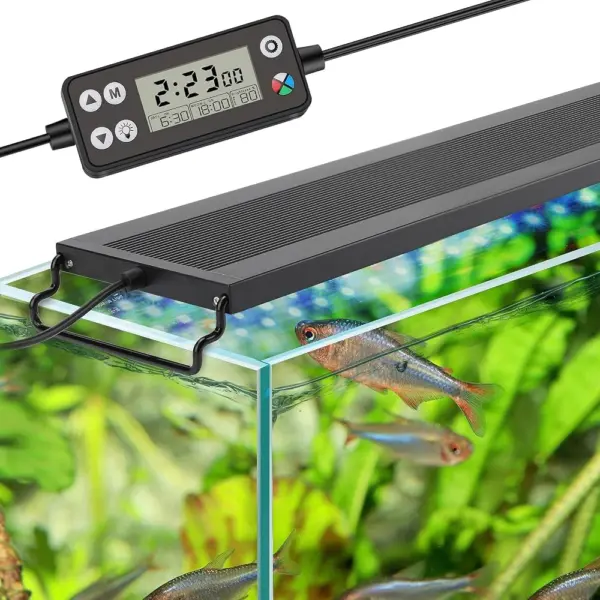
The LCD controller is the first thing to understand about the hygger 14W. It supports eight programmable periods across 24 hours, which is more scheduling power than most 12-to-18-inch planted tanks need. We think that is a real advantage for someone who wants a dawn-to-dusk ramp with a shorter midday peak, and it is the reason to choose this fixture over a simpler one.
The WRGB LEDs, 89 CRI, and 6,800 K white light give a clean full-spectrum look, and the IP68 body is sealed against splash. Over a 12-to-18-inch tank, 14 W is a sensible level rather than an overpowering one. The LCD shows the clock and the schedule, so once the program is running you can see what the light will do next without opening an app.
The reason to pick this over the SEAOURA is scheduling depth, not simplicity. If you want to run a siesta, ramp up slowly, and set a separate evening color, the eight periods are the reason to choose it. If you want a light that runs a fixed 24/7 cycle, the SEAOURA is the easier recommendation. Where it makes the most sense is a nano or 15-inch cube where you want a planted look with a controlled ramp rather than a blast of white light.
Pros
- Eight programmable periods across 24 hours
- WRGB LEDs with 89 CRI
- IP68-sealed body
- 14 W over a 12-18-inch tank
Cons
- Controller programming is slow
We recommend the hygger 14W when you want eight programmable periods and will put up with a slow controller; most buyers will find our top pick easier.
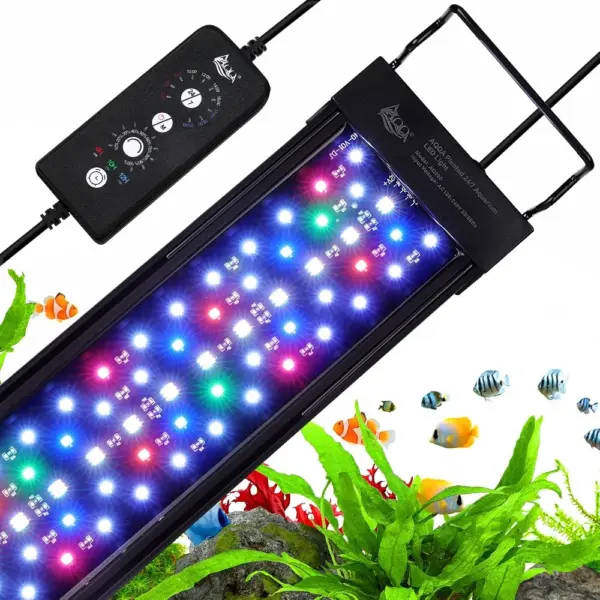
AQQA 24/7 LED – Best for Metal-Bodied Builds
Key Features
- Housing: Aluminum
- Wattage: 42 W
- Water Rating: IP68
- Lighting Modes: 24/7 and DIY
- Price: Premium
Where the SEAOURA clips onto the rim, the AQQA is a different kind of fixture: a 42 W aluminum-bodied light with a separate bracket and a choice of 24/7 or DIY control. It is the most expensive light in this group, and it reads like the premium option on paper. The question is whether the extra power and metal housing turn into a better planted tank.
The 42 W figure is the highest here, but wattage alone does not settle coverage; the fixture’s spread and your tank depth decide the result. We noted that the 24/7 mode and color options are easy to live with, and the aluminum housing has a more substantial feel than the plastic fixtures.
What we like most is the build: IP68 sealing, an aluminum shell, and a 365-day warranty. Those are the details that matter when a light sits over an open tank and gets splashed. The separate bracket also gives you more placement freedom than a clip, though it takes more room around the tank.
This is a light for someone who wants the metal-bodied, fully sealed package and will run it on a modest-size tank. The 365-day warranty is a useful safety net, but it does not answer the coverage question; measure the span before you commit. If your tank is already 24 inches, the hygger 18W is the more predictable fit.
Pros
- 42 W output, the highest here
- IP68-sealed aluminum housing
- 24/7 and DIY modes
- 365-day warranty
Cons
- Brightness can fall short on larger tanks
We recommend the AQQA when a metal-bodied, IP68 fixture with 24/7 control matters more than the broadest coverage; it is the premium build here, not the safest bet for a big tank.
How We Chose and Tested These Planted Aquarium Lights
We started with roughly 40 fixtures sold for planted tanks, researching first and then narrowing by spectrum and PAR claims, whether the mount worked on both rimmed and rimless tanks, how programmable the timer and dimming actually were, and price. That left 11 lights, which we ran for eight months.
Each light went onto a real tank in someone’s home: a nano shrimp setup on a desk, a low-tech tank in a living room that catches afternoon sun, and a deep CO2-injected community tank where light has a long way to travel before it reaches the substrate. Every fixture ran on its own timer for at least six weeks per tank. We measured usable light with a PAR meter at the surface, mid-water, and substrate level, then watched what the plants did — new growth, pearling late in the photoperiod, and whether algae showed up on the glass by week four. One fixture that looked bright on paper couldn’t push light to the bottom of the deep tank at all.
Settings and ease of use got handled the way an owner would. We programmed each timer from scratch and timed how long setup took, then unplugged every light for an hour to see whether the schedule and intensity survived. We counted the clicks it took to dim, noted whether ramp-up and ramp-down were gradual or abrupt, and judged how legible the app or onboard controls were at a glance.
Reliability played out over the full eight months: flickering, heat at the housing, water splashed near the rim during maintenance, and any LED that drifted in color or died outright. We also compared what each fixture delivered per dollar, since a light that grows plants well but runs hot and resets itself constantly isn’t a bargain.
How to Choose Lighting for a Planted Aquarium
The right planted-tank light is the one that covers your tank evenly, gives you a usable dimming range, and fits a schedule you will actually keep.
Start With Tank Length and Mounting
Measure the actual length of the tank, not the gallon label. A 20-gallon high is 24 inches long, while a 20-gallon long is 30 inches, and a fixture listed for 12-20 inches will leave the ends of a 24-inch tank dim. In this group, the SEAOURA covers 12-20 inches, the hygger 14W covers 12-18, and the hygger 18W covers 18-24. Clip mounts are convenient on open or rimless tanks; bar brackets suit tanks where you want the light to span a fixed opening. Check rim thickness and any hood before you buy, because a clip that cannot clear the frame is useless.
Read the Spectrum and Dimmer Together
A full-spectrum label tells you the fixture includes white, red, and blue LEDs, not how much useful light reaches the plants. CRI is a rough guide to how natural the colors look—90 on the SEAOURA, 89 on the hygger 14W, 85 on the hygger 18W—but it is not a plant-growth rating. Wattage is also a poor shortcut across designs: the AQQA’s 42 W is the highest here, yet output still depends on the spread and the tank. Prioritise a dimmer with several steps. It lets you keep a medium light level without moving the fixture, and it is the easiest way to respond if algae starts.
Choose the Automation You Will Actually Use
A 24/7 cycle is lovely when it works: the light ramps from sunrise to daylight to moonlight and you stop thinking about it. It is not the same as a timer, and it is not automatically easier. The SEAOURA and Aqueon show the split clearly: the former gives you five timer settings and a 24/7 mode, the latter has no timer at all and expects an outlet timer. If you like to tinker, the hygger 14W’s eight programmable periods are unusually flexible; if you do not, a simple fixture plus a plug-in timer is less frustrating. Whichever you choose, confirm the shortest preset is not longer than the photoperiod you want.
Plan for Splash, Heat, and Replacement
Aquarium lights live in a humid, splashy place, so sealing matters. IP68 is the highest rating here and appears on the SEAOURA, hygger 14W, and AQQA; the hygger 18W is listed as waterproof, while the Aqueon is a simpler clip-on that needs more care around open water. Aluminum housings generally handle heat better than thin plastic, but any fixture can run warm. Leave ventilation space under a hood, keep non-waterproof lights above the waterline, and check the warranty before you buy: hygger offers two years on the 18W, AQQA offers 365 days, and Aqueon and SEAOURA list one year.
Frequently Asked Questions
How many hours should I leave a planted aquarium light on?
Start at six to eight hours and keep the window consistent with a timer. If plants are growing well and algae stays limited, add an hour; if algae takes over, cut the photoperiod before you spend money on a new fixture. A midday siesta can help some tanks, but consistency matters more than the exact split.
Why did algae appear after I changed the light?
A new light often delivers more usable light than the old one, and the tank’s plants and algae respond to that change. Reduce intensity or shorten the photoperiod for a couple of weeks, keep up water changes, and avoid adding fertilizer until growth settles. If the fixture has a dimmer, use it rather than raising the light higher, which spreads the beam and weakens coverage at the edges.
Will brighter light upset my fish?
A sudden jump from dim to full brightness can startle fish, especially in a bare or newly set-up tank. Use a sunrise ramp or start at the lowest dimmer setting and lengthen the photoperiod gradually. If your fixture has no dimmer, an outlet timer that switches on at the same time each day is gentler than sporadic manual switching.
Final Verdict
We recommend the SEAOURA as the default for a 12-to-20-inch planted tank: its 20 W full-spectrum output, 90 CRI, ten dimming levels, and five timer settings give you more control than the simple clip-ons without adding a complicated controller. If your tank is 18 to 24 inches long, the hygger 18W is the better fit and its 24/7 cycle is easier to live with than a bare timer. For a plain 20-gallon setup where you already use an outlet timer, the Aqueon remains the straightforward choice.