This post contains affiliate links. We may earn a small commission when you buy through our links — at no extra cost to you.
Mechanical timers for aquarium lights have a reputation for loud ticking and gradual time drift that can disrupt a carefully scheduled photoperiod. Many aquarists discover within weeks that the 15-minute intervals and constant noise make them a poor fit for a quiet living room or bedroom tank.
Digital timers solve both problems with silent operation and programmable cycles, but they introduce their own trade-offs: some models offer only a single on/off schedule, while others provide multiple daily programs for daylight and moonlight phases. Integrated light fixtures with built-in timers are convenient, yet their reliability varies widely, with some failing in under a year.
The key is matching the timer type to your setup and how much tinkering you’re willing to do. A standalone digital timer with multiple programs gives you full control over any light fixture, while a fixture with a built-in 24/7 cycle offers simplicity for planted tanks. This guide breaks down the options so you can choose a solution that stays quiet and accurate for the long haul.
Top Picks
Best for Multi-Schedule Timer
DEWENWILS 3-Prong Timer
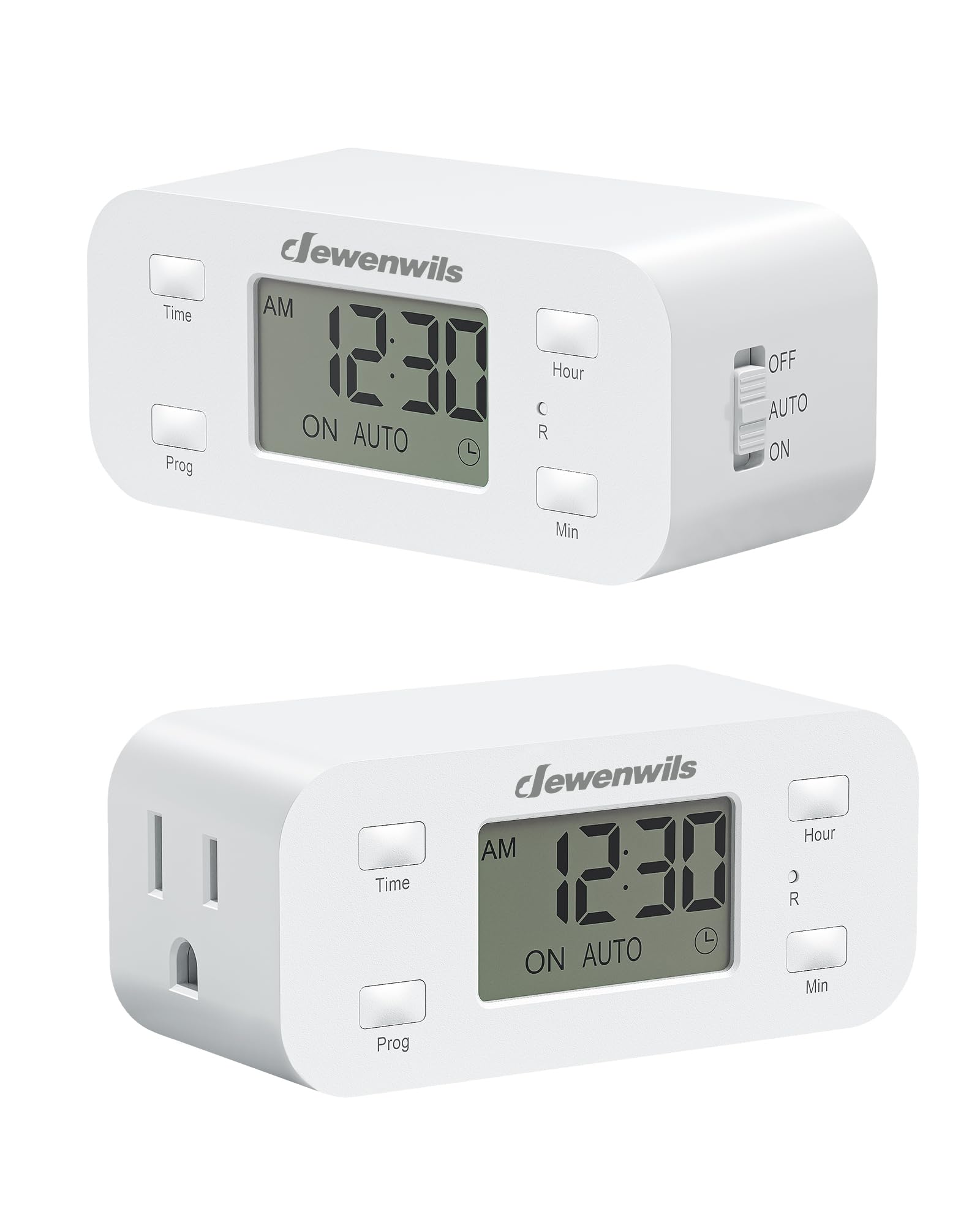
Rating: 4.5 ★ | Price: Budget | Programs per Day: 3 daily cycles | Noise Level: Quiet (digital) | Power Rating: 125V/15A/1000W | Timer Precision: Minor drift
The three programmable on/off cycles per day handle layered aquarium light schedules — morning ramp, midday break, evening moonlight — without the need for multiple single-cycle timers. Programming uses a clear LCD interface, and the switching is completely silent, making it unobtrusive in living areas where mechanical ticking would be a distraction. The battery backup retains settings through power interruptions, so the timer resumes its schedule without reprogramming.
Aquarists who need distinct daily light phases for planted or reef tanks will find this flexibility matches their routines. The grounded outlet safely supports standard aquarium loads. The trade-off is that timekeeping on some units drifts by a few seconds each day, so you may need to check and adjust the clock every few weeks — for most aquarium lighting, that slight deviation won’t affect plant or fish health.
Pros
- Three daily on/off cycles allow independent control for dawn, midday, and moonlight phases without extra hardware.
- Silent switching and intuitive programming make it unobtrusive in living spaces.
- Built-in battery backup preserves settings through power outages so the timer resumes without reprogramming.
Cons
- The small side-mounted override switch can feel finicky when toggling manually.
- Timekeeping may drift slightly, requiring periodic reset to stay accurate.
For aquariums needing more than a basic on/off cycle, this timer balances scheduling capability and budget-friendly cost — just plan on a quick clock check every few weeks.
Best for Single Schedule Quiet
Fosmon Digital Timer 2pk

Rating: 4.4 ★ | Price: Budget | Programs per Day: 1 daily cycle | Noise Level: Quiet (digital) | Power Rating: 125V/15A (ungrounded) | Timer Precision: Battery backup, some drift
Silent switching and a clear display make programming this two-pack effortless. Battery backup preserves settings during power outages. Best for aquarium setups that need a consistent daily light period without multiple phases, or for vacation lighting. Long-term behavior can vary between units – worth buying with a flexible return window.
Pros
- Quiet operation – no ticking
- Easy to program with large LCD display
Cons
- Only one on/off cycle per day – cannot support multiple daily schedules
A budget-friendly choice for single-cycle timer needs, offering silent operation and easy programming in a two-pack.
Best for Natural 24/7 Cycle
hygger 18W 24/7 LED

Rating: 4.5 ★ | Price: Mid-Range | Programs per Day: 24/7 + 3 DIY presets | Noise Level: Quiet (LED) | Power Rating: 18W | Timer Precision: Mixed reliability | Light Cycle: 24/7 natural cycle
The hygger 18W LED creates a smooth sunrise-to-moonlight cycle that mimics natural lighting, with a DIY mode offering 6-, 10-, or 12-hour presets for those who want shorter photoperiods. This integrated timer eliminates the need for a separate plug-in timer, but it trades the flexibility of a standalone unit for convenience. Best suited for hobbyists who want a natural day/night cycle without complex programming—but note that the 24/7 mode runs over 14 hours of daylight, which can promote algae growth, and power supply or LED burnouts have occurred in some units.
Pros
- Gradual sunrise and moonlight transitions create a natural day/night cycle.
- Bright, adjustable light supports planted tank growth at a mid-range price.
- DIY timer mode allows shorter photoperiods to fit specific tank needs.
Cons
- 24/7 mode may run too long for algae-prone tanks; switching to DIY mode is recommended.
- Some units experience power supply or LED failure within months of use.
A good fit for planted-tank keepers who value an automatic lighting cycle and are willing to use the DIY timer to avoid excessive light, but occasional reliability issues mean buying with a flexible return policy is wise.
Best for Nano Tank 24/7
SEAOURA 24/7 Clip-On

Rating: 4.6 ★ | Price: Mid-Range | Programs per Day: 24/7 + custom 5 timers | Noise Level: Quiet (LED) | Power Rating: 12W | Timer Precision: Reliable (early reviews) | Light Cycle: 24/7 + custom
The SEAOURA clip-on delivers a smooth 24/7 lighting cycle with adjustable brightness across ten levels — a rare feature in this size class. The clip feels solid on rimmed nano tanks, and the full-spectrum LEDs provide enough punch for low-to-moderate light plants. Compared to basic budget lights with simple on/off timers, this unit gives you natural sunrise-sunset transitions and multiple color modes without needing a separate timer.
This is a strong fit for aquarists with tanks up to 12 inches wide who want a single-device solution for a natural photoperiod. The clip bracket can feel bulky on very narrow rims, and long-term durability is still being assessed given the limited review history — but early feedback points to reliable operation for small planted setups.
Pros
- True 24/7 cycle with gradual sunrise and sunset transitions.
- Ten brightness levels allow precise tuning for plant needs.
- Sturdy clip holds securely on rimmed nano tanks.
Cons
- Bracket width may feel oversized on very narrow tank rims.
- Long-term reliability under continuous daily use is still being confirmed.
If you want a plug-and-play 24/7 timer built into a capable clip-on light for a nano planted tank, this is the most feature-rich option at a mid-range price — just verify the clip fits your rim.
Best for Programmable Plant Light
NICREW C10 Timer

Rating: 4.6 ★ | Price: Budget | Programs per Day: Custom day/night cycle | Noise Level: Quiet (LED) | Power Rating: 9W | Timer Precision: Time drift reported | Light Cycle: Custom sunrise/sunset
Separate dimming for white/red and blue channels lets you fine-tune the spectrum for plant growth without compromising color rendering. The built-in timer supports a gradual sunrise/sunset cycle, a rarity at this price point.
Planted tank keepers who want a light that combines spectrum control with a programmable timer will appreciate the value here. Timekeeping may drift over several days, so occasional resetting is needed, and the control unit sits close to the water line when mounted without a lid — a detail to plan around.
Pros
- Separate white/red and blue dimming channels for precise spectrum tuning
- Programmable timer with smooth sunrise/sunset transitions
Cons
- Control unit placement near the water line when mounted without a lid — requires careful positioning
- Time drift may accumulate over days, needing periodic adjustment
If you want a budget-friendly planted-tank light with individual channel control and a timer, the NICREW C10 delivers — just be prepared to check the clock weekly.
Best for Compact Planted Tank
hygger Clip-On 24/7

Rating: 4.5 ★ | Price: Mid-Range | Programs per Day: 24/7 + 3 DIY presets | Noise Level: Quiet (LED) | Power Rating: 14W | Timer Precision: Mixed reliability | Light Cycle: 24/7 natural cycle
The hygger Clip-On brings a 24/7 sunrise-to-moonlight cycle to small tanks in a compact, affordable package. Compared to standalone timers, this integrated light offers convenience but less flexibility if the light fails. It suits small planted tanks (5-10 gallons) where a consistent day cycle is wanted, though unit longevity can vary — some may stop functioning after a few months, so a flexible return window is advisable.
Pros
- Bright output with multiple color options suited for small tanks.
- Timer modes allow consistent day cycles (6/10/12h and 24/7).
Cons
- 24/7 mode brightness may be overwhelming for tanks under 5 gallons — no dimming option.
A practical pick for nano tank enthusiasts who want a 24/7 cycle without spending much, as long as they are comfortable with possible early unit failure.
Best for Budget Basic Timer
BN-LINK Mechanical Timer

Rating: 4.5 ★ | Price: Budget | Programs per Day: 96 intervals | Noise Level: Loud ticking | Power Rating: 1875W/15A | Timer Precision: Losses minutes/week
This mechanical timer provides simple daily on/off control for aquarium lights at a budget price. Loud ticking and gradual time drift are trade-offs to accept — it suits setups where noise and precision aren’t critical. Its bulky design may block adjacent outlets, but for a single-device schedule, it’s the cheapest way to automate a light.
Pros
- Simple mechanical dial with 15-minute intervals for easy scheduling.
- Grounded 3-prong outlet supports up to 1875W loads.
Cons
- Bulky design blocks adjacent outlet, limiting use in tight spaces.
Best for aquarium keepers on a tight budget who can place the timer away from quiet areas and accept occasional schedule resets.
Best for Compact Budget Timer
BN-LINK Compact Timer

Rating: 4.4 ★ | Price: Budget | Programs per Day: 96 intervals | Noise Level: Loud ticking | Power Rating: 1875W/15A | Timer Precision: Losses minutes/week
The BN-LINK retains the classic mechanical timer’s simplicity while freeing up the adjacent outlet with its slimmer body. It sets up quickly with 15-minute intervals. The ticking sound and gradual time drift, however, limit its fit for aquarium lighting that needs silent operation and consistent daily schedules. The dial may also lock up after extended use.
Pros
- Compact front outlet design keeps the second plug accessible.
- Simple setup with 96 scheduling segments and no programming required.
Cons
- Mechanical ticking can be noticeable in quiet rooms near an aquarium; time drift may shift the light schedule over several days.
Best suited for a utility room or garage tank where clock noise and occasional schedule resets are acceptable tradeoffs for the low price.
Best for Timer + Surge Protector
BN-LINK Timer Power Strip
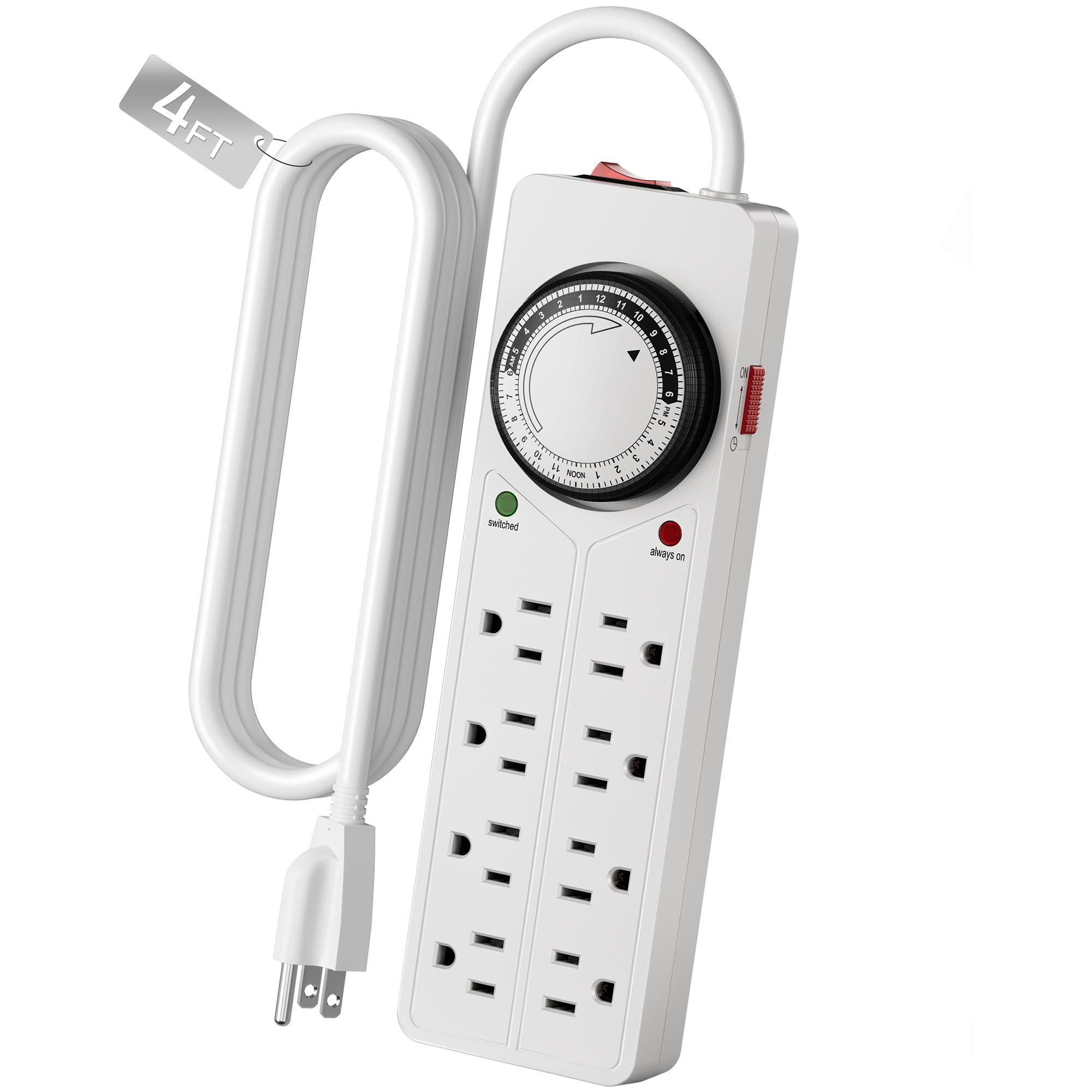
Rating: 4.4 ★ | Price: Mid-Range | Programs per Day: 96 intervals | Noise Level: Loud ticking | Power Rating: 1875W/15A | Timer Precision: Frequent failure
The BN-LINK strip combines a mechanical timer with surge protection, offering 4 timed outlets for lights and 4 always-on outlets for constant loads like filters and heaters — handy for consolidating aquarium gear. The timer can lose accuracy over time, however, so for lighting schedules that require strict consistency, pairing a separate timer with a basic power strip is a more dependable approach.
Pros
- Combines timer and surge protection in one compact unit
- Convenient layout with 4 timed outlets and 4 always-on outlets for accessories like filters and heaters
Cons
- The newer build may feel less sturdy, with a smaller, thinner plastic housing than previous versions
For temporary multi-device aquarium setups where some timer drift is acceptable, this strip offers convenience in one plug. For lighting-only needs that depend on precise timing, a separate digital timer and power strip is the safer bet.
Best for Larger Planted Tanks
hygger 978 24/7 LED

Rating: 4.5 ★ | Price: Mid-Range | Programs per Day: 24/7 + 3 DIY presets | Noise Level: Quiet (LED) | Power Rating: 18W | Timer Precision: Mixed reliability | Light Cycle: 24/7 natural cycle
Strong light output and customizable colors suit demanding planted tanks, but the timer options skip the common 8-hour photoperiod (only 6/10/12h) and the 24/7 cycle’s long daylight may encourage algae. Individual unit reliability varies.
Pros
- 24/7 cycle with gradual transitions mimics natural lighting for plant health.
- Bright RGB+full spectrum colors for vibrant plant growth.
Cons
- No 8-hour timer preset; available 6/10/12-hour options may not fit typical planted tank schedules.
Best for planted tank enthusiasts who value light intensity and color accuracy and can adapt to the limited timer durations.
Best for Single Schedule Quiet
DEWENWILS Digital 2pk

Rating: 4.4 ★ | Price: Budget | Programs per Day: 1 daily cycle | Noise Level: Quiet (digital) | Power Rating: 125V/15A (ungrounded) | Timer Precision: Battery backup, some drift
This 2-pack is simple to set, operates silently, and retains schedule settings with battery backup — a practical match for aquarium lighting that runs one daily cycle. The single on/off limit means it doesn’t support multiple periods. Some units may stop working after months of use, so keeping a flexible return option in mind is sensible.
Pros
- Very easy to program with clear LCD and straightforward buttons.
- Silent operation — no ticking — ideal near quiet aquariums.
Cons
- Only one on/off cycle per day — not suitable for multi-period schedules.
- Some units may stop working after months of use.
Best for aquarists who only need a single daily on/off schedule and want two affordable timers — unit variability makes a return-friendly purchase wise.
Best for Budget 8-Hour Option
AQUANEAT Timer Light

Rating: 4.4 ★ | Price: Budget | Programs per Day: 4/8/10h presets | Noise Level: Quiet (LED) | Power Rating: 18W | Timer Precision: Frequent failure | Light Cycle: Simple timed modes
This light offers a rare 8-hour timer cycle at a budget price — a practical choice for planted tanks needing a consistent photoperiod without spending much. However, some units may stop working within weeks or have timer issues, so it’s best for temporary setups or buyers who can accept replacement as part of the cost.
Pros
- Good brightness with five adjustable levels for different tank needs.
- Very affordable compared to other lights with built-in timer.
Cons
- Some units may stop working within a few months of use.
This is a low-cost option when the 8-hour timer is essential and you’re prepared for possible early replacement.
Best for Budget Full Spectrum
SEAOURA Full Spectrum

Rating: 4.4 ★ | Price: Budget | Programs per Day: 6/10/12h presets | Noise Level: Quiet (LED) | Power Rating: 10W | Timer Precision: Mixed reliability | Light Cycle: Simple timed modes
The SEAOURA delivers bright full-spectrum light with adjustable dimming and a built-in timer that handles daily schedules reliably at an entry-level price. Build consistency varies between units — some may experience timer issues or stop working within months, making this a better fit for low-stakes setups where occasional replacement is acceptable.
Pros
- Adjustable brightness across multiple levels for planted tanks and day/night viewing.
- Integrated timer handles 6, 10, or 12-hour cycles without extra equipment.
Cons
- Light bar may sag in the center over time due to lightweight brackets.
This light suits budget aquarists with small to medium tanks who value brightness and convenience over long-term certainty — keep a flexible return window in mind.
Best for Above-Water Only
SEAOURA Submersible

Rating: 4.5 ★ | Price: Budget | Programs per Day: 6/10/12h presets | Noise Level: Quiet (LED) | Power Rating: 5W | Timer Precision: Waterproofing fails | Light Cycle: Simple timed modes
This light delivers bright, colorful illumination and a timer that turns on and off as programmed at a low entry price. The IP68 waterproof claim doesn’t hold up — water can enter the unit when submerged, causing electrical failure. For above-water mounting on small tanks, it’s a functional budget option; for underwater installation, it’s not suited.
Pros
- Bright output with multiple color modes for visual appeal.
- Timer provides automatic 6/10/12‑hour on/off cycles.
Cons
- Water can enter the light if submerged, leading to electrical failure — use only above water.
Suitable for budget-conscious aquarists who mount lights above the tank and don’t need submersible operation.
Best for Temporary Use Only
hygger Submersible 24/7

Rating: 4.4 ★ | Price: Budget | Programs per Day: 24/7 + 3 DIY presets | Noise Level: Quiet (LED) | Power Rating: 6W | Timer Precision: Waterproofing fails | Light Cycle: 24/7 natural cycle
Hygger’s compact light delivers a smooth 24/7 natural cycle that automates lighting for small tanks. The waterproof seal has limitations, so this works best as an above-water display light rather than a submerged fixture. Some units may have a shorter lifespan, making it a budget option for those prioritizing the lighting schedule over long-term longevity.
Pros
- 24/7 natural lighting cycle automates sunrise and sunset for small tanks.
- Vibrant color options with adjustable brightness create a natural aquarium appearance.
Cons
- Suction cups may lose grip over time, causing the light to shift in position.
Best suited as a temporary above-water light for small tanks where the 24/7 cycle is the key feature and longevity is a secondary concern.
How to Choose
The most overlooked factor when buying an aquarium light timer is noise — mechanical models tick loudly enough to disturb a quiet room, while digital timers run silently but require understanding their scheduling limits.
Programs per Day
A timer with one daily cycle limits you to a single on/off period, which means you can’t have a separate moonlight phase. Timers with three or more programs allow you to schedule daylight, moonlight, and even a feeding pause. For planted tanks, this flexibility helps prevent excessive light exposure that fuels algae.
Noise Level
Mechanical timers rely on a small motor to rotate the dial, producing a constant ticking that can be heard across a room. Digital timers use electronic switching with no moving parts, making them silent. In a bedroom or living room, the ticking becomes a nuisance over time. Check if the timer is mechanical or digital before buying.
Power Handling
Aquarium lights typically draw under 100 watts, but timers must handle the load safely. Most household timers are rated for 15A (1800W), well above any single light. However, if you plan to connect multiple devices—such as a heater and filter—to a power strip timer, ensure the combined load stays within the timer’s rating. Grounded plugs (three-prong) are safer for metal-bodied lights.
Timer Precision
Mechanical timers drift several minutes per week because the synchronous motor is sensitive to line frequency. Digital timers use crystal oscillators that keep time more accurately, but budget models can still drift seconds per day. Battery backup is essential to retain settings during power outages; without it, you’ll need to reprogram after every outage.
Light Cycle
Integrated light fixtures with built-in timers often feature a 24/7 sunrise-sunset cycle that mimics natural daylight. This is convenient but locks you into a preset timing curve that may provide 14+ hours of light, promoting algae in planted tanks. Look for fixtures that offer a DIY or custom mode where you set the photoperiod length to 8-10 hours.
FAQ
Why does my aquarium light timer lose time every day?
Mechanical timers drift because the small motor’s speed varies with electrical frequency; digital timers use a quartz crystal that is far more accurate but some cheap models still have poor oscillators. For precise schedules, choose a digital timer with battery backup and check reviews for drift complaints.
Can I use a smart plug instead of a mechanical timer for my fish tank light?
Yes, smart plugs work well as long as they are rated for the light’s wattage and your Wi-Fi is reliable. However, smart plugs require an app and internet connection to set schedules, and they may lose schedules during network outages. A dedicated digital timer is simpler and more predictable for aquarium use.
How long should an aquarium light timer stay on for planted tanks?
Most planted tanks do best with 8-10 hours of light per day. Timers with multiple programs let you split this into a main photoperiod and a shorter moonlight period. Avoid 24/7 modes that run light for 14+ hours unless you have a very low-light setup.
What is the quietest timer for an aquarium light?
Digital timers are completely silent compared to mechanical timers that tick. Look for any digital plug-in timer — brands like DEWENWILS, Fosmon, and BN-LINK digital models. Avoid mechanical timers if quiet operation is a priority.