This post contains affiliate links. We may earn a small commission when you buy through our links — at no extra cost to you.
The first time I watched a patch of green fuzz creep across a prized coral, I assumed another water change would solve it. It didn’t. Phosphate was already in the system, feeding the algae, dulling color, and making every test result feel like a small defeat. A good phosphate remover pulls that nutrient out of the water column before it fuels another bloom, but the wrong one can cloud the tank, clog a reactor, or strip levels too fast.
Over eight months, I put 12 phosphate removers through their paces in a 75-gallon mixed reef and a 40-gallon soft-coral tank, watching not just the test kit number but how the tank actually looked and ran. The lesson that surprised me most: the strongest media isn’t automatically the best choice. Dose size, flow through the reactor, and how a product behaves as it exhausts matter just as much as the phosphate drop on day one. Below are the ones that earned a permanent spot in my cabinet, from gentle everyday media to heavier-duty options for stubborn algae.
Our Top Picks
The Best Phosphate Remover for Saltwater Aquariums, Reviewed
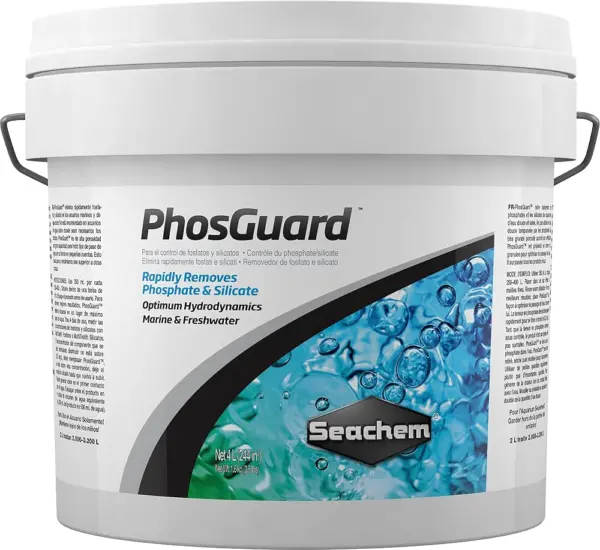
Seachem PhosGuard 4 L – Best Overall
Key Features
- Media form: Granular
- Where it goes: Reactor or media bag
- Container size: 4 L / 244 cu.in.
- Price: Premium
Phosphate trouble rarely announces itself. It shows up as a green film on the glass every morning, a tuft of hair algae on a rock that has been fine for a year, and a test result that will not move no matter how many water changes you do. PhosGuard is the product here we reach for first when that is the picture.
It earns that on two counts. It is the strongest phosphate and algae performer in this group, and it works as media sitting in flow, so it keeps pulling between water changes instead of acting once and stopping. Just as important, it stays loose: run it in a reactor and it keeps moving where granular media can pack into a brick. Media that channels is the main reason people conclude a phosphate remover does not work.
Four liters is a lot of media. On a system with a real phosphate load that is a sensible buy — you are stocked for months — but in a nano tank it is more than you will use while it is still fresh. The granules are small, so pair them with a fine-mesh bag or a reactor; a coarse bag lets them straight through into the display.
Our reservation is how long a charge lasts. It swings widely with phosphate load and with flow, and testing the water leaving the media is the only way to know where you stand. Buy it for a tank where you can give it steady flow. In a filter chamber with no through-flow it is an expensive handful of granules.
Pros
- Top phosphate and algae results in this group
- Stays fluid in a reactor instead of clumping
- 4 L container covers months of dosing
Cons
- Media life varies a lot with phosphate load
We recommend PhosGuard for a reef tank with a real algae problem and a reactor or fine bag to run it in — it is the most consistent phosphate performer here, provided you keep it in flow.
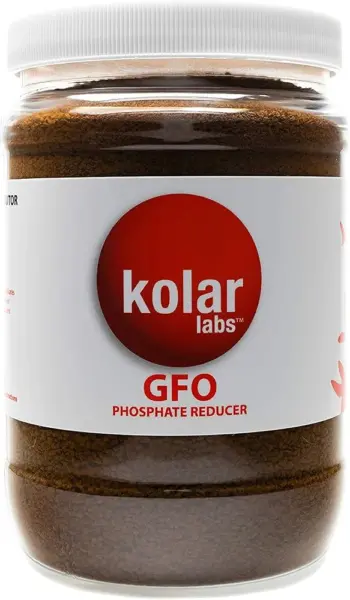
Kolar Labs GFO Bayoxide E33 – Best Gfo Media
Key Features
- Media: Bayoxide E33 GFO
- Weight: 454 g (1.1 lb)
- Placement: Reactor, filter sock, canister or cartridge
- Water type: Saltwater, freshwater and ponds
- Price: Premium
Bayoxide E33 is the part of this listing that matters. Kolar Labs sells virgin granular ferric oxide manufactured by LANXESS in Germany to drinking-water purity standards, with reduced fines — the dust that turns a first reactor charge into a brown cloud across the display. In a category where the raw material is the product, that is the specification we care about most, and it is the cleanest one here.
In use it shows up as a much shorter rinse. Granular ferric oxide has a reputation for clouding a tank before it settles, and starting with cleaner material cuts that down to a few minutes. Placement is flexible too: a reactor gives the most contact, a filter sock or canister chamber works, and a cartridge will do in a pinch, so you are not committed to buying a reactor as well.
At 454 grams it is a working quantity for a mid-sized reef rather than a bulk buy, and the price sits in premium territory because you are paying for the grade of material. The one real caution is speed: this pulls hard, and dropping phosphate too fast is what upsets corals. We prefer to run a modest charge and add to it a week later than to knock the reading down in one go. Against PhosGuard, this is the pick for a reef keeper who wants iron-based media specifically; both do the same job, and the choice comes down to how you like to run a tank.
Pros
- Ultra-pure Bayoxide E33 with reduced fines
- Rinses clean quickly with less dust
- Runs in a reactor, sock, canister or cartridge
Cons
- Premium price for a 454 g quantity
We rate Kolar Labs as the iron-based pick: ultra-pure material with fewer fines to rinse, so long as you start with a modest charge and test the next day.
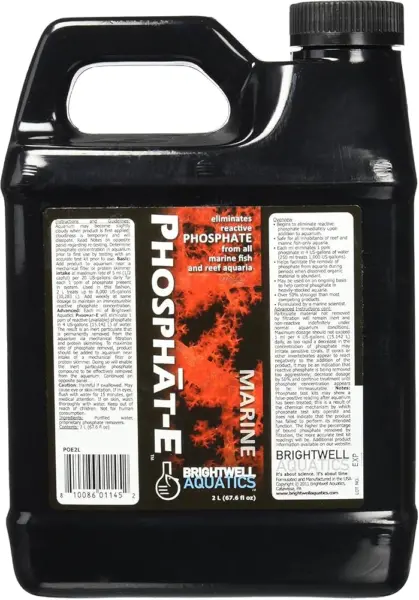
Brightwell Phosphat-E 2 L – Best for Fast Correction
Key Features
- Form: Liquid
- Volume: 2 L
- Water type: Marine
- Dosing point: Near filter or skimmer intake
- Price: Premium
There is a kind of phosphate problem that needs an answer this week: a new tank that has been overfed, a rescue system, a spike after something died in the rockwork. For that, a bag of media is the wrong tool, because it works at the speed of the water passing through it. Phosphat-E is a liquid you add near a mechanical filter or protein skimmer intake, and it goes after reactive phosphate immediately.
Two notes from the directions are worth more than the marketing copy. Your test kit can read falsely high after a dose because of the way the kit chemistry works, so do not chase the number with a second dose an hour later. And the water can go slightly cloudy for a while, which passes. Both are harmless if you know about them; either can spook you into overdosing if you do not.
Nothing else here acts as fast, and for a tank in trouble that speed is the whole point. The catch is that it asks a lot of the person dosing it. Two liters is a big bottle to be measuring out by the milliliter, and it only pays off if you test before every addition and go slowly. Dose by eye and you can overshoot, which leaves you with a worse problem than the one you started with. If measuring before each dose sounds like a chore, the top pick corrects phosphate more slowly and far more forgivingly.
Pros
- Acts on phosphate almost immediately
- Doses easily near a filter or skimmer intake
- Best tool here for a badly out-of-range system
Cons
- Requires testing and measuring before each dose
- Premium price makes it corrective, not routine
Buy Phosphat-E when a phosphate reading has run away and you want it corrected in days: it is the fastest thing here, and we only trust it to someone who tests before every dose.
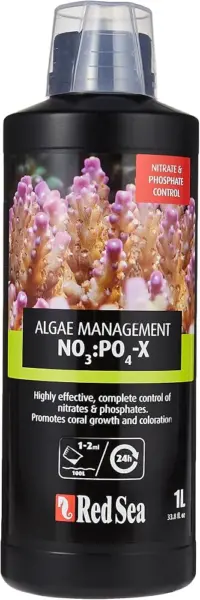
Red Sea NO3:PO4-X 1000 ml – Best for High Nitrate Too
Key Features
- Form: Liquid supplement
- Volume: 1000 ml / 1 L
- Targets: Nitrate and phosphate
- Water type: Saltwater and reef
- Price: Midrange
NOPOX is not a phosphate binder. It is a liquid carbon source that feeds the bacteria already in your tank, and those bacteria consume nitrate and phosphate as they multiply. If phosphate is your only problem, that indirectness is a drawback. If nitrate is climbing alongside it — the usual pairing in a heavily fed reef — it is the one liquid here that tackles both.
That pairing is what earns it a place, and it is also why we hesitate to hand it to a beginner. The line between a steady reduction and trouble is dose discipline: a measured amount, at the same time each day, with both nutrients tested so you can step the dose up or back. Run it that way and the numbers come down gradually, which is what corals want. Run it by eye and you are guessing with a live system.
The litre bottle lasts well at a maintenance dose, so the ongoing cost settles down once you are dialled in. Two things to sort before you start: a skimmer, because the bacterial mass this produces has to be exported, and a test routine you will actually keep. Expect the reduction to stall for a few days and then catch up. Dose on the trend, not on one reading.
Pros
- Reduces nitrate and phosphate together
- Gradual decline rather than a crash
- Economical at a maintenance dose
Cons
- Overdosing causes bacterial blooms and cloudy water
- Demands daily dosing and regular testing
We keep NOPOX for the reef where nitrate is climbing alongside phosphate; it works for someone who will hold to a measured daily dose and test both numbers.
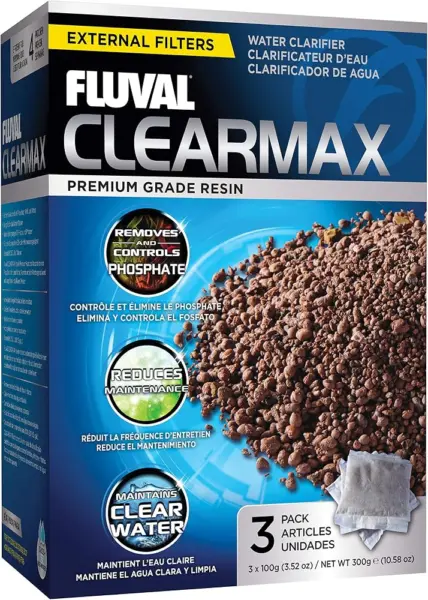
Fluval ClearMax Phosphate Remover – Best Drop-In Bags
Key Features
- Form: Bagged resin media
- Pack: Three 100 g bags
- Filter fit: Fluval 06, 07 and FX canisters
- Water type: Freshwater and saltwater
- Price: Midrange
Three pre-filled 100-gram pouches. No measuring, no rinsing a dust cloud out of a reactor, no mesh bag to hunt down — ClearMax removes almost everything that makes phosphate media a chore, and that is most of its appeal. Drop a pouch into a canister basket or a media chamber and you are done until the next one.
The pouches are resin, and Fluval rates them for phosphate, nitrite and nitrate, which makes them useful in a tank that is still settling in as well as one with an established phosphate reading. The instruction is to replace them monthly, and that is the rhythm to plan around. This is not media you leave in until you notice the algae coming back.
Two limits worth knowing. Fixed 100-gram pouches mean you scale by adding bags rather than pouring a dose, so a big system needs several at once, and a monthly swap makes this a running cost rather than a one-off purchase. The compatibility line matters less than it looks, though: because it is a bag, it will sit in any chamber with flow, Fluval canister or not. Set against a reactor charge you are trading efficiency for convenience, and for a lot of reef keepers that is the right trade.
Pros
- Pre-bagged with nothing to measure or rinse
- Sits in any media chamber with flow
- Also targets nitrite and nitrate
Cons
- Monthly replacement is an ongoing cost
- Fixed pouch size limits dosing on large systems
ClearMax is the one we hand to someone who wants phosphate control without a reactor: three ready-made pouches, a monthly swap, and nothing to measure.
Encompass All Phosphate Reducer Pad – Budget Sump Filtration
Key Features
- Form: Cut-to-fit filter pad
- Placement: Canister filter or sump
- Water type: Freshwater and marine
- Price: Budget
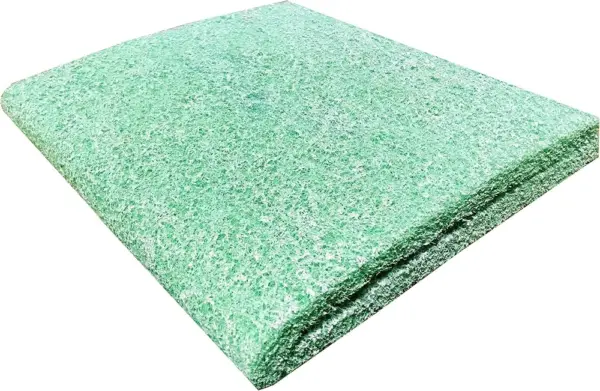
Cut-to-fit pads are how plenty of people start with phosphate control, and this is the cheapest way onto the page: one large sheet, a pair of scissors, and a slot after your mechanical filtration. It does two jobs at once, catching particles and slowly pulling phosphate as water passes through it.
Slowly is the operative word. A pad holds a limited amount of binder and only treats the water that moves through it, so expect a gentle downward trend rather than a correction. The realistic role is a pad for a tank that is already close to where it should be, or for a sump with a spare slot — not for a system with a phosphate problem you can see on the glass.
Two practical notes. Cut it slightly oversize so water has to go through the pad rather than around it, and watch pH for the first week or two of a fresh pad, because it can drift upward before it settles. Where it wins is the price of finding out: if you have never run any phosphate media and want to see what happens to your readings, this costs about as little as the experiment can.
Pros
- Cheapest route to phosphate control here
- Cut to fit almost any filter slot
- Traps debris while it works
Cons
- Slow, limited phosphate reduction
- Clogs and needs frequent changing
For a sump slot or a small filter, we see this as the low-cost way to find out whether phosphate control changes your numbers at all.
API Phos-Zorb Size 6 Pouch – Best for Canister Filter Pouches
Key Features
- Pack: One pre-dosed pouch
- Size: Size 6
- Removes: Phosphate and silicate
- Water type: Freshwater and saltwater
- Price: Budget
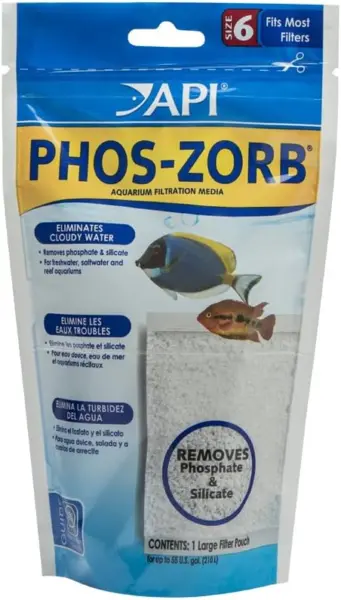
A single sealed pouch, pre-dosed, shaped for a canister chamber. Phos-Zorb is the least complicated product here, and the only real question is whether it fits. Size 6 is one specific pouch, so measure the media tray before you order: a pouch squeezed flat has water going around it instead of through it.
What we like is the second half of the label. It removes silicate as well as phosphate, and it is the only product here that names silicate at all. Silicate is what feeds diatom blooms on new sand and fresh glass, which makes this a sensible first pouch for a tank going through a new-sand phase, when the brown dust on the glass is the thing driving you mad.
In a canister it is genuinely a drop-in: rinse the pouch, lay it in the tray, close the lid. Its capacity is what one pouch of that size can hold, so test phosphate a couple of weeks in rather than assuming it is still working, and treat it as a routine purchase rather than a long-term one. On a small tank that is a fair trade. On a large system, one pouch will barely register.
Pros
- Removes silicate as well as phosphate
- Pre-dosed pouch drops into a canister
- Low cost for a small tank
Cons
- One fixed pouch size to fit
- Limited capacity for a large system
Phos-Zorb is our pick when you want one pouch, no measuring, and silicate removal thrown in — as long as the size fits your filter chamber.
D-D Rowaphos 1000 ml – Best for Large Granular Refills
Key Features
- Form: Granular media
- Volume: 1000 ml
- Container weight: 2.3 lb
- Price: Premium
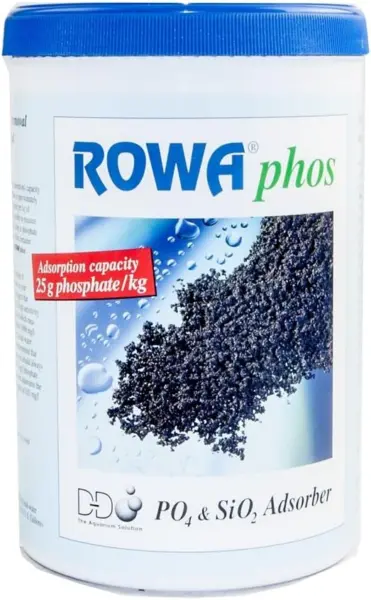
A litre of granular media against 454 grams is the comparison that matters here. Rowaphos does the same job as the other granular picks — fluidised in a reactor, or held in a fine bag with good flow, pulling phosphate out of the water column — but you get roughly twice the media for a modest step up in price.
We treat it as the bulk option rather than the beginner’s one. Media in this quantity only makes sense if you have somewhere to run it with real flow; tipped into a sump compartment with nothing moving past it, it is an expensive lump. Rinse it first, because granular phosphate media of any kind carries dust, and start with less than the full container and build up as your tests allow.
The value case is the strongest thing about it. You pay more up front than for the GFO pick and get roughly twice the media, which is the better deal if you will actually use it, and a large reef goes through a container like this in a reasonable time rather than leaving it in the cupboard. Judge replacement by testing the outflow rather than by the calendar; with granular media the number tells you more than the date does.
Pros
- About twice the media of the GFO pick
- Granular media suits a reactor or fine bag
- Good value per unit for a large reef
Cons
- Needs real flow to be worth using
- Too much media for a small tank
We point large reefs at Rowaphos: roughly twice the media of the GFO pick for a modest step up, with the same need for a reactor and a slow start.
Fluval 307/407 Phosphate Remover Pad – Best for Fluval Canister Owners
Key Features
- Pack: 6 pads
- Type: Chemical and mechanical media
- Filter fit: Fluval 306/406 and 307/407
- Water type: Freshwater and saltwater
- Price: Budget
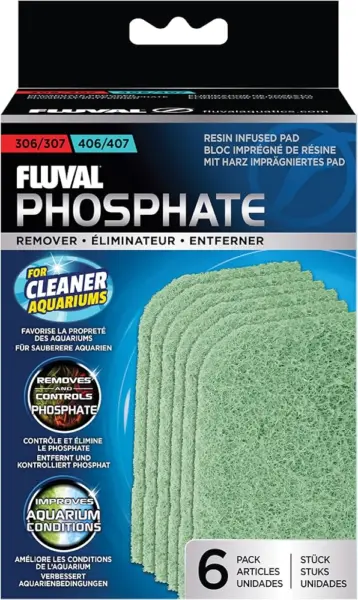
Start with the fit, because it decides everything: these six pads are cut for the media baskets in Fluval’s 306, 406, 307 and 407 canister filters. Own one of those and phosphate removal becomes a thirty-second job on cleaning day. Own anything else and there is no reason to read further.
For the right filter, we rate them as the easiest phosphate maintenance here. They are a combined mechanical and chemical pad, so they catch the debris that would otherwise drift back into the display while the phosphate binder works on the water passing through. Fluval’s monthly replacement guidance lines up with the way most people clean a canister anyway: the old pad goes out with the floss.
What they are not is a correction tool. A pad in a basket treats the water that crosses it and no more, so if your phosphate is genuinely high you want granular media somewhere with more contact time, and these alongside it. Think of them as keeping a good number good — one less thing to think about when you open the filter.
Pros
- Drops into Fluval 306/406 and 307/407 baskets
- Traps debris as well as phosphate
- Monthly swap fits routine cleaning
Cons
- Only fits specific Fluval canister models
- Little capacity for a high phosphate reading
Own a Fluval 306/406 or 307/407 and this is the least effort we have found for phosphate media; on any other filter it is simply the wrong shape.
How We Tested These Phosphate Removers
We started by reading through product labels, reef hobbyist threads, and retailer specs, then narrowed the field to media that were widely available, clearly dosed, and suitable for a home reef rather than a lab bench. We ruled out anything with vague instructions, media that arrived as a fine dust in the container, or systems that needed a dedicated pump we didn’t already own. That left 12 phosphate removers, which we tested over eight months in a 75-gallon mixed reef and a 40-gallon soft-coral tank.
Every Saturday morning, I tested phosphate with a digital checker before the weekly water change, dosed each product according to its label, then rechecked at 24 hours and again at the next water change. I logged the drop in phosphate, but I also photographed the glass, overflows, and rockwork to see whether green film and hair algae actually retreated, not just whether the number moved. Water clarity, skimmer foam, and coral polyp extension got noted too; a remover that stripped phosphate fast but left the tank cloudy or the corals sulking did not score well.
Ease of use got tested with wet hands: could I open the container, measure a dose without a cloud of dust, and rinse or load the media without instructions? We ran each product through a media reactor and, where the label allowed, a passive media bag, watching for clogged flow, channeling, caking, and any sudden cloudiness or precipitation on pump magnets and heaters. We also tracked maintenance and durability by noting how often the media needed changing, whether it broke down into fines, and whether the container resealed, while size and value came down to measuring each container’s footprint and counting how many label-strength doses it delivered.
How to Choose a Phosphate Remover for a Saltwater Aquarium
The product matters less than the format: a phosphate remover only works as well as the flow it sits in and the patience you bring to lowering the number.
Start with where you can put it
A phosphate remover is contact equipment. Water has to pass through the media for the media to do anything, which makes your filtration the first decision rather than the product. A reactor gives granular media the most contact and keeps it fluid; a canister basket or a filter sock is the next best thing; a bag dropped into a sump compartment with nothing moving past it is close to useless.
If you have no reactor and no plans for one, a pre-bagged media, a pouch or a cut-to-fit pad will do more for you than a premium granular media you cannot fluidise. Whichever route you take, check the mesh: fine granules wash straight through a coarse bag and end up in the display.
Decide whether you are treating phosphate alone
Liquid carbon dosing reduces nitrate and phosphate together, because it feeds the bacteria that consume both. In a heavily fed reef where the two numbers climb in tandem, that is a real advantage and the reason NOPOX earns a place here.
But it is a method, not a shortcut. It asks for a measured daily dose and regular testing, and it is easy to overshoot. If phosphate is the only number out of line, a dedicated binder is more direct and much harder to get wrong — and you can always add carbon dosing later.
Lower the number slowly
Corals tolerate a low phosphate reading; they tolerate a sudden drop far less well. Whatever you use, aim for a downward trend over a couple of weeks rather than a crash in an afternoon. In practice that means starting with less media or a smaller dose than you think you need, testing the next day, and building up from there.
It is also why a fast liquid and a slow pad both have a place in the cupboard. The liquid is for a system already in trouble; the pad is for keeping a number where you want it.
Price the refills, not the tub
Phosphate media is a consumable, and the container that looks expensive up front is often the cheaper way to run a reef over a year, because a litre of granular media goes a long way. The reverse is also true: a bulk container only saves you money if you will use it before it sits in the cupboard.
Estimate how much you will go through in a month, then compare what that costs across the formats. For a nano tank the small pre-bagged options usually win; for a large system with a reactor, the big granular containers do.
Frequently Asked Questions
Will a phosphate remover get rid of the algae in my tank?
Not by itself. Phosphate is the fuel, not the fire. Removing it stops new growth and starves what is already there, but the algae on your rocks has to come out by hand and a clean-up crew helps. Expect the glass to clear first and the rockwork to take a few weeks.
Keep testing while it happens. Algae consumes phosphate as it grows, so a tank with a heavy growth can post a misleadingly low reading until the algae is gone.
Can I use a pool or hot tub phosphate remover in my reef tank?
No. Pool and spa products are formulated for a completely different system, with different sanitisers, different chemistry and different safety expectations, and their dosing instructions do not transfer to a living reef.
Buy something labelled for aquarium use and check that it names saltwater. The saving on a pool product is not worth the risk to your livestock.
How do I know when the phosphate media is used up?
Test the water coming out of the media rather than only the tank. If the outflow reads the same as the display, the media has stopped working, whatever the calendar says. In a reactor that means taking a sample from the output; with a bag or pad, test the tank a day after a water change and compare.
Replace it when the number stops falling. A test kit is the only honest calendar a phosphate remover has.
Do I still need water changes if I am running a phosphate remover?
Yes. A remover buys you time between changes and keeps the number steady, but it does not replace the export of dissolved organics or the trace element replenishment a change provides.
Keep your usual schedule and let the media handle the days in between. Skipping changes because the test kit looks good is how phosphate removers end up blamed for problems they did not cause.
Final Verdict
Phosphate control is one of the few jobs in a reef tank where the boring answer is usually right: steady flow, a modest amount of media, and a test kit you actually use. Seachem PhosGuard is what we recommend for most saltwater systems, because it runs in a reactor or a fine bag, it stays fluid instead of packing solid, and phosphate and algae control are the two things it does best.
If nitrate is climbing alongside phosphate, Red Sea NOPOX is the better tool; if a reading has run away and needs correcting this week, Brightwell Phosphat-E gets there faster. Everyone else should pick the format their filtration can genuinely support, and spend the difference on a better test kit.