This post contains affiliate links. We may earn a small commission when you buy through our links — at no extra cost to you.
The algae bloom in my 20-gallon tank wasn’t the light’s fault; it was the schedule. I’d been flipping the fixture on with my morning coffee and off somewhere near bedtime, and eight hours of light had quietly turned into eleven. A light timer solves that with one outlet: the same sunrise and sunset every day, whether you’re traveling, working late, or asleep on the couch. Your fish and plants get a routine instead of your routine, and the green fuzz on the glass stops winning.
What surprised me is how much the inexpensive ones vary. A mechanical dial looks foolproof until you realize it’s drifted ten minutes over a month, or you hear it clicking from across a quiet room at midnight. We’ve kept 14 of these timers in rotation over the past five months, and the ones worth keeping share a few traits: a battery that holds the schedule through an outage, programming you can manage with wet hands, and a display you can read without a flashlight. The picks below are the ones that stayed plugged in.
Our Top Picks


The Best Aquarium Light Timers, Reviewed
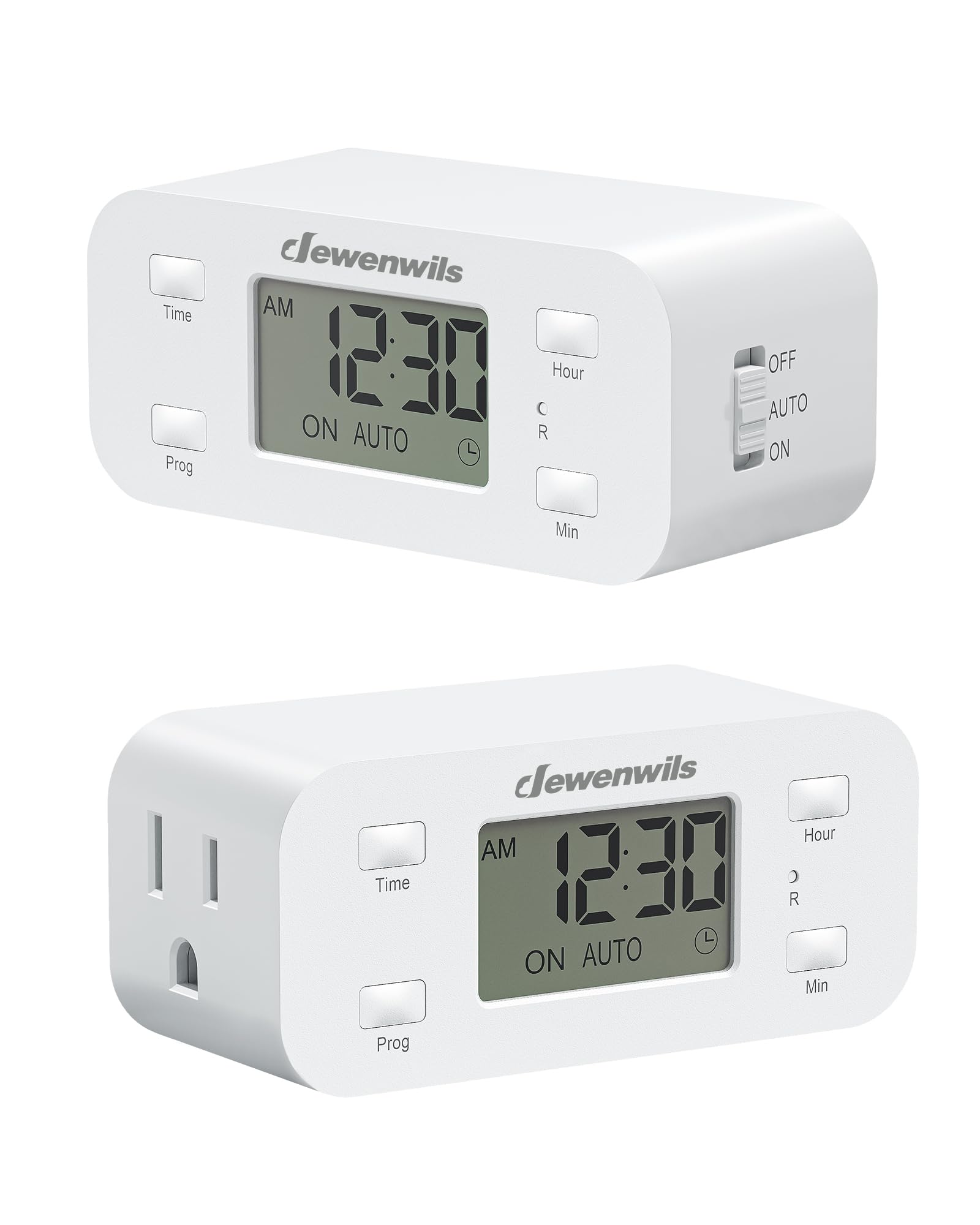
DEWENWILS 3-Program Timer – Best Overall
Key Features
- Noise: Silent
- Backup: 3 months
- Outlet: 1 three-prong
- Programs: 3 daily on/off
- Price: Midrange
The first thing we check on an aquarium timer is the plug, and this DEWENWILS gets that right: a three-prong outlet for grounded light fixtures, not a polarized slot that forces an adapter. From there, the three daily on/off programs are the reason it became our default. You can run one window for a straightforward photoperiod or split the day into two shorter windows without buying a second timer.
We used the extra programs for a morning and evening window and appreciated that the schedule repeats every day without a seven-day menu to navigate. The 3-month backup battery is the quiet hero: after an outage, the timer keeps the program instead of snapping back to a blinking 12:00. It is also silent, which matters if the tank sits in a living room or bedroom. The body is compact enough to leave the neighboring socket usable, and the three-prong outlet means one less adapter dangling behind the tank. That combination is why this is the one we recommend for most tanks.
The caveat is timekeeping: some units run a few seconds fast each day, so check the clock against your phone once a month if you run a strict photoperiod. Durability is the other unknown; some units quit within months, so test both timers during the return window rather than saving the second one for later.
Pros
- Three daily on/off programs
- Three-prong outlet fits grounded fixtures
- Holds schedule through outages
- Silent in living spaces
Cons
- One timed outlet per timer
For most aquarium lights, this is the timer we recommend: grounded, programmable in three daily windows, and quiet enough to live beside the tank.
DEWENWILS Polarized Timer – Best for Two-Prong Lights
Key Features
- Noise: Silent
- Backup: 3 months
- Outlet: 1 polarized timed
- Programs: 1 daily on/off
- Price: Midrange
If your aquarium light ends in a two-prong adapter, this is the DEWENWILS to look at first. The single polarized timed outlet accepts that plug directly, and the two-pack means you can put one on the display tank and keep the second for a quarantine or nano setup. The trade-off is built in: one timed outlet and one on/off program per day.
We like the five-button setup for a simple reason: there is less to get wrong. Set the current time, set the on time, set the off time, and the schedule repeats daily. The display is large enough to read from a step back, the timer is silent, and the backup battery holds the program for up to three months if the power drops. In a bedroom or office tank, the silence is a real upgrade over a mechanical tick.
The limitation is flexibility. There is no second program for a midday siesta, and no grounded outlet if your fixture has a three-prong plug. For a simple LED bar on a 6- to 8-hour daily window, neither matters. For a planted tank running a split photoperiod, step up to the three-program DEWENWILS. We also noted that some units can lose a minute or two over time, so glance at the clock when you do a water change.
Pros
- Fits two-prong LED adapters
- Simple daily schedule
- Silent, with 3-month backup
Cons
- One on/off program per day
- No grounded outlet
If your aquarium light uses a two-prong adapter and one daily window is enough, this simple, silent timer is the easy choice.
BN-LINK Heavy Duty Timer – Best Budget Mechanical
Key Features
- Outlet: 1 three-prong
- Control: Mechanical
- Intervals: 15 minutes
- Price: Budget
The case for this BN-LINK is the price and the simplicity of a mechanical dial: no menus, no battery to think about, and 15-minute pins that click on and off. For a fish room or a utility tank where the light is on a plain daily window, that is often all you need.
We found the 15-minute increments more useful than the 30-minute pins on cheaper mechanical timers, especially if you are tuning a photoperiod around an algae problem. The three-prong outlet fits grounded fixtures, and the heavy-duty rating gives you headroom if you ever move it to a fan or a grow light. The dial is large and the pins are easy to see, though setting a full day’s worth of pins takes a few minutes the first time.
What you give up is quiet and precise timekeeping. Mechanical timers tick, and this one can be audible in a quiet room; we keep it out of bedrooms. The clock mechanism can also drift, so check it against your phone every few weeks and adjust the dial if the light starts coming on late. Those are real trade-offs, but they buy a timer that is dead simple to set and easy to replace. Tuck it into a cabinet, check the dial monthly, and it does the job.
Pros
- 15-minute pin intervals
- Three-prong heavy-duty outlet
- No menu to learn
Cons
- Audible mechanical tick
- Clock can drift
A cheap, simple mechanical timer for a grounded light on a plain daily schedule, as long as ticking and a monthly time check don’t bother you.
G-Homa Dual-Outlet Timer – Best for Two Lights on One Schedule
Key Features
- Control: Mechanical
- Outlets: 2 grounded
- Schedule: 24-hour daily
- Price: Budget
Two grounded outlets on one timer is the whole point of this G-Homa. If you run a display light and a second fixture—say, a refugium light or a pair of matching LEDs—you can put both on the same daily schedule without adding another plug-in timer to an already crowded strip.
We appreciate the grounded outlets and the simple dial, which is easy to read without a manual. The dual outlets are the reason to choose it: one timer can run a main light and a second fixture on the same daily window. The trade-off is that both outlets share one schedule, so it is not the right pick if you want the refugium light to come on after the display light goes off.
The mechanical movement ticks, and the plugs sit close together; two chunky adapters can fight for space. Some units also stop working after a few months, so test it before you bury it behind the tank. For a simple two-light setup on a budget, though, it is a practical way to cut one timer out of the nest of cords.
Pros
- Two grounded outlets on one schedule
- Simple 24-hour dial
- Budget way to run two fixtures
Cons
- Both outlets share one schedule
- Close spacing can crowd bulky plugs
Two grounded outlets on one daily schedule make this a practical budget pick for a main light and a second fixture, with mechanical noise and close spacing as the trade-off.
Tiffcofio 2-Pack Timer – Best for Budget Backup Timers

Key Features
- Pack: 2 timers
- Outlet: 1 three-prong
- Listing: ETL
- Intervals: 30 minutes
- Price: Budget
The spare-timer drawer is a real thing in this hobby: one for the quarantine tank, one for the grow-out, one for the holiday bin. This Tiffcofio two-pack is aimed straight at that drawer. Each timer is a three-prong mechanical unit with a 24-hour dial and 30-minute pins, and the pair is budget-priced for two timers. For a hobbyist with more than one small tank, that is a useful thing to have on hand.
We like the 30-minute pins for a basic light schedule: you can set a clean on/off window without programming a digital menu, and the three-prong plug fits grounded fixtures. The timer is ETL listed, which is the minimum we want on anything plugged in near water. Two timers also let you keep one on the display tank and one on a quarantine setup without swapping cords.
The compromises are mechanical: the pins are small, the dial ticks, and the 30-minute steps are coarser than the 15-minute timers here. The build is the weak point, so check both timers as soon as they arrive. For a pair of simple tanks or a backup drawer, that is a fair exchange. Just don’t expect the quiet, precise schedule of the digital picks.
Pros
- Two three-prong timers in one pack
- 30-minute pins are easy to set
- ETL listed
Cons
- 30-minute steps are coarse
- Build quality varies
A budget two-pack for spare tanks and backup duty, with three-prong plugs and 30-minute pins; expect mechanical ticking and a coarser schedule.
How We Tested 14 Aquarium Light Timers
We started by reading through hobbyist forums and retailer listings for anything that could carry an LED fixture’s load, hold its settings without power, and actually fit next to a surge protector on a crowded shelf. From there we bought 14 timers, mixing mechanical dials with digital units and a few app-connected models, and ran them for five months.
Each timer went onto a real tank: a 20-gallon community setup in the living room that runs on a strict plant schedule, a nano tank on a bedroom nightstand, and a planted tank in a home office where the light stays on during work calls. We set every schedule against an atomic clock and checked each one weekly for drift, then pulled the plug mid-cycle to fake a power outage and see whether the schedule survived or reset itself.
Ease of use got timed, not eyeballed — I programmed each unit with the manual face-down and my hands still damp from a water change, and noted where I got stuck. At night we listened from three feet away in a quiet room, which is where the mechanical dials gave themselves away with a faint tick, and we paid attention to which displays washed out under a tank light’s glare. We also knocked each unit off a counter once and wiped it down with a damp cloth to see how it handled the humidity of a fish room.
Battery life was checked by running each timer on cells alone until the display faded, with a note on whether the settings held when it did. For the connected models, we paired them, rebooted the router, and watched whether the schedule came back on its own. Value came down to how many of those boxes a timer ticked without asking for a bigger share of the tank budget.
How to Choose an Aquarium Light Timer
The best aquarium timer is the one that holds the same on/off window every day without asking you to think about it, so start with the plug and the schedule before you look at extra features.
Match the plug before you shop
Aquarium LEDs are split between two-prong adapters and grounded three-prong cords. A polarized-only timer like the DEWENWILS Polarized Timer will not accept a grounded plug, while a three-prong model like the DEWENWILS 3-Program Timer handles grounded fixtures and many two-prong cords. Check the plug on your light, not the plug on the wall. If you are buying for a power strip, count the outlets you need and whether the timer’s body will block the next socket. The G-Homa is the pick here when two grounded fixtures need to share one schedule.
One window or several?
Most fish-only tanks need a single on/off window, and a one-program timer is simpler to set and harder to get wrong. Planted tanks and reef setups sometimes use a split photoperiod, and that is where three daily programs earn their keep. The DEWENWILS 3-Program Timer gives you three on/off pairs; the simpler DEWENWILS Polarized Timer gives you one. More programs are not automatically better, because every extra step is another thing to check when the light comes on at the wrong time.
Timekeeping and outage memory matter more than the display
A timer that gains a few minutes a week is worse than a plain switch because you stop noticing the drift. Digital models with a backup battery hold their program through short outages, which is the feature we prioritize for a tank that runs on a fixed photoperiod. Mechanical timers can be perfectly usable, but they tick and they drift, so check the dial against your phone every few weeks. If your power flickers often, spend for the memory.
Quiet and compact are real aquarium features
An aquarium often sits in the room where you relax, so a mechanical tick can be more annoying than a small display. Digital timers are silent, and compact bodies leave the neighboring outlet free for a filter or heater. If you need two lights on the same schedule, a dual-outlet mechanical timer like the G-Homa saves a plug; if you need two different schedules, use two single-outlet timers instead. The timer should disappear into the setup, not become another thing to listen to or work around.
Frequently Asked Questions
Can I use a regular lamp timer for an aquarium light?
Yes. A plug-in lamp timer does the same job as an aquarium-branded timer: it cuts power to the light on a daily schedule. Match the plug, confirm the timer is rated for the light’s wattage, and set the on/off window. If your fixture has a built-in dimmer or sunrise controller, use that instead; an external timer only switches the outlet on and off.
Can I plug a power strip or filter into the timer?
Use the timer for the light, not the whole tank. A filter and heater should stay on continuously, and a power strip on one timer can switch off equipment you meant to leave running. If you do add a second device, keep the total load under the timer’s rating. The dual-outlet G-Homa is the practical fit for two lights on one schedule, not for a filter and a light.
Why does my aquarium light come on at the wrong time?
Check the timer’s current time and AM/PM setting first; a mechanical dial is easy to set 12 hours off. Then look at the pins or program: on many timers the pins down mean on, and one wrong pin shifts the whole window. If the clock itself has reset, the backup battery is dead or the outlet is switched. Replace the battery or the timer rather than chasing the schedule.
Final Verdict
For most aquarium lights, the DEWENWILS 3-Program Timer is the one we recommend. It has the three-prong outlet that fits grounded fixtures, three daily windows for a split photoperiod, a three-month memory for outages, and silent operation.
The simpler DEWENWILS Polarized Timer is the better fit for a two-prong LED on a single daily window, and the G-Homa is the dual-outlet choice when two fixtures share one schedule. Start with the plug on your light; that decision eliminates half the list.