This post contains affiliate links. We may earn a small commission when you buy through our links — at no extra cost to you.
The wrong algae scraper doesn’t just push green film around—it can leave a permanent scratch across the pane you stare through every day. The right one lifts soft algae, waterline film, and stubborn spots without turning tank maintenance into a contortion act. It fixes the job you dread on Saturday morning: seeing your fish again without draining half the tank.
I keep a 40-gallon freshwater tank, and over four months my team tested 14 scrapers, from short-handled pads to magnetic models that work from the outside. Magnetic strength, blade sharpness, size, and whether the scraper stayed stuck to the glass separated the useful ones from the frustrating ones. The best were easy to control, resisted rust, and felt worth the money; the weak ones either slid away from the glass or made me nervous near a seam. The picks below are the ones I’d keep within reach of the tank.
Our Top Picks



The Best Aquarium Algae Scrapers, Reviewed
QANVEE 26-Inch Scraper – Best Overall
Key Features
- Head: Razor blade and brush
- Surface: Glass tanks
- Handle length: 15-20-26 inches
- Included blades: 10 stainless steel blades
- Price: Midrange
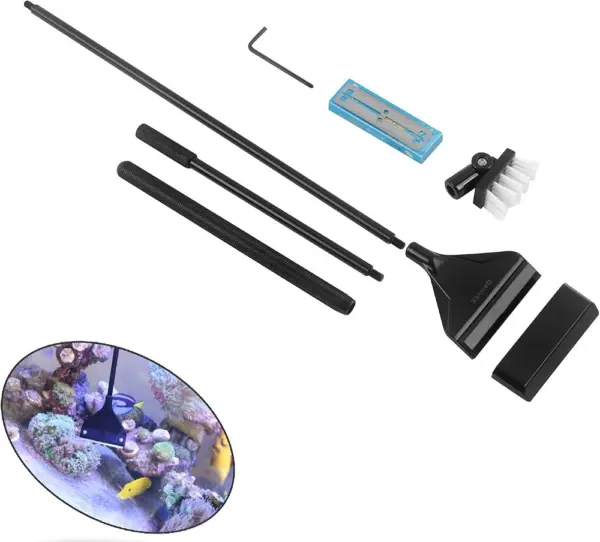
Two tools share one head on the QANVEE: a wide stainless blade for the algae that has set hard, and a brush behind it for the soft film the blade skates over. The blade also carries a plastic cover that turns the head into a gravel spatula, so you can level a sand bed without dragging a razor through it.
The blade is what sold us. Green spot algae that a pad only smears comes off glass in a single pass, and the handle threads together into three lengths — 15, 20, or 26 inches — so the bottom of a deep tank is reachable without putting your shoulder in the water. A real edge plus real reach is why this is the scraper we recommend first.
Assembly takes a couple of minutes and the whole thing breaks down again for storage. Ten replacement blades come in the box, which matters more than it sounds: a dull razor skips across algae instead of cutting it, and the instinct is to press harder, which is how glass picks up marks. Swap the blade the moment it starts skating.
The limit is the surface. This is a glass tool, and a stainless edge on acrylic is a scratch waiting to happen. On glass the edge holds up, the brush gets into the corners the blade misses, and there is not much else to want.
Pros
- Razor blade and brush on one head
- Adjusts to 15, 20, or 26 inches
- Ten stainless replacement blades included
- Blade cover doubles as a gravel spatula
Cons
- Glass only, not for acrylic
The scraper we recommend first for glass tanks: a razor and a brush on one adjustable handle, plus ten spare blades for when the edge dulls.
Aqueon Magnetic Cleaner – Best Magnetic Cleaner
Key Features
- Type: Two-piece magnetic
- Surface: Glass or acrylic
- Footprint: 1.5 x 2.25 x 3 inches
- If separated: Falls straight down
- Price: Budget
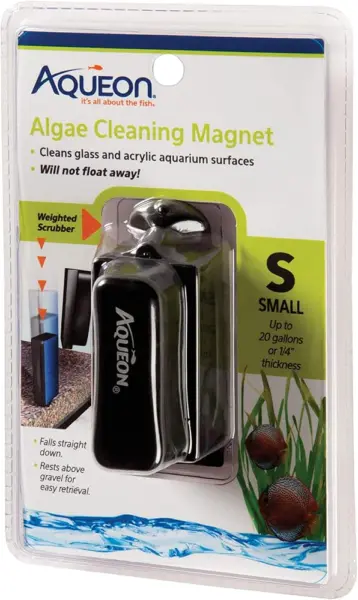
Small, cheap, and rated for both glass and acrylic, the Aqueon magnet is the tool that earns its place in the stand under a small tank. Two pieces, no blade, no handle to thread: drop the inside pad in, put the grip against the outside of the pane, and steer.
Two design details do the work. The pad is curved, so it keeps contact across a bow-front instead of rocking on the high point. And the inside half is weighted to fall straight down rather than drift, so when the halves let go you know exactly where to reach.
We rate the grip as good rather than great. It holds through ordinary glass and the curved pad does not wander once it is seated, but getting it back into position after a separation takes patience, and the small version covers ground slowly on anything past a 40-gallon breeder. For weekly film on a nano or a mid-size tank, that is a fair trade.
It is rated for acrylic as well as glass, which is rarer here than it should be — the API pad scraper is the only other acrylic-safe option in this group. Keep the pad clean either way, because grit caught under a magnet is the usual reason a pane picks up a scratch.
Pros
- Works on glass and acrylic
- Curved pad follows bow-front glass
- Weighted pad drops where you lost it
- Inexpensive enough to own two
Cons
- Takes patience to reseat after a slip
We recommend it as the everyday magnet: inexpensive, safe on glass or acrylic, and small enough to work the corners of a nano.
API Acrylic Scraper – Best for Acrylic Tanks
Key Features
- Head: Scrubbing pad
- Handle: 18 inches
- Surface: Acrylic only
- Price: Midrange
Acrylic is the reason this scraper exists. A razor clears glass faster than anything and ruins acrylic the moment it touches, so API builds this one around a thick scrubbing pad on an 18-inch handle and labels it acrylic only. If that is your tank, this is the one we point you to.
The pad is the trade-off. It lifts soft algae in a couple of passes, but a spot that has set needs pressure and repetition rather than a single cut, so a job that takes one stroke with a blade takes several here. The long handle makes that easier to live with — you are working from above the tank instead of leaning over the rim.
Eighteen inches reaches the bottom of most standard tanks and runs short on a deep one, because the handle does not extend. The head is the other half of it: bulky in a small cube, undersized on a wide pane, so it suits the middle of the size range better than either end. The Aqueon magnet is the easier weekly tool for acrylic; this is the one to reach for when a patch has had time to settle.
Pros
- Pad will not gouge acrylic
- 18-inch handle keeps arms dry
- Holds pressure on set patches
Cons
- Takes several passes on tough algae
If your tank is acrylic, this is the scraper we point you to — no blade, no gouging, just a pad that asks for some patience.
hygger Magnetic Cleaner – Best for Thick Glass
Key Features
- Blades: Metal and plastic
- Surface: Glass only
- Retrieval: Floats when detached
- Glass thickness: 1/5 to 3/8 inch
- Price: Premium
Three-eighths of an inch is thick glass, and it is where a lot of magnetic cleaners stop working. The hygger is rated for panes from 1/5 to 3/8 inch, which puts it in range of the big braced tanks where a small magnet slides instead of gripping.
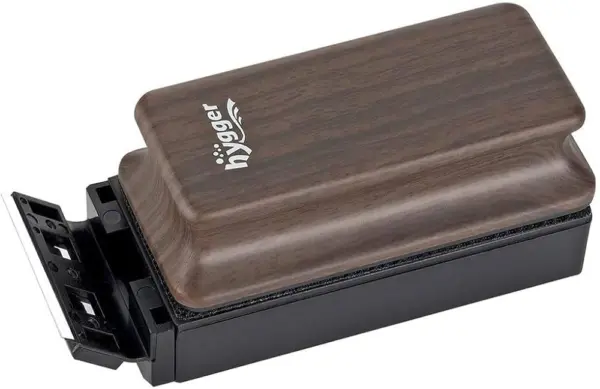
It floats, too. Take the outside grip away and the inside half rises to the surface, so a separation costs you a scoop rather than a search along the substrate. Two blades come in the box — metal for freshwater, plastic for saltwater — and they clip on without tools.
We think the price is fair for the problem it solves. The wood-look grip is a more pleasant thing to hold than the plain plastic on cheaper magnets, it does not look out of place beside a living-room tank, and the magnet has enough bite to keep the pad flat through heavy glass.
The risk with any magnet is grit. A grain of sand caught under the pad gets dragged the length of the pane and leaves a trail behind it, so lift the inside half out and check it before you start, particularly after you have disturbed the substrate. The scraper blade is best saved for the hard spots you can see.
Pros
- Rated for glass up to 3/8 inch
- Inside half floats for retrieval
- Metal and plastic blades included
- Wood-look grip is comfortable
Cons
- Glass only, no acrylic
- Costs more than most of the set
We suggest it for thick glass on a big tank, where its 3/8-inch rating and floating inside half genuinely change what you can reach.
HOTOOLME 25.6-Inch Scraper – Best Budget for Deep Tanks
Key Features
- Surface: Glass
- Max reach: 65 cm
- Handle sections: 2 extension rods
- Included blades: 10 blades
- Price: Budget
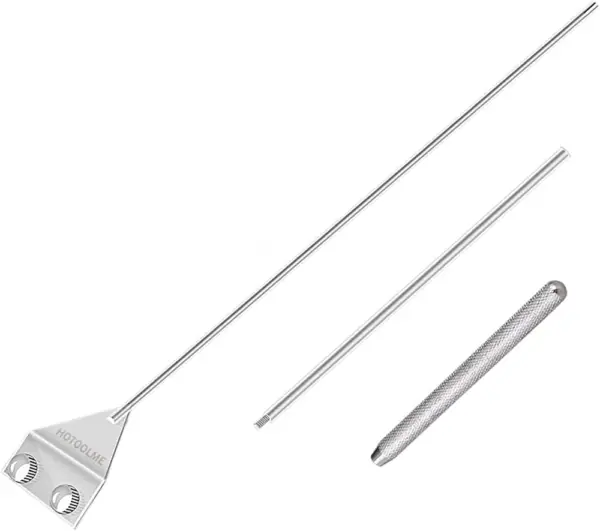
Two extension rods take the HOTOOLME out to 65 cm, which is enough to stand on the floor and reach the bottom of a 180-gallon tank. It is one of the least expensive ways here to buy that much reach, which is why we keep it as the answer to the deep-tank question.
Reach is the whole purchase, and it delivers. The sections screw together into a rigid handle that does not flex when you lean on it, and the hollow blade head lets water pass through instead of pushing back at you. On a tall tank it beats a magnet, which is really only useful for the top third of the glass.
Steel is where it asks for care. Rust is what kills scrapers like this, and it is a storage problem rather than a design one: dry the handle and the blade after every use and the tool keeps going. The ten spare blades mean you can retire a dull edge instead of forcing it, and the blade is genuinely sharp once the head is off, so it wants a drawer of its own rather than a bucket with other gear.
Pros
- Extends to 65 cm for deep tanks
- Ten spare blades included
- Hollow head cuts drag
- Rigid when fully assembled
Cons
- Glass only, not for acrylic
The budget answer for a deep tank: 65 cm of reach, ten blades, and a rigid handle for less than most of the magnets here.
DaToo Mini Magnetic – Best for Nano Tanks
Key Features
- Pads: Soft and abrasive sides
- Size: 4.5 x 2.1 inches
- Magnet: N38 NdFeB
- Surface: Glass
- Price: Budget
Four and a half inches is the whole idea. In a five- or ten-gallon nano the DaToo turns inside the corners and slips behind plants where a full-size magnet wedges, and the N38 magnet is more than enough for the thin glass those tanks are built from. It is the magnetic cleaner we reach for on small tanks.
The inside half carries two pads: a soft non-woven side for the film that appears between water changes, and a more abrasive side for green that has started to set. The shell is ABS rather than the brittle plastic on cheap magnets, the warranty runs a year, and the outside half is small enough to park on the tank frame between passes.
Small has a cost. On a four-foot tank you are making a lot of short passes, and on thick glass the magnet will not have the bite it does on a nano. Rated for glass only, so an acrylic cube wants the Aqueon instead.
Pros
- Fits between plants in a nano
- Strong N38 magnet for thin glass
- Two pad grades on one head
- One-year warranty
Cons
- Glass only, not acrylic
- Slow on tanks much wider than it
We keep it on the list for nano tanks: four and a half inches of strong magnet that reaches where full-size tools cannot.
API Glass Scraper – Best Long-Handle Scrubber
Key Features
- Head: Thick scrubbing pad
- Handle: Extra-long
- Surface: Glass only
- Price: Budget
There is no blade on this one — just a thick, rounded pad on a long handle. That is the appeal if you prefer not to run a steel edge along your silicone seams, and it makes this the simplest tool in the group to pick up and use.
For soft green film on a mid-size glass tank, we think it is the easiest thing here to live with: wet the pad, work the pane in overlapping strokes, and your hands stay dry the whole time. The pad is thick and firm, so it holds its shape under pressure instead of folding over and skipping.
Its shape is the limitation. The head is bulky for a five- or ten-gallon tank — it fills a corner and cannot get under the rim — and on a very wide tank it covers ground slowly. The handle does not extend, so on a tall tank you clean the top comfortably and stretch for the bottom.
It also will not touch anything crusted. Green spot that has been on the glass for a month needs an edge, and no amount of pressure on a pad substitutes for one. That is a job for the QANVEE or the HOTOOLME, not for a firmer hand.
Pros
- Long handle keeps hands out of the water
- Firm pad holds up under pressure
- No blade near silicone seams
- Simple to rinse and store
Cons
- Bulky head in small tanks
- Cannot remove crusted algae
We recommend it for soft film on a mid-size glass tank, where a firm pad and a long handle beat a blade most weeks.
Flipper Nano Cleaner – Best for Small Glass Tanks
Key Features
- Design: 2-in-1 scrub and scrape
- Retrieval: Floats when detached
- Tank size: Up to 25 gallons
- Glass thickness: Up to 1/4 inch
- Price: Premium
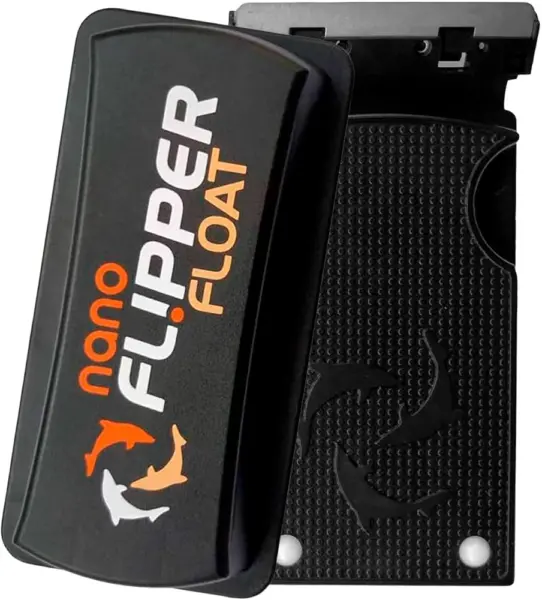
The flip is the whole idea: a push on the outside handle rotates the inside pad, so you scrub a pane and then swing the stainless blade into position without breaking contact or putting your hand in the tank.
It is rated for glass up to a quarter inch or tanks up to 25 gallons, and the blade side rests on three contact points that hold the edge slightly off the glass — a good detail on a small tank, where the blade works close to the substrate and there is grit about. The inside half is designed to float if the halves separate.
We like it most as a second tool. On a nano it is genuinely quick, a few minutes for the front pane, and the flip removes the reach-in that makes people skip the job altogether. The hold is what decides whether a magnet earns its place, though, and on glass thicker than the rated quarter inch this small Flipper struggles.
It is also the most expensive tool here by a clear margin, which is fair for the mechanism and less fair for the coverage. On a nano, the DaToo does much the same work for a fraction of the money.
Pros
- Flips between scrub and scrape
- Three contact points reduce trapped grit
- Floats if the halves separate
- Quick on a nano
Cons
- Rated only to 1/4 inch and 25 gallons
- Most expensive here by a margin
We see it as a second tool for a small tank, where the flip saves a reach-in and the quarter-inch rating still applies.
Kirecoo 25.6-Inch Scraper – Best for Corner and Edges
Key Features
- Head: Right-angle scraper head
- Surface: Glass
- Max length: 25.6 inches
- Included blades: 10 blades
- Price: Budget
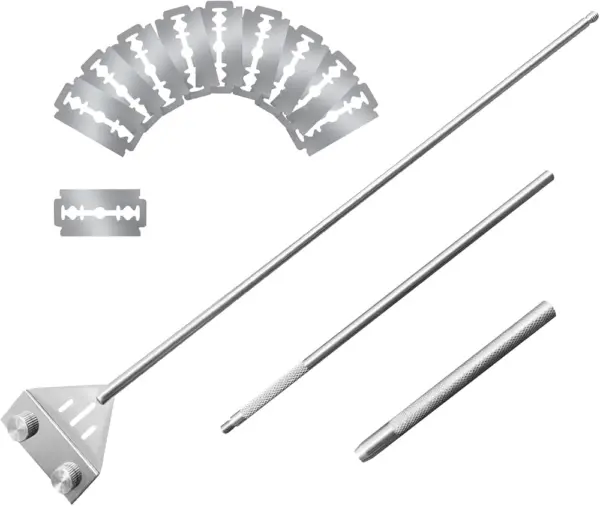
The head sits at a right angle to the handle, which sounds like a small thing until you are clearing the seam where the front pane meets the side. It lies flat against the glass and works up into the corner instead of stopping short of it, and that is the reason we kept this one in the list.
The rest is a standard long-handle scraper done well: stainless sections that screw together to 25.6 inches, a hollow head that lets water through, ten blades in the box, and an assembly you can break down without tools. At just under eight ounces it is light enough to work one-handed at full extension.
Two things to watch. The blade plate is held by small screws, and if they work loose the head stops cutting — check them when you change a blade. And like every steel scraper here it wants drying before it goes into a cabinet; stored wet, it rusts.
Pros
- Right-angle head works into corners
- Ten blades included
- Tool-free assembly and teardown
Cons
- Blade plate screws can work loose
- Rusts if stored wet
We like it for the corners: the right-angle head gets into the seam most long-handled scrapers skate straight past.
How We Tested the Aquarium Algae Scrapers
We started by pulling together scrapers sold for both glass and acrylic tanks, then cut the list to 14 models that represented the range of sizes, handle styles, blade materials, and magnetic designs shoppers actually compare. Every scraper spent four months in rotation on my 40-gallon freshwater tank and a colleague’s 75-gallon saltwater tank. We used them during Saturday water changes, after feeding when film showed on the front pane, and along the gravel line where algae likes to gather.
For magnetic models, we noted whether the outside magnet held onto the inside one through thick glass, whether it slipped during turns, and whether it stayed put when we paused. We also checked size against real tank jobs—reaching the back corner, slipping between plants, and cleaning close to the substrate without scraping up gravel. On acrylic tanks, we looked for scratches after every pass and watched whether a blade caught the silicone seams.
Effectiveness came down to passes: we pressed each blade or pad against the same patch of green spot algae and counted how many strokes it took to clear it, noting whether soft algae lifted or just smeared. Blades had to feel sharp enough to catch dried spots at the waterline, and we checked for rust after repeated dunkings and storage in wet hands. At the end, we asked whether each scraper was easy to steer one-handed, simple to rinse, and solid enough that we’d buy it again with our own money.
How to Choose an Aquarium Algae Scraper
The scraper has to match the tank rather than the other way around: the surface you own decides whether a blade is allowed anywhere near it, and the depth of the tank decides whether a handle beats a magnet.
Match the Scraper to the Surface
Glass and acrylic are not interchangeable, and it shows up at the tool. A stainless razor lifts hard algae off glass in one pass and etches acrylic the moment it touches; a firm pad is slower on glass and the only safe choice on acrylic. So start here: if the tank is acrylic, shop only within the acrylic-safe group — the API pad scraper, or a magnet rated for both surfaces like the Aqueon.
The trap is that glass-only and acrylic-safe tools look almost identical on a shelf, and a scraper sold for glass is not a gentler version for acrylic. It is the wrong tool. Check the stated surface before anything else on the listing.
Reach: Handles Versus Magnets
A magnet only cleans where your arm can carry it over the rim; below that the angle goes awkward and the inside pad loses contact. A handle trades maneuverability for depth. Adjustable handles here run from 15 to 26 inches, and one reaches 65 cm. Measure from the rim to the bottom — a 24-inch-deep tank wants most of a 26-inch handle.
In a 10-gallon tank the same handle is a nuisance, and a 4.5-inch magnet is faster. Buy the reach the tank needs, not the longest handle in the listing.
Glass Thickness and Magnet Grip
Thickness ratings are the specification most people skip and the one that decides whether a magnet works. The hygger is rated for 1/5 to 3/8 inch glass; the Flipper Nano for a quarter inch or 25 gallons. Buy under your glass thickness and the inside half slides, then drops.
Retrieval design matters too: the Aqueon’s inside half is weighted to drop straight down so you know where to reach, while the hygger and Flipper float to the surface. Both beat hunting along the substrate for a pad that drifted.
Blades, Pads, and What Wears Out
A razor is a consumable. A dull edge skips over algae instead of cutting it, and pressing harder is how glass picks up marks. Kits that ship with ten blades — the QANVEE, HOTOOLME and Kirecoo — let you swap the edge rather than force it, and that alone is worth choosing them over a single-blade tool.
Pads wear more slowly but hold grit, so rinse them after every use. Dry anything steel before it goes into a cabinet: rust is what kills long-handled scrapers, and it is entirely a storage problem.
Frequently Asked Questions
How often should I scrape the glass?
Weekly, before algae hardens. Soft green film comes off with a pad in about a minute; green spot that has sat for a month needs a blade and firm pressure. A quick pass at every water change keeps you in the first situation rather than the second.
Can I leave a magnetic cleaner in the tank between uses?
Don’t. The pad grows its own film and collects grit, and grit is what marks glass. Take both halves out after each session, rinse the inside pad under the tap, and let them dry separately before they go back on the tank.
Do I need a different scraper for a saltwater tank?
Sometimes, for the blade. Saltwater grows coralline algae that only an edge will lift, and steel left wet in a reef tank rusts. The hygger ships a plastic blade alongside its metal one for exactly that reason. Whatever you use, dry the steel after every session.
Final Verdict
The QANVEE is the scraper we recommend for most glass tanks: a razor for the spots a pad cannot touch, a brush for the film the razor leaves behind, and enough handle to keep your shoulder dry. Acrylic owners should take the API pad scraper instead — no blade, no gouging, and more patience required.
If you want the job done from outside the water, the Aqueon magnet handles weekly film on either surface for very little money. Match the tool to your surface and your reach, and everything after that is technique.