This post contains affiliate links. We may earn a small commission when you buy through our links — at no extra cost to you.
Setting up a saltwater tank is exciting, but the equipment choices can be overwhelming. Many budget-friendly options look good on paper but start failing after just a few months—pumps seize, filters leak, and calibrations drift.
The key is knowing where to invest your money for long-term reliability. A quality refractometer and a solid RO/DI system are non-negotiable, while UV sterilizers and wave makers often require a more careful hand.
This guide cuts through the noise to highlight the gear that actually delivers consistent performance, so you can focus on your fish and corals instead of replacing broken hardware.
Top Picks
Best for Daily Salinity Checks
Agriculture Solutions Salinity Refractometer

Rating: 4.6 ★ | Price: $ | Accuracy: ±1 PPT, ATC | Reliability: Recalibrate before use | Ease of Use: Easy, dual scale
The Agriculture Solutions refractometer delivers salinity readings accurate to within 1 PPT thanks to automatic temperature compensation (ATC) and a sharp dual scale. No more squinting at a bobbing hydrometer—sample application takes seconds, and the focus ring brings numbers into crisp view. The chromium body feels durable, and the included hard case protects it in storage. The dual PPT and specific gravity scale eliminates conversion tables, making it fast to use.
The one tradeoff: calibration can drift, so a distilled-water zero-check is needed before each use—a 30-second ritual that becomes second nature. For hobbyists graduating from a swing-arm hydrometer or needing a reliable travel refractometer, this sub-$20 tool hits the sweet spot. In low light, the reticle may be harder to read, but under typical tank illumination, it’s clear. It’s not a digital lab instrument, but it matches the accuracy most reef keepers need for daily checks.
Pros
- Accurate enough to replace a digital meter for daily checks.
- Clear dual scale and straightforward focus ring make readings quick.
- Costs less than a single hydrometer replacement yet lasts years.
Cons
- Scale markings can be hard to read under dim aquarium lighting.
- Calibration drifts between uses; a distilled-water zero-check is needed each session.
If you’re building a saltwater setup on a budget or want a grab-and-go backup, this refractometer delivers lab-level accuracy for the price of a few hydrometer replacements—as long as you make the 30-second calibration check a habit.
Best for Pure Water for Reefs
Aquatic Life RO Buddie 4-Stage
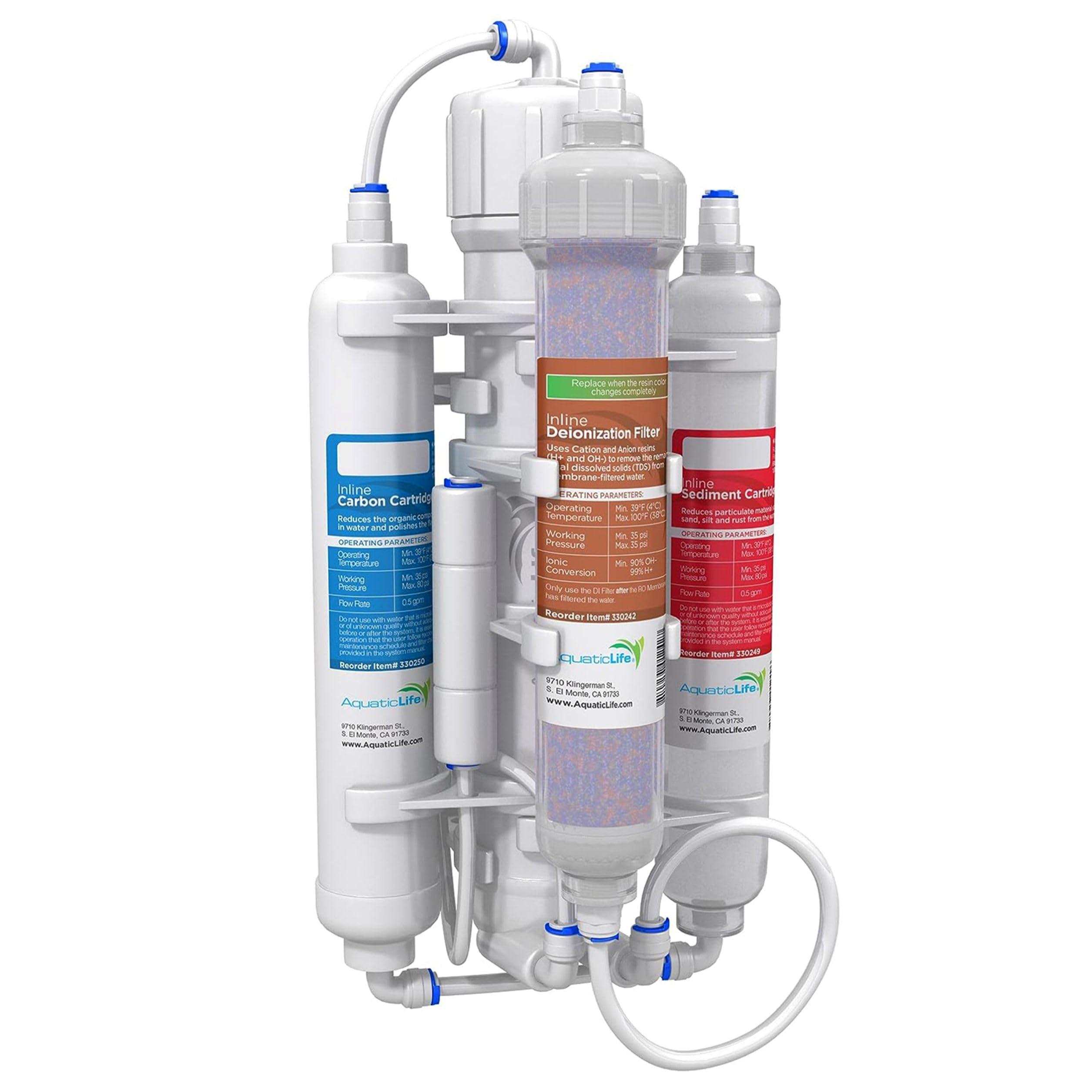
Rating: 4.5 ★ | Price: $$ | Accuracy: 0 TDS target | Reliability: Leaks possible at joints | Flow Rate: 50 GPD (slow) | Ease of Use: Pre-assembled, simple
The RO Buddie’s 4-stage filtration strips dissolved solids to zero, critical for sensitive marine tanks. The compact unit attaches to any standard sink faucet and arrives mostly pre-assembled. Output is slow — roughly 2 gallons per hour — so larger water changes take planning. Connections may loosen over time, so periodic tightening is worth building into a maintenance routine. This system suits hobbyists with tanks under 75 gallons who want pure RO/DI water without the cost of an under-sink install. For anyone needing high daily output or who dislikes occasional adjustments, a larger unit fits better.
Pros
- Produces consistent zero TDS water for sensitive saltwater tanks.
- Complete 4-stage filtration in a compact, sink-attachable unit at a mid-range price.
- Comes pre-assembled and connects easily to a standard faucet or hose.
Cons
- Flow rate is slow; filling a 5-gallon container takes 2–3 hours.
The RO Buddie is the right call for small-tank owners who prioritize water quality over speed and are comfortable with occasional connection checks.
Best for Soft Coral & Lps
NICREW Marine LED Light 32W

Rating: 4.4 ★ | Price: $$ | Reliability: LEDs may fail after 1-2 yr | Noise Level: Silent | Ease of Use: Timer can confuse
The 32W NICREW delivers separate white/blue channels and a built-in timer for sunrise/sunset simulation at a budget price. This suits beginner reef keepers with 30- to 36-inch soft coral or LPS tanks who want visual appeal without spending premium. However, the PAR output is not enough for demanding SPS corals, and the timer programming can be confusing with possible reset after power loss.
Pros
- Bright lighting that supports soft corals and LPS growth.
- Cost-effective entry point compared to high-end fixtures.
Cons
- LED longevity can vary between units, with some experiencing failure after extended use.
A capable entry-level light for soft corals and LPS, but worth buying with realistic expectations about timer setup and long-term durability.
Best for Deep Tank Cleaning
hygger 6-in-1 Cleaning Kit

Rating: 4.5 ★ | Price: $$ | Ease of Use: Secure attachments
The hygger kit’s telescopic handle stays rigid even at its 35.4-inch max, making it a natural fit for tall aquariums and reef tanks where gentle scraping on glass matters. The stainless steel scraper locks firmly, and the included attachments cover basic maintenance. The trade-off: replacement sponges and scraper blades are not sold separately, so you’ll likely buy a new kit when they wear out. This works best for owners who prioritize a sturdy, wobble-free reach over the convenience of replaceable pads – especially those with deep tanks who found other handles flex under pressure.
Ideal for saltwater hobbyists with aquariums 24 inches or taller who want one tool that reaches the bottom without the handle bowing. The rigid build also suits reef tanks where accidental contact with coral or rock is a concern. Not for anyone who wants to swap out pads individually between cleaning sessions – you’ll be ordering a whole replacement set.
Pros
- Handle stays rigid at full extension, no flex when scrubbing glass
- Metal scraper locks securely, good for soft algae and film on glass
- Long reach suits deep tanks and reef setups without leaning
Cons
- Replacement pads and blades are not sold separately – plan to buy a new kit when they wear out
- Included net feels small for larger tanks, limiting its usefulness
If a rigid, long-reach handle is your priority for deep saltwater tanks, this kit delivers that stability better than alternatives – just accept that you’ll replace the whole set when the pads wear out.
Best for Quick Temp Checks
PAIZOO Digital Thermometer

Rating: 4.5 ★ | Price: $ | Accuracy: ±0.9°F | Reliability: Non-replaceable battery | Noise Level: Silent | Ease of Use: Stick-on, tap to read
The PAZOO’s bright touch-activated LED is far more readable than cheaper stick-on models — no squinting needed, and the numbers are clear across a room. For saltwater hobbyists with small tanks, this makes temperature checks effortless. But the non-replaceable battery means the unit becomes disposable after a year or two, and the adhesive can weaken over time, especially around saltwater tanks with condensation. This thermometer suits casual monitoring on nano or medium systems, not permanent use on deep tanks where internal probes are more accurate.
Pros
- Bright LED display is readable across the room, even in dim light.
- Sticks on the outside — no wires or probes inside the tank.
- Sleek, low-profile design doesn’t clutter the aquarium.
Cons
- Adhesive may weaken after weeks, especially in humid saltwater environments.
- Battery is non-replaceable; the thermometer becomes disposable when it dies.
A budget thermometer with clear readability, best for hobbyists who value quick visual checks over long-term durability.
Best for Budget Circulation
FREESEA Wave Maker 1600 GPH

Rating: 4.3 ★ | Price: $ | Reliability: Often fails 2-4 mo | Noise Level: Can click | Flow Rate: 1600 GPH | Ease of Use: Short cord
The FREESEA Wave Maker delivers 1600 GPH of circulation from twin adjustable heads, secured by a firm magnetic mount. The 5-foot power cord restricts placement, and longevity can vary between units – some may need replacement sooner than expected. This pump is best suited for budget-minded aquarists seeking temporary or secondary flow in medium tanks, rather than long-term unattended use.
Pros
- Strong water flow for circulation in medium to large tanks
- Secure magnetic mount holds firmly on thick glass
- Good value for the flow output compared to similar GPH units
Cons
- In quiet rooms, clicking sounds may be noticeable
A high-flow budget pump best used as a temporary or secondary source – not for permanent installation in quiet spaces.
Best for Budget Backup
AUTOUTLET Salinity Refractometer

Rating: 4.6 ★ | Price: $ | Accuracy: ±1 PPT, ATC | Reliability: Similar drift risk | Ease of Use: Easy calibration
Delivers accurate salinity readings matching store equipment, at a budget-friendly price. Calibration is simple with the included screwdriver, and the automatic temperature compensation works across typical aquarium conditions. The build uses lightweight aluminum and plastic optics; some units may arrive with minor cosmetic damage, so inspecting immediately is wise. This is a capable clone of the more reviewed top pick — ideal for those wanting a second unit for travel or emergencies where minor tradeoffs in fit and finish are acceptable.
Pros
- Salinity readings match those from local fish store equipment.
- Quick to calibrate and straightforward to use.
Cons
- Occasional units show cosmetic flaws or arrive with minor damage.
Grab this if you need an affordable backup refractometer for travel or quarantine tanks and can accept the chance of a minor cosmetic defect.
Best for Routine Maintenance
UPETTOOLS 6-in-1 Cleaning Kit

Rating: 4.5 ★ | Price: $$ | Ease of Use: Attachments may loosen
Covers basic cleaning with its scraper, brush, net, and gravel rake at a reasonable price, with a telescopic handle reaching 3.2 ft. The handle may flex under heavy scrubbing, making it less suitable than a more rigid competitor for deep or stubborn algae.
Pros
- All-in-one kit covers algae, gravel, and corner cleaning tasks.
- Includes six attachments for scraping, brushing, netting, and raking gravel.
Cons
- Attachments can come loose during use, reducing cleaning efficiency.
Suited for casual weekly maintenance on smaller tanks where handle flex and loose attachments are minor trade-offs.
Best for Large Tank Clarity
Marineland Penguin 350 Bio-Wheel Filter

Rating: 4.4 ★ | Price: $$ | Reliability: Motor may fail months | Noise Level: Loud to many | Flow Rate: 350 GPH | Ease of Use: Easy cartridge swap
The Marineland Penguin 350 moves a lot of water at a reasonable price, using Rite-Size cartridges for mechanical, chemical, and biological filtration. The Bio-Wheel provides additional surface area for beneficial bacteria, which can help in saltwater systems when paired with appropriate media. That said, motor hum and water noise are present, and some units have shown motor stoppage within months—worth factoring into any decision for a display tank that needs consistent flow.
Pros
- Multi-stage filtration keeps water visibly clear even in heavily stocked tanks.
- Quick assembly and simple cartridge swaps reduce maintenance time.
Cons
- Noise from water fall and motor may be noticeable in quiet rooms, and motor durability can vary between units.
A cost-effective choice for large freshwater tanks where a little ambient sound is acceptable, but saltwater keepers prioritizing quiet, long-term reliability should look elsewhere.
Best for Small Tank Bio
Penn-Plax Undergravel Filter

Rating: 4.4 ★ | Price: $ | Reliability: Fragile, breakage common | Noise Level: Quiet (air-driven) | Flow Rate: Air-lift dependent | Ease of Use: Snap assembly
The two-plate Penn-Plax Undergravel Filter is designed for 15-20 gallon tanks and provides biological filtration using air-driven lift tubes or optional power heads. Assembly snaps together quickly, and the cost is low enough for budget setups. This system is limited to small tanks, so it’s not a fit for larger aquariums.
Pros
- Effective biological filtration for small tanks
- Easy to assemble and set up
Cons
- Packaging can result in broken tubes or airstones on arrival
Best for budget-conscious hobbyists with small tanks who value low upfront cost.
Best for Turtle Tanks
TARARIUM Internal Filter 290GPH

Rating: 4.5 ★ | Price: $$ | Reliability: Some stop early | Noise Level: Quiet | Flow Rate: 290 GPH | Ease of Use: Top access cleaning
Adjustable 290 GPH flow and 2.6-inch minimum water level suit turtle tanks. It keeps them cleaner and runs quietly. Durability can be hit-or-miss—some units may stop functioning within months. This filter is better suited for turtle keepers than saltwater setups requiring consistent conditions.
Pros
- Quiet enough for indoor use
- Keeps turtle tanks cleaner than expected
Cons
- Water clarity may require frequent cleaning to stay clear
Best left for turtle keepers; not a fit for saltwater aquariums.
Best for Ultra-Budget Check
QZQ Digital Thermometer
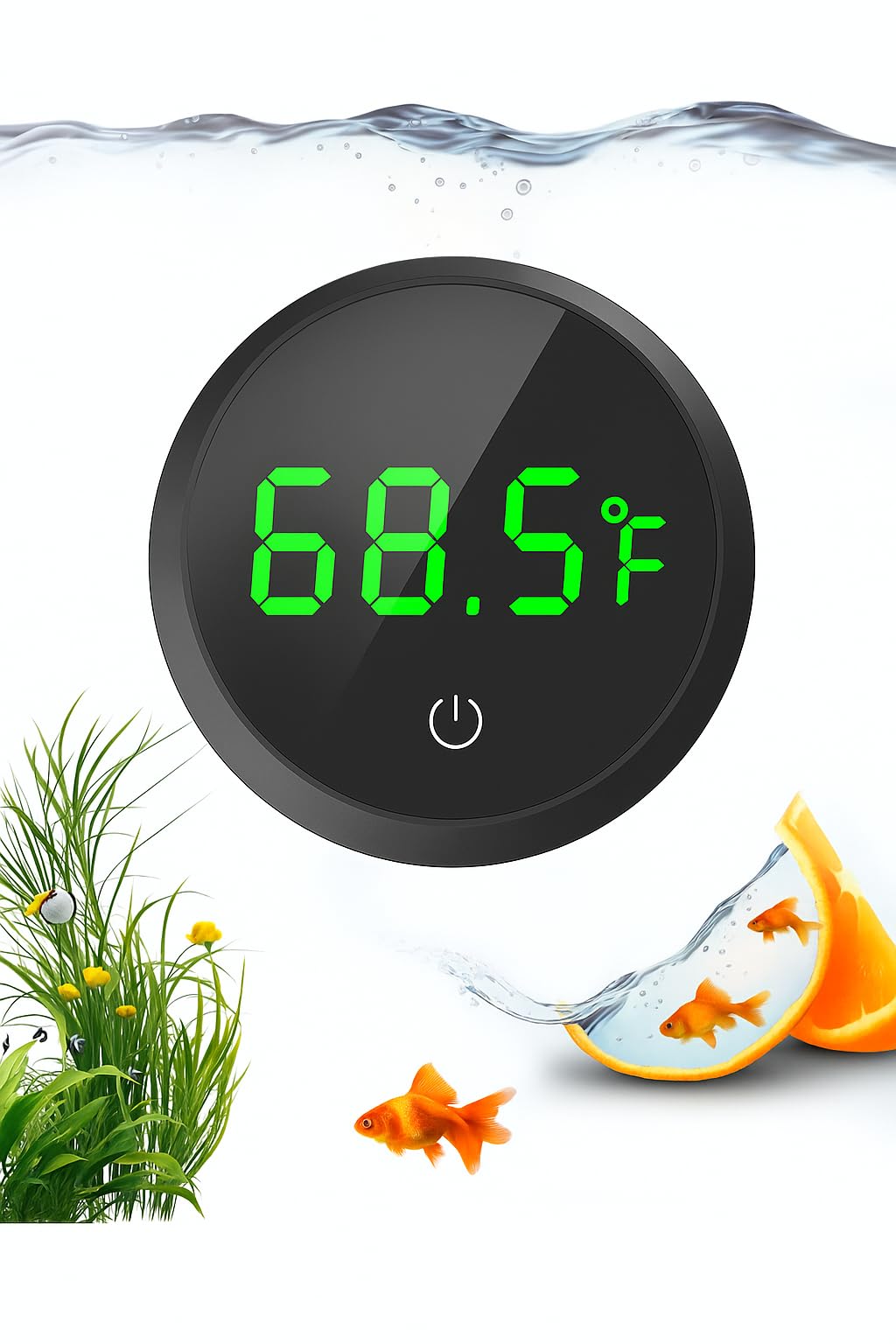
Rating: 4.5 ★ | Price: $ | Accuracy: ±1°F, often off | Reliability: Adhesive weakens | Noise Level: Silent | Ease of Use: Stick-on, tap
The QZQ Digital Thermometer offers a bright, touch-activated LED display at a rock-bottom price, making it tempting for budget-conscious aquarium keepers. Installation is as simple as sticking it to the outside of the tank. However, readings can drift several degrees from actual temperature, and the adhesive may weaken over time, causing the unit to fall off. These limitations make it unsuitable as a primary thermometer – it works best as a quick-check backup or for temporary monitoring in low-stakes setups where precise readings aren’t critical.
Pros
- Bright LED display remains visible even in direct light
- Adheres to the outside of the tank with no tools needed
Cons
- Readings may be several degrees off and adhesive can weaken – fine as a secondary check only
Useful as a quick temperature check or backup for budget tanks, but not for precise monitoring.
How to Choose
The most important decision you’ll make for your saltwater tank is not how much to spend, but which products will give you reliable performance month after month.
Accuracy
For salinity measurement, accuracy is non-negotiable. Refractometers with automatic temperature compensation (ATC) adjust readings across 10-30°C, preventing temperature swings from throwing off your salinity. Without ATC, a warm tank can read 2-3 PPT lower than actual.
Digital refractometers offer precision but cost more and require batteries. A quality analog unit like the Agriculture Solutions model gives you consistent readings for years if you recalibrate monthly with distilled water.
Reliability
Reliability is where many budget saltwater products fall short. Pumps and filters under $50 often use cheap impellers or seals that degrade quickly, leading to failure within months. For essential equipment like filters and wave makers, spending a bit more on a proven brand reduces the chance of a mid-cycle breakdown.
For RO/DI systems, the weak point is usually the plastic push-fit connectors. Check these monthly for leaks—they can loosen from vibration. Replacing with brass fittings solves the issue permanently if needed.
Noise Level
Noise from filters and wave makers is a top frustration. Hang-on-back filters like the Marineland Penguin create a distinct water-fall sound that can be distracting in a quiet room. Internal filters and canisters are generally quieter because the motor is submerged, dampening vibration.
Wave makers can develop clicking noises when the impeller gets out of alignment or debris gets trapped. Cleaning the impeller every two weeks prevents this. Magnetic mounts also reduce vibration transfer to the glass compared to suction cups.
Flow Rate
Flow rate determines how well water circulates and how effectively filters process waste. For a saltwater tank, aim for 10-20 times the tank volume per hour for filters, and 5-10 times for wave makers. A 75-gallon tank needs at least 750 GPH from a filter and 375 GPH from a wave maker.
But higher flow isn’t always better—too much current stresses corals and fish. Adjustable wave makers let you dial in the perfect flow. Also note that actual flow is often 20-30% lower than rated due to head pressure and media resistance.
Ease of Calibration and Use
Refractometers require calibration before every session for best accuracy—just a drop of distilled water on the prism and adjust the screw. Skipping this step can lead to salinity drift of 0.5-1.0 PPT over weeks.
For lighting, timer programming should be intuitive. Some budget lights lose their settings after a power outage, forcing you to reprogram. Lights with a physical controller or non-volatile memory are better for set-and-forget operation.
FAQ
Why does my UV sterilizer fill with water and stop working?
Submersible UV sterilizers often have poor seals around the quartz sleeve or bulb housing. Water seeps in, short-circuiting the bulb or pump. This is a common design flaw in budget units like COODIA and COOSPIDER. Avoid leaving any UV sterilizer running unattended; inspect seals monthly and replace units that show moisture inside the tube.
How often should I recalibrate my saltwater refractometer?
Check calibration with distilled water before each use. If the zero line drifts more than 0.5 PPT, adjust using the calibration screw. Over time, salts and oils can build up on the prism, causing drift. Clean the prism with a soft cloth and distilled water after each session for consistent accuracy.
Can I use a freshwater power filter on a saltwater tank?
Yes, most hang-on-back and internal filters work in saltwater if the wetted parts are corrosion-resistant. However, many budget filters use steel impeller shafts that rust quickly in saltwater. Check that the shaft is ceramic or stainless steel, and expect to replace foam/sponge media more frequently due to salt buildup.
What’s the best budget wave maker that won’t break down quickly?
In the under-$50 range, no wave maker is guaranteed to last beyond a year. The FREESEA 1600 GPH offers the best flow per dollar but often fails in 2-4 months. For a more reliable option, save for a Jebao or Sicce model in the $70-100 range, which use sealed motors and longer-lasting impellers.