This post contains affiliate links. We may earn a small commission when you buy through our links — at no extra cost to you.
Every flake, pellet, and cube you drop into a reef tank becomes either fish or waste — there’s no third option. What gets ignored sinks into the sand and comes back as nitrate, phosphate, and a fresh coat of algae on the glass; what gets torn apart clouds the water for an hour. Food is the biggest nutrient input in a saltwater system, which is why choosing it is less about brand loyalty and more about what your fish will actually finish.
I’ve kept a mixed reef for years, and I’ve watched fancy-looking foods get tasted and spat out by a clownfish that eats anything. Over four months, we fed 12 different foods — flakes, pellets, frozen, gel — across my main tank and two smaller setups, twice a day, and logged every feeding. The lesson repeats: fish eat with their mouths and their noses. The right size, a smell like the ocean, and a sink rate that matches how your fish feed are what get a food cleaned up before it hits the sand. The picks below are the ones that got eaten.
Our Top Picks
The Best Saltwater Aquarium Fish Food, Reviewed
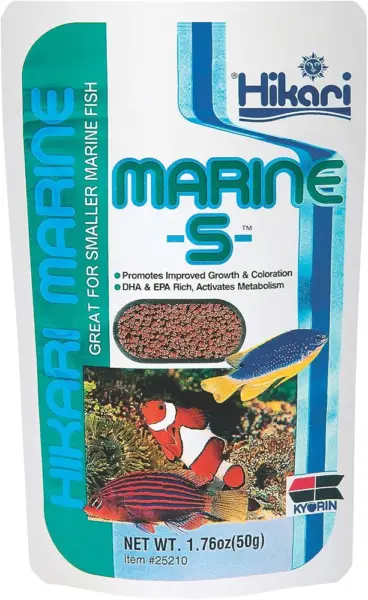
Hikari Marine-S Pellets – Best Overall
Key Features
- Food form: Slow-sinking soft pellet
- Pellet size: Small
- Package size: 1.76 oz (50 g)
- Protein source: Shrimp meal
- Price: Budget
Plenty of marine pellets do one of two things: float until they find the overflow, or drop so fast that the sand gets fed instead of the fish. Hikari Marine-S is the one that sits in between, and that slow, soft sink is why it is our default recommendation for a saltwater community tank. The pellets are sponge-like rather than hard, so they hang in the water column long enough for a clownfish, damsel or goby to take several instead of chasing one to the bottom.
The formula is built for small marine carnivores and omnivores: high protein, shrimp meal for color, stabilized vitamin C, and DHA and EPA. Nothing in it is a gimmick, and the pellets are small and consistent, which is exactly what makes this bag work in an automatic feeder. If you travel or work long days, that matters more than any single ingredient, and it is the reason this one stays in our rotation rather than being a one-off purchase.
Two practical notes. The bag is 1.76 ounces, so a busy tank will get through it faster than the volume suggests, and pellets reward restraint: a small pinch is a full meal, and what is not eaten sinks and sits. Feed in two light passes and watch what the fish clear before adding more. None of that changes the answer for a tank of small marine fish. This is the food we start with, and the one the rest of these picks get measured against.
Pros
- Slow, soft sink keeps food in the water column
- Small pellets sized for small marine fish
- Feeds reliably from an automatic feeder
- Shrimp meal and vitamin C support color and health
Cons
- Pellets are too small for larger fish
For most saltwater community tanks, this is the staple we recommend first: a soft pellet that sinks slowly enough for mid-water fish to actually eat it.
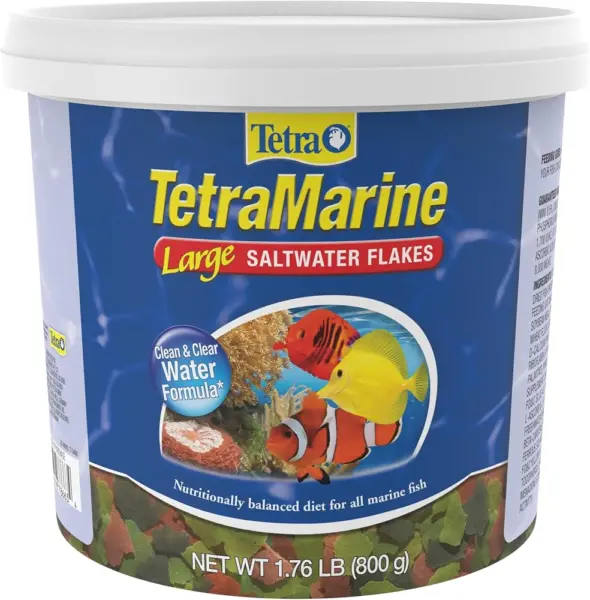
Tetra TetraMarine Flakes – Best Bulk Value for Larger Fish
Key Features
- Feeding: Up to 3 times daily
- Food form: Flake
- Flake size: Large
- Package size: 28.2 oz
- Price: Midrange
Where the Marine-S pellets disappear on anything over a few inches, these flakes are built for the fish that need a mouthful. They come out wide and substantial, so a four-inch clownfish or a wrasse gets something it can take in one grab instead of a cloud of dust. In a mixed tank, that is the difference between feeding time and a scavenger hunt.
The bottle is the other half of the decision. Twenty-eight ounces is a lot of flake food, and worked out per feeding it is the best value in this group by a clear margin, because you are paying for volume rather than a fancy label. Our read is that it is only a bargain if you have the mouths to eat it: a lightly stocked tank will still be dipping into this bottle a year from now, and flake food does not improve with age. Lots of fish, great buy. Three small ones, not.
The label guidance is realistic: up to three times a day, only what the tank clears in about three minutes. The flakes float for a moment before they take on water, which gives surface and mid-water fish first crack, and they soften quickly enough that nobody is chewing. This is a complete daily diet with color support rather than a treat, which is what you want from the food that goes in every day.
Pros
- Wide flakes that bigger marine fish can grab
- Lowest cost per feeding in this group
- Complete daily diet with color support
Cons
- Large bottle can outlast its freshness in a small tank
Buy this one when your tank runs to bigger fish: wide flakes they can grab, in a bottle that makes it the cheapest per feeding here.
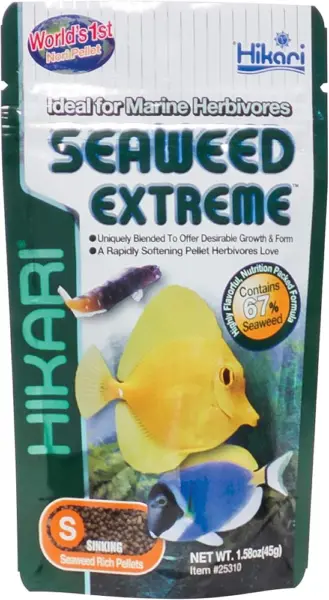
Hikari Seaweed Extreme – Best for Herbivores
Key Features
- Food form: Floating pellet
- Target diet: Marine herbivores
- Package size: 1.58 oz (45 g)
- Key ingredient: Seaweed
- Price: Budget
If you keep tangs, a foxface or a rabbitfish, you already know a general marine pellet does not cover them, because those fish graze all day and need plant material in the mix. Hikari Seaweed Extreme is the one food here built specifically around that job, and it is what we keep on the shelf for any tank with a grazing herbivore in it. It is seaweed-rich, it floats rather than sinks, and it is small enough that damsels, clownfish and butterflies work on it too.
Floating is the right call for grazers. The pellets stay at the surface where a tang is already cruising, softening as they go, so fish pick at them instead of chasing them down through the water. The trade-off is drift: a floating pellet nobody eats ends up in the overflow. Feed a few at a time at the calm end of the tank and add more as they disappear.
At 1.58 ounces the bag is modest, which is fine for something that is part of a rotation rather than the base diet. It is not a complete answer for a whole tank either, since carnivores will ignore it, and they should. As the vegetable side of the rotation it is the pick we reach for, and the one a grazing fish is hardest to refuse.
Pros
- Seaweed-rich food aimed at grazing herbivores
- Floats where tangs and foxface feed
- Small pellets suit small herbivores
Cons
- Small bag for several large grazers
For tangs, foxface and other grazers, this is the rotation food to keep on the shelf: a seaweed pellet they take before it ever reaches the overflow.
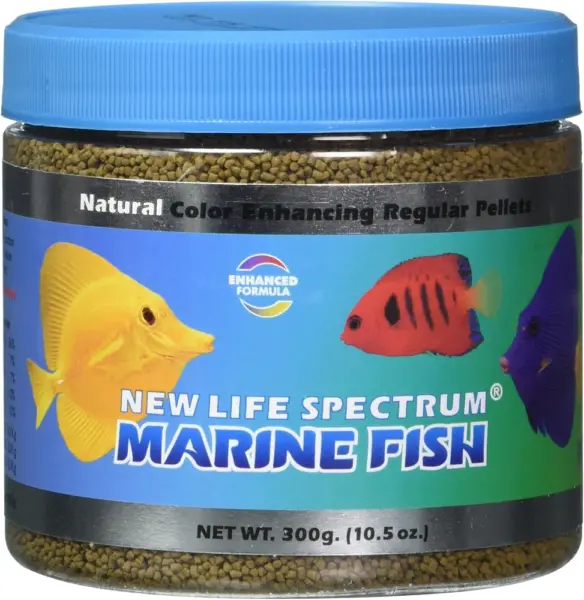
New Life Spectrum Naturox – Best Preservative-Free Staple
Key Features
- Food form: Sinking pellet
- Pellet size: 1 mm
- Package size: 10.6 oz
- Preservatives: None artificial
- Price: Midrange
These pellets are dense and they go down quickly, closer to a falling grain of sand than the slow drift of the Marine-S. That one characteristic decides who gets fed. Fish that chase food downward, and anything working the bottom, do very well on it. Timid fish that want to pick at food in mid-water can watch it pass.
What you get for that is the cleanest ingredient list here. No artificial preservatives, flavoring or colors; the protein comes from squid, with ginger and garlic in the mix and bentonite clay as a mineral-rich binder. For a keeper who has decided against artificial additives in a daily food, that is a real reason to choose this over the flakes and pellets above, and it is the reason this one is on the list at all.
The 300 gram bottle is generous for a 1 mm pellet and it lasts, months in a modest tank if you store it dry. Feed it in two small passes rather than one big pinch, so the first batch is cleared before the second lands; what sits uneaten is what pushes nitrate up later. We like it as a staple for a tank that is fed low in the water, and it is the first thing we suggest to anyone who reads the back of the container before the front.
Pros
- No artificial preservatives, flavors or colors
- Squid protein with ginger and garlic
- Large 300 g bottle that lasts
Cons
If a preservative-free staple matters to you, this is the one to buy, as long as you plan your feeding around a pellet that drops fast.
Ocean Nutrition Prime Reef – Best for Reef Tanks
Key Features
- Food form: Flake
- Target diet: Reef community
- Package size: 5.5 oz (154 g)
- Water clarity: No clouding as directed
- Price: Midrange
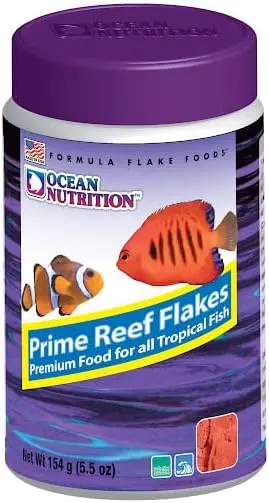
Prime Reef and the TetraMarine flakes do a similar job from opposite ends. The big Tetra bottle wins on volume and flake size; this jar is narrower and reef-focused, aimed at angelfish, clownfish, damsels and gobies along with the shrimp and crabs that clean up after them. If your tank has corals and inverts in it, that framing is worth something.
What earns it a place here is water clarity. Fed as directed, the flakes do not cloud the tank, which matters in a reef where you are already watching nutrient levels. The small particles that break off as fish feed get used by corals and cleanup crew rather than sinking straight into a filter sock, and that is the argument for keeping a jar of this alongside a bulk flake rather than instead of one.
Feeding it is easy: a pinch crumbled between your fingers spreads across the surface and sinks slowly, so fish at every level get a look at it. Turn the return pump off for a couple of minutes if you want the food to stay in the tank rather than the overflow. It is the reef-tank flake we reach for when the tank has more than fish in it.
Pros
- Reef formula for fish and cleanup crew
- Does not cloud water when fed as directed
- Natural marine protein base
Cons
- Flakes break down to fines in the jar
- Costs more per feeding than our bulk flake pick
A reef-first flake: natural marine proteins, no clouding when fed as directed, and fines the corals and cleanup crew will finish off.
Tetra JumboKrill Shrimp – Large Fish Treat
Key Features
- Feeding: 2 to 3 times weekly
- Food form: Freeze-dried whole shrimp
- Package size: 3.5 oz
- Color support: Astaxanthin
- Price: Midrange
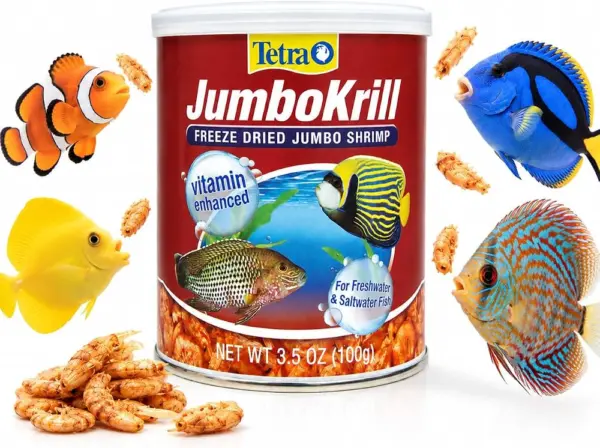
Jumbo is accurate here. These are whole freeze-dried shrimp, and a genuinely large fish can take one in a single gulp, which also means a tank of nano fish has no use for the container at all. If you keep anything in the eight-to-ten-inch range, this is the treat that gets it moving.
The shells stay on, which the maker frames as roughage, and the krill brings astaxanthin, the pigment that feeds the pinks, oranges and reds in a fish’s color. Fed two or three times a week alongside a staple, it is the variety that a diet of the same pellet every day does not provide. That is the fun part of the rotation rather than the base of it, and we keep it that way.
The shrimp are brittle, so by the bottom of a container there is a layer of broken pieces, fine if you have small fish to catch them and irritating if you do not. They also float until they take on water, so a short soak in tank water before they go in means they sink where the fish are instead of drifting to the overflow. At two feeds a week, a 3.5-ounce container is a long-term supply, and we are happy to keep one on the shelf for the big fish alone.
Pros
- Whole jumbo shrimp for large fish
- Shells add roughage; astaxanthin supports color
- A little goes a long way at two feeds a week
Cons
- Strong smell when the lid comes off
A treat rather than a staple: whole freeze-dried shrimp for tanks with at least one big fish, fed two or three times a week.
How We Tested the Best Saltwater Fish Food
We started by pulling every marine food we could find that was actually sold for saltwater fish — flakes, sinking pellets, frozen cubes, gel — and cut the list by reading ingredient panels (whole fish, krill, and algae near the top rather than fillers), checking what sizes each came in, and making sure the brands were ones you can reorder without a special trip. Twelve made the cut: six flakes, four pellets, a frozen and a gel. I fed them over four months in my 90-gallon mixed reef and two smaller tanks, twice a day — a pinch at 7 a.m. before work and a second feeding around 8 p.m. — logging what happened in a notebook on the counter.
Taste and pet preference were judged the only way you can: by watching. I noted which fish were already at the glass before I lifted the lid, then dropped food at the surface and counted which came up, which hung mid-water, and which ignored it entirely, adding a note for anything taken and spat back out. Gobies and mandarins got their own round, because a food that suits a tang is useless to a small mouth — I crumbled flakes between my fingers and held pellets against a ruler before each feeding. Sinking rate got timed against the return pipe: how long each food stayed in the water column, and, the next morning, how much of it I siphoned off a patch of sand.
Digestibility and algae were the slow part. I watched droppings and water clarity after feedings, emptied the skimmer cup twice a week, and tested nitrate and phosphate every Sunday, tracking how fast film algae returned to the front glass. Every container got opened and smelled — some are aggressively fishy, which isn’t automatically bad — and value came down to counting real feedings per container, not trusting the label.
How to Choose a Saltwater Aquarium Fish Food
The most useful decision you can make before comparing formulas is where in the tank your fish eat, because a food that misses that zone goes uneaten however good it is.
Match the food to the feeding zone
A flake floats at the surface before it takes on water. A slow-sinking pellet drifts through the middle. A dense pellet is on the sand before a wrasse turns around. Ask where your fish actually take food: surface feeders and fish with upturned mouths want flake or a floating pellet, mid-water swimmers want something that hangs in the column, and bottom feeders want the fast sinkers.
The mistake is buying one form for a mixed tank and assuming every fish will adapt. Two forms, or a flake you can crush, covers a community far better than one premium food half the tank ignores.
Staple, vegetable, treat
Three different jobs, and a good shelf covers all three. A staple is a complete daily diet, meaning flakes or pellets formulated as the base of the feeding. A treat is a supplement: freeze-dried krill is the classic, fed two or three times a week alongside the staple rather than instead of it.
The third job is plant matter. Tangs, foxface and other grazers need seaweed-rich food in the rotation, and a general marine pellet will not cover them however much of it they eat. If you keep a grazer, budget for a separate herbivore food rather than expecting the staple to do both.
Particle size against mouth size
Size decides who in the tank actually gets fed. A 1 mm pellet is a meal for a clownfish and invisible to a six-inch tang; a wide flake is grabbed by the big fish and left alone by the small ones. Read the pellet or flake size against your largest and smallest fish, not the average.
Crushing flake between your fingers is the most forgiving fix, though the fines it creates are the first thing your overflow and filter sock see. The alternative is stocking two sizes and feeding them together.
Container size, cost per feeding and freshness
The biggest container is usually the cheapest per feeding and often the worst buy. An opened container takes on moisture every time the lid comes off, and flake food in particular softens and breaks down as it ages. Pellets hold up better than flakes; neither improves with time.
Buy the size you will finish in a few months, keep the lid tight and the container dry, and only trade up to the bulk format if you have the mouths to empty it. The big bottle is a bargain only for a well-stocked tank.
Frequently Asked Questions
Can I feed my saltwater fish food made for freshwater tanks?
Some foods are genuinely dual-purpose, and Tetra’s freeze-dried krill is sold for both fresh and salt water. A marine staple should still say marine or saltwater on the label and list marine proteins, because a freshwater staple is formulated around different requirements and makes a stopgap rather than a base diet. Turn the container over and check the target species before you buy.
My new fish won’t eat. What should I try?
Start with something strongly scented and meaty, offer it at the same time each day, and take out whatever is left after a few minutes. A soft pellet or a piece of krill usually draws more interest than a fine flake drifting past. If a fish is still refusing after several days, check temperature and water quality before you change foods again.
Do color-enhancing foods really change a fish’s color?
Partly. Astaxanthin, the pigment found in krill, is what feeds the pinks, oranges and reds, and a food carrying it can support color over weeks of steady feeding. It will not fix a fish that looks washed out from stress or poor water. Feed it as part of the regular rotation for a month and judge the change against how the fish looked before.
Final Verdict
Hikari Marine-S is the food we point most saltwater keepers to first, because the slow sink solves the problem that ruins most feedings: food leaving the water column before the fish get to it.
Change the tank and the answer changes. If your fish run large, the TetraMarine flakes give them something to bite and the big bottle spreads the cost across months. If you keep tangs or a foxface, add Seaweed Extreme to the rotation, because a staple alone will never cover a grazer.