This post contains affiliate links. We may earn a small commission when you buy through our links — at no extra cost to you.
Many cycling products promise instant results, but real biological filtration takes one to two weeks even with supplements. A bottle of bacteria cannot shortcut the time it takes for a filter to mature—that’s biology, not marketing.
What does work is pairing a reliable ammonia detoxifier with a bacterial starter that actually colonizes your filter. This combination makes the process predictable and safe for fish, regardless of the brand you choose.
This guide focuses on the products that deliver on their core function—whether it’s detoxifying ammonia or seeding beneficial bacteria—and explains which combo fits your tank size, budget, and experience level.
Top Picks
Best for All Aquariums
Seachem Prime

Rating: 4.8 ★ | Price: $$ | Freshwater vs Saltwater: Both
Seachem Prime immediately removes chlorine and chloramine while binding ammonia, nitrite, and nitrate into a non-toxic form for 48 hours. This gives the biological filter time to catch up during cycling or after a spike. The formula is safe to dose up to five times the normal amount in emergencies, making it a practical tool when ammonia levels rise unexpectedly.
This conditioner suits any aquarium owner — freshwater or saltwater — especially those managing a fish-in cycle or recovering from an ammonia spike. The strong sulfur smell during dosing is temporary and dissipates quickly, though sensitive noses may prefer to dose near ventilation. Pair it with a dedicated bacterial starter like Seachem Stability to build the nitrogen cycle efficiently.
Pros
- Detoxifies chlorine, chloramine, and ammonia instantly for 48 hours.
- One capful treats 50 gallons, making it cost-effective per gallon.
- Safe to use at 5x the normal dose during emergencies without harming fish.
Cons
- Strong sulfur odor during dosing, though it fades within minutes.
- Does not add beneficial bacteria; must be paired with a starter for cycling.
The most cost-effective water conditioner per gallon treated — a single bottle that handles dechlorination and ammonia detoxification for any freshwater or saltwater setup.
Best for Prime Users
Seachem Stability

Rating: 4.8 ★ | Price: $$ | Freshwater vs Saltwater: Both | Speed of Cycling: Gradual
Stability’s blend of aerobic, anaerobic, and facultative bacteria works over days to establish a colony, making it a gradual cycling supplement rather than an instant solution. Unlike the top pick’s immediate ammonia detoxification, this product focuses on building the biofilter steadily. Best for hobbyists already using Prime who want a consistent, fish-in cycling approach or maintenance doses after water changes.
Pros
- Effective bacteria establishment speeds up tank cycling and reduces ammonia spikes.
- High-quality formulation from Seachem delivers consistent performance.
- Fish health and safety are maintained when dosed correctly.
Cons
- Cycling speed is slower than specialized starters like Fritz TurboStart – may take a week or more for noticeable results.
- Water quality improvement can be inconsistent; some tanks see no change in ammonia or nitrite levels.
A solid bacterial supplement for gradual cycling when paired with Prime, but not the fastest option available.
Best for Fishless Cycling
Fritz Ammonium Chloride
Rating: 4.7 ★ | Price: $$$ | Freshwater vs Saltwater: Both
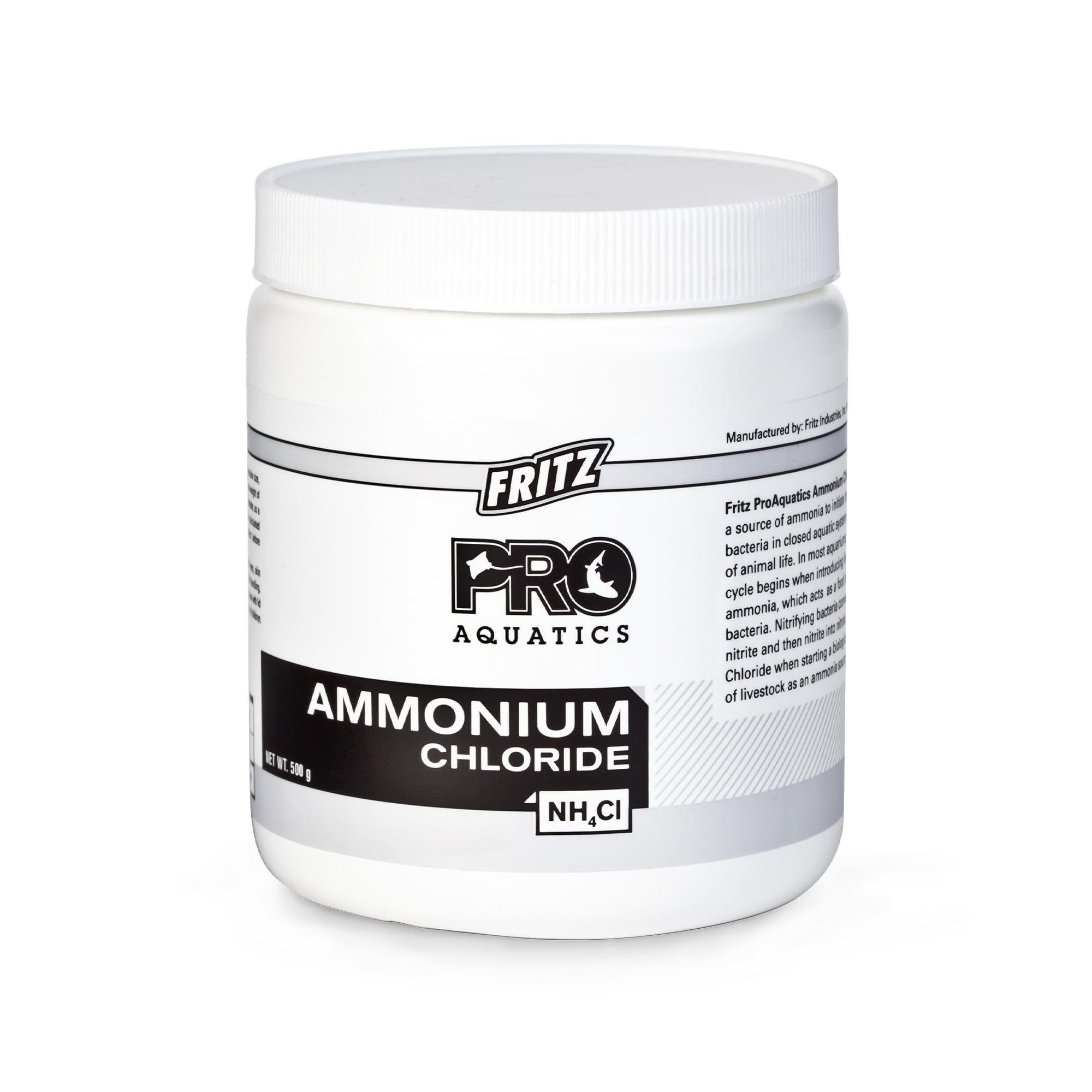
Unlike cycling methods that rely on fish food or decomposing shrimp, Fritz Ammonium Chloride lets you set an exact ammonia concentration — 4.5 grams per 100 gallons produces 4 ppm, the sweet spot for growing nitrifying bacteria. Breeders and those with 50-gallon-plus tanks benefit most: a leveled half-teaspoon per 100 gallons is quick and repeatable. The powder is stable and stores indefinitely, making a single container sufficient for many setups. Some containers can lose potency over time, so testing the water after the initial dose confirms the cycle is on track.
Pros
- Precisely controls ammonia concentration for a predictable cycle.
- A single container lasts through many cycles, offering per-cycle economy.
- Measures easily with common kitchen teaspoons for larger volumes.
Cons
- Accurate dosing for tanks under 10 gallons requires measuring 1/8 teaspoon, which can lead to variability.
When you need full control over the nitrogen cycle without introducing livestock, this ammonium chloride delivers predictable results — provided the tank is large enough to dose with a teaspoon, not a fraction of one.
Best for Budget Beginners
API Quick Start

Rating: 4.8 ★ | Price: $ | Freshwater vs Saltwater: Both | Speed of Cycling: Variable
API Quick Start costs less than most bacterial supplements, and its simple dosing suits first-time tank owners. The bottle contains live nitrifying bacteria meant to kickstart the nitrogen cycle, and many users see ammonia levels stabilize after use. However, cycling results are not consistent across all setups. Some tanks fail to cycle as expected, and fish losses have been reported when relying on this product alone. Pairing it with regular water testing is necessary, but for a tight budget or an emergency boost after a water change, it offers an entry point that pricier options don’t match. This is a starter for small tanks and beginners who can accept some unpredictability, not a substitute for proper cycling or a high-reliability supplement like Stability.
Pros
- Helps establish beneficial bacteria and stabilize ammonia levels in new tanks
- Budget-friendly option for a 4-ounce bottle
- Clear dosing instructions and easy to pour
Cons
- Cycling results can vary between tanks; some setups may not cycle as expected
- Fish loss has occurred in some cases when relying solely on this product
A budget entry point for new aquarium owners who pair it with careful water testing, but not a substitute for traditional cycling methods or higher-reliability starters.
Best for Emergency Spikes
API Ammo-Lock

Rating: 4.6 ★ | Price: $ | Freshwater vs Saltwater: Both
API Ammo-Lock works instantly to bind ammonia at a budget-friendly price, suitable for both freshwater and saltwater tanks. Where Seachem Prime offers longer-lasting detoxification and broader water conditioning, Ammo-Lock is a short-term fix for sudden ammonia spikes during cycling. Best for budget-conscious aquarists who need quick relief from elevated ammonia levels, though its performance can be less consistent than Prime for ongoing use — some users see no improvement.
Pros
- Binds ammonia instantly during emergency spikes.
- Budget-friendly option for quick treatment.
Cons
- Not a full water conditioner — only detoxifies ammonia, not suitable as primary conditioner.
An affordable option for emergency ammonia spikes when budget is the priority.
Best for Reef Tanks
Brightwell MicroBacter7

Rating: 4.7 ★ | Price: $$$ | Freshwater vs Saltwater: Both | Speed of Cycling: Moderate
This bioculture reduces nitrate and phosphate and clears cloudy water in established tanks. Overdosing can cause ammonia spikes, so precise dosing is required. It is a premium option for experienced reef keepers managing nutrient control, not for general cycling.
Pros
- Effectively clears cloudy water and helps control algae growth.
- Reduces nitrate and phosphate levels in reef and planted aquariums.
Cons
- Overdosing can cause ammonia spikes and fish loss, so precise dosing is necessary.
Best for experienced reef keepers who want advanced nutrient control and water clarity, but not a general cycling solution for beginners.
Best for Fluval Owners
Fluval Cycle

Rating: 4.7 ★ | Price: $$ | Freshwater vs Saltwater: Both | Speed of Cycling: Moderate
Fluval Cycle is a cost-effective bacterial supplement that pairs well with Fluval filter systems. It has less supporting evidence than top alternatives like Seachem Stability. Some fish species may show sensitivity to the formula, making it better suited for tanks with hardy livestock. For Fluval owners seeking an affordable backup starter, it serves its purpose.
Pros
- Effective bacteria starter for cycling tanks
- Good value for the price
Cons
- May cause temporary water cloudiness after dosing
A suitable option for Fluval tank owners who want an affordable backup bacteria starter and can accept occasional cloudiness.
How to Choose
The key to successful cycling is understanding that ammonia detoxifiers and bacterial supplements serve different, complementary roles.
Ammonia Detoxification Capability
A detoxifier binds ammonia and nitrite into a less toxic form for up to 48 hours, but it does not remove them from the water. That bound ammonia still registers on test kits and must eventually be consumed by bacteria.
If you rely solely on a detoxifier, your ammonia readings will stay high, and your filter will never mature. Pair it with a bacterial supplement to give the biofilter time to grow without stressing fish.
Bacteria Strains
Aerobic bacteria consume ammonia and nitrite but need oxygen-rich water. Anaerobic bacteria handle nitrate reduction but thrive in low-oxygen zones like deep substrate or porous media.
Most all-in-one starters contain both types, but their ratios vary. For a standard canister or HOB filter, a blend heavy on aerobic strains is most effective. Reef tanks benefit from the additional denitrifying strains found in products like MicroBacter7.
Concentration and Dosing Per Gallon
Concentration determines how much product you need per treatment and affects long-term cost. A highly concentrated conditioner like Prime treats 50 gallons per capful, making it economical for large tanks.
For bacterial supplements, dosing by the drop or capful works well for tanks above 10 gallons. Smaller tanks require careful measurement, and some products (like Fritz ammonium chloride) demand precise teaspoon fractions that are easy to misjudge.
Freshwater vs Saltwater Compatibility
Most cycling products are labeled for both freshwater and saltwater, but saltwater systems have different bacterial populations and lower ammonia tolerance. A conditioner that works in both is fine, but bacteria starters formulated specifically for marine environments may cycle faster in reef tanks.
Check the label: if a product says “freshwater only,” it likely lacks the halophilic bacteria needed for saltwater. All picks in this guide support both environments unless noted otherwise.
Speed of Cycling Effect
Faster cycling sounds appealing, but speed often comes at the cost of consistency. Products that claim to cycle a tank in 24 hours often use dormant bacteria that reawaken slowly or require exact water conditions to work.
A moderate pace—7 to 14 days—is more reliable and less likely to cause ammonia spikes. Seachem Stability and Fluval Cycle fall into this range, while specialized starters like Fritz TurboStart (not covered here) are faster but less forgiving of mistakes.
FAQ
Why isn’t my API Quick Start cycling my tank?
API Quick Start contains live nitrifying bacteria, but its viability depends on storage temperature and tank conditions. If the bottle was shipped warm or sat on a shelf for months, many bacteria may have died. Additionally, Quick Start works best for boosting an existing cycle or for very low-ammonia environments; in a tank starting from zero, it often fails to establish a robust colony. For guaranteed results, use a refrigerated product like Fritz TurboStart or pair Quick Start with an ammonia detoxifier and daily testing.
Can I use Seachem Prime alone to cycle a tank without adding bacteria?
No. Prime detoxifies ammonia and nitrite for 48 hours, but it does not add beneficial bacteria. The biofilter must still grow on its own. If you add no bacteria source, the cycle will take as long as it would with plain dechlorinated water—typically 4 to 6 weeks. Prime makes that wait safer for fish, but it is not a substitute for a bacterial supplement.
How much Fritz ammonium chloride do I need for a 10-gallon fishless cycle?
For a 10-gallon tank, you need approximately 0.45 grams of powder to reach 4 ppm ammonia, which is about 1/16 teaspoon. Measuring that accurately is tricky—a kitchen gram scale gives the best result. If you over‑dose, perform a water change; under‑dose and ammonia stays too low for bacteria to multiply. Fritz is excellent for large tanks but frustrating for small ones.
Do aquarium bacteria supplements need to be refrigerated to stay alive?
Yes, most liquid bacteria supplements (including Seachem Stability, API Quick Start, and Fluval Cycle) lose viability above 75°F. Once opened, refrigerate them and use within a few months. Bottles that have been sitting in a hot warehouse or delivery truck may arrive with a fraction of the labeled bacteria, which explains many “didn’t work” reports. Powdered products like Fritz ammonium chloride do not require refrigeration.