This post contains affiliate links. We may earn a small commission when you buy through our links — at no extra cost to you.
A decoration can make or break a tank. The wrong one looks like a painted toy, bobs to the surface when you fill the tank, or turns the water tea-brown by morning. I’ve found the pieces I return to are the ones fish actually use—caves they claim, wood shrimp graze, plants that look natural underwater. The right piece gives a fish a place to hide, gives you something to look at, and asks for little beyond a weekly scrub.
Over four months, our team lived with 15 decorations across four tanks—betta, shrimp, community, and quarantine—judging appearance, color, size, stability, and value. We watched how fish and shrimp reacted, whether driftwood leached color, and how each held up to algae scrubbing. Wood quality and floatability separated the best: some needed weighting, and some wood stayed buoyant for days. For bubbler ornaments, we ran each air stone for a week and noted whether bubbles came out steady or sputtered. The pieces below stayed in the tank after the novelty wore off.
Our Top Picks

The Best Aquarium Decorations, Reviewed
SpringSmart Rock Cave – Best Overall
Key Features
- Weight: 5.28 oz
- Material: Ceramic
- Openings: Two
- Dimensions: 3.5"D x 3.5"W x 3.35"H
- Price: Budget
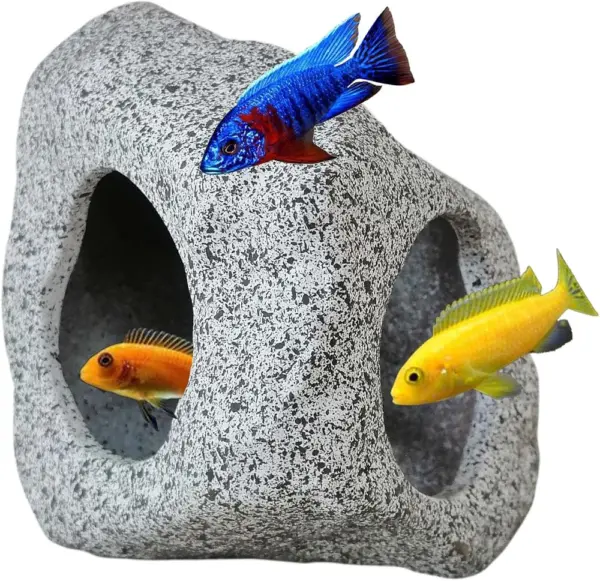
Roughly the size of a softball, this ceramic cave is the piece we reach for first in a small tank. At 3.5 inches across and 3.35 tall it leaves a betta room to turn around without swallowing the floor of a 5-gallon, and the two openings mean a fish is never cornered inside it. If you buy one decoration this year, make it a hideout: it is the piece fish use every day, and it is the cheapest pick in this guide.
The granite-look ceramic does two things painted resin ornaments struggle with. It sinks the moment it hits the water — no weighing down, no waiting for it to waterlog — and it has no finish to bubble or flake, which is where a lot of painted decorations fail after a few months submerged. We also like that the shape is not symmetrical: rotate it so one opening faces the front glass and you can watch the fish come and go.
Cleaning is a rinse under the tap and a soft brush once algae darkens the surface; with no paint, scrubbing costs you nothing, and the smooth shell does not hold a green film the way textured resin does. It is plain gray stone, not a showpiece, and that is the trade for a cave that looks like it came out of a river rather than a toy box. Ours went in half-buried in a corner, and the resident betta claimed it the same afternoon.
Pros
- Sinks immediately and stays where you put it
- Two openings, so a fish is never cornered
- No painted finish to peel or fade
- The least expensive pick in this guide
Cons
- Interior can be rougher than the outside
Our default for almost any tank: an unpainted ceramic cave that sinks, stays put, and gives a betta somewhere to retreat — for the least money here.
Ameliade 8-Piece Plant Set – Best Starter Set
Key Features
- Pieces: 8
- Weight: 11.2 oz
- Includes: 1 rock cave and 7 plants
- Material: Plastic
- Price: Budget
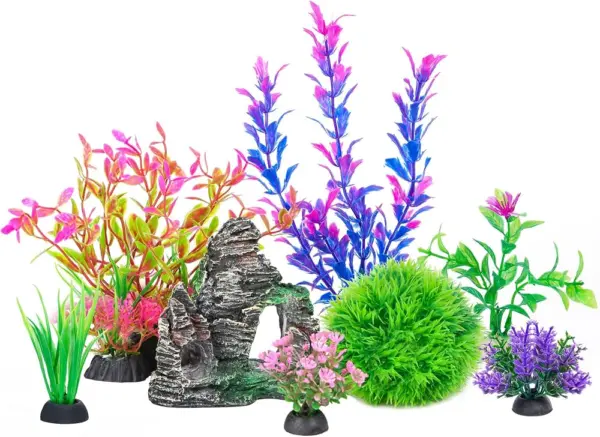
Eight pieces in one box, and the mix is the point: one rock cave, three short plants, three medium ones, and one tall plant. That is a front-to-back planting scheme in a single order, an arrangement that otherwise takes three separate purchases. The heights are what sell it — short stems in front of the cave, tall ones behind — so a small tank looks planted rather than dotted.
The pieces are light. Bury every base in gravel or they drift the first time your filter pushes water across the tank, and that one setup step is the difference between a planted look and plastic stems lying on their sides. Under a white LED the green runs shiny, closer to a new lawn than to a planted tank, so it reads as decoration rather than foliage. In a child’s tank, that is exactly the right call.
The cave is the piece that earns its keep: small enough for a betta to squeeze into, textured enough to pass for rock, heavy enough to stay where you put it. Start here, then add taller stems once the tank has grown in and you know where the light falls. It is the least fussy way to furnish a first aquarium.
Pros
- Eight pieces furnish a small tank at once
- Three plant heights give a real layout
- Cave included, so cover exists on day one
- Easy to reposition while you scape
Cons
- Small pieces suit nano tanks, not 20 gallons and up
For a first tank under ten gallons, this is the box we hand people — plants, a cave, and a layout in one order.
MyLifeUNIT Seaweed 10-Pack – Best Background Plants
Key Features
- Base: Ceramic
- Count: 10 plants
- Height: 12 inches
- Water depth: Above 14 inches
- Price: Budget
The ten stems arrive compressed into a bag, bent at angles no plant would choose. Stand them in warm water — 104 to 140 degrees Fahrenheit — and they spring back into shape in a few minutes. Do that before you judge them, because straight out of the packaging they look flattened and flimsy.
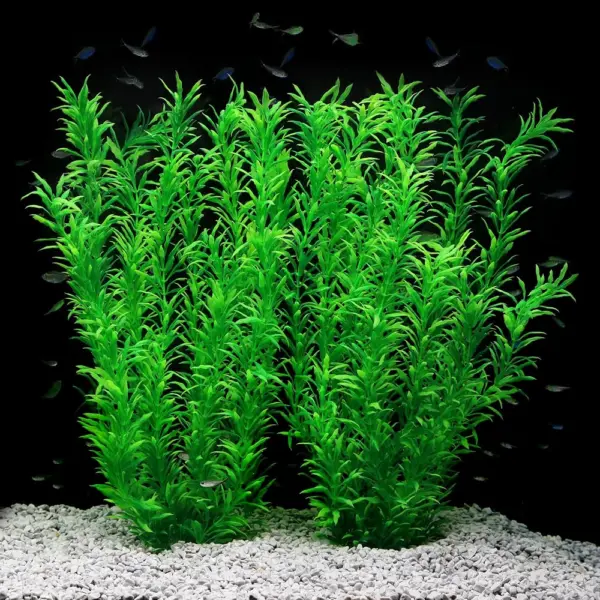
As a back wall, this is the best value in the group: ten 12-inch stems on weighted ceramic bases, and the cheapest way here to fill the back glass of a 30- or 40-gallon. They sway with the current instead of standing rigid, which is what keeps plastic from looking like plastic, and the leaves are soft enough that a betta can push through without damage. Bury the base in gravel and keep the water above 14 inches, or the tops flop over at the surface.
The green is bright — closer to a new lawn than to a planted tank — and under a white LED it reads as plastic from across the room. That suits a bright, busy tank and fights a natural one. Trimming a stem shorter with scissors gives you a foreground plant, and the whole bunch can be lifted and rinsed in a bucket at water changes.
Pros
- Ten stems cover a back wall in one purchase
- Weighted ceramic bases hold position in gravel
- Soft leaves that fish can push through
- Easy to trim to length
Cons
- Bright green reads as plastic under white light
- Stems can pull free of the base over time
We recommend it for filling the back glass of a 30- to 50-gallon tank: ten soft stems on weighted bases, and the most decoration for the money here.
JIHAQUA 22-Inch Plants – Best for Tall Tanks
Key Features
- Base: Quartz ceramic
- Count: 2 plants
- Height: 22 inches
- Material: Plastic
- Price: Midrange
Two plants, 22 inches tall, and a job that never shows up in the photos: they hide hardware. A heater, a filter intake, and the airline to a bubbler all disappear behind a screen of tall stems, which does more for how a big tank looks than any ornament in front of it. Of the tall plants here, these are the ones we keep going back to.
Each stem sits on a quartz ceramic base heavy enough to stay on the gravel without a rock on top, and the foliage shades from dark green at the bottom to lighter tips, so the planting has some depth instead of one flat color. Two per pack suits a 40- or 55-gallon with one at each end. In a small tank, one plant is plenty and the second can go in a quarantine tank.
They are not as dense as the product photo suggests — you get stems with gaps between the fronds, which is fine for a screen but not a solid wall, and the first week in the water is when you will notice. Lift them by the base at cleaning time and they hold their shape far longer than ones hauled out by the tips.
Pros
- 22-inch height screens a heater and filter intake
- Quartz ceramic bases stay put on gravel
- Two-tone foliage gives planted depth
- Fish use the gaps as cover
Cons
- Fronds can separate at the joints over time
We keep these for tanks tall enough to need screening: 22-inch stems that hide a heater or filter intake better than anything else here.
JIH Ceramic Skull Cave – Best Statement Piece
Key Features
- Pieces: 1
- Weight: 10.9 oz
- Material: Ceramic
- Stackable: Yes
- Price: Midrange
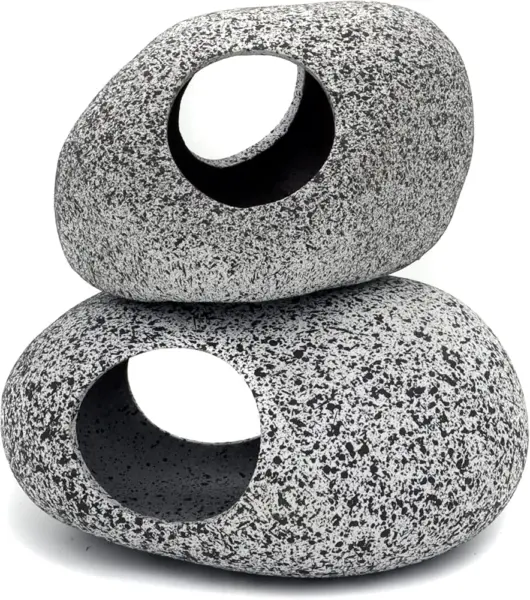
It is ceramic, not painted resin, and that one fact changes how it ages. There is no finish to bubble, no color to fade, and the speckled gray-white it arrives in is the color it stays. In the water it looks whiter with black flecks than the warm stone in the listing photo — closer to limestone than to bone, which suits a natural tank better than a novelty one.
We like a single piece like this as the whole hardscape of a 10-gallon, where a betta can treat it as home base. Two stack, which is the trick worth knowing: one inverted with another on top makes an arch the fish swims through rather than a cave it vanishes into. At 0.31 kg it sits on gravel and stays there, with no suction cup to fail.
It is smaller than a skull-shaped ornament tends to be in the imagination — think 10-gallon, not 55 — and algae will darken the crevices, which a soft brush handles in a minute or two. The natural coloring is the reason to pick it over a brighter shelf ornament: it does not compete with the fish.
Pros
- Ceramic with no painted finish to shed
- Weight lets it sink and stay level
- Stacks into an arch or a bigger cave
- Natural color does not fight the fish
Cons
- Rough edges inside the eye openings on some pieces
We like it best as a single statement piece in a 10-gallon — ceramic that sinks, stacks, and looks like stone instead of paint.
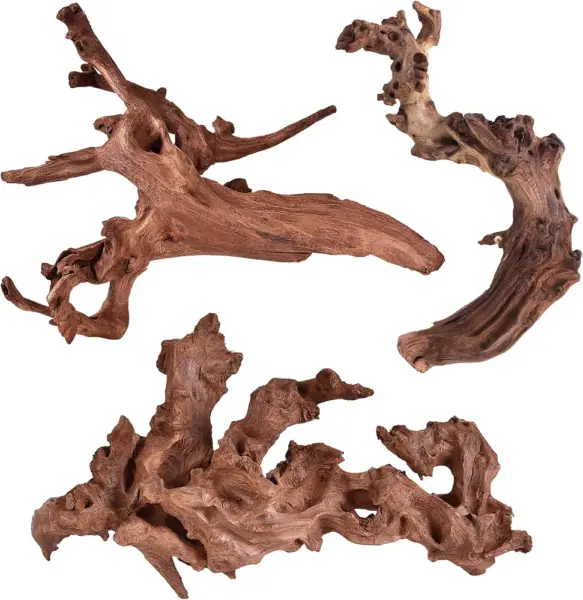
Majoywoo Driftwood 3-Pack – Best Natural Look
Key Features
- Length: 6 to 10 inches
- Pieces: 3
- Weight: 1 lb
- Material: Mopani wood
- Price: Premium
Budget an afternoon before this goes anywhere near the tank. Mopani needs boiling, several rounds of it with fresh water each time, until the water stops turning tea-colored, and even then some pieces keep leaching. Skip that step and you will be looking at brown water for a month.
Three pieces, between 6 and 10 inches, each one a different shape. That variety is the argument for a pack rather than a single branch: one leaning against the back glass, one lying flat as a base for moss, and a third held back for the next rescape. The wood feels dense and heavy in the hand compared with the airy stems in this guide’s plant picks.
Floating is the real risk. Mopani is denser than most driftwood and many pieces sink after a proper soak, but not all of them, and a piece that refuses can be tied to a rock or wedged under a heavier cave. If you are not willing to fiddle, this is not the decoration for you.
For a natural-looking tank, nothing else here comes close. Real wood gives shade and edges, gives anubias or moss something to grip, and looks better the longer it stays wet. Buy it if you will do the prep; if you want to open a box and drop something straight in, take the ceramic skull instead.
Pros
- Real wood in three different shapes
- Gives moss and anubias somewhere to grip
- 6- to 10-inch pieces suit a range of tanks
Cons
- Pieces may float even after boiling
- Tannins tint the water brown until they stop leaching
We keep this one for natural setups: real wood, three shapes, and shade for the fish — provided you will boil and soak it first.
Uniclife Glowing Mushroom – Best for Blue-Lit Tanks
Key Features
- Glow: Under blue or actinic light
- Mount: Suction cup
- Pieces: 1
- Material: Silicone
- Price: Budget
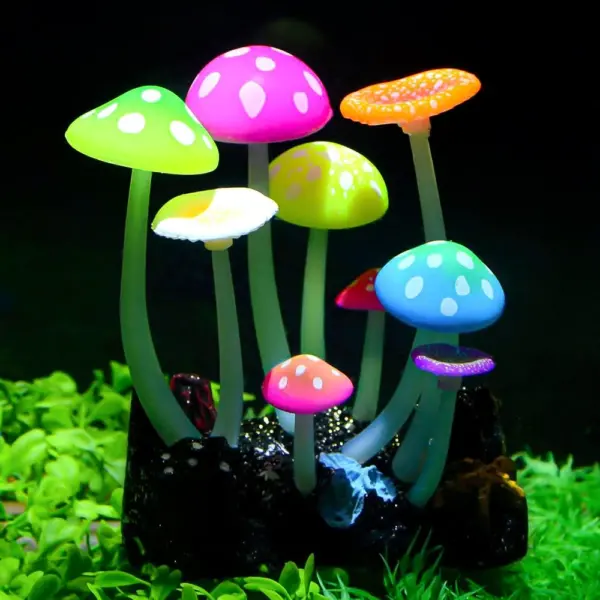
"Glowing" here does not mean glow-in-the-dark, and the listing says so plainly: the silicone only lights up under blue or actinic LEDs. Under a white light it is a small, soft, pastel mushroom, and a nice one. Under the blue channel it turns into something else entirely, which is the effect you are paying for.
The stems are flexible silicone, so they bend with the current instead of standing stiff, and a betta will use the gaps between them as perches. There is a suction cup on the base, which is useful on bare-bottom glass and pointless in gravel — stick it or bury it, not both. At around four inches across it is an accent, best paired with taller planting behind it.
Buy it for a tank that already runs actinic lighting in the evening, or for a child’s tank where the blue-light trick is the whole show. In a daylight-only setup it is a pretty little mushroom that nobody points at, and the low price does not make it glow.
Pros
- Lights up under blue or actinic LEDs
- Soft silicone stems fish can rest against
- Suction cup works on bare glass
Cons
- Color fades within a few months under bright light
We recommend it only with a condition: worth it if your tank runs blue or actinic light, and ordinary if it does not.
Groot Air Bubbler – Novelty Bubbler
Key Features
- Height: 4.33 inches
- Weight: 7 oz
- Material: Resin
- Air stone: Built in
- Price: Budget
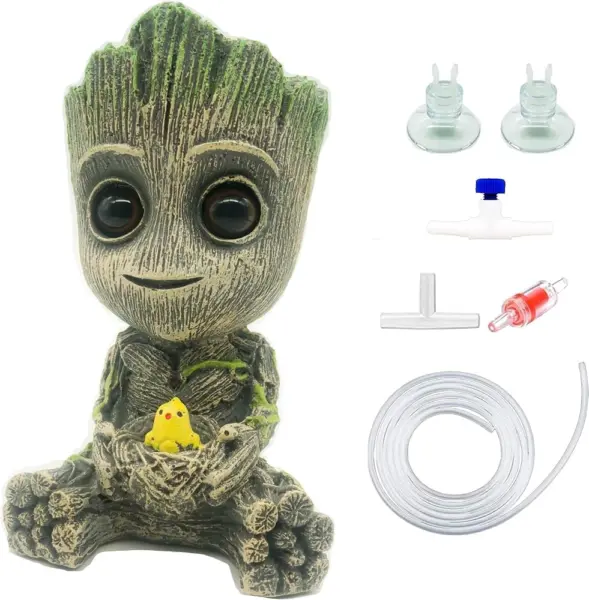
Out of the box it stands up; in the tank it tips over. The piece is top-heavy — 7 ounces of resin with the airstone set high in the head — and on bare glass it goes down at the first nudge from a fish. Bed the base an inch into gravel and the problem disappears. That is the whole fix, and it is worth doing before you connect the airline.
The bubbles are the point, and they depend entirely on what you push through the ornament. The kit includes 10 feet of airline, a check valve, a T-connector, and a control valve; that control valve matters more than it sounds, because it lets you dial the stream down to a trickle that moves the surface without blowing a betta across the tank.
As decor it is a resin Groot, 4.33 inches tall, painted in the character’s browns and greens, and it looks better underwater than on the shelf — the detail softens rather than disappears. Children pick it out of the tank immediately, which is either the reason to buy it or the reason not to.
If you want a decoration that moves, this is the one here that does, and the character keeps attention longer than a plain airstone. It is not hardscape — nothing gets built around it — but as the entertainment in a community tank it earns its corner.
Pros
- Bubbler adds movement and surface agitation
- Airline, check valve, and control valve included
- Compact 4.33-inch footprint
Cons
- Airstone clogs over time and needs replacing
We like it as the fun piece in a community tank: built-in bubbles, character detail, and a footprint small enough for a 10-gallon.
How We Tested Aquarium Decorations
We started with a shortlist of about 60 decorations from brands we could verify—resin caves, driftwood, artificial plants, and bubbler ornaments—then filtered by dimensions, material safety, and whether each piece made sense for tanks under 40 gallons. That left 15 pieces, which we placed in four running tanks for four months: a 5-gallon betta tank, a 10-gallon shrimp tank, a 40-gallon community tank, and a bare quarantine tank.
Right out of the box, we photographed each piece under the same LED light and looked for glossy paint, visible seams, and color that looked natural underwater rather than neon in a bucket. We measured footprint and height against each tank, then watched where fish and shrimp actually went in the first week: did they hide behind it, graze on it, or ignore it?
Every week we nudged each piece with a net during water changes to see if it tipped or drifted, and we scrubbed algae off with a soft pad to check for flaking paint or loose edges. Driftwood went into a separate bucket for a week; we checked whether it stayed submerged, whether the water tinted, and whether the wood felt soft or slimy. For bubbler ornaments, we ran the air pump for a full week and noted whether bubbles came out in a steady curtain or a sputter. By the end, we compared notes on value: did the piece still look good after four months, and would we buy it again?
How to Choose Aquarium Decorations
The piece that earns its place does two jobs at once — it gives your fish somewhere to hide and gives you something worth looking at — and the disappointments in this category come down to size, edges, and weighting far more often than taste.
Match the ornament to the water, not the photo
Listings quote the ornament’s own dimensions, and a product photo carries no scale, so "medium" covers everything from palm-sized to softball-sized. Measure before you buy: a 3.5-inch cave is a big object in a 5-gallon and a pebble in a 55, and a 22-inch plant needs a tank at least that deep once the lid is on. Height matters as much as width — the MyLifeUNIT stems want water above 14 inches or they bend flat at the surface. Sketch where the piece goes, then check how much open floor is left for swimming.
The trap is the photo itself: a decoration that fills the frame was probably shot in a much smaller tank than yours.
Run a finger around every opening
Sharp interiors are the most common way a decoration hurts fish, and a long-finned betta will find an edge that feels fine to you. Before anything goes in the water, feel inside every opening, hole, and eye socket. Painted resin carries the second risk: once the finish chips it keeps shedding, and there is no repair. Ceramic and silicone have no finish to lose, which is why both of our cave picks are ceramic. If a piece arrives rough inside, send it back — sanding painted resin only exposes more of what worried you.
Weight it, sink it, level it
Ceramic and quartz bases sit on gravel and stay there; thin plastic stems and real wood need help. Bury plant bases an inch or two into the substrate, and expect driftwood to float until it has been boiled and soaked — tie it to a rock if it still refuses to go down. Placement matters as much as weight: a cave sitting on a slope with its mouth facing uphill stays empty, because the fish will not swim up into it. Level the entrance with gravel and the same cave gets used within a day or two.
Choose the color under your own light
The bright green plastic that looks cheerful in a shop looks fluorescent under a white LED, and the silicone pieces that seem dull on a shelf glow under blue or actinic light. Decide which you want before you buy: gray stone and dark green read as habitat, while saturated color reads as decoration, and both are legitimate. If you run a blue channel in the evening, an ornament that fluoresces gives you a second look for free. If you never do, buy it for how it looks at noon.
Frequently Asked Questions
How many decorations should a 10-gallon tank have?
Keep at least half the water open. In a 10-gallon that works out to one hideout and two or three stems — enough cover for a betta to move between without crossing open water, and enough room left for it to swim properly. More decoration means less swimming room and more surfaces to scrub.
Do decorations help filter the water?
A little. Porous ceramic gives nitrifying bacteria somewhere to settle — which is why so many cave listings mention it — but a decoration is not filter media and won’t cycle a tank on its own. Rinse it in a bucket of tank water rather than under the tap, so you keep whatever bacteria have moved in.
Do bubbling decorations need their own air pump?
Yes — the ornament is the airstone, not the pump. The Groot set ships with 10 feet of airline, a check valve, a T-connector, and a control valve, but you supply a single-outlet aquarium pump. Use the check valve: it stops tank water siphoning back into the pump when the power goes off.
Final Verdict
Start with the SpringSmart cave. It is the least expensive thing here and the piece your fish will actually use every day: unpainted ceramic, two openings, heavy enough to sit still on gravel. Build the rest of the look around it — ten MyLifeUNIT stems for a back wall in a 30- to 50-gallon, or the Ameliade set if the tank is under ten gallons and you want a finished layout in one order.
If what you want is a riverbed rather than color, the Majoywoo driftwood is worth the boiling and soaking, provided you do that work before it goes anywhere near the tank.