This post contains affiliate links. We may earn a small commission when you buy through our links — at no extra cost to you.
Ceramic rings are the unglamorous workhorse of aquarium filtration: rough, porous noodles that give beneficial bacteria a place to settle so ammonia and nitrite don’t swing between water changes. My first canister filter came packed with a bag of them, and I ignored them until a cloudy tank reminded me that mechanical floss alone doesn’t cut it. They’re not a magic fix, but the right rings can mean clearer water, steadier readings, and a filter that isn’t running on the edge.
The catch is that a good-looking ring isn’t necessarily a useful one. Some crumble into dust when you rinse them, some are so dense that water barely moves through, and some bags hold too few pieces to fill a real canister tray. Over the past four months, I’ve run 15 different ceramic ring options in my own tanks and my team’s test setups, from a shrimp tank to a heavily stocked community tank, and the differences in porosity, size, durability, and how clean they stay were obvious within weeks. If you’re upgrading from cartridges or replacing a tired bag of media, the picks below are the ones that earned their place.
Our Top Picks
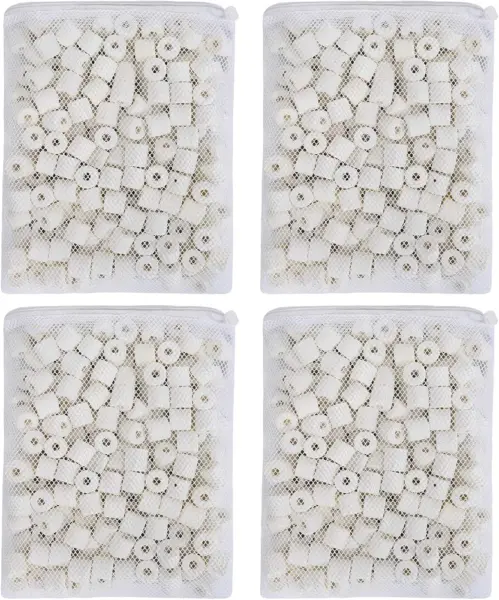
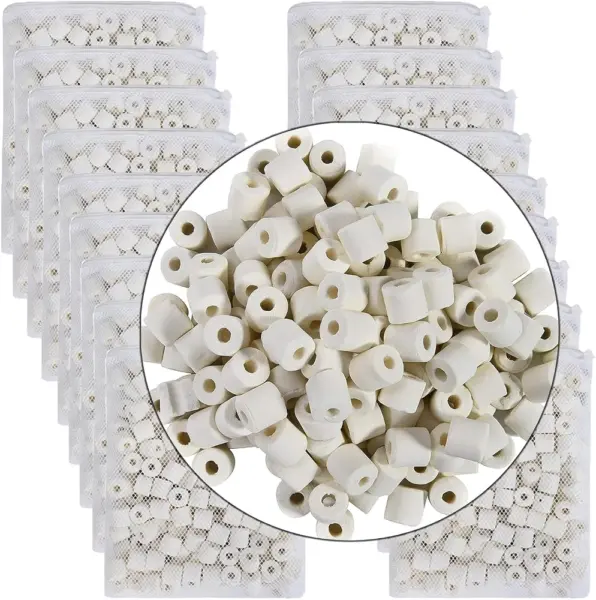
The Best Aquarium Ceramic Rings, Reviewed
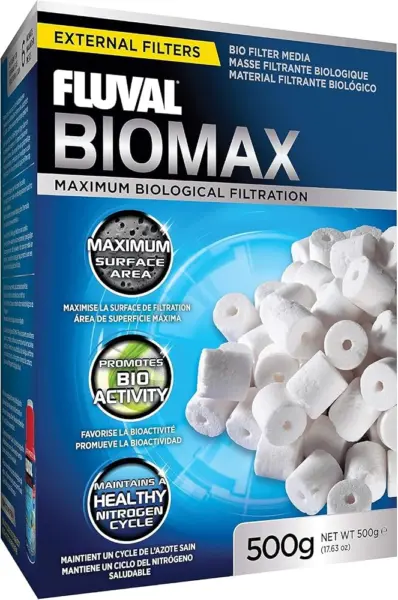
Fluval BioMax 500g – Best Overall
Key Features
- Form: Loose porous media
- Quantity: 1.1 lb
- Filter fit: 14 Fluval canister models
- Water type: Fresh and salt
- Price: Midrange
Fourteen Fluval models, from the 104 up through the 406 and out to the FX5 and FX6, and this bag is sized to fill the media baskets in all of them. That sounds like a small thing until you have spent twenty minutes snapping oversized rings to fit a 206 tray. BioMax pours in, settles into the basket, and leaves enough gap between pieces for water to move through rather than around.
It’s our default for a Fluval canister because the structure is doing real work: the pieces are riddled with internal passages rather than being smooth shells, which buys contact time as water passes through. Tanks that were hazy before a media change tend to clear quickly once a seeded bag goes in, and the ceramic stays inert in fresh or salt water, so it won’t drag your parameters around while it colonizes.
The pieces are chunky. In a 306 or an FX basket that’s fine; in a narrow hang-on-back chamber you’ll be forcing the last few in. Give it a rinse in a colander first — the media arrives gritty, and that dust is ugly in the water column even when it’s harmless.
Ignore the monthly replacement suggestion on the pack. Rinse instead: squeeze the media in the water you pull during a water change, never under the tap, and swap roughly half at a time so the colony on the rest keeps the tank cycled while the new material seeds.
Pros
- Fits 14 Fluval canister models
- Porous media that clears hazy water
- Rinses and re-seeds instead of wearing out
Cons
- No media bag included in the box
For a Fluval canister, this is the media we hand people first: porous, inert in fresh or salt water, and sized to fill the trays without trimming.
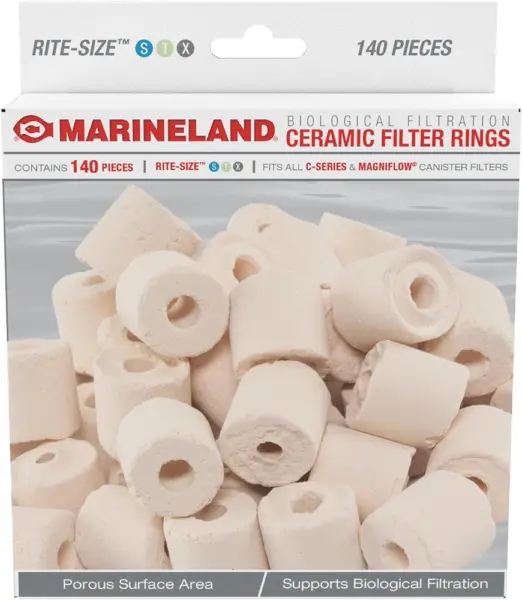
Marineland Ceramic Rings 140 ct – Best for Canister Trays
Key Features
- Count: 140 rings
- Filter fit: C-series and Magniflow
- Ring sizes: Rite-Size S, T and X
Smaller rings than the top pick, and 140 of them in the box. Marineland’s Rite-Size rings are aimed at the S, T and X baskets in the C-series and Magniflow canisters, and the smaller diameter is the whole point: they turn corners, fill the gap around a prefilter, and pack a tray more completely than a handful of big cylinders. We like them for exactly that — shallow square trays where coverage matters more than how fancy the ceramic is.
They’re ceramic in the plain sense: hard rings that keep their shape through rinsing and don’t shed crumbs toward the impeller. Water runs clear on them, and nothing exotic is going on — just a lot of wetted surface for bacteria to sit on while the flow goes past.
A box this size refills a full canister with enough left for a second basket, which is why it suits the periodic top-up rather than the build-from-scratch job. Loose rings are the trade-off: keep a mesh bag on hand if the media ends up anywhere with a pump downstream of it.
Pros
- Small rings pack tight trays and corners
- Holds its shape without crumbling
- 140 rings covers a full canister refill
Cons
The straightforward choice for a C-series or Magniflow canister: 140 small rings that fill a tray corner to corner and hold up to rinsing.
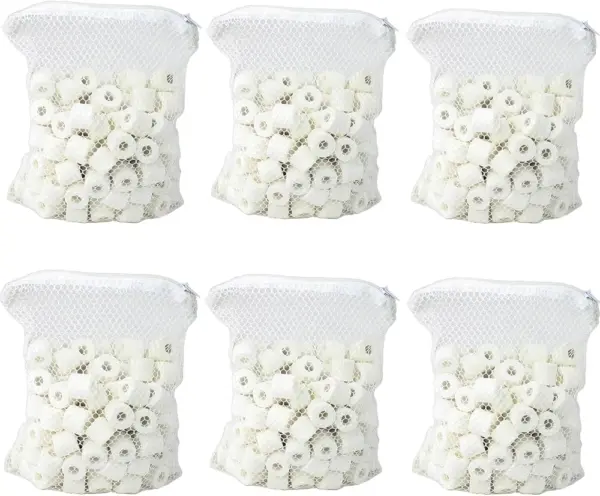
AQUANEAT Bio Ceramic Rings 6 lb – Best Bulk Kit for Sumps
Key Features
- Bag size: 8 x 5.5 in
- Quantity: 6 lb in 6 bags
- Ring size: 11/16 x 5/8 in
- Water type: Fresh and salt
- Price: Midrange
Six mesh bags come with this one, and the zips are the detail that matters: a full bag lifts out of a sump in one piece, rinses in a bucket of tank water, and goes back without you chasing rings around the baffles. Eight by five and a half inches each, which is a workable parcel to lift one-handed.
The rings run eleven sixteenths of an inch across and are hollow through the middle, and the mesh is fine enough to keep them contained. Fresh and salt water both work, and the same bags drop straight into a pond filter or a media tower where you want volume rather than finesse.
Where this earns its place is the packaging as much as the ceramic: six ready-to-drop parcels instead of a sack you portion out with a scoop. For a pond, a big sump, or a fish room with several filters, that’s the difference between maintenance you do and maintenance you postpone.
Pros
- Six reusable zippered media bags
- Large rings suit sumps and ponds
- Works in fresh and salt water
Cons
- Too large for shallow hang-on-back baskets
Six pounds, six reusable zippered bags, and rings big enough to keep a sump or pond moving — the bulk buy we point pond keepers toward.
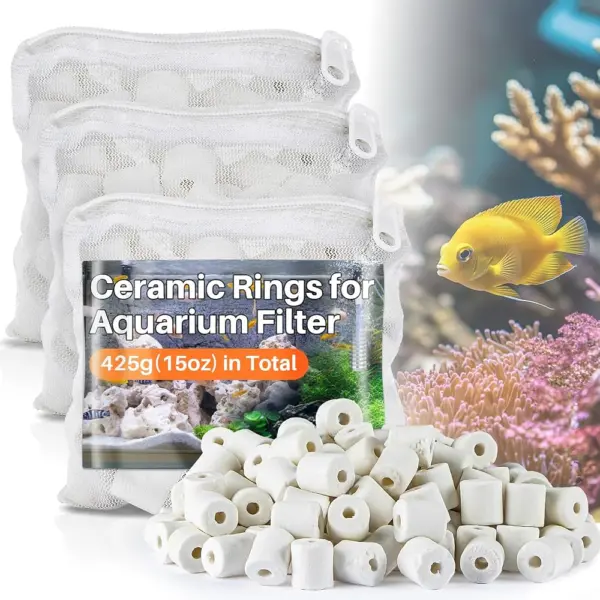
Sukh Ceramic Rings 15 oz – Best for Small Tanks
Key Features
- Bags: 3 mesh bags
- Quantity: 15 oz
- Filter fit: Fluval 106–406, FX5, FX6
- Water type: Fresh, salt and pond
- Price: Budget
Three small bags instead of one big one is the whole idea here. Fifteen ounces of hollow, porous rings, plus three mesh bags to divide them between, so one bag goes in the filter, one in the quarantine tank, and one waits for the next setup. For a small system that’s the right quantity — you’re not storing five pounds of media you may never use.
The compatibility list runs the whole Fluval range from the 106 to the 406, plus the FX5 and FX6, ponds and cartridges, so it drops into most chambers you’d point it at. Rinse it first; new ceramic is dusty, and a couple of minutes in a colander saves you a hazy afternoon. After that it follows the same routine as any bio media: clean it in old tank water and never swap the lot at once.
Pros
- Three bags to split across filters
- Fits the Fluval 106–406 range
- Rated for fresh, salt and pond use
Cons
- Fifteen ounces won’t fill a full-size canister tray
For a nano tank or a quarantine filter, this is the sensible size: fifteen ounces split into three bags, so you’re not storing pounds of leftover media.
JIH Bio Ceramic Rings 4 lb – Best for Tight Chambers
Key Features
- Quantity: 4 lb in 4 bags
- Ring size: 1/2 x 1/2 in
- Water type: Fresh and salt
- Price: Midrange
Half-inch rings — the smallest diameter here, level with the JIHAQUA box — and that’s what you want when the media basket is shallow and a bigger ring would sit proud of the rim while water went around it.
Four pounds arrive in four mesh bags. The rings are hollow and porous, sized so water moves through the middle as well as around the outside, and the ceramic is inert in fresh or salt water.
Four pounds is a middle weight: enough to fill a couple of hang-on-back baskets or top up a canister without committing to a sack that lives in the cupboard for a year. Budget ten minutes with a colander before the first use — new rings come dusty, and unlike established media you can rinse these under the tap, because nothing is living on them yet.
Pros
- Half-inch rings fit shallow baskets
- Four mesh bags included
- Inert in fresh and salt water
Cons
The size to buy when the basket is shallow: half-inch rings in four bags, enough for a couple of hang-on-back filters without a cupboard full of spares.
JIHAQUA Bio Ceramic Rings 18 lb – Best for Ponds and Fish Rooms
Key Features
- Quantity: 18 lb in 18 bags
- Ring size: 1/2 x 1/2 in
- Water type: Fresh and salt
- Price: Premium
Eighteen pounds is a serious commitment of shelf space: eighteen mesh bags, each holding about a pound of half-inch rings. It’s the biggest box in this group by a wide margin, and it’s the one to look at when a single canister is not the job.
For a pond, a fish room, or a club order split between members, this is the sensible buy: the cost per pound is the lowest here, the rings are small enough to fill tight chambers, and the ceramic is inert in fresh or salt water. You’re paying for volume and getting volume — no half measures.
The bags are the practical part: filled, zipped and ready to drop, so you grab one when a filter needs refreshing instead of measuring from a sack. Keep the spares dry — ceramic doesn’t expire, but a damp bag in a garage will grow things you don’t want near a tank.
Pros
- Eighteen pre-filled bags for large systems
- Half-inch rings fill tight chambers
- Lowest cost per pound in this group
Cons
- Far more media than a single tank needs
The box to buy when one canister isn’t the job: eighteen pounds of half-inch rings in pre-filled bags, at the lowest cost per pound here.
Reefing Art Ceramic Bio Media 24 pcs – Best for Sump and Refugium Builds
Key Features
- Count: 24 pieces
- Volume: Half gallon per box
- Weight: 1.75 lb
- Material: Non-metallic ceramic
- Price: Midrange
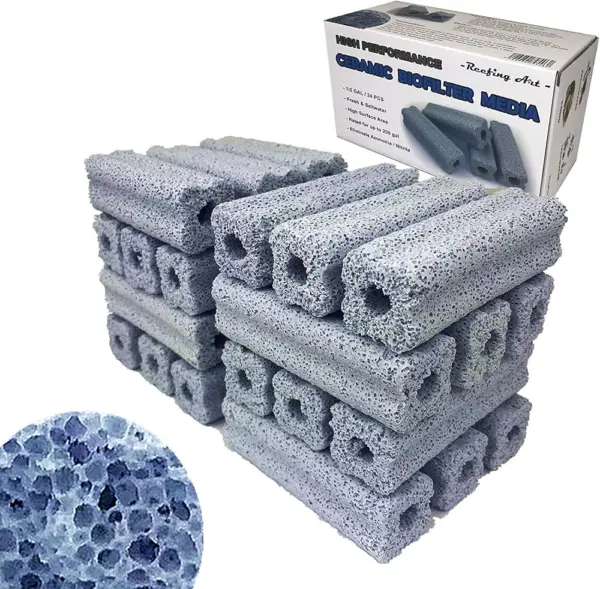
Twenty-four pieces fill about half a gallon, and not one of them is a ring. These are hollow ceramic blocks — chunky, stackable shapes meant to be built into something rather than poured into a tray.
The material is the selling point: non-metallic ceramic that won’t leach aluminum, with a porous internal structure and a rough outer face. Fresh water, ponds and reef sumps all take it, and the pieces are light enough to stack without much fuss.
Light cuts both ways. In a high-flow sump a loose pile can shift, so build the stack against a baffle or weigh the top piece down. The hollow centre also means a heavy-handed rinse can snap one in half, which is worth knowing before you scrub them.
Where these earn a place is the sump and refugium work that rings handle badly: a rear chamber in an all-in-one, a media tower, a stack behind a filter sock. If your media goes into a canister drawer, buy rings instead — they pack tighter and stay put.
Pros
- Stackable blocks for sump builds
- Non-metallic ceramic that won’t leach
- Rough, open surface for colonization
Cons
- Half a gallon per box won’t fill a large sump
A sump builder’s media rather than a canister refill: stackable hollow ceramic blocks that suit open chambers and rear compartments, not shallow trays.
How We Tested Ceramic Rings in Real Filters
We built our shortlist by reading listings for material, dimensions, and bag quantity, then crossing off anything with vague ceramic claims or a surface that looked slick rather than porous. We ended up with 15 kinds of rings in a range of sizes and counted how many pieces actually fit a standard canister tray without crushing. Before anything went into a filter, we rinsed each batch in a white bucket and noted how much dust and grit came off and how quickly the water cleared. We also weighed a dry cup of each, soaked it for 24 hours, and weighed it again to compare water uptake as a rough porosity check.
The rings ran for four months in three setups: a canister on a 75-gallon community tank, a media bag in a hang-on-back filter, and a small canister on a shrimp tank. Every two weeks we opened the filters and checked whether the rings had compacted, whether flow had slowed, and how much mulm sat on the surface. We rinsed half of each batch in tank water and watched whether biofilm came off easily or the rings started to crumble; we also kept up ammonia and nitrite tests, especially in the first two weeks after a media swap, and took side-by-side photos to compare water clarity. Rings that packed into a solid brick, shed grit, or chipped after a short drop onto tile were marked down.
At the end, we compared how much usable media each bag delivered by counting rings that fit our trays without forcing, noting how many rinses they survived, and factoring in the quantity in each package relative to what it cost. The winners weren’t always the most porous on paper. They were the ones that stayed intact, fit the space they were meant for, kept water moving, and showed a clear surface for bacteria to colonize without turning into a rinsing headache.
How to Choose Aquarium Ceramic Rings
Ceramic rings are the cheapest biological filtration you can buy, and nearly every disappointment comes down to two things: a ring size that won’t fit the chamber you own, and more media than your tank can ever colonize.
Ring size decides where the media can go
Two diameters cover most of this category: half-inch rings and the eleven-sixteenth rings that turn up in the bulk packs. Half-inch media fills shallow hang-on-back baskets, small canister drawers and rear chambers in all-in-one tanks. The larger rings suit sumps, media towers and ponds, where depth and flow give them room to work.
Get this wrong and the rings sit proud of the basket while water slips past them — biological filtration you paid for and never used. Check the depth of the chamber, not just its width, before you pick a size.
Buy media for the tank you have
Ceramic is cheap by the pound, which is exactly how people end up with eighteen pounds of it for a twenty-gallon tank. A single canister drawer takes about a pound of media; a hang-on-back basket takes a few ounces. Everything past that sits in a cupboard, and a tank can only colonize so much surface at once anyway.
Setting up one filter? Buy the small pack and top up later. Feeding a pond, a fish room or a club order? That’s when the bulk boxes earn their price.
Porosity and the surface-area numbers
Every box quotes a surface area, and none of those figures are comparable between brands. What you can actually judge is texture: rings with a rough face and visible internal passages hold more bacteria than glassy ones, and open-celled blocks beat both for sheer volume inside the same footprint.
It matters less than fit and flow, though. A plain ring in a well-placed tray outperforms an exotic one sitting in a dead corner where no water moves past it.
Where the media sits in the filter
Biological media belongs last, after the mechanical stage, and it needs to stay clean enough to breathe. Put a coarse sponge or a layer of floss ahead of the rings and they stay open for months. Bury them under a mat of sludge and the pores clog with detritus instead of housing bacteria.
Don’t cram the chamber either. A little loose volume with water moving evenly across the whole basket beats another handful of rings jammed into the last gap.
Rinsing, replacing, and keeping the colony alive
New ceramic arrives gritty, and new rings have nothing living on them, so rinse those under the tap — a colander and a couple of minutes is plenty. Once the media is seeded, the rules change: rinse it in water pulled during a water change, never under the tap, and never with soap.
Replace a portion at a time and leave the rest in place so the filter keeps cycling. The monthly replacement schedules printed on some packaging are a suggestion, not a rule.
Frequently Asked Questions
Do ceramic rings cycle a new tank on their own?
No. The rings are habitat, not bacteria — the colony has to come from somewhere. Seed them with a bag of media from an established filter, a squeeze from a mature sponge, or a bottled culture, then test ammonia and nitrite every couple of days.
When both read zero after you feed the tank, the rings are working. Rings alone in a brand-new tank just sit there looking ceramic.
Do ceramic rings clear cloudy water?
Not directly. They process ammonia and nitrite, which is chemistry you can’t see; cloudiness is usually fine particles or a bacterial bloom. Put floss or a filter sock ahead of the media to polish the particles out, and give a bloom a few days to settle.
If green water is the problem, sort out light and nutrients first — rings won’t fix either.
Can I use ceramic rings in a saltwater reef sump?
Yes. Inert ceramic behaves the same in salt water, and a bag of half-inch rings in a sump is a normal way to add biological capacity to a reef system.
The catch is detritus: rings in a high-flow sump collect it, so keep a filter sock upstream and lift the bags out for a rinse every few months. Stackable blocks suit an open sump chamber better than loose rings.
Final Verdict
If you run a Fluval canister, buy the BioMax and stop thinking about it: it fills the trays, holds a colony through rinsing, and stays inert in fresh or salt water. Everything else here is a fit decision. Shallow baskets and hang-on-back chambers want the half-inch JIH rings, a sump or a pond wants the AQUANEAT bags, and a fish room or club order wants the eighteen-pound JIHAQUA box.
Match the ring to the chamber and the rest is just rinsing.