This post contains affiliate links. We may earn a small commission when you buy through our links — at no extra cost to you.
Small tanks are not small versions of big tanks. Five gallons of water can swing several degrees in an afternoon, and a heater that overshoots by two degrees is the difference between a calm betta and a stressed one. What you need is not the most powerful heater on the shelf—it’s one that holds a steady temperature, fits without swallowing the tank, and is simple enough that you’ll actually check it. I’ve kept five-gallon tanks on kitchen counters and office desks, and I’ve learned that the cheap preset pucks are not all created equal.
Over four months, I tested 14 heaters for five-gallon setups through morning feedings, weekly water changes, and the room-temperature dip during a cold snap. The good ones share a few traits: a thermostat that matches the water, a footprint small enough to hide behind a filter, and suction cups that don’t give up after a month. A few were fine; a few were quietly alarming. The picks below are the ones I’d trust with a betta, a shrimp colony, or a handful of tiny tetras.
Our Top Picks
The Best Aquarium Heaters for 5-Gallon Tanks, Reviewed
hygger Mini 50W – Best Overall
Key Features
- Safety: Low-water and overheat shutdown
- Wattage: 50 watts
- Controls: External controller with digital display
- Tank rating: 5–10 gallons
- Price: Midrange
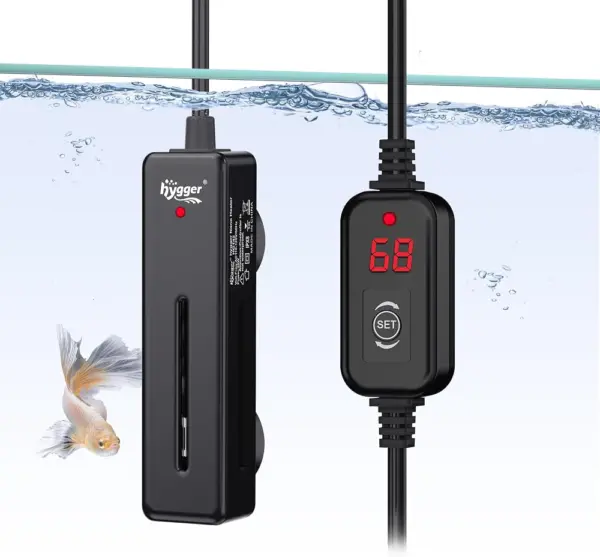
The controller sits at the end of the cord rather than on the glass, and that one decision is why this is the heater we recommend first. In a five-gallon the heater hangs close to the surface and close to your wrist, so twisting a dial under water is the least pleasant chore in the hobby. Here you read a small display, step the target up or down, and walk away. The element is about four inches long and an inch tall, small enough to tuck behind a clump of plants or a sponge filter.
Adjustability earns its keep at this volume. Five gallons moves fast — an open window, a cold snap, a water change mixed a little cool — and a preset heater has no answer when the room runs colder than usual. The display shows the set point and the water, so you can see the difference instead of guessing at it. The safety side is real too: it cuts the element when the water drops below the minimum and shuts down on overheat, with an alarm when something is wrong. In a tank you drain partway every week, that isn’t a marketing line.
Two things to know before you buy. Fifty watts is at the top of what five gallons needs, so run it alongside a filter or airstone that moves the water rather than dropping it into a still, unfiltered bucket. And the controller needs somewhere to live, which means one more piece of cord at the rim of a tank you were trying to keep looking clean. Neither changed our mind.
Pros
- Setting lives outside the water
- Display shows target and actual temperature
- Low-water and overheat shutdown with alarm
- Four-inch element hides in a small tank
Cons
- Controller and cord add clutter at the rim
Our pick for a five-gallon: set-and-read temperature control, a body small enough to hide, and cutoffs that matter when the water level drops.
HITOP 25W Adjustable – Best Budget Adjustable
Key Features
- Wattage: 25 watts
- Body length: 7 inches
- Tank rating: 5–10 gallons
- Temperature range: 68–93 °F
- Price: Budget
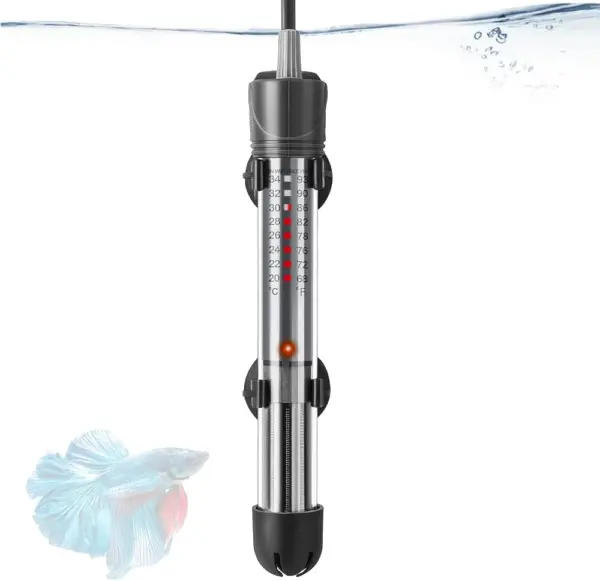
An adjustable range of 68 to 93 °F at roughly what a preset heater costs is why this one made the list, and it’s the pick for anyone who wants a betta tank at 80 °F without buying a controller. The trade is that the setting lives on the heater itself, so every change is a hand in the water. We minded that less than expected: set it once, check it against a thermometer for a week, then leave it alone.
Twenty-five watts is the right amount for five gallons in a normal room, and the 5 to 10 gallon rating leaves headroom if you move up to a ten later. The body is seven inches long and under an inch across, so it occupies more vertical space than the little preset pucks do — we mounted ours low behind a piece of driftwood, and it disappeared into the aquascape within a week.
Build is where the money went. The quartz tube is 2 mm, roughly a third thicker than the 1.5 mm glass common at this end of the market, and in a tank with a fish that shoulder-barges everything, that’s the specification we care about most. Two suction cups plus a spare hold it, and the five-foot cord reaches an outlet in most desk setups without an extension.
Pros
- 68–93 °F range for preset-heater money
- 2 mm quartz, thicker than the usual tube
- 5–10 gallon rating leaves room to upsize
Cons
- Runs a few degrees warmer than the dial says
If you want a real thermostat without paying for a controller, this is the one — 25 watts, a 5 to 10 gallon rating, and a warmer setting a twist away.
NICREW 50W – Best After a Power Cut
Key Features
- Wattage: 50 watts
- Controls: External controller with memory
- Tank rating: 5–10 gallons
- Overheat cutoff: 98 °F (36 °C)
- Price: Midrange
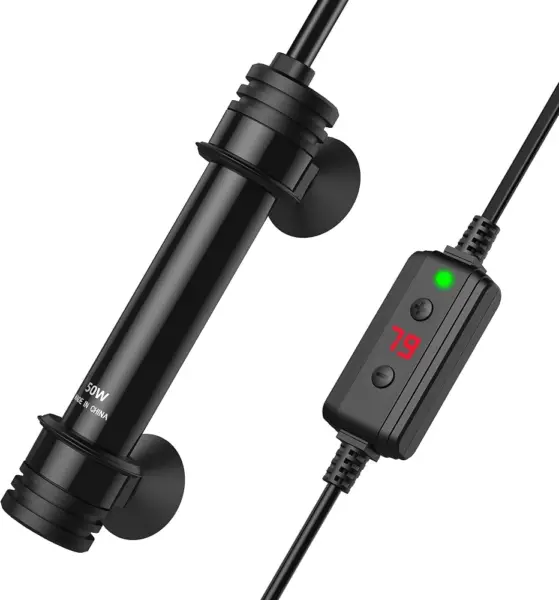
The controller remembers your setting. After a power cut it comes back where you left it instead of starting over, which sounds like a small convenience until you keep a tank at 80 °F, lose power for a couple of hours in February, and come home unsure what the heater has been doing all afternoon. The rest is a familiar external-controller layout: a display unit on the cord, a submersible element, suction cups for the glass.
Fifty watts across a 5 to 10 gallon rating heats quickly, and that cuts both ways in a nano tank — fast recovery after a water change, less margin if the controller reads the water wrong. That’s why the dual sensors and the 98 °F cutoff are the parts we point to: the element shuts off before a small volume of water can get dangerous. Set the target low to begin with, watch the first week against a thermometer, and it settles into a routine.
The element mounts upright or sideways on the cups and stays put on clean glass. It’s heavier than the preset pucks and feels less like a toy in the hand. Having the readout outside the tank is the underrated part: no fogged glass, no leaning in with a flashlight to work out whether the light is red or green.
Pros
- Returns to your setting after an outage
- Cuts off at 98 °F before a small tank overheats
- Dual sensors and quick heat-up
Cons
- Display can read a few degrees off the water
We like it most in homes with unreliable power: it comes back to your setting after an outage and shuts off at 98 °F.
HiTauing 50W – Best Guarded Element
Key Features
- Safety: Out-of-water and over-temperature shutoff
- Wattage: 50 watts
- Controls: External digital controller
- Tank rating: 5–10 gallons
- Price: Premium
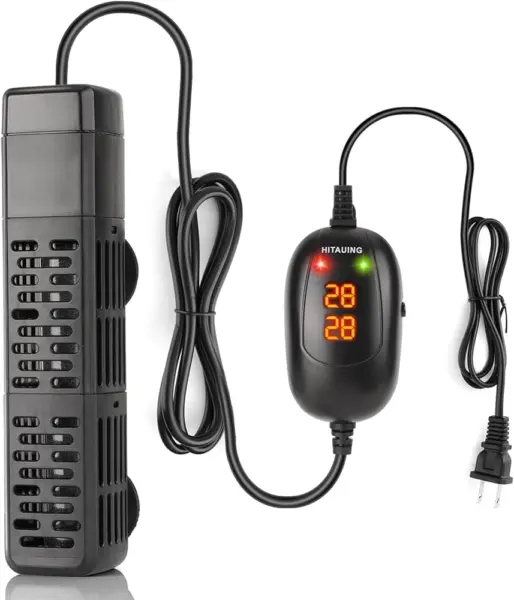
Most heaters in this group are bare glass tubes with a hot band near the top, and a betta that wedges itself between the heater and the back glass will find it. HiTauing wraps the element in a housing, so the surface a fish can touch stays cooler and there’s nothing sharp to catch a fin. If you keep snails or shrimp that climb, the same shell gives them a surface to graze instead of bare glass.
The controller carries the rest of the pitch: two LED digits showing the target and then the actual water temperature, with a light for heating versus holding. There’s also a water sensor, so lifting the heater clear during a water change powers it down rather than letting it cook itself — one of the classic ways a small heater dies.
It’s the priciest of the six, which is the honest trade for a guarded element. If your fish ignore the heater entirely, the hygger does the same job for less money. If your betta sleeps pressed against the glass, the housing is the whole reason to buy.
Pros
- Housing keeps fish off the hot element
- Powers down when lifted out of water
- External display shows set and actual temperature
Cons
- Bulkiest body of these picks
Buy this one when a fish actually touches the heater — the housing is the reason, and we think it’s worth putting up with the bulk.
DaToo 50W Digital – On-Heater Readout
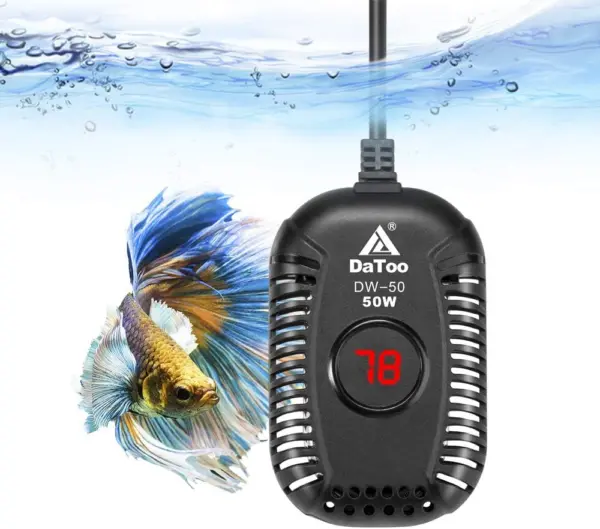
Key Features
- Display: On-heater LED readout
- Sensors: Three-point temperature control
- Wattage: 50 watts
- Tank rating: 2–10 gallons
- Price: Budget
Unlike the hygger and the NICREW, the numbers on this DaToo sit on the heater itself rather than on a controller at the end of the cord. That means nothing extra to mount at the rim of a five-gallon, and you read the temperature through the water — which works better than it sounds, because the digits are big enough to check from across the room.
Three sensing points is the claim that separates it from the cheap preset pucks, and the point of that design is to stop the element short-cycling in a small volume of water. We set ours for a betta tank and left it, and the readout is what we used every day; not hunting for a separate thermometer is a convenience you notice only once it’s gone. The 2 to 10 gallon rating is the widest here, so the same heater moves to a ten when you do.
Space is the bigger consideration. In a five-gallon it claims a real share of the back glass, and it is chunkier in person than the listing photos make it look. The ABS shell and thicker quartz are the sort of build detail you appreciate only after a glass tube has cracked on you.
Pros
- Readout on the heater, no controller to mount
- 2–10 gallon rating has the widest range here
Cons
- Bigger in the tank than photos suggest
- Temperature regulation can drift with age
A good fit if you’d rather read the temperature off the heater than off a controller, and you can spare the back glass.
AQUANEAT 25W Mini – Best for Tiny Preset Tanks
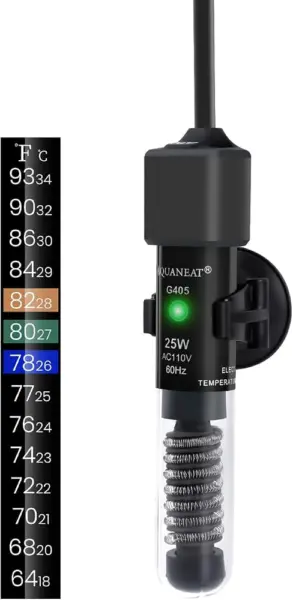
Key Features
- Wattage: 25 watts
- Body length: 4.5 inches
- Tank rating: 3–5.5 gallons
- Preset temperature: 78 °F
- Price: Budget
There is no dial, and that’s the point: 25 watts, preset to 78 °F, plug it in and stick it to the glass. For a betta on a desk in a three- or five-gallon, that removes the one setting you could get wrong. The body is four and a half inches, short enough to sit under the waterline in a tank that isn’t filled to the brim.
The light does the thinking — red while it’s heating, green when it’s resting — so a glance from the doorway is your daily check. The single suction cup holds it upright or sideways, and it will let go eventually; that’s the nature of the mount rather than a fault, and it takes a second to press back on when you do a water change.
Where this one stops is a tank that wants 80 °F. There’s no adjustment at all, so when a cold room holds the water at 76, you have no move except a warmer room or a different heater. The warranty is the shortest of this group at thirty days, which tells you what the maker expects. For a betta bowl upgrade, a quarantine bucket, or a spare on the shelf, neither point matters much.
Pros
- Preset 78 °F, nothing to adjust
- 4.5-inch body suits small tanks
- Red and green light for a quick check
Cons
- No way to adjust above or below 78 °F
- 30-day warranty is the shortest here
For a small tank in a warm room, this preset tube is the simplest thing here — we keep one on the shelf as a spare.
How We Tested (and Lived With) Five-Gallon Aquarium Heaters
We started by pulling together heaters sold for tanks in the five- to ten-gallon range, then narrowed the list to models with a footprint that would fit under a standard hood, a thermostat you could actually set, and enough mounting hardware to keep the heater off the substrate. That left 14 units, from small preset pucks to adjustable glass heaters with guards.
Over four months, those heaters ran continuously in three five-gallon setups: a betta tank on a kitchen counter, a shrimp tank on a desk, and a quarantine tank in a quiet corner. I checked water temperature at both ends of each tank every morning before feeding and again after lights-out, using a separate thermometer, and logged the gap between the set point and the actual reading to judge temperature control. I also timed how long each heater took to bring a tank from room temperature to 78°F, watched for overshoot after a water change, and noted whether the indicator light cycled in a steady rhythm or stayed on for long stretches. A cold snap that pushed the room into the low 60s gave me a second look at how well each one recovered.
Size and ease of use got the same treatment. I mounted each heater with its included suction cups, then left it in place through weekly water changes to see whether it slid down the glass or stayed put. I adjusted the dial with wet hands, unplugged and replugged each unit during maintenance, and checked whether the cord reached an outlet without an extension cord. After four months, I looked for signs of wear that would matter over a year, not just four months: condensation inside the housing, cracked glass, stiff suction cups, and any change in build quality or how tightly the thermostat held temperature. Value came down to whether the extras—a guard, a better dial, a longer cord—were worth paying for, not just the lowest price on the shelf.
How to Choose a Heater for a 5-Gallon Tank
Five gallons is a small, fast-moving body of water, so the control a heater gives you matters more than the number of watts printed on the box.
Match the rating to the tank, not to a future upgrade
Read the maker’s gallon rating first. A 25-watt heater rated for 3 to 5.5 gallons and a 50-watt rated for 5 to 10 both suit a five: the 50 warms faster and recovers quicker after a water change, while the 25 has a gentler touch in a small volume. What you don’t want is a heater rated for 20 to 75 gallons "for later." In five gallons it has a coarser effect and less margin before it overshoots. Pick one whose range covers your tank today, and replace the heater when you replace the tank.
Preset or adjustable
A preset heater holds 78 °F and nothing else. That’s the right call for a betta in a warm room, and it removes a dial that can be knocked out of position. Adjustable is worth paying for when your target isn’t 78 — bettas often do better at 80, and some species want cooler water — or when the room swings through the year. It’s also what you reach for when the tank sits at 76 in January and you need those extra degrees. If you can’t name the temperature you want, buy preset and put the difference toward a thermometer.
Where the controls sit, and where the heater goes
There are two layouts: a dial or display built into the heater, or an external controller on the cord. The first is simpler and leaves nothing extra at the rim. The second lets you change the setting with dry hands, which is a real luxury when the heater is at the bottom of a planted tank.
Placement matters just as much. Keep the whole unit under water, put it where water actually moves, and mount it low and horizontal if you want it out of sight. A heater sitting in still water warms the water around it and very little else.
The protections worth paying for
Two cutoffs earn their keep in a small tank: overheat shutdown and out-of-water shutdown. The first stops a stuck element before five gallons turns into poaching water. The second saves the heater when you drain the tank and forget it’s still plugged in. An audible alarm is a bonus if the tank lives somewhere you don’t walk past every hour. Whatever the box promises, unplug the heater and give it ten to twenty minutes to cool before you lift it out — thermal shock is what cracks glass.
Frequently Asked Questions
Do I really need a heater in a 5-gallon tank?
It depends on the fish. Bettas, guppies, tetras and most tropical species want 76 to 80 °F, and a room sitting at 68 to 72 will pull five gallons well below that overnight. Goldfish and white cloud minnows are the exceptions — they are cool-water fish and don’t need one. If you’re keeping a betta, budget for a heater and a separate thermometer from the start; a small unheated tank is how fin problems and lethargy begin.
Do the stick-on thermometer strips that come with these heaters work?
As a rough check, yes; as your only thermometer, no. Those strips read the temperature of the glass, which lags behind the water and shifts with room temperature, sunlight and the lid being off. Use a separate in-water thermometer, either a floating glass one or a probe, and keep the strip as a backup you can read from across the room. If the two disagree, believe the one sitting in the water.
How long should a small aquarium heater last?
Longer than a season, and shorter than you might hope. These units are sealed, so nothing is serviceable and the warranty is the honest signal of expected life — 30 days on the cheapest preset, a year on most of the adjustable ones. Replace the heater when the tank stops holding its set temperature at the same room temperature, not when the indicator light stops working. A spare preset heater on the shelf turns a failure into a five-minute swap instead of an emergency.
What does a 50-watt heater cost to run?
Very little. Fifty watts is less than a classic incandescent bulb, and the element only draws power while the water is below its set point, which in a heated room is a fraction of the day. The bigger lever is losing less heat: a lid, a spot away from the window, and a room you already keep comfortable. For an exact figure, multiply your electricity rate by the hours the heating light actually stays on.
Final Verdict
Get the hygger Mini 50W. It’s the one heater here that puts the setting outside the tank with a display you can read at a glance, and low-water and overheat cutoffs are worth more in five gallons than they are in fifty.
If a digital controller feels like more than you need, the HITOP 25W gives you an adjustable thermostat for less money, with the dial on the heater. And if your betta sleeps pressed against the glass, pay for the HiTauing’s housing — that guarded element is the one thing the rest of these picks can’t do.