This post contains affiliate links. We may earn a small commission when you buy through our links — at no extra cost to you.
Many aquarium heaters promise precise temperature control but deliver inconsistent performance – some run too hot, others fail within months. The real cost of a cheap heater isn’t the price tag; it’s the stress of fluctuating temps and potential fish loss.
The best approach is to focus on heaters with external digital controllers and built-in safety features like auto shut-off. These models let you set exact temperatures and provide a clear readout, eliminating guesswork. While they cost a bit more upfront, they remove the common headaches of glass breakage and thermostat drift.
The choice often comes down to whether you prefer a proven long-term brand or a newer model with modern features at a lower price. Either way, the key is verifying heater performance with an independent thermometer – a simple step that catches most issues before they become problems.
Top Picks
Best for Large Digital Tanks
HiTauing 300W Upg

Rating: 4.7 ★ | Price: Mid-Range | Wattage / Tank Size: 300W, 40-75 gal | Temp Control Type: Digital adjustable 63-94°F | Display / Controller: External digital display | Safety Features: Auto-shut off, overheat protection | Build Quality / Longevity: Explosion-proof quartz, removable housing
The HiTauing maintains set temperature within a narrow band thanks to its digital PID controller. The external control unit displays both target and current temp, and the auto shut-off when water level drops below the heating element adds a layer of safety missing from many glass tubes.
Setup is straightforward: mount with suction cups, plug in, set temperature. The digital readout is clear and responsive. However, a small number of units have arrived with cracked glass or developed issues like melting of plastic components during use. Inspecting the heater on delivery and during the first few days is a sensible precaution — these events are not typical but have been reported.
This heater is best suited for aquariums between 40 and 75 gallons where precise temperature control matters — think planted tanks with sensitive fish or breeding setups. The 300W output is too high for smaller tanks, and hobbyists who prefer a brand with decades of history may look elsewhere. For everyone else, the HiTauing offers features commonly found on more expensive units at a compelling price.
Pros
- Temperature control holds within 1°F of the set point.
- External digital display shows both target and actual temperature for easy monitoring.
- Shatter-resistant quartz heating element and automatic shut-off on low water enhance safety.
- Digital interface is intuitive; no calibration or external thermometer needed.
Cons
- Some units may arrive with glass damage or develop plastic melting issues early in use.
This heater combines digital accuracy with safety features at a price that undercuts comparable models. It’s the smart choice for large-tank hobbyists who want performance without paying a premium.
Best for Small Nano Tanks
hygger 50W Dig
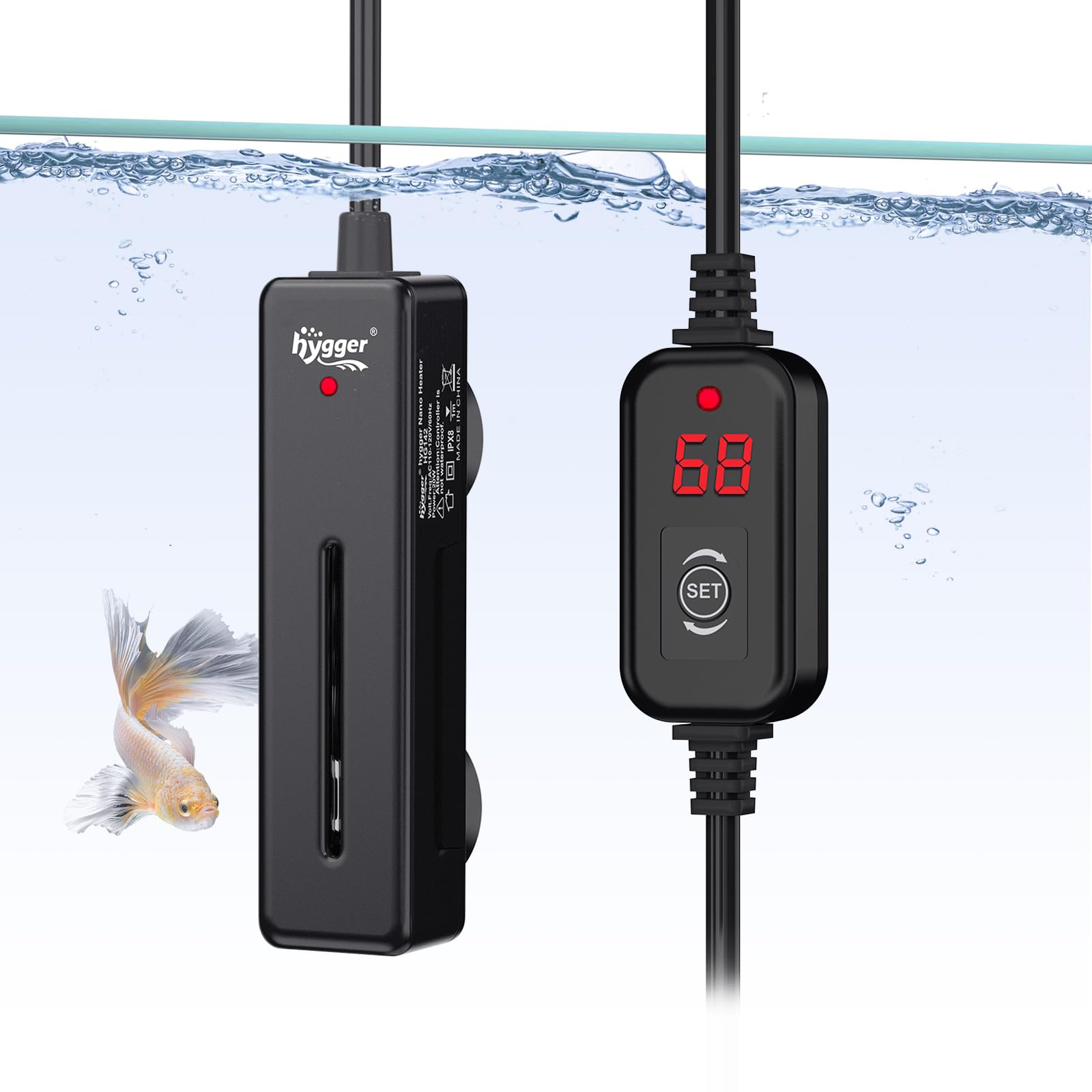
Rating: 4.5 ★ | Price: Mid-Range | Wattage / Tank Size: 50W, 5-10 gal | Temp Control Type: Digital adjustable 59-93°F | Display / Controller: External digital controller | Safety Features: Low-water shutoff, overheat protection | Build Quality / Longevity: Shatterproof case
The hygger 50W brings digital temperature control and safety features rarely found at this size. Its shatterproof casing and automatic low-water shutoff address the fragility and risk that plague many budget nano heaters. In contrast to the bare-bones options that rely on glass tubes and fixed presets, this model gives you an external controller with an adjustable range (59–93°F) and a digital readout. One tradeoff: the displayed temperature may differ slightly from a separate thermometer in some units. For most small tanks this variance is small, and a quick calibration using an external thermometer resolves it easily.
This heater suits owners of 5–10 gallon tanks — especially betta or shrimp setups where sudden temperature swings or glass breakage can be catastrophic. The protective casing and shutoff features provide peace of mind that a bare glass stick cannot. If you demand exact temperature matching between the display and an external thermometer, plan to verify with a separate probe. For everyone else, the built-in readout is close enough for daily use, and the mid-range price undercuts digital competitors while offering similar functionality.
Pros
- Heats water quickly and holds temperature steady for small aquariums
- Shatterproof casing and low-water shutoff add a layer of safety for nano tanks
- Compact design fits easily in 5–10 gallon tanks without crowding
Cons
- 50W output is only sufficient for tanks up to 10 gallons — larger tanks need a higher wattage model
- Digital adjustability adds complexity for users who only want a fixed-temperature preset
A safe, feature-rich choice for nano tank owners who want digital control and protective design over the cheapest option.
Best for Long-Term Setups
Eheim Jager 150W

Rating: 4.4 ★ | Price: Premium | Wattage / Tank Size: 150W, up to 40 gal | Temp Control Type: Dial adjustable, needs calibration | Display / Controller: No digital display | Safety Features: Auto shut-off when dry | Build Quality / Longevity: Shatterproof glass, German engineering
The Eheim Jager 150W prioritizes longevity over convenience. Its German-engineered glass construction has proven durable over many years, outlasting typical digital heaters. The analog dial requires a separate thermometer to set correctly — this is not a plug-and-play heater.
This heater suits experienced hobbyists who already use a thermometer and are comfortable with manual setup. Beginners who want quick installation should look at the top pick. Once properly calibrated, the heater maintains temperature reliably for years. The manual adjustment has tradeoffs that are manageable for patient aquarists, but can frustrate those seeking immediate simplicity.
Pros
- Built to withstand years of continuous use in freshwater and saltwater tanks.
- Once calibrated, holds temperature steadily for long periods.
- Solid glass construction with auto shut-off when dry adds safety.
Cons
- Dial numbers do not match actual temperature; a separate thermometer is required for accurate setting.
- The adjustment knob requires considerable force to turn, especially with wet hands.
For experienced aquarists who value durability over convenience and will calibrate with a thermometer, the Eheim Jager 150W is a long-term heater that outperforms cheaper alternatives over years of service.
Best for Aquascape Aesthetics
Fluval M 200W

Rating: 4.4 ★ | Price: Mid-Range | Wattage / Tank Size: 200W, up to 65 gal | Temp Control Type: Dial adjustable | Display / Controller: No digital display | Build Quality / Longevity: Mirror finish, compact design
Fluval’s mirror finish makes the M 200W nearly invisible against dark tank backgrounds, a clear advantage for aquascapers who prioritize aesthetics. Build quality feels substantial, with thick glass and a well-sealed housing that inspire confidence during daily use. Unlike digital alternatives such as the Fluval E series, this model skips the display and relies on a simple dial – a trade-off that keeps the heater visually clean but removes any temperature readout.
This heater fits mid-size tanks (20–65 gal) where appearance matters more than exact temperature control. The dial can be imprecise, so achieving a specific temperature requires an external thermometer for calibration. Lifespan may fall short for those expecting several years of trouble-free operation; pairing with a separate controller or buying from a retailer with a flexible return policy is worth considering.
Pros
- Mirror finish nearly invisible against dark backgrounds – ideal for planted tank setups.
- Solid build quality with thick glass and sturdy components.
- Backed by a long-established brand with widespread user satisfaction.
Cons
- Temperature dial can be imprecise – achieving exact settings requires an external thermometer.
- Some units may have shorter lifespans than expected at this price tier.
If a nearly invisible heater is your priority and you don’t mind dialing in temperature with a separate thermometer, the Fluval M 200W delivers on looks and core heating.
Best for Medium Tanks Digital
HITOP 100W Dig

Rating: 4.6 ★ | Price: Mid-Range | Wattage / Tank Size: 100W, 12-30 gal | Temp Control Type: Digital adjustable 68-93°F | Display / Controller: External digital display | Build Quality / Longevity: Quartz glass
The HITOP 100W brings the convenience of a digital readout and precise temperature adjustment to medium-sized tanks without the premium price tag. Unlike some budget digital heaters that pack in extra features, it keeps things simple—just set the temperature and let the quartz glass element do the work. The trade-off is a red LED that lacks brightness; you’ll need to be within a few feet to read the numbers clearly.
This heater suits tanks from 12 to 30 gallons, making it a solid match for community freshwater setups and turtle enclosures where durability matters. The external controller adds flexibility in placement, though you’ll want to position it where the display is easily visible. For anyone prioritizing digital control on a budget over a bright, glanceable readout, this hits a reasonable middle ground.
Pros
- Digital readout and controls make setup and adjustment straightforward.
- Holds target temperature well for a heater in this price range.
- Compact quartz design fits neatly in smaller tanks and turtle habitats.
Cons
- The red LED display is dim—reading the temperature from across the room is impractical.
- Temperature accuracy can vary between units; a separate thermometer is worth keeping on hand.
A cost-effective digital heater for medium tanks when you don’t mind checking the temperature at close range.
Best for Budget Small Tanks
Tetra 100W Heater

Rating: 4.4 ★ | Price: Budget | Wattage / Tank Size: 100W, 10-30 gal | Temp Control Type: Preset 78°F | Build Quality / Longevity: Glass tube
The Tetra 100W heater offers an affordable way to heat small tanks, with a compact design and simple operation that appeals to beginners. It performs well in 10-20 gallon setups with hardy fish. However, its basic preset design and variable unit quality make it more appropriate as a backup or temporary heater rather than a long-term primary solution.
Pros
- Great value for a basic preset heater
- Compact size fits small tanks well
Cons
- Fixed 78°F preset may not match actual tank temperature; use a separate thermometer to verify
- Some units stop heating after several months, making it better suited as a backup or short-term heater
For a quarantine tank or temporary setup with undemanding fish, this heater delivers acceptable performance at a low price.
Best for Budget Large Tanks
Orlushy 300W Heater

Rating: 4.4 ★ | Price: Budget | Wattage / Tank Size: 300W, 40-75 gal | Temp Control Type: Adjustable knob | Build Quality / Longevity: Quartz glass
This 300W heater delivers fast, affordable heating for large tanks. The performance is solid for temporary setups, but durability and temperature accuracy are inconsistent, making it a gamble for permanent installations.
Pros
- Affordable 300W adjustable heater for 40–75 gallon tanks
- Heats water quickly in large volumes
Cons
- Temperature dial may not hold a steady setting, worth checking with an external thermometer
- Glass body can crack or plastic components may degrade in some units
Best reserved for temporary setups or budget-focused large tanks where occasional monitoring is acceptable.
Best for Budget Digital Tanks
HiTauing 300W Adj

Rating: 4.5 ★ | Price: Mid-Range | Wattage / Tank Size: 300W, 40-75 gal | Temp Control Type: Digital adjustable 63-94°F | Display / Controller: External digital controller | Safety Features: Over-temp & low-water shut-off | Build Quality / Longevity: Quartz glass
Digital controller and safety features at a low mid-range price make this a compelling option for large tanks. It heats quickly and maintains temperature accurately. With over-temperature protection and automatic power-off, it addresses common safety concerns. However, the upgraded version offers better long-term consistency, making this a sensible pick when the top choice is unavailable or for budget-focused setups that can accommodate occasional unit variance.
Pros
- Accurate temperature control with easy digital setup
- Heats quickly even in large tanks
Cons
- Some units may develop electronics issues within months; unit-to-unit consistency varies
Best for budget-minded hobbyists with large tanks who want digital precision and accept the potential for unit variance – a competent alternative when the top pick is out of stock.
Best for Ultra-Budget Nano
AQUANEAT 25W Mini

Rating: 4.4 ★ | Price: Budget | Wattage / Tank Size: 25W, 3-5.5 gal | Temp Control Type: Preset 78°F | Build Quality / Longevity: Glass tube, weak suction cup
This 25W heater is one of the cheapest ways to warm a nano tank, making it a natural fit for a hospital tank or a temporary setup while you sort out a permanent solution. The compact glass body slides easily into 1–5 gallon tanks without crowding the space. That said, the suction cups can lose their grip over time, and the preset 78°F may drift a few degrees in either direction — fine for hardier fish like bettas in a pinch, but not recommended for sensitive shrimp or as a primary heater.
Pros
- Budget-friendly for nano tanks
- Compact size fits 1–5 gallon tanks easily
Cons
- Suction cups may weaken after several weeks, causing the heater to float
Keep this on hand for a quarantine tank or as a backup — it’s cheap enough to justify, but plan to upgrade if the tank becomes a permanent home.
Best for Large Digital Precision
Fluval E 300W

Rating: 4.3 ★ | Price: Premium | Wattage / Tank Size: 300W, up to 100 gal | Temp Control Type: Digital adjustable 0.5°F increments | Display / Controller: Digital display on unit | Safety Features: Dual sensors, fish guard | Build Quality / Longevity: Dual sensor design, trusted brand
Accurate digital control with a real-time display makes monitoring easy for large tanks up to 100 gallons. The heater responds quickly and holds temperature well, but some units may have shorter-than-expected lifespans, and the low-flow error can require careful placement near the filter output. The premium price reflects advanced features rather than assured longevity.
Pros
- Accurate digital display shows real-time temperature in 0.5°F increments.
- Heats large tanks quickly with 300W output.
Cons
- Durability can be inconsistent across units; some may have a shorter lifespan than expected.
- Low-flow error may activate unless the heater is positioned near a filter outlet.
Best for large-tank owners who prioritize digital accuracy and are willing to manage the low-flow placement, accepting that the premium price does not guarantee long-term durability.
How to Choose
The most reliable aquarium heaters combine a digital controller with integrated safety shut-offs, eliminating the guesswork and risk of cheaper preset models.
Wattage and Tank Size
The rule of thumb is 3 to 5 watts per gallon of water. A 100W heater works for 20–30 gallon tanks, while 300W covers 40–75 gallons. Oversizing can cause rapid temperature swings, especially in small tanks, and undersizing forces the heater to run continuously, shortening its life.
In larger tanks, consider using two smaller heaters rather than one large one. If one fails, the other provides a safety buffer, and heat distributes more evenly across the tank.
Temperature Control Type
Preset heaters are fixed at 78°F and require no adjustment, but they often drift from the set temperature. Adjustable heaters let you dial in a precise temp, which is critical for sensitive species. The trade-off is that dial-based models (like Eheim’s TruTemp) need recalibration with an external thermometer to match the actual tank temperature.
Digital controllers display the exact current temperature and allow 1-degree increments, making them the most user-friendly option. They also reduce the risk of accidental temperature changes during maintenance.
Digital Display and Controller
An external digital controller or a built-in display lets you read the temperature without submerging a separate thermometer. Some models show both set and actual temperature side by side, which helps you spot drift early. The downside is that displays on the heater itself can be hard to read across a room, especially if the tank is placed below eye level.
External controllers often include additional safety features like low-water shutoff, and they keep the electronics out of the tank, reducing the chance of corrosion.
Safety Features
Automatic shut-off when the heater is exposed to air (dry burning) prevents the glass from cracking or melting. Overheat protection stops heating if the water temperature exceeds a safe limit, avoiding cooked fish. These features are common on digital models but rare on budget preset heaters.
A heater guard—a plastic sheath over the glass—adds protection against fish burns and accidental breakage during cleaning. Models with a removable housing (like the HiTauing Upgraded) are easier to clean and less likely to trap debris.
Build Quality and Longevity
Thick quartz glass or shatterproof plastic lasts longer than thin glass tubes, which can crack from thermal shock if placed near a strong filter output. German-engineered models like Eheim Jager are known for 10+ years of service, but they require manual calibration. Digital heaters may have shorter lifespans due to electronic components, but the convenience and accuracy often outweigh that trade-off.
Check user reports for recurring failure patterns; many budget heaters fail within 6–12 months due to melted plastics or faulty thermostats. Investing in a well-reviewed digital model with a solid warranty is usually cheaper in the long run.
FAQ
Why does my aquarium heater keep cycling on and off?
Frequent cycling is normal as the heater maintains temperature, but if it turns off and on every few seconds, the thermostat may be faulty or the heater is undersized for the tank. First check that the heater wattage matches your tank volume—an undersized heater runs constantly to catch up. If the tank is properly sized, try moving the heater near a filter outflow for better water circulation. If the cycling persists, replace the heater, as a failing thermostat can eventually stick on and overheat the tank.
Can I use a higher wattage heater than recommended for my tank size?
You can use a higher wattage heater if you have a reliable thermostat, but it’s risky with preset or low-quality models. A higher-wattage heater heats faster, but if it malfunctions and sticks on, it can spike the temperature quickly, killing fish. For adjustable digital heaters with overheat protection, a slightly oversized heater is acceptable—just ensure the heater has a safety shut-off and pair it with a separate thermometer. Avoid using more than double the recommended wattage for your tank.
How long should an aquarium heater last before needing replacement?
Budget glass heaters often fail within 6–12 months due to corrosion or thermostat drift. Mid-range quartz heaters typically last 2–3 years, and premium models like Eheim Jager can last 5–10 years with proper care. No heater is immune to failure; inspect the heater monthly for cracks, rust, or erratic temperature swings, and replace it at the first sign of trouble. A proactive replacement every two to three years for budget models prevents unexpected fish losses.
What is the difference between a preset and an adjustable aquarium heater?
A preset heater is set at the factory to 78°F (or 77°F in some models) and cannot be changed. It’s simple and cheap, but tank temperature may drift well above or below that target depending on room conditions. An adjustable heater lets you set the exact temperature between roughly 63°F and 94°F, which is essential for species with specific needs (like discus or coldwater fish). Adjustable heaters with digital controls are far more accurate, but cost two to three times more than presets. For most hobbyists, an adjustable heater is worth the premium for peace of mind.