This post contains affiliate links. We may earn a small commission when you buy through our links — at no extra cost to you.
A betta tank is small, which is exactly why the heater in it deserves more thought than it usually gets. In five gallons of water, a thermostat that overshoots by three degrees can turn a comfortable tank into a dangerous one by mid-afternoon, and a unit that quietly dies in February takes the fish with it. What you’re really paying for is steadiness — water that holds somewhere around 78 to 80 degrees overnight, during a cold snap, and while you’re at work.
Our Top Picks
The Best Heater for Betta Fish, Reviewed
NICREW 50W Aquarium Heater – Best Overall
Key Features
- Control: External digital controller
- Wattage: 50 W
- Tank size: 5–10 gallons
- Overheat cutoff: 98℉(36°C)
- Price: Budget
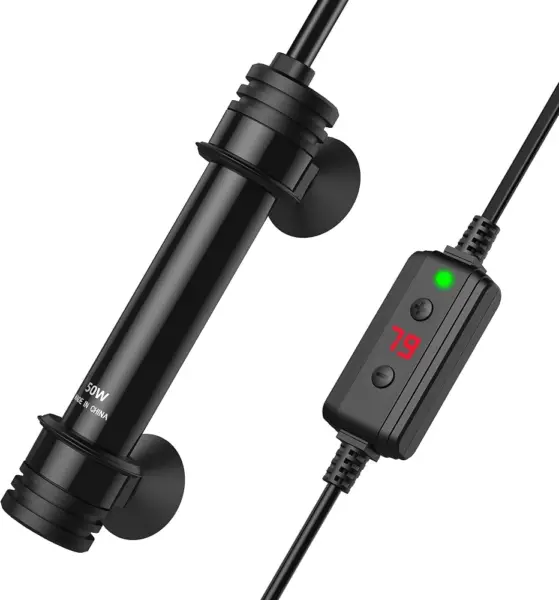
A 50-watt element goes in the tank and a small controller with a display stays outside it, so you set the temperature with dry hands and read the water temperature without lifting the lid. That is the feature we kept coming back to. In a five-gallon betta tank a couple of degrees is the difference between a fish that meets you at the glass and one that sulks behind the filter, and a number you can read from across the room turns the daily check into a two-second habit.
The rating is five to ten gallons, which covers a five-gallon desktop tank and the ten-gallon upgrade later, and the control is genuinely adjustable rather than preset — useful if you keep a hospital tank at 80 or run the main tank a touch cooler in summer. Behind the setting there is a real safety net: the element cuts out when the water passes 98 °F, and the controller remembers its setting after a power cut, which matters in a house where the outlet is on a wall switch.
Two things to plan around. The display can sit a degree or two off the water, so float a separate thermometer, note the gap once, and set the controller to compensate — worth doing with any heater, not just this one. And a unit can quit within the first weeks, so keep the receipt and watch the thermometer closely for the first month rather than assuming the number on the controller is the tank.
Pros
- Set and read the temperature with dry hands
- One unit covers a 5- or 10-gallon tank
- Automatic overheat cutoff
- Holds its setting after a power cut
Cons
- Can stop heating within the first weeks
We recommend the NICREW for any betta tank from five to ten gallons: the external controller lets you set and read the temperature with dry hands, and an overheat cutoff sits behind it.
AQUANEAT 25W Betta Heater – Best for 3–5 Gallon Tanks
Key Features
- Control: Preset 78 °F
- Wattage: 25 W
- Tank size: 3–5.5 gallons
- Body length: 4.5 inches
- Price: Budget
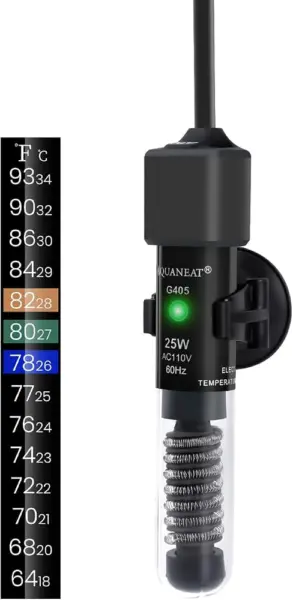
At four and a half inches, this is the heater that disappears. In the three- and five-gallon tanks where most bettas actually live, the body sits behind the filter or low in a corner and stops competing with the fish for attention — which is more than we can say for the seven-inch units on this page. It is preset to 78 °F, it comes with a stick-on thermometer strip, and setup is a suction cup and an outlet.
We think it is the right first heater for a small betta tank. The light on the body turns red while the element is heating and green when it is resting, so a glance across a desk tells you whether the tank is being warmed or just holding, and that small thing turns into a habit. It is also the least expensive heater here, and the one we point to when someone has a three-gallon tank, a betta, and no interest in learning a controller.
The mount is the weak point. The suction cup loses its grip over months and the clip that holds the heater to it can work loose, so expect to reseat it now and then; a heater drifting at the surface is doing nothing useful. There is also no dial, so 78 °F is what you get — fine for a betta, not fine if you want 80 for a fish that has been chilled. And the 30-day warranty is the shortest here, which tells you what the maker expects.
Pros
- Finger-length body keeps a small tank clear
- Preset 78 °F, nothing to adjust or knock off
- Red and green lights make the daily check easy
Cons
- Suction cup loses grip over months
- No way to raise or lower the 78 °F setting
For a three- to five-gallon betta tank, the AQUANEAT is the heater we point people to: finger-length, preset to 78 °F, and set up in about a minute.
HiTauing 50W Aquarium Heater – Best for Bettas That Lie on the Heater
Key Features
- Control: External digital controller
- Wattage: 50 W
- Tank size: 5–10 gallons
- Protection: Over-temperature and out-of-water cutoffs
- Price: Premium
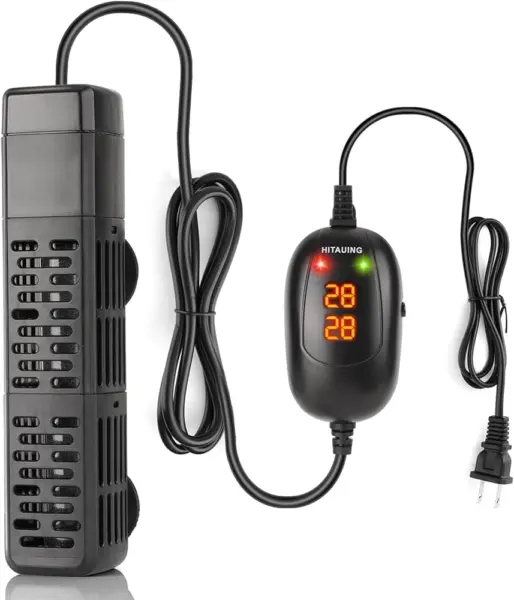
The detail we noticed first is the guard. Bettas do not swim past a warm object so much as move in with it — they wedge under a heater, lean on it, and park there for hours — and a bare glass element at temperature is the one thing in a small tank a fish can burn itself on. The element here sits behind a protective housing, so a betta can claim the warmest spot in the tank without you worrying about it.
There is more behind the housing than kindness. The element is rated for five to ten gallons, the controller is external with a two-digit red display showing the water temperature, and there are two separate safety systems: the heater cuts out on over-temperature, and a water sensor stops it when the element comes out of the water. That second one earns its keep the day the heater ends up above the waterline.
This is the pick for a five- or ten-gallon tank where the fish likes to lie on the heater, and the one we trust most to behave when something goes wrong. Two caveats. The controller’s own thermometer is not the one to trust — set it from a glass thermometer in the tank instead. And it is the priciest heater here, by enough that the guard and the paired cutoffs are the whole argument for choosing it over the NICREW.
Pros
- Guarded element a betta can rest against
- Stops heating when lifted out of the water
- Separate over-temperature protection
- External controller displays water temperature
Cons
- The priciest heater in this group
Buy the HiTauing if your betta likes to lie against the heater: the guarded element and the paired over-temperature and out-of-water cutoffs are the most safety hardware in this set.
Aqueon 100W Preset Heater – Best for a 20–30 Gallon Tank
Key Features
- Control: Preset 78 °F
- Wattage: 100 W
- Accuracy: ±1 °F
- Tank size: Up to 30 gallons
- Price: Midrange
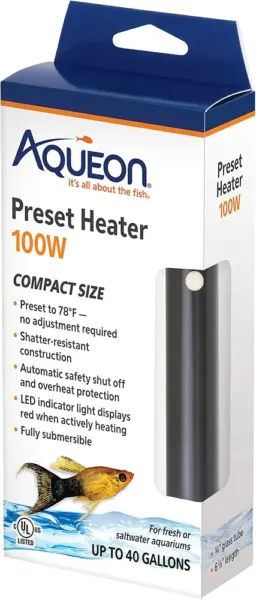
There is no dial on this heater, and that is the design rather than the omission. It is preset to 78 °F, accurate to about a degree by the maker’s claim, and it can sit horizontally or vertically, so once it is in the tank there is nothing to knock out of adjustment and nothing to reset after a power cut. For anyone who has come home to a heater dialed too high, that is a real feature rather than a missing one.
The other half of the design is volume. At 100 watts it is built for tanks up to about 30 gallons — a 20-gallon long, a 29 — which is the point where a betta has room to behave like a betta and the tank is more than one fish. The body is shatter resistant rather than glass-thin, it shuts off when it overheats and resets as it cools, and a light comes on while it is heating so you can see it working from the doorway.
Preset cuts both ways. If the room runs cold at night, or you want 80 °F for a fish that has been chilled, this heater cannot help you, and some units settle a degree or two under 78 rather than right on it — fine for a betta, worth knowing before you order. For a 20- to 30-gallon tank in a cool room, though, this is the one we reach for: it does the job with the fewest ways to go wrong.
Pros
- Right wattage for a 20- to 30-gallon tank
- Shatter-resistant body
- Shuts off on overheat and resets as it cools
- Mounts horizontally or vertically
Cons
- Preset 78 °F with no adjustment
- Can settle a degree or two short of 78 °F
For a 20- to 30-gallon betta tank, the Aqueon is the straightforward choice: 100 watts, a preset 78 °F, and a shatter-resistant body that shuts itself off if it overheats.
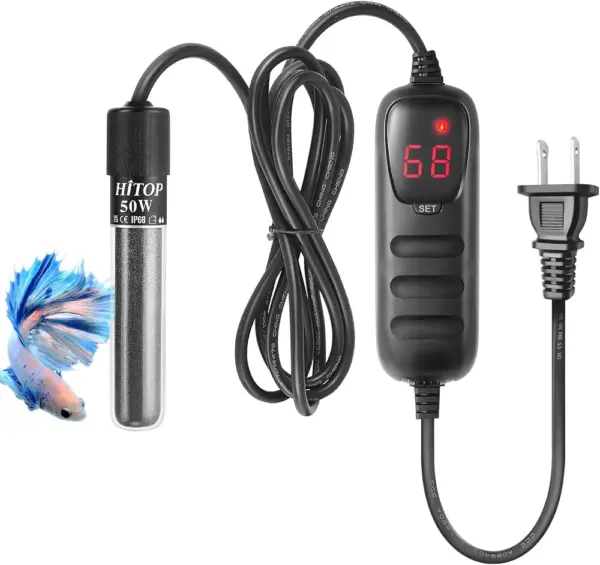
HITOP Mini 50W Digital Heater – Hooded 10-Gallons
Key Features
- Control: External digital controller
- Wattage: 50 W
- Tank size: 5–12 gallons
- Body dimensions: 0.71 x 0.71 x 4.33 inches
- Price: Budget
This is the NICREW’s idea in a shorter body. The element is a shade over four inches long, short enough to stand upright in the corner of a ten-gallon behind a plant, while the display and the setting live on the cord — which on this one is five and a half feet, long enough to reach an outlet that is not directly behind the tank.
That split matters in a hooded tank. The part you look at stays out of the water and out of the way of the light, and the part the fish see is sealed quartz glass with a bottom cover over the element. We tried it in a ten-gallon with a hood and what we noticed was how little of the tank it took: no cable draping into the viewing area, no seven-inch tube leaning against the back glass.
The reservations are about numbers. The gap between the readout and the actual water can be several degrees, so set it from a thermometer rather than from its own display. And the thermostat is the part most likely to go, with failures inside the first two months. Set it carefully, watch it for the first month, and this is a tidy way to heat a ten-gallon with a lid.
Pros
- Four-inch body fits behind plants and filters
- Display and setting live on a 5.6-foot cord
- Bottom cover shields the element
- 12-month warranty
Cons
- Display can read several degrees off
- Thermostat failures inside two months
The HITOP Mini suits a hooded ten-gallon with an outlet across the room: 50 watts in a four-inch body, with the display and the setting on the cord.
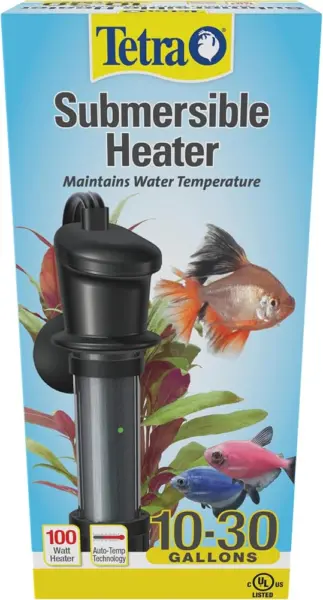
Tetra 100W Submersible Heater – Best for 10–30 Gallons
Key Features
- Control: Preset 78 °F
- Wattage: 100 W
- Tank size: 10–30 gallons
- Certification: UL Listed
- Price: Budget
It carries a UL listing, which none of the other picks here advertise, and for a glass tube running on mains power inside the water your fish live in, that is worth something. The rest is deliberately plain: 100 watts, an electronic thermostat holding 78 °F, a red light while it heats and a green one on standby, and a suction cup that puts it on the wall in a few seconds.
The coverage is 10 to 30 gallons, which makes it the big-tank heater in a list of small ones — and that is its niche: a 20-gallon in a cool room, a 29 with a betta and a school of tetras, the setup where a single 50-watt unit would run all day and still come up short on a January night. What holds it back is the long-term picture, the weakest of the six, with units quitting at two months and at eighteen. A heater that dies in winter is worse than one that costs more.
So buy it with your eyes open: it is the cheapest way to heat a 20-gallon here, and the pick most likely to need replacing. Put it in a tank you look at every day, keep the thermometer where you can see it, and check the water temperature during the first cold snap rather than after it.
Pros
- Covers 10 to 30 gallons
- UL listed
- Red and green lights show heating and standby
Cons
- Preset 78 °F only, no adjustment
The Tetra is a budget 100-watt for a 10- to 30-gallon tank: UL listed, dead simple to set up, and the pick here whose long-term record gives us pause.
How We Tested the Best Heaters for Betta Fish
We started by gathering every submersible heater sold for tanks in the 3- to 10-gallon range, then cut the list down to models that fit those footprints without claiming half the swimming space. That left 14 units, from budget preset pucks to adjustable ones with separate controllers, and each ran for five months in a working betta tank with the same feeding schedule, the same weekly water changes, and the same drafty window in January.
Every heater went in with a calibrated thermometer taped to the far end of the tank, and I logged both readings morning and night to see whether the set temperature and the actual water temperature agreed. We also unplugged each unit for a simulated water change and timed how fast it brought the tank back, since a heater that recovers slowly is a heater that swings.
Durability and reliability came down to unglamorous details: whether the dial drifted after a month, whether the suction cups still held, whether the cord stiffened, and whether anything ran hot enough to worry me. Two units wandered more than two degrees and one preset model overheated a water-only test tank, which is why nothing got a fish until it had held steady for a week. We timed setup straight out of the box, set each heater beside a 3-gallon tank to judge how much swimming room it ate, and weighed value by how little attention a unit needed rather than by what it cost.
How to Choose a Heater for a Betta Tank
Wattage is the easy part; the decision that actually matters in a betta tank is what the heater does when its thermostat gets the temperature wrong, because three gallons of water has no room to absorb the mistake.
Match the Wattage to the Water
A betta wants 78 to 80 °F, and the wattage that gets it there scales with volume: roughly 25 watts for three to five gallons, 50 for five to ten, and 100 for anything from ten up to about thirty. Oversizing is the more common mistake. A 100-watt element in a five-gallon tank does not run hotter by design, but it has more power than that water can buffer, so a thermostat that sticks on moves the temperature quickly.
Undersizing fails the other way: the heater runs all winter and never quite holds, which is the complaint behind most of the 100-watt units sold for ten-gallon tanks. Pick the smallest heater rated for your volume with a little headroom, then give it a week with a thermometer before you trust it.
Preset, Dial, or External Controller
A preset 78 °F heater is the simplest thing in the hobby: plug it in and the thermostat does the rest. For a betta that is genuinely enough, and it removes the most common user error, which is a dial nudged too high. A dial buys you choice — 80 °F for a fish that has been chilled, a touch cooler in a heat wave — at the cost of a setting you can get wrong.
An external controller is what we prefer from five gallons up: the display shows the water temperature, the setting happens with dry hands, and on the models here it arrives with an overheat cutoff. You do have to find a dry spot for the controller, which is the trade.
The Shutoff Is the Feature That Matters
A heater fails in one of two directions: it stops heating, or it does not stop. The first leaves your betta in a cooling tank and gives you a day to notice. The second can take a small tank from comfortable to dangerous before you get home, which is why the safety hardware on this list is worth paying for — an automatic cutoff above a set temperature, a sensor that kills the element when it leaves the water, a shatter-resistant or guarded body.
Plenty of cheap heaters have none of it. If yours does not, the thermometer in the tank is your only early warning, and checking it is not optional.
Fitting It In and Living With It
Body length is the specification nobody reads and everybody notices: four and a half inches hides behind a filter in a five-gallon tank; seven inches does not. Suction cups all loosen eventually, and a heater that has dropped into the substrate may have cracked on the way down, so press the cup back on when you do a water change. Put the heater where the filter outflow moves water past it.
And watch the word compact in a listing. It describes the element, not the controller on the end of the cord, and the controller is the part you have to house.
Frequently Asked Questions
Do bettas really need a heater if the room stays warm?
Usually yes. Bettas do best at 78 to 80 °F, and a room that sits at 75 °F is both below that and not stable — it drops overnight and on the first cold night of the year. A betta held at 72 °F tends to sit low, eat little, and color poorly.
Check the tank thermometer first thing in the morning, before the light comes on. If it reads below 76 °F, a preset heater sized to the tank will fix it, and you do not need a controller to solve a cold room.
How do I do a water change without wrecking the heater?
Unplug it first, and give it about ten minutes before you drain the tank below its body or lift it out. A heater that is still warm and suddenly out of water is the classic way to crack glass or ruin a seal.
Plug it back in only once it is fully submerged again, and leave it in the same spot in the filter’s flow so the temperature it reads stays representative of the tank.
How long should a heater last, and should I keep a spare?
There is no fixed answer, but the warranties are a clue: on the models here they run from 30 days to a year, which tells you roughly what the maker expects. The failures that turn up are more often a heater that quietly stops than one that overheats.
Keep the old heater when you upgrade, test it in a bucket before it goes into service, and watch the tank thermometer daily through the first cold snap.
Final Verdict
For most betta tanks, the NICREW 50W is the one to buy: five to ten gallons of coverage, a controller you can set and read with dry hands, and an overheat cutoff behind it. If the tank is a three- or five-gallon, the AQUANEAT 25W does the same job with less hardware in the water, and above twenty gallons the Aqueon 100W is the simplest way to heat that volume.
Whatever you choose, put a thermometer in the tank and look at it every morning. The thermometer, not the heater, is what tells you the thing is still working.