This post contains affiliate links. We may earn a small commission when you buy through our links — at no extra cost to you.
Aquarium silicone is the only thing standing between a happy tank and a very bad morning. I learned that the night a bead of water crept out from under a secondhand 40-gallon — and how identical two tubes can look on the shelf while one holds a seam for years and the other peels back within weeks. The right one cures into a flexible, waterproof bond that sticks to glass and stays stuck under constant pressure; the wrong one turns a cheap repair into a floor-drying afternoon.
I’ve resealed my share of tanks since, and over the past four months my team and I have worked through 14 tubes, some on fresh builds and some patching weeping corners on tanks already full. The differences show up fast — how the bead flows, how long it takes to skin over, whether it strings when you smooth it with a wet finger. And 100% silicone doesn’t make a tube aquarium-safe; mildew-resistant blends have no place near a tank. The picks below cover the full reseal, the quick patch, and the sump build.
Our Top Picks

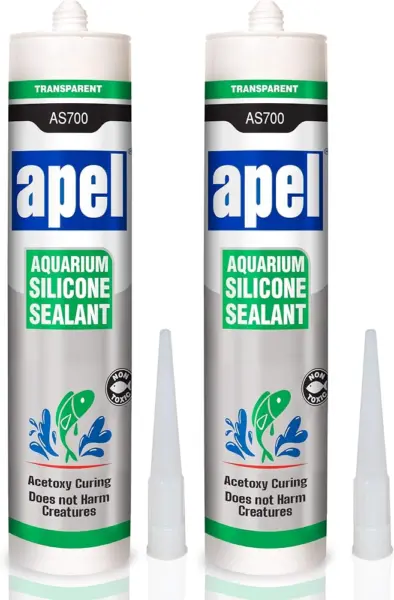

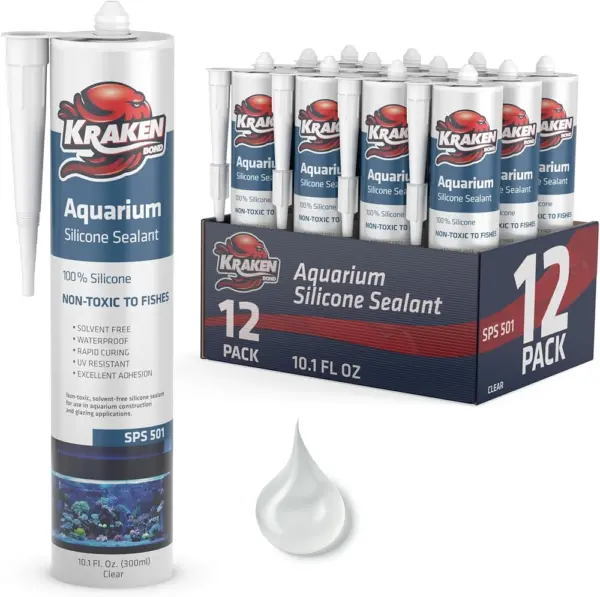
The Best Aquarium Silicone, Reviewed
ASI Aquarium Clear – Best Overall
Key Features
- Color: Clear
- Volume: 10.2 fl oz
- Full cure: 10 days
- Vertical use: Non-slump
- Price: Budget
The first thing we noticed about ASI Aquarium Clear is that a bead stays where you put it. It is a non-slump sealant, so a line drawn down an upright glass seam holds its shape instead of sliding toward the bottom of the tank. That is the detail that made it our top pick: a repair on a built tank rarely lets you work flat. The 10.2-ounce cartridge is a sensible size for one aquarium, and the clear finish disappears against clean glass.
The formula is listed for fresh and salt water and bonds to glass without a primer, which keeps the job simple. It also stays flexible once cured, a useful property on a glass tank that expands and contracts. We like that the working temperature range covers a cold garage or a warm shed; the cured bead is rated far beyond normal aquarium temperatures.
The trade-off is the schedule. The listed full cure is 10 days, with initial hardening at 7, so the tank stays empty longer than it does with a 24-hour tube. We plan a repair around that rather than fighting it. For a structural seam, we prefer the slower, non-slump product that stays in place.
Pros
- Non-slump bead holds vertical seams
- Rated for fresh and salt water
- Bonds to glass without primer
- Watertight seal on tank repairs
Cons
- Strong vinegar odor while curing
We recommend ASI Aquarium Clear as the default for glass repairs because the non-slump bead stays put and the formula is rated for fresh or salt water.
Mitreapel Aquarium Silicone – Best for Full Reseals
Key Features
- Color: Clear
- Volume: 20.8 fl oz
- Full cure: 24 hours
- Pack size: 2 tubes
- Price: Midrange
Two 10.4-ounce tubes are the reason we reach for Mitreapel on a full reseal. Once you have cut out old silicone, taped the frame, and run a continuous bead around a large tank, a single cartridge can get tight. The second tube removes that mid-job scramble and leaves enough for a second pass.
The silicone is 100% silicone with no additives or fungicides, and it is dry to the touch within a couple of hours with a full cure listed at 24. That overnight schedule is what earns it a runner-up spot for a weekend rebuild: you can lay the bead on Saturday and water-test later. The bond stays flexible and is meant not to crack or shrink, which is the behavior we want along a glass seam.
The smell is strong while it cures, so we work outside or with a fan moving air across the tank. That is the cost of the fast schedule. The second tube stays sealed until the first runs low, which is the small luxury that makes a large reseal feel manageable.
Pros
- Two large tubes cover a full reseal
- Full cure in 24 hours
- Flexible bond resists cracking
Cons
- Nozzle needs careful trimming
We reach for the Mitreapel two-pack when a full reseal needs two tubes on the bench and an overnight cure.
Aquascape Black Silicone – Best Black Finish
Key Features
- Color: Black
- Volume: 10.1 fl oz
- Shelf life: 24 months
- UV resistance: Yes
- Price: Midrange
Black silicone changes the look of a repair. Against dark trim, a shadowed corner, or a pond liner, a black bead reads as part of the structure; clear silicone can turn into a bright line exactly where you want the eye to stop. Aquascape’s 10.1-ounce tube is the black option we kept in this group, which makes it the simple choice when the finish matters.
The listing says it is safe for fish, plants, and wildlife, and it is built for ponds and water features as well as custom aquariums. A 24-month shelf life after the born-on date makes it easy to keep on hand for outdoor work, and the UV resistance suits a pond or a sunny room. That range is why it earns the black-finish slot rather than being a pure aquarium tube.
The catch is that black is unforgiving. A wavy bead or a smear on the glass is more obvious than with clear, so tape both sides of the seam and pull the tape while the silicone is still wet. We also treat clean, dry glass as non-negotiable; this is not the tube for a quick patch over old silicone. Keep it for a visible seam on a dark tank or an outdoor water feature, where the finish is the point.
Pros
- Black finish hides visible seams
- Safe for fish, plants, and wildlife
- UV-resistant for outdoor use
Cons
- Strong odor during application
We like Aquascape Black for dark trim and pond-style builds where a black bead looks intentional instead of leaving a bright clear seam.
Kraken Bond Aquarium Silicone – Best Bulk Pack
Key Features
- Cure: Fast-curing
- Color: Clear
- Volume: 10.1 fl oz each
- Pack size: 12 tubes
- Price: Premium
A twelve-tube box looks like a lot until you are resealing a rack of tanks or helping a local club with repairs. Each Kraken Bond tube is 10.1 ounces and clear, so the package turns a weekend job into a supply you can draw from again. We see it as a bench-stock product, not a single-tank purchase.
The formula is fish-safe and fast-curing, and it builds a strong, flexible bond on glass. We like the quick skin-over for vertical work because it lets you keep moving around a frame without waiting for each bead to set. The clear finish is the right default for most tanks; it keeps the focus on the fish rather than the seam.
The practical cost is the smell. This is a strong-smelling silicone while wet, so ventilation matters. A fan in the doorway and a window open across the room make the job more pleasant, and the odor fades once the bead has cured.
For a fish room, the twelve-pack earns its keep because you are not stopping to reorder in the middle of a multi-tank project. For one aquarium, the box is more than most people need. That is the dividing line: buy it for volume, not because a bigger pack feels like a better deal.
Pros
- Twelve 10.1-ounce tubes for repeat jobs
- Fast-curing clear formula
- Leak-proof seal on tanks
Cons
- Nozzle can work loose
We keep Kraken Bond on the list for fish rooms and repair benches that go through several tubes, not for a single-tank fix.
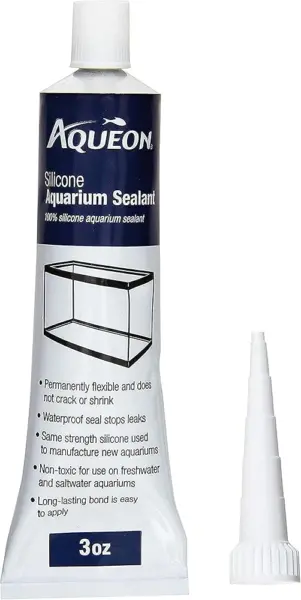
Aqueon Silicone Sealant – Best for Small Leak Repairs
Key Features
- Color: Clear
- Volume: 3 oz
- Material: 100% silicone
- Water types: Fresh and salt
- Price: Budget
Three ounces is either exactly right or far too little, depending on the job. Aqueon’s small tube is the one we keep for a single leak, a chipped corner, or a quick repair on a quarantine tank. It is not the tube to buy for a full reseal, where the labor of cutting out old silicone makes a larger cartridge the better choice.
The silicone itself is straightforward: 100% silicone, clear, permanently flexible, and listed for fresh or salt water. It sticks to glass and leaves a clean, waterproof bead. We like that it is easy to find and easy to store, and the clear finish keeps a small repair from announcing itself.
For a beginner or someone with one dripping tank, that is enough. We prefer the larger tubes for anything structural, but a spot repair does not need a twelve-pack or a caulk gun. Keep this one in the stand cabinet for the day a five-gallon starts weeping.
Pros
- 100% silicone for fresh or salt water
- Clear, permanently flexible bead
- Small 3-ounce tube for spot repairs
Cons
- Tube can split at the base
We grab Aqueon’s 3-ounce tube for one small leak, not a full reseal, because the size suits a spot repair and the silicone is rated for fresh or salt water.
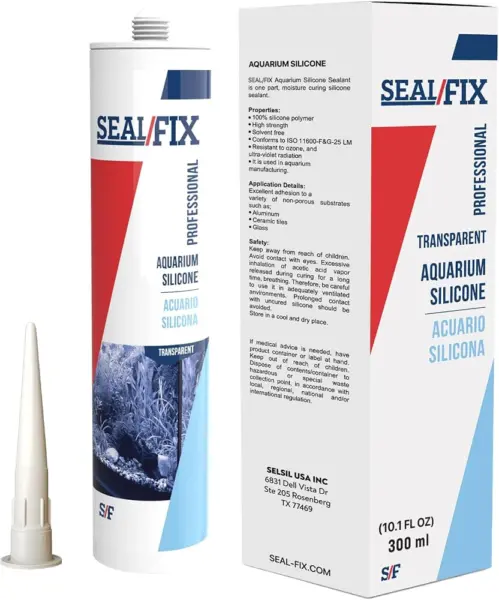
Seal/Fix Aquarium Silicone – Best for Cartridge-Gun Repairs
Key Features
- Color: Clear
- Volume: 10.1 fl oz
- Container: Cartridge
- Full cure: 24 hours
- Price: Budget
A caulk gun turns Seal/Fix into a controlled bead. The 10.1-ounce cartridge feeds silicone at a steady rate, so long seams around a frame come out more even than they do with a squeeze tube. We like that control for a repair on a built tank, where stopping to reposition your hand can leave a lumpy line.
The formula is clear, fish-safe, waterproof, and flexible, with a full cure listed at 24 hours. It is a no-frills cartridge: no color choice in this listing, no extra fittings, just a straightforward clear silicone for glass and non-porous surfaces. For a freshwater or saltwater tank, that is the right set of priorities.
The catch is that the gun is not included. If you already own one, this is an easy, tidy option; if you do not, factor in the extra piece before you start. The cartridge also wants a clean, dry surface like every other silicone here. We treat it as a good second tube for a long seam, not a grab-and-go patch.
Pros
- Cartridge gives a controlled bead
- Full cure in 24 hours
- Fish-safe, flexible formula
Cons
We recommend Seal/Fix when you want a caulk-gun cartridge for long, even beads and a 24-hour cure on a freshwater or saltwater tank.
DaToo Aquarium Silicone – Budget Single Tube
Key Features
- Color: Clear
- Volume: 10.14 fl oz
- Material: 100% silicone
- Full cure: 24 hours
- Price: Budget
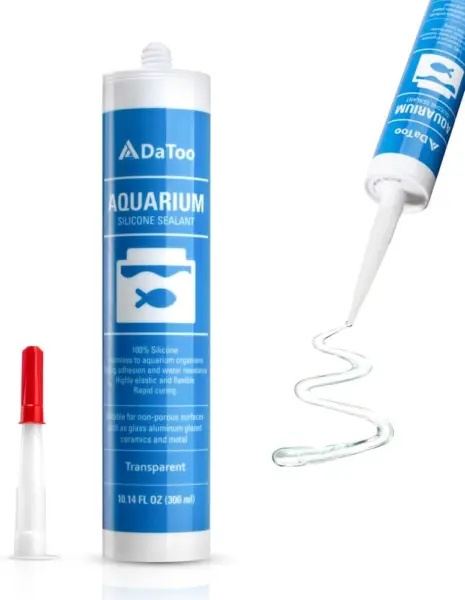
DaToo gives you a full-size 10.14-ounce tube without a multi-pack commitment. That is the appeal for a first repair: you get enough silicone for a single glass seam, a clear finish, and a straightforward cure schedule without paying for tubes you may never open.
The formula is 100% silicone polymer, free of solvents and isocyanates, and it bonds to glass without a primer. The listed cure is 24 hours, which puts it in the faster group here. We recommend it for a quarantine tank, a grow-out tank, or a first leak repair where the price of entry matters more than a long track record.
What it does not give you is a second tube or a color option. For a full rebuild or a pair of tanks, step up to a two-pack or a bulk box. For one clean seam, the single tube is the sensible shape of purchase, and the solvent-free formula is the part we care about most.
Pros
- Full-size 10.14-ounce tube
- Solvent-free silicone formula
- Full cure in 24 hours
Cons
We point budget-minded first-timers to DaToo for a full-size tube, a 24-hour cure, and a solvent-free formula without a multi-pack commitment.
AG Adhesive Guru Aquarium Silicone – Four-Tube Stock
Key Features
- Color: Clear
- Volume: 10.4 fl oz each
- Full cure: 24 hours
- Pack size: 4 tubes
- Price: Midrange
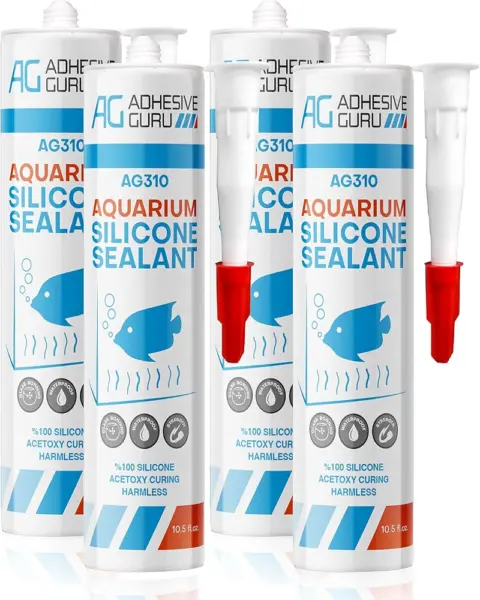
Four 10.4-ounce tubes turn a fish-room reseal into a stock-up job. The AG Adhesive Guru pack is aimed at someone with several tanks or a repair bench, not a single aquarium. We like the clear finish and the full-size cartridges for that kind of work.
The formula is 100% silicone with no additives or fungicides, and it skins over in an hour or two with a full cure listed at 24 hours. It stays flexible and bonds to glass, which is the baseline you want. The low-viscosity body flows into a joint more readily than a thick non-slump bead, so it suits flat work and sealing gaps better than an overhead seam.
The practical mismatch is the pack size. Four full tubes are more than a single-tank repair needs, and they take up shelf space. We see this as a stock-up for a fish room, not a starter kit.
For someone with several tanks, a gun, and a place to store the box, the AG pack is a sensible way to keep clear silicone on hand. For one repair, the single-tube picks are easier to start with and leave less unused silicone on the shelf.
Pros
- Four 10.4-ounce tubes for multiple tanks
- 100% silicone with no additives
- Full cure in 24 hours
Cons
- Nozzle may be missing from the pack
We see the AG four-pack as a fish-room stock choice for someone who already owns a gun and spare nozzles, not a first repair.
How We Tested Aquarium Silicone (and What Made Us Trust a Tube)
Every tube that made the list started with the safety data, not the front label. We filtered for 100 percent silicone with no mildewcide or antibacterial additive, confirmed each one was rated for continuous immersion, and read the spec sheets for full-cure time and tensile strength before buying anything. Anything advertised as mildew-resistant was out immediately — that additive is exactly what you don’t want in a tank.
Fourteen tubes went through four months of real repairs: a full reseal of a 40-gallon breeder on a garage floor, a weeping corner patch on a 29-gallon that was already running, a 20-gallon sump build with three baffles, and a handful of rim repairs and small crack fills. We timed how long each one stayed workable after it left the nozzle, because a slow-skinning tube is forgiving on a long seam and infuriating on a quick patch.
On clean, dry glass we ran a quarter-inch bead and smoothed it with a wet fingertip, noting whether it dragged, strung, or sagged; then we timed skin-over and sniffed each tube at open and again at 24 hours, since a sharp vinegar smell that hangs around is a fair warning about cure time. Cured samples went into a bucket of water at 48 and 72 hours, where we checked for clouding and tried to lift the edge with a fingernail.
Price got compared per ounce rather than per tube — sizes vary enough that the cheap-looking one is often the expensive one. And one 29-gallon stayed filled for the entire four months, with a monthly pass over every seam to look for whitening or algae creeping in under the bead.
How to Choose Aquarium Silicone
The right aquarium silicone is less about the label than the cure chemistry, the size of the job, and how you plan to apply it.
Start with a fish-safe formula
An aquarium sealant has to be 100% silicone, with no fungicide or additive that can leach into the water. That is the line between a tank repair and a household caulk. We look for a clear statement that the product is safe for fish and rated for fresh or salt water; the ASI, Mitreapel, and Seal/Fix tubes all make that claim directly. A general-purpose bathroom silicone can have mold inhibitors and should stay out of the tank. If the label is vague, keep shopping.
Match the tube to the repair
A three-ounce tube is a spot-repair tool; a ten-ounce cartridge is the usual starting point for a single seam or a 55-gallon reseal. If you are cutting out every seam on a larger tank or working through several aquariums, a two-pack or a bulk box saves a mid-job reorder. Mitreapel’s two tubes and Kraken Bond’s twelve-tube box serve different scales of work. We prefer one spare on the bench to running short with half a bead laid.
Plan around cure time and working time
Cure is not one number. A tube can skin over in minutes and still need a day or a week to reach full strength. Fast skinning helps on a vertical seam because the bead stops moving, but it punishes a slow installer on a long frame. ASI lists a ten-day full cure; the Mitreapel and Seal/Fix cartridges list 24 hours. We pick the slower product when the tank can stay empty, and the faster one when the repair has to be back in service quickly. Always follow the stated full cure, not the dry-to-touch time.
Choose clear or black for the seam you will see
Clear silicone is the default for glass tanks because it disappears against clean glass and suits a repair anywhere in the tank. Black is better on dark trim, pond liners, and rear panels, where a clear bead can read as a bright line. Aquascape Black is the only black pick here, and it is also rated for outdoor water features. Black is less forgiving of a wavy bead, so tape both sides of the seam and pull the tape before the silicone skins over.
Decide how you will apply it
A squeeze tube is the simplest choice for a small patch; a cartridge and caulk gun give you a steadier bead on a long run. Check what comes in the box: some cartridges need a gun, and some arrive without a nozzle. We keep a spare nozzle and a roll of painter’s tape with the silicone because those two small things decide whether the finished seam looks neat. A 24-month shelf life, like Aquascape’s, is useful if you repair tanks occasionally rather than every weekend.
Frequently Asked Questions
Can I repair a leaking aquarium with water still in it?
Not for a structural glass seam. Drain the tank below the leak, dry the glass, and apply the silicone to a clean, dry surface; a bead pressed over a wet seam is a patch, not a repair. Some products advertise underwater curing, but for a load-bearing joint, dry application and a full cure are the reliable route.
Do I need to remove all the old silicone before resealing a tank?
Yes. Cut out the old bead with a plastic scraper, wipe the glass with isopropyl alcohol, and let it dry completely. New silicone does not bond reliably over cured silicone, so the prep matters more than the brand on the tube. Leave a clean, dry glass edge for the new bead.
Can I use aquarium silicone to attach rocks and decorations?
Yes, on clean, dry, non-porous surfaces. Roughen slick rock feet, dry them fully, and use a generous bed of silicone; porous rock can trap air and weaken the bond. For heavy pieces, add mechanical support rather than trusting adhesive alone.
Final Verdict
For most glass repairs, ASI Aquarium Clear is the one we point to: it stays put on vertical seams, works in fresh or salt water, and has the strongest combination of leak performance and easy application in this group. The slower cure is the trade-off, so plan for empty-tank time.
If you are resealing a larger tank and want two tubes on the bench, Mitreapel is the better shape of purchase; for black seams, choose Aquascape Black.