This post contains affiliate links. We may earn a small commission when you buy through our links — at no extra cost to you.
The first time a frag refuses to stay put, you learn that aquarium glue isn’t really one product. A zoanthid that rolls off the rockwork every time the return pump kicks on needs a cyanoacrylate gel that sets underwater; a weeping seam on an older tank needs aquarium-safe silicone, and no gel on the shelf will save it. I’ve gotten both wrong — once with a glue that clouded a nano tank, once trusting a reef-safe label that meant nothing. The right one holds a frag exactly where you press it, cures fast, and doesn’t haunt your water chemistry.
Over the past four months, my team and I have put 14 tubes, gels, putties, and silicone cartridges to work — mounting frags to live rock, patching a sump baffle, and re-seating a leaking bulkhead. The lesson that surprised me most: surface prep beats brand loyalty. A rock scrubbed with a toothbrush and blotted dry holds twice as well as a wet, slimy one. The picks below are the ones we’d buy again, sorted by what they’re actually built to do.
Our Top Picks


The Best Aquarium Glue, Reviewed
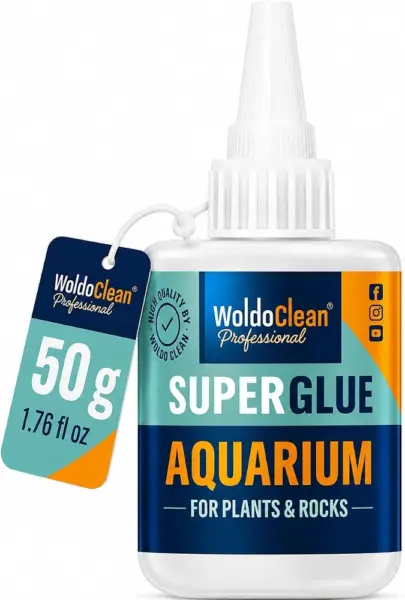
WoldoClean Aquarium Super Glue Gel – Best Overall
Key Features
- Cap: Anti-clog
- Size: 1.76 oz
- Type: Cyanoacrylate gel
- Set time: 0.5 minutes
- Price: Midrange
The job this bottle is built for is the fiddly one: a frag that keeps sliding off its plug, a java fern that floats back up every morning, a rock that shifts whenever the filter kicks on. WoldoClean sells a cyanoacrylate gel that bonds underwater in fresh or salt water, and that single property is what makes it the default here — you can work with the tank full, your hands wet, and the rock exactly where it already sits.
The dosing is what we keep coming back to. A small drop goes on the rock or the wood rather than on the plant, you press the base against it and hold, and the joint is set; the anti-clog cap means the bottle opens cleanly on the tenth use as well as the first, which is more than we can say for the plain tubes in the cupboard. At 1.76 ounces it is a genuinely big bottle for this category, where most cyanoacrylate arrives in little tubes that are done before a scape is.
Where it caught us out was on dark plastic. Cured cyanoacrylate can dry to a pale haze — invisible against grey rock, obvious on a black filter housing or a black background panel. Keep it for porous surfaces and for joints you can bury under substrate and the result looks clean. One thing it will not do is rescue a weeping seam; this is an adhesive, and the silicones further down this list are the ones for water.
Pros
- Bonds underwater with the tank still full
- Anti-clog cap keeps the bottle usable
- Cures in around half a minute
- Generous 1.76 oz bottle for the category
Cons
- Gel runs on smooth vertical faces
- Holds unevenly on some plastics
For planting, fragging and sticking rock together, this is the bottle we reach for — it grabs underwater and the anti-clog cap keeps the second half usable.
FUAUFAS ASI Aquarium Silicone – Best for Resealing a Tank
Key Features
- Size: 10.2 fl oz
- Type: RTV silicone
- Full cure: 10 days
- Initial hardening: 7 days
- Price: Budget
Seven days to initial hardening and ten days to a full cure — those are the listed figures, and they are the number to plan a reseal around, because until that window closes the tank is a glass box you cannot fill. We treat it as a week-long job with slack on top: lay the bead, walk away, and resist the urge to test it early with a half-inch of water.
What you get for the wait is the right kind of silicone for structural work. It is a non-slump formula, so a bead laid on a vertical pane stays where it is put instead of sagging toward the bottom edge, and it bonds to glass without a primer. The 10.2-ounce cartridge is also the format that makes a full reseal practical — a three-ounce tube gives out halfway around the frame. On coverage per dollar, it is the strongest value in this group.
The trade-off is the smell. It gives off a sharp vinegar reek while curing, strong enough that this is a garage or open-window job with the tank empty and nobody leaning over it. Air it out and what is left after the cure is the inert, fish-safe rubber you were after — the smell is the chemistry working, not a sign that something went wrong.
Pros
- Holds its shape on vertical glass
- Bonds to glass without a primer
- Cartridge size covers a full reseal
Cons
- No expiry date printed, only a batch code
For a tank leaking at a seam, this is the cartridge we recommend: glass-grade silicone that stays put on a vertical pane and cures safe for fish.
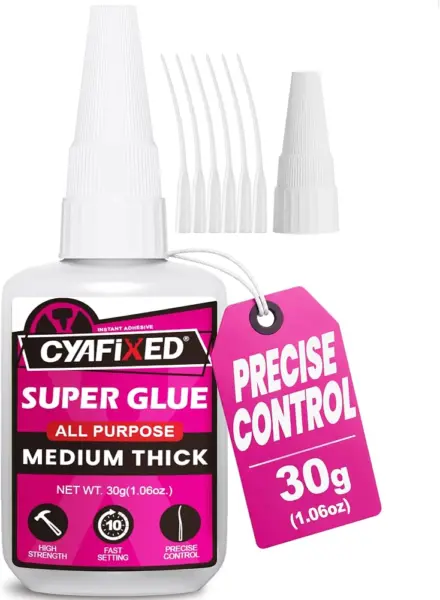
CYAFIXED Super Glue Liquid – Best for Precision Work
Key Features
- Size: 1 fl oz
- Type: Cyanoacrylate liquid
- Viscosity: 680 CPS
- Tensile strength: 3,580 psi
- Price: Budget
Six microtips and a spare anti-clog cap ship with this one-ounce bottle, and the tips are the reason to choose it over a plain tube. Fit one and you can lay a controlled bead along a rock joint or place a single dot on a frag plug, which is the difference between a repair and a puddle. The listed viscosity of 680 CPS is medium-thick, and the applicator is what turns that into usable control rather than a slow blob; it is rated at 3,580 psi tensile strength, far more than any frag joint needs.
Know what you are buying, though: this is a liquid, not a gel, so it wants two surfaces that meet closely — a flat-cut plug on flat rock, a clean break in a plastic fitting — rather than bridging a gap or filling a void. It also grabs fast, so there is no nudging a plant into a better position once it takes. For mounting something round onto bumpy live rock, the gel at the top of this list is the better tool; for a repair you will never look at again, this is the neater one.
Pros
- Six microtips for genuinely precise dosing
- Spare anti-clog cap extends usable life
- High listed tensile strength for small joints
Cons
- Thin liquid runs on angled surfaces
- Bottle can dry up between projects
We keep this one for precise, small-scale work: a dot on a frag plug or a hairline repair, with six microtips that put it exactly there.
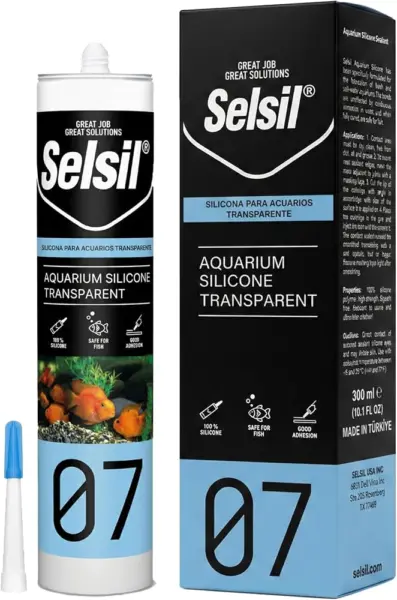
SELSIL Aquarium Silicone Clear – Best Clear Silicone for Display Tanks
Key Features
- Size: 10.14 fl oz
- Type: Silicone sealant
- Color: Clear
- Cure time: A few hours
- Price: Midrange
Clean, dry glass is where this silicone grips, and slick non-porous surfaces are where it can fail to set at all — that split is most of the decision. Wipe the pane down, let it dry completely, and this clear formula does what the label says. Skip that step, or try it over a damp or greasy surface, and you will be scraping a tacky mess off a rimless tank a day later.
What it does well is the seam itself. The formula is highly elastic, so the cured joint flexes with the tank instead of sitting there brittle, and it cures clear, which is the entire point on a display sump or an open-top tank where the joints are on show. It is rated waterproof and resistant to UV and ozone, and the maker quotes a cure of only a few hours — quick enough that a small repair does not swallow a whole weekend.
Where it fits: a visible repair, not a structural rebuild. If a corner of a display tank has let go, the elasticity and the clear cure give the nicer result of the silicones here. If the whole frame needs redoing, the larger FUAUFAS cartridge is the more sensible purchase. Either way, plan one uninterrupted session — silicone does not reward coming back to it.
Pros
- Cures clear on seams you can see
- Highly elastic joint resists cracking
- Quick cure compared with other silicones
Cons
- Nozzle can separate from the tube mid-job
This is our pick when the seam will be seen: an elastic clear silicone for display tanks, provided you give it clean, dry glass to grip.
Aquascape Black Silicone Sealant – Best Black Silicone
Key Features
- Size: 10.1 fl oz
- Type: Silicone sealant
- Color: Black
- Shelf life: 24 months
- Price: Premium
Black silicone exists for the places where a bright clear line would be the first thing you noticed: a dark background panel, an overflow weir, a pond liner seam where the rubber is already black. This is that product, and it is the only one on this list rated for outdoor water features as well as in-tank work, with UV resistance and a temperature range that covers a pond through a hard winter.
It is a good black, too, curing to a matte finish that disappears against dark glass or a black plastic rim. The caveat is grip. This one wants a dry, clean, slightly scuffed surface, and on damp or greasy material it can peel rather than hold, so it is the wrong choice for a quick patch on wet rock or an algae-slick liner. Prep it properly and it does what black silicone should, which is make the joint vanish.
Pros
- Black hides seams against dark backgrounds
- UV resistant for outdoor ponds
- Safe for fish and plants once cured
Cons
- Peels on damp or greasy surfaces
- Twenty-four-month shelf life from the tube date
For dark backgrounds, overflow weirs and pond work, black is the whole point, and this is the tube we keep for it — rated indoors and out.
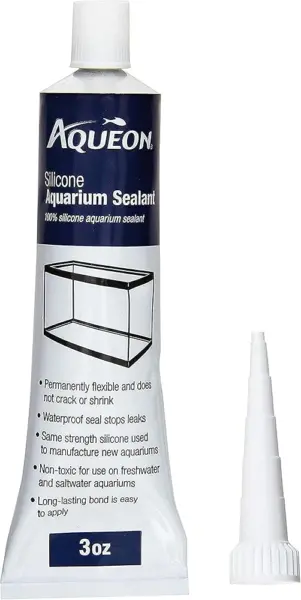
Aqueon Silicone Sealant Clear – Best for Small Repairs
Key Features
- Size: 3 oz
- Type: 100% silicone
- Color: Clear
- Flexibility: Permanently flexible
- Price: Midrange
Three ounces is the whole story here. This is the tube for one repair on a small tank — a weeping corner on a ten-gallon, a lid that has come apart — not for rebuilding a four-foot frame. Buying it expecting otherwise is how people end up three-quarters through a bead with nothing left to squeeze.
Asked to do a normal job, it does it. This is 100% silicone, permanently flexible, waterproof and clear, and it holds glass together; the sealing itself is not the weak point, and a patched corner on a small tank is exactly what it was designed for. It is also the cheapest way into a genuine aquarium silicone if you only need one repair.
The tube is where it falls down. The plastic is stiff, so laying a bead takes a firm, steady hand, and the design does not leave much margin if it gives out partway through the job. Treat it as a single-session purchase: open it, use it all, and do not count on it being there next spring.
Pros
- 100% silicone, permanently flexible
- Clear waterproof seal that stops leaks
- Right size for one small repair
Cons
- Base of the tube can split mid-use
For a single small repair where you will use the whole tube in one sitting, this seals fine — just do not expect the tube to survive to a second job.
How We Tested Aquarium Glue
We started by pulling every glue, gel, putty, and silicone cartridge we could find that was explicitly labeled for aquarium use, cross-checking reef forums against manufacturer spec sheets and a few late-night threads from people with the same leaking bulkhead we had. We cut anything with vague or contradictory safety claims, anything that required draining the tank, and anything priced like a piece of equipment rather than a consumable. That left 14 products, which we used over four months across a 40-gallon breeder, a 10-gallon nano, and a quarantine tank that started seeping at exactly the wrong time.
Frag mounting was most of the work. For each cyanoacrylate, we glued a toadstool leather and a zoanthid frag to dry rubble, then counted how many seconds the bond held before the flow pulled it loose, coming back at one week and one month to see what was still attached. We squeezed every tube with wet hands and with nitrile gloves on, because a glue you can’t open with slime on your fingers is one you’ll stop reaching for; several tubes welded themselves shut between sessions, and two of us glued fingertips together.
The silicone side got its own test. We patched a cracked sump baffle and re-seated a bulkhead, then filled the tank and watched the seams for 48 hours before trusting either repair. Along the way we tracked how long each product needed before it stopped moving under its own weight, how bonds held up after weeks in saltwater, and how many frags a single tube managed before it dried out — the value question nobody asks until the third tube in a month.
How to Choose Aquarium Glue
The first decision is not which brand — it is which of two fundamentally different products you are holding: a cyanoacrylate that bonds things to things, or a silicone that keeps water inside the glass.
Two Products Share One Name
A cyanoacrylate gel is an adhesive: it holds a frag to a plug, a fern to driftwood, a rock to another rock, and it can do that with the tank full. Silicone is a sealant: it bonds glass to glass and keeps a seam watertight, and it goes on dry. Buying one when you needed the other is the most common way this purchase goes wrong — a bottle of gel will not stop a leak, and silicone will not hold a plant. Decide first whether something is floating or something is dripping.
How Long the Tank Sits Empty
A gel adhesive grabs in seconds and lets you keep working with fish in the tank. Silicone is the opposite: even a fast-curing formula needs its full cure before water goes in, and the silicones here run from a few hours up to the ten days listed for the FUAUFAS cartridge. Plan the reseal around that window rather than around the bead, because the bead is an afternoon’s work and the cure is not.
If you cannot leave the tank dry for that long, a silicone repair is not this weekend’s project. Buy the tube, keep it sealed, and pick a stretch when the fish can live in a bucket with a spare heater.
Dry, Damp or Underwater
Read the surface requirement before anything else. Silicone wants clean, dry, dust-free glass and will not cure properly over a wet seam — draining below the leak and letting the pane dry is part of the repair, not optional prep. Cyanoacrylate is the opposite: it is happiest on a damp surface and will bond under water, which is why it is the only practical choice for a plant that is already in the tank. Do not buy a gel to fix a leak, and do not try to silicone a running seam.
Bottles, Cartridges and Coverage
Format matters more than it looks. Cyanoacrylate comes in small bottles, and the cap is the part that decides whether you get one session out of it or ten — the anti-clog caps on the WoldoClean and CYAFIXED bottles are why those two keep working. Silicone comes in squeeze tubes and rigid cartridges, and the squeeze tubes are the ones that split at the base mid-job.
Match the size to the job: a three-ounce tube patches a corner, and a ten-ounce cartridge is what you want around the frame of a larger tank. Buying small for a big reseal means running out halfway around a bead you then have to strip and redo.
Curing, Smell and Fish Safety
Every silicone on this list gives off a vinegar smell while it cures, some more sharply than others. That is the cure doing its work, not a defect, and it is why a reseal is a garage or open-window job with the tank empty. The fish-safe claim on a label applies to cured silicone, not wet silicone, so the practical rule is simple: cure fully, air the tank out, then fill it, check for leaks and discard that first fill before livestock goes back in.
Frequently Asked Questions
Can I use aquarium silicone on an acrylic tank?
Silicone bonds to glass; acrylic is a different material, so a bead of it on an acrylic tank works as a fillet over a joint that is already solvent-welded rather than as a structural repair for a split panel. Check with the tank’s maker before you rely on it, and if the acrylic itself has cracked, replacing the panel is the safer answer.
Does an opened bottle of aquarium super glue go bad?
Yes. Cyanoacrylate cures on moisture, and every time you open the bottle a little gets in. An unopened bottle stored cool and dry can reach the 24 months some makers claim; an opened one is best used within a season. Buy the size you will finish, keep the cap on between dabs, and store it away from the stand where the tank keeps the air humid.
Is aquarium silicone different from the tube I use around the bathtub?
Yes, and the difference matters. Bathroom and kitchen silicones often carry mildew inhibitors and other additives that are not made for fish, and in a tank they can leach. Buy a product labeled for aquariums — every silicone on this list is — even when the household tube looks identical and costs less.
Final Verdict
Start with the WoldoClean gel. For the everyday aquarium-glue job — planting, fragging, fixing rock — it bonds underwater, sets in seconds and comes in a bottle large enough to finish a scape, and that combination is why it takes the top spot.
If what you have is a leak rather than a floating plant, no gel on this page will help. Buy the FUAUFAS cartridge instead, clear a week for the cure, and work with the windows open. Between those two, you have covered almost every version of this search.