This post contains affiliate links. We may earn a small commission when you buy through our links — at no extra cost to you.
A betta’s fins move like wet silk, which is why so many decorations quietly undo a good setup: a rough seam or a hollow little castle can shred those fins or trap a curious fish overnight. The right piece gives a betta somewhere to rest near the surface and a cave to retreat into without eating the swim space it needs. You’re shopping for a healthier, calmer fish and a tank that looks intentional — softer textures, plants that stay where you put them, and colors that don’t bleed into the water.
I’ve kept bettas on kitchen counters and office desks for years, and the mistakes are almost always the same: something too big for a five-gallon tank, or a plant that floats nicely for a week and then sinks to the gravel. My team and I spent four months living with 16 decorations, from silk plants to floating logs, and paid attention to which ones the fish actually approached and used. The picks below earned their place — soft at the edges, stuck where we put them, and worth the money.
Our Top Picks
The Best Decorations for Betta Fish, Reviewed
CousDUoBe Betta Leaf Pad – Best Overall
Key Features
- Mounting: Suction cup
- Leaf sizes: 2.36 x 1.77 in and 1.97 x 1.50 in
- Leaves per pack: 2
- Price: Budget
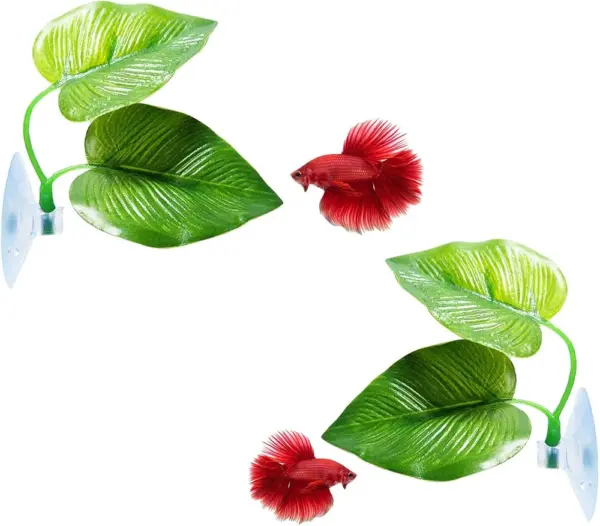
A betta does most of his living in the top two inches of the tank, coming up for air between naps, so a leaf parked just under the waterline does a job nothing on the gravel can do. You get two in the pack, each on a suction cup: the larger leaf is 2.36 by 1.77 inches, the smaller 1.97 by 1.50, which is roughly the footprint of a betta lying down.
This is the first decoration we put in a new betta tank, and the one we notice when it is missing. Both leaves bend under a fingertip, so a long-finned male can drape himself over one without the snagging risk of a hard plastic plant. Expect him to hover underneath it rather than lie on top at first. That is not a dud purchase; it is cover, and a covered betta settles faster than one with nowhere to tuck.
The cups are the part that needs attention. They grip clean glass firmly and start letting go once the glass films over, so plan on reseating them every few months. Position them before the tank is full, because doing it with a net handle and wet sleeves is miserable. We also run a fingertip around the molded rim of each leaf on arrival; a rough edge on a soft leaf is a minute with a nail file, and a torn fin takes weeks to heal.
Pros
- Soft leaf material that will not snag long fins
- Two leaves cover both ends of a small tank
- Height is adjustable on the suction cup
Cons
- Suction cups let go once the glass films over
Our default first buy for a betta tank: a soft leaf under the waterline where a resting fish already spends its time, held by a suction cup that needs occasional reseating.
SpringSmart Ceramic Cave – Best Hideout
Key Features
- Weight: 5.28 oz
- Material: Ceramic
- Openings: Two
- Dimensions: 3.5 x 3.5 x 3.35 in
- Price: Budget
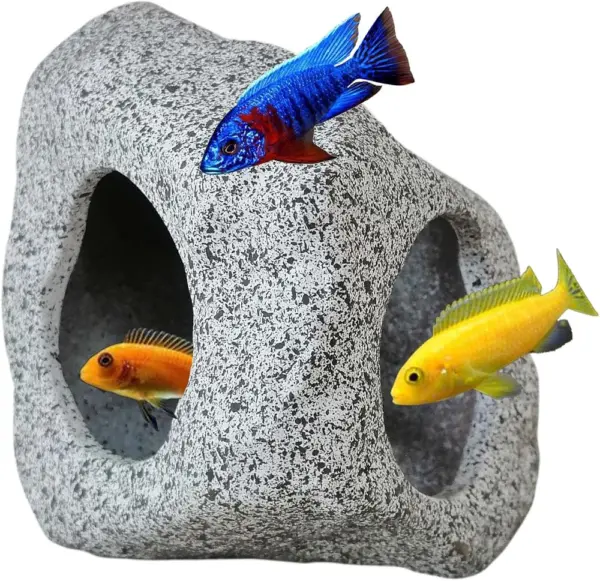
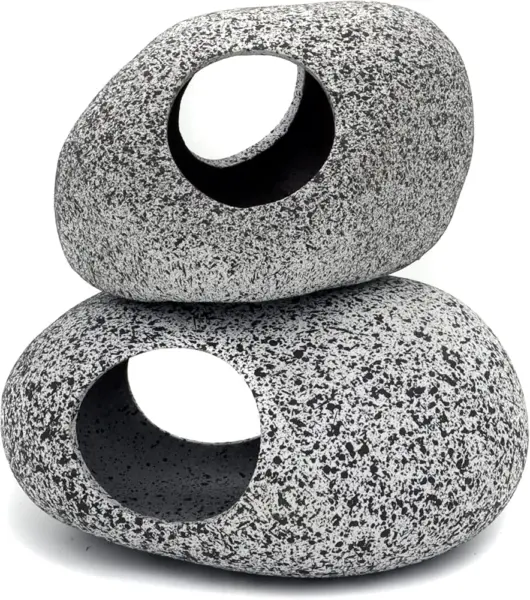
Two openings are what make this our hide of choice. A betta that darts inside has a second way out, which matters in a tank where he is the only fish but still gets startled by a hand at the glass. At 3.5 inches across, 3.35 tall, and 5.28 ounces of granite-textured ceramic, it lands where you put it and stays there without being half-buried in gravel to hold it down.
It reads bigger in the product photos than in your hand, and that is the point in a small tank: three and a half inches is a one-betta hide, not a centrepiece, and it leaves room to swim. Set it so the second opening does not face the glass, or you have built a one-door cave with a window. The grey speckled finish is quiet enough that the fish stays the bright thing in the tank.
The one real risk is the trip to your door. Ceramic turns up cracked often enough that we check the rim and feel inside both openings before it goes near water, and a hairline crack in something that lives submerged is a return, not a repair.
Pros
- Two openings, so a hiding fish is never trapped
- Dense ceramic sinks on contact and stays put
- Small footprint leaves swimming room
Cons
- Can arrive cracked or chipped in transit
For a five-gallon tank we reach for this hide: heavy ceramic that sinks on contact and a second opening, so a startled betta is never cornered.
Zoo Med Floating Betta Log – Best for Surface Feeding
Key Features
- Weight: 5.76 oz
- Material: Plastic
- Dimensions: 3 x 3.75 x 3 in
- Feeding hole: Yes
- Price: Midrange
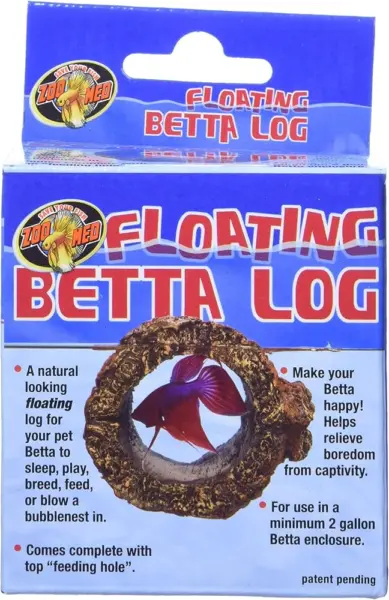
The floating log is where the whole idea of betta furniture started: a hollow plastic log, 3 by 3.75 inches, black and lightly bark-textured, sitting at the surface like a piece of driftwood that never sinks. Set against a planted tank it looks less like a pet product than most of what is sold for bettas, which is not nothing in a tank you have to look at every day.
The feeding hole in the top is the part we appreciate most. Drop a pellet through it and the fish comes up inside the log to eat, turning a two-second feed into a small event he will keep returning to. The interior is also where a settled betta tends to build his bubble nest, and a fish that nests inside a decoration has decided the tank is safe.
Placement matters more than we expected. The log drifts, and in a small tank it finds the glass; if it comes to rest with the opening against the wall, you have given your fish a solid tube with no door. Tuck it into a corner behind a plant, or accept nudging it back every few days. The inside is rougher than the outside, too, so run a finger around the opening, not just along the bark.
Even so, we keep one in the tank. A betta with a surface hideout he can patrol and a hole that drops food into his lap spends more of the day in view, and that is most of what decorating a betta tank is for. Just do not buy it as your only resting spot; a leaf hammock does that job more reliably.
Pros
- Feeding hole turns meals into a game
- Interior hollow invites bubble nests
- Natural log look at the waterline
Cons
- Some logs waterlog and stop floating
- Paint chips and peels over months
The most entertaining thing at the surface, with a feeding hole and a hollow to nest in, though buoyancy and chipped paint keep it from being the dependable bed.
Ameliade 8-Piece Decor Set – Best Starter Bundle
Key Features
- Pieces: 8
- Material: Plastic
- Plant mix: 3 short, 3 medium, 1 tall
- Set contents: 1 rock cave, 7 plants
- Price: Budget
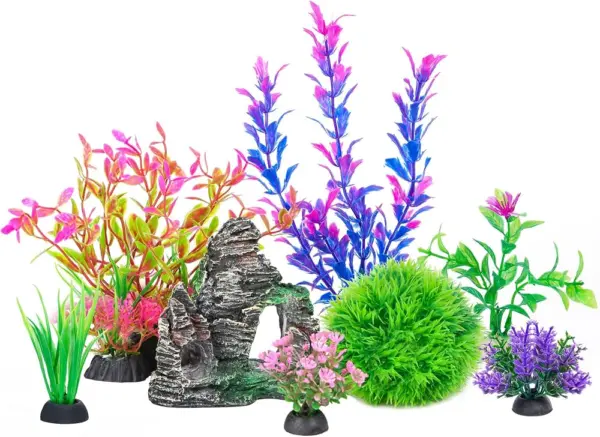
Stocking a tank one ornament at a time is how you end up with three pieces that do not go together and a tank that still looks bare. This set skips that stage: one rock cave and seven plastic plants, three short, three medium, and one tall, arriving as eight separate pieces rather than a fixed arrangement.
That separateness is why we rate it. The cave goes at one end, the plants fan around it, and nothing is joined together, so you can split the set across two small tanks or hold three pieces back and rebuild the layout in a month when you are bored of it. For a first betta tank it gets you to furnished in an afternoon, and none of it is so characterful that you will be stuck with a look you have gone off.
Two things to know before it goes in. The plants are light, so press each base down into the gravel until it grips; dropped on top of sand they drift. And the leaves are soft plastic rather than silk, which is the right call around fins, but the odd piece arrives with a rough molding seam. A minute with a nail file sorts the ones that do.
Pros
- Eight separate pieces you can rearrange freely
- Gets a new tank furnished in one purchase
- Soft plastic leaves rather than stiff stems
Cons
- No surface rest in the set, it is cover only
Eight pieces that turn an empty tank into a planted one in an afternoon, and enough of them to split across two small tanks when you want a change.
CousDUoBe 12-Piece Plants – Best Plant Pack
Key Features
- Base: Weighted
- Plants: 12
- Material: Plastic
- Height range: 2 to 8.6 in
- Price: Budget
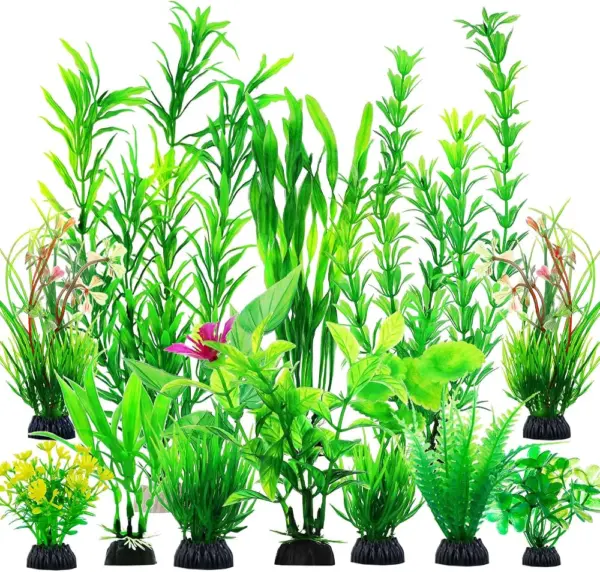
A bare tank fills up fast, and then one day it looks crowded, which is why a bag of twelve plants does more work than a single ornament. These run from 2 inches to 8.6, all in the same green, each on its own weighted base: tall ones along the back, short ones up front, and a tank that suddenly looks deeper than the glass says.
The leaves are soft, bending rather than stabbing, so a betta can push through a clump without catching a fin, which is more than you can say for a lot of molded plastic plants. They need no light and no fertilizer, a real advantage under a basic LED in a five-gallon. We use them as the filler behind whatever the feature piece is: the cave, the log, the skull.
Two small things worth knowing. The bases are weighted but light, and on sand they tip until you work them down into the substrate; give them a week to settle. And unpainted green plastic is the lowest-risk finish you can put in water, with no paint to chip and nothing to fade, which is why this pack ends up in the tanks where an ornament is the star.
Pros
- Twelve plants at heights from 2 to 8.6 inches
- Soft leaves that will not snag a fin
- No lighting or trimming needed
Cons
- Tallest plant stops at 8.6 inches
We buy this one for volume: twelve soft plants from two to eight inches that fill the back of a tank without a single edge to worry about.
Smoothedo 2-Piece Plant Set – Resting Plant
Key Features
- Blades: 6
- Material: Plastic and resin
- Dimensions: 6 x 4 x 2 in
- Pieces per set: 2
- Price: Midrange
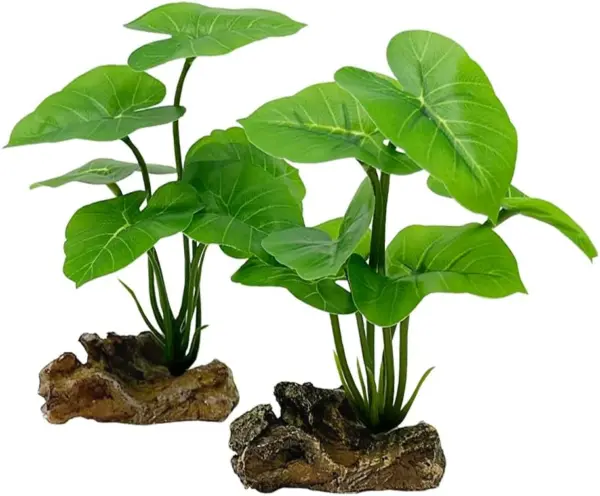
Some bettas never take to a suction-cup hammock. They rest on the filter, the heater bracket, a plant leaf, anywhere but the thing you bought. If that is your fish, a broad-leaved plant with a bit of height is the better bet, because the resting spot is part of the scenery rather than an object hanging off the glass.
This set is two of them: a fan of six blades on a weighted base, 6 inches tall and 4 inches wide, molded in plastic and resin in a green that reads as a plant rather than a plastic one at a glance. The blades splay outward, so there is a broad landing in the middle of the fan instead of a single upright leaf.
We like it as the second attempt. It is more forgiving of placement than a cup, and planted near a back corner a betta already patrols it becomes part of his route rather than a destination he ignores. The weighted base means it does not need burying as deep as a lighter plant. Two pieces is a small pack and both are the same shape, so treat it as one resting spot and one piece of scenery. Wash it before it goes in; new pieces carry a faint manufacturing smell that rinses away.
Pros
- Six broad blades make a wide landing
- Weighted base sits upright without deep burying
- Leaves soft enough for fins to brush past
Cons
- Two pieces only, and both the same shape
Worth trying when your betta ignores a leaf hammock: a broad, soft resting plant that becomes part of the scenery instead of another thing stuck on the glass.
JIH Ceramic Skull Cave – Character Hide
Key Features
- Weight: 10.9 oz
- Material: Ceramic
- Stackable: Yes
- Price: Midrange
The finish is the surprise. In the tank the skull reads white with black speckles rather than bone grey, and once a little algae settles into the crevices it looks less like a novelty and more like something that has been in the water a while, which is exactly what you want from a themed ornament in a planted tank.
It is ceramic rather than resin, and at 0.31 kg it sinks the moment it touches water and stays where it lands. It is also stackable, so two of these become a two-level cave with ledges to swim between, which is more interesting than one larger skull and gives a betta a ramp as well as a room. Ceramic is why we prefer it to a painted skull: nothing to chip, and it scrubs clean.
Where we are cautious is the molding inside. Eye sockets and interiors are where rough edges sit, and that is the first thing to feel for: run a finger inside both sockets before it goes in, and file anything that catches. Do that and it is a good character hide for a tank that already has its basics covered. The look is the reason to buy it; no betta needs a skull to be happy.
Pros
- Dense ceramic sinks and stays where placed
- Stackable into a two-level cave
- No painted finish to chip or flake
Cons
- Rough edges can sit inside the eye sockets
Buy it for the look: a ceramic skull that sinks on contact and stacks into a two-level cave, once you have checked the eye sockets for rough molding.
How We Tested 16 Betta Decorations
We started with a long list of a few dozen decorations sold for tanks under 10 gallons, then cut anything that reviewers repeatedly described as flaking, shedding dye, or arriving with rough seams, along with anything so large it would swallow a third of the swimming room in a five-gallon tank. That left 16 pieces — silk and plastic plants, floating logs, resin caves, a bridge or two — and each one stayed in rotation for four months.
Before anything touched water, I ran a pair of sheer tights over every edge, seam, and leaf tip and noted where the fabric snagged, then felt inside each opening to judge texture and whether a betta could swim through cleanly or wedge itself. Each piece went into a cycled five- or ten-gallon tank on a kitchen counter or desk, where I watched whether the resident fish approached it within a day, draped itself over a leaf, hid inside, or ignored it entirely.
Every week during water changes I lifted each decoration out, wiped it down with tank water, and looked for fading, bubbling paint, or plastic gone soft. Floating pieces were checked for waterlogging to see how many weeks they truly stayed at the surface, and suction-cupped pieces were left undisturbed for a month to see whether they held or slid down the glass. At the end, we weighed what each one cost against how it looked and held up, since a plant that sheds in three weeks is worse value than one that costs a little more and doesn’t.
How to Choose Betta Tank Decorations
A betta tank needs two things filled before it needs anything pretty: somewhere to hide and somewhere to rest near the surface.
Fill the Hide and the Resting Spot First
Bettas come to the surface to breathe, so a fish hanging against the glass is often just tired with nowhere better to be. A leaf pad, a floating log, or a tall plant that reaches near the top gives him a place to do that lying down, and it is the single most useful addition to a tank that already has a cave.
After those two jobs are covered, plants are for cover and for you. A clump at each end of the tank gives a betta a route around the edges instead of a dash across open water, and it hides the heater and filter intake at the same time.
Fit the Piece to the Tank You Have
A cave measuring 3.5 inches across looks modest in a listing and takes up real estate in a five-gallon. Before you buy, picture the footprint against the tank rather than against the photo: one cave plus one plant cluster is comfortable in a five-gallon, while a cave, a log, two ornament clusters and a dozen plants is a rockfall.
Keep the middle and the front third open, and put height at the back and sides. That is also where tall plants earn their keep, screening equipment without crowding the space your fish actually swims through.
Check the Surfaces Before They Go In
Fin damage is the failure that matters with a long-finned betta, and it usually starts somewhere you cannot see from the front of the tank. Run a nylon stocking or the back of a fingernail over every surface: the inside of a cave, the eye sockets of a skull, the molded rim of a leaf, the seam where a stem meets a base.
If it snags, it will snag a fin. A pass with a nail file or fine sandpaper fixes most of what you find, and a cave with a rough interior you cannot reach is one to send back rather than shrug at.
Expect Paint and Suction Cups to Age
Painted resin is the finish that fails first, chipping on a hollow ornament and fading on anything silicone, while unpainted ceramic and green plastic plants keep their color because there is no finish to lose. If you want an ornament that still looks right in two years, buy the one with nothing painted on it.
Any glass-mounted piece will eventually let go, and more often once the glass films over. Reseating the cup on clean glass, pressed flat from the middle out, buys months at a time; plan for that rather than being surprised by it.
Frequently Asked Questions
Do I need to soak new decorations before they go in a betta tank?
Rinse everything in warm water, with no soap ever, and go further for anything painted, resin, or silicone: soak it overnight in a bucket of dechlorinated water and smell it afterwards. A solvent or paint smell, an oily film on the surface, or a tint in the water means it does not go into a stocked tank.
How do I clean algae off aquarium decorations?
Lift the piece out during a water change and scrub it in a bucket of tank water with a soft toothbrush. Ceramic and unpainted plastic take a firm scrub; painted resin and silicone do not, so use a cloth and light pressure there. Skip soap, bleach, and the dishwasher. Algae comes back either way, so the goal is knocking it back, not sterilizing.
Can I move a decoration from one tank to another?
Only once it has dried out completely, and 24 hours in dry air is the working rule. Wet decor carries water, and water carries whatever is in the tank, including parasites and algae spores. Never move a piece straight from a tank with a sick fish into a healthy one, and give porous or painted pieces the longest drying time.
Final Verdict
If you buy one thing, make it the CousDUoBe leaf pad. It puts a soft bed exactly where a betta already spends his day, and the two leaves cover both ends of a small tank so a nervous fish always has somewhere to be.
Pair it with the SpringSmart cave if your betta is new, nervous, or sharing the tank with anything that chases him; the second opening is what makes it a hide rather than a trap. From there the rest is scenery, and good scenery: plants for cover, and the Zoo Med log if you want feeding to be the most interesting part of the day.