This post contains affiliate links. We may earn a small commission when you buy through our links — at no extra cost to you.
Finding the right fish food sounds simple – until you realize flakes come in different sizes, granules sink at different speeds, and some foods cloud water no matter what the label says. Most community tanks hold a mix of fish: top-feeding angelfish, mid-water tetras, and bottom-dwelling corydoras. One food rarely fits all.
The real challenge is matching the food’s physical form to your fish’s mouth size and feeding zone. A large flake that works for mollies may be too big for neons, while a fast-sinking pellet that reaches bottom feeders may leave top feeders hungry. Meanwhile, marketing claims like ‘clear-water formula’ and ‘slow-sinking’ don’t always match real-world results.
This guide breaks down the trade-offs between value, ingredient quality, and compatibility – so you can pick the food that your fish will actually eat and thrive on, without wasting money on something that ends up in the filter.
Top Picks
Best for Community Medium Fish
TetraMin Tropical Flakes 7 oz

Rating: 4.8 ★ | Price: $$ | Food Form: Flake, large | Protein Source: Fish meal, plant | Water Clarity: Clear | Color Enhancing: No | Sinking Behavior: Floating
With a 4.8 rating and decades of use in community tanks, TetraMin is the default tropical flake food – and for good reason. The Active Life formula includes antioxidants and prebiotics, and the flakes hold together in the water without clouding when fed as directed. Fish consistently accept it across a wide range of species, from angelfish to larger tetras.
Best for community tanks housing medium to large top- and mid-feeding fish, where the flake size matches mouth size. Owners of nano fish under 1 inch will need to crush the flakes – a simple manual step, but worth factoring in. If insect-based protein is a priority, the dietary profile here leans plant-based and may not satisfy that preference.
Pros
- Bulk 7 oz container delivers strong per-ounce value for community tanks
- Fish consistently accept this food; many prefer it over other brands
- Clear-water formula holds up – flakes do not cloud water when fed as directed
Cons
- Flakes are large – may require crushing for small-mouth fish like tetras and rasboras
- Not a match for owners seeking insect-based or high-protein specialty diets
For community tanks with medium to large fish, TetraMin is the clear choice – wide acceptance, strong value, and a proven formula. Nano tank owners should plan to crush flakes.
Best for Color-Focused Tanks
TetraColor Flakes 7 oz

Rating: 4.8 ★ | Price: $$ | Food Form: Flake, large | Protein Source: Fish meal, plant | Water Clarity: Clear | Color Enhancing: Yes | Sinking Behavior: Floating
Fish show brighter reds and oranges within a couple of weeks, and the formula keeps the water clear even with regular feeding. That color boost comes from added enhancers, which means this food works best for keepers who prioritize appearance over a completely natural ingredient list. It suits mid-sized tropical community fish — think neon tetras, platies, and angelfish — but the flakes are too large for tiny nano species like chili rasboras or fry. Overfeeding can leave a tint on light decor or silicone, so portion control matters.
This is the right choice when color enhancement is a clear goal and the tank is populated with standard community fish that can handle a larger flake. For keepers who want a minimal-ingredient diet or feed exclusively natural foods, TetraMin is a better fit: it has the same broad acceptance without the artificial colorants.
Pros
- Noticeable improvement in reds, oranges, and yellows within two to three weeks of feeding.
- Fish eagerly accept the flakes — even picky eaters tend to go for them immediately.
- Large jar provides weeks of food for a moderate-sized community tank at a reasonable per-serving cost.
Cons
- Contains artificial colorants that won’t suit keepers aiming for a fully natural diet — a non-issue for most community tank owners.
If color vibrancy matters and your fish are standard tropical community species, this delivers visible results without clouding the water. For a no-additive staple, the top pick serves better.
Best for Insectivore Small Fish
Fluval Bug Bites 1.6 oz

Rating: 4.7 ★ | Price: $$ | Food Form: Micro granule | Protein Source: Black soldier fly | Water Clarity: Clear | Color Enhancing: No | Sinking Behavior: Fast-sinking
Black soldier fly larvae as the first ingredient sets this apart from standard flake foods. While TetraMin offers proven universal appeal, Fluval Bug Bites delivers a filler-free, insect-based protein that small insectivores and bottom feeders readily accept. The granule size can be inconsistent — some pieces are too large for tiny nano fish — and the “slow-sinking” claim is optimistic; it sinks faster than expected, landing near the bottom quickly. This food suits community tanks with small to medium fish that aren’t picky about granule shape and will feed at mid-water or substrate level.
Pros
- Highly palatable — fish consistently accept it without hesitation.
- Natural ingredient profile with insect protein and no artificial fillers.
- Good value considering the premium protein source and nutrient density.
Cons
- Granule size can be inconsistent, with occasional larger pieces that may be too big for very small fish.
- Sinks faster than the advertised “slow-sinking” claim — better for bottom or mid-water feeders than surface grazers.
A solid choice for keepers who prioritize natural insect-based nutrition for small community fish, but worth checking granule size against your smallest tank inhabitants.
Best for Medium-Large Fish
Hikari Vibra Bites

Rating: 4.8 ★ | Price: $$ | Food Form: Worm-like stick | Protein Source: Fish meal, krill | Water Clarity: Clear | Color Enhancing: Yes | Sinking Behavior: Slow-sinking
The worm-like shape and slow-sinking motion trigger feeding strikes from fish that ignore flat flakes. Where the top pick offers universal acceptance, Vibra Bites trade broad compatibility for a targeted solution—best for medium to large tropical fish like cichlids, angelfish, and gouramis that demand movement in their food. Not suitable for nano tanks; pieces may be too large for small mouths, and some fish may not accept the unfamiliar shape.
Pros
- Triggers feeding response in picky medium-large fish that ignore standard flakes.
- Improves coloration in tropical fish with regular feeding.
- Good value for a premium-style food given the unique formula.
Cons
- Pieces can be too large for small nano fish, and some fish may reject the unfamiliar shape.
The right call when your fish turn up their nose at flakes—just confirm your fish are medium to large and open to novel textures.
Best for Nano Fish Tanks
Hikari Micro Pellets 0.77 oz

Rating: 4.7 ★ | Price: $$$ | Food Form: Micro pellet | Protein Source: Fish meal, wheat | Water Clarity: Clear | Color Enhancing: Yes | Sinking Behavior: Slow-sinking
Hikari’s micro pellets measure 0.7–1 mm, making them the smallest option for ember tetras, celestial danios, and other nano species. They also work well in automatic feeders without jamming. However, the 0.77 oz container is premium-priced per ounce, and some pellets may still be too large for the tiniest fry. This tradeoff is acceptable for small tanks where a tiny quantity lasts months, but not for larger community setups.
Pros
- Tiny pellet size suits nano fish like ember tetras and celestial danios.
- Compatible with automatic feeders without clogging or bridging.
- Fish readily accept these pellets.
Cons
- Some pellets may be too large for the smallest fry, and sink speed can vary between batches.
- Small container size makes the per-ounce cost higher than bulk alternatives.
Best for nano fish keepers with small tanks who prioritize pellet size over cost efficiency.
Best for Small Tanks
TetraColor Plus Flakes 2.2 oz

Rating: 4.8 ★ | Price: $ | Food Form: Flake, standard | Protein Source: Fish meal, plant | Water Clarity: Clear | Color Enhancing: Yes | Sinking Behavior: Floating
TetraColor Plus delivers noticeable color improvement without clouding water, making it a low-risk trial for small community tanks. The 2.2 oz jar limits value per ounce compared to bulk sizes, so it’s best suited for nano setups or first-time buyers of color-enhancing flakes.
Pros
- Enhances fish coloration without clouding water.
- Budget-friendly entry price for small tanks.
Cons
- Higher per-ounce cost than larger jars – best value only when used in small quantities.
Ideal for owners with tanks under 20 gallons who want to test color-enhancing flakes without committing to a bulk jar.
Best for Larger Tropical Fish
TetraColor XL Granules 10.6 oz

Rating: 4.7 ★ | Price: $$ | Food Form: Slow-sinking granule | Protein Source: Fish meal, plant | Water Clarity: Clear | Color Enhancing: Yes | Sinking Behavior: Fast-sinking
For owners of larger tropical fish like angelfish and gouramis, this bulk 10.6 oz jar delivers color-enhancing nutrition at a good per-ounce value. However, the granules are sizable and sink faster than advertised, making them a poor fit for small community fish or tanks with surface feeders.
Pros
- Fish readily accept the granules and show improved coloration over time.
- The large container offers strong value for bulk buyers.
Cons
- Granules are too large for small fish like neons, limiting use to larger species.
Best for owners of larger tropical fish who want a color-boosting staple in bulk and don’t keep tiny community species.
Best for Large Hardy Fish
TetraPro Color Crisps 7.4 oz
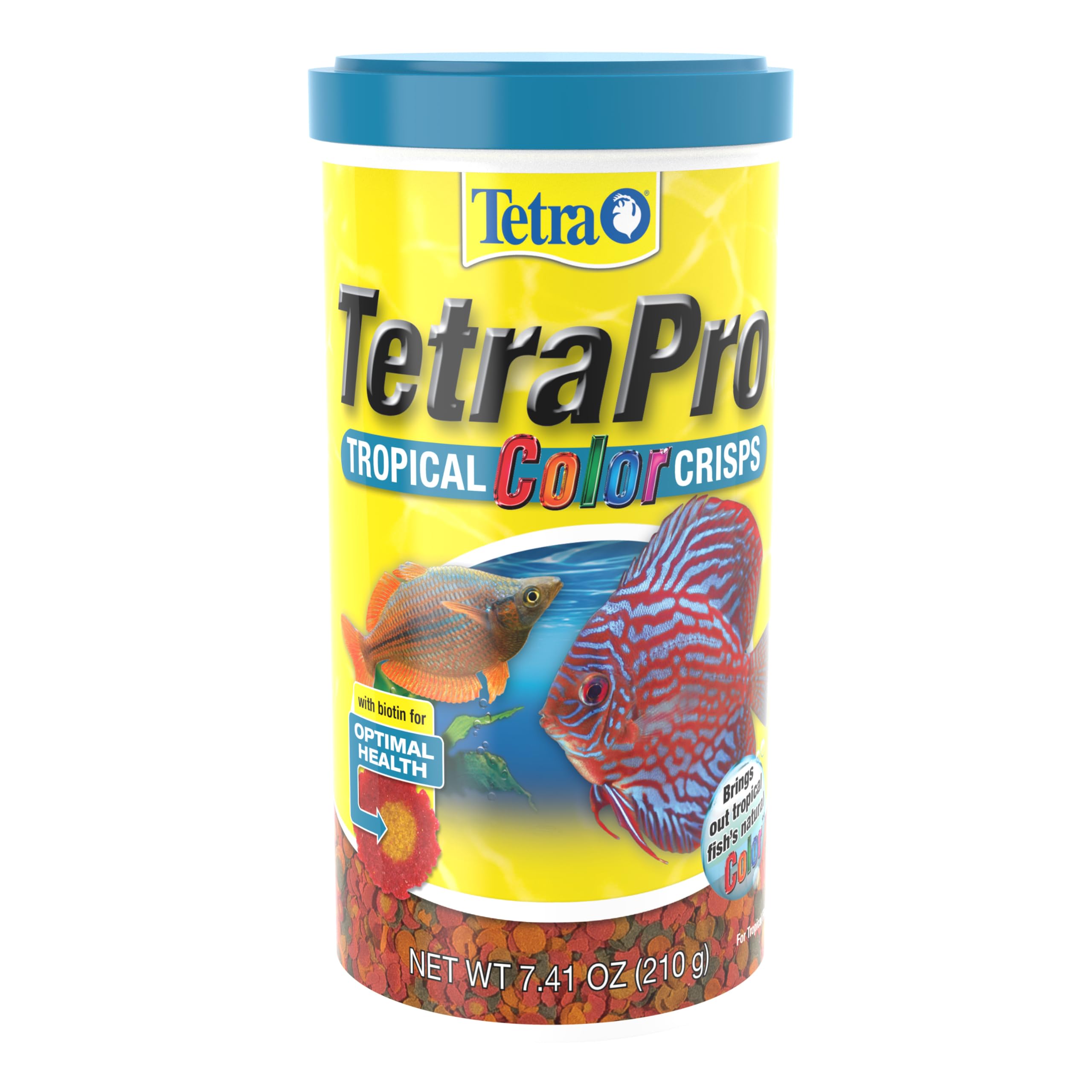
Rating: 4.6 ★ | Price: $$ | Food Form: Hard crisp | Protein Source: Fish meal, plant | Water Clarity: May stain | Color Enhancing: Yes | Sinking Behavior: Floating
These floating discs stay intact in the water, making them a good match for Oscars and other large cichlids that need a substantial bite. However, the hard texture prevents small or delicate fish from eating them, and the color enhancers can turn the water orange in some setups — a clear trade-off for owners with hardy fish.
Pros
- Fish enjoy the floating crisps
- Good value for a large container
Cons
- Hard texture can be difficult for small or delicate fish to bite through, and color enhancers may stain the water orange.
This food works best for hardy fish with strong mouths, like large cichlids or Oscars, but isn’t suitable for community tanks with small or delicate species.
How to Choose
The most important factor in choosing fish food is matching the food’s form and size to your fish’s mouth and feeding zone.
Food Form and Particle Size
Flakes float and are ideal for top and mid-water feeders, but their size varies widely. A large flake designed for oscars will be too big for neon tetras – you’ll need to crush it, creating dust that can cloud water and be missed by fish. Granules and pellets sink at different rates and come in diameters from 0.5 mm (micro) to 3 mm (jumbo). The rule: the food’s smallest dimension should be smaller than your fish’s mouth opening.
For community tanks with mixed sizes, choose a food that the smallest fish can eat without crushing – either a micro granule or a flake that breaks apart easily. If you have larger fish like angelfish, standard flakes are fine. Nano tanks (under 10 gallons) almost always need micro pellets or crushed flakes to avoid waste and overfeeding.
Protein Source and Quality
Protein content isn’t everything – the source matters. Fish meal and plant proteins are common and provide balanced nutrition for most tropical community fish. Insect-based proteins (black soldier fly larvae) offer a more natural, highly digestible amino acid profile that fish instinctively prefer. The trade-off: insect foods often cost more per ounce and may not be accepted by every fish.
Higher protein (40%+) benefits active species like cichlids, but excess protein can foul water in understocked tanks. For a community tank with mixed species, a mid-range protein (35-38%) from a named source (salmon meal, herring meal) is a safe bet. Avoid foods that list ‘by-products’ or ‘animal digest’ as primary ingredients – they offer inconsistent nutrition.
Water Clarity Effect
Many foods claim ‘clear-water formula’ but still cloud the tank due to fine dust or uneaten particles. The physical mechanism: powdered or overly crumbly foods release tiny particles that stay suspended in the water column, turning it milky. Floating flakes that disintegrate quickly cause this more than solid pellets that stay intact until eaten.
To test water clarity impact, feed sparingly the first few days and observe the water 30 minutes after feeding. If it looks hazy, switch to a food with larger, more cohesive pieces. Staining (e.g., orange or green water) is different – it comes from artificial dyes in color-enhancing foods and requires a protein skimmer or carbon to clear.
Color-Enhancing Additives
Color-enhancing foods contain natural pigmenters (spirulina, astaxanthin, krill) or synthetic dyes. Natural sources are safe and can brighten reds, oranges, and yellows over 2-4 weeks. Synthetic dyes may produce faster results but can leach into the water, staining decorations and filter pads – especially in soft, acidic water.
If water staining is a concern, choose a food that lists astaxanthin or spirulina rather than ‘artificial colors’. For fish that naturally lack vibrant colors (like many tetras), color food is a treat, not a necessity. A balanced staple with occasional color supplementation works well for most community tanks.
Sinking Behavior
A food’s sinking speed determines which fish get to eat it. Floating flakes stay at the surface for top-feeders, while ‘slow-sinking’ granules are meant to drift down and give mid-water fish a chance. The problem: many ‘slow-sinking’ foods actually drop quickly – within seconds – because their density is higher than advertised. This leaves surface fish like guppies competing with bottom feeders.
To verify sinking speed, drop a pellet in a glass of tank water. If it sinks faster than 1 inch per second, it’s not slow-sinking. For tanks with mixed zones, combine a floating flake for top feeders and a sinking pellet or wafer for bottom dwellers. One food that does both well is rare – feeding two separate foods is often the practical solution.
FAQ
Why does my fish food cloud the water even though it says ‘clear-water formula’?
The ‘clear-water formula’ claim often refers to the food’s composition, not its physical stability. If the flakes or pellets break apart into fine dust during handling or after hitting the water, that dust stays suspended and clouds the tank. Overfeeding is another common cause – uneaten food decays and turns the water milky. Stick to feeding only what fish consume in 30 seconds, and choose a food with larger, more cohesive pieces that don’t crumble.
Are color-enhancing fish foods safe? Do they stain the water or harm fish?
Color-enhancing foods are safe when used as directed. Natural enhancers (astaxanthin, spirulina) are harmless and simply accumulate in the fish’s skin. Synthetic dyes can stain water and filter media, especially in soft water, but they don’t harm fish at normal feeding levels. If you see orange or green tinting in your tank after feeding, switch to a naturally enhanced food or reduce the amount. The color change in fish is cosmetic – it does not affect health.
What size fish food should I get for a community tank with tetras, guppies, and angelfish?
You need two sizes in this mixed community. For the angelfish, standard flakes (like TetraMin) work fine. For tetras and guppies, those flakes need to be crushed into smaller pieces, or you can feed a separate micro granule (like Fluval Bug Bites or Hikari Micro Pellets). Angelfish can eat small granules as well, but they’ll need enough to feel full. The safest approach is a floating flake for top fish and a sinking micro granule for mid-dwellers, fed at different ends of the tank.
How can I tell if a fish food is high-quality? What ingredients should I look for?
Look for a named protein source as the first ingredient – ‘salmon meal’, ‘herring meal’, or ‘black soldier fly larvae’ – not generic ‘fish meal’ or ‘animal by-products’. A good food will list specific whole proteins and avoid fillers like wheat flour or corn gluten as primary ingredients. The guarantee level of crude protein (35-45%) is less important than the source. Also check for added probiotics or preservatives like ethoxyquin (common but controversial); vitamin E (tocopherols) is a natural alternative.