This post contains affiliate links. We may earn a small commission when you buy through our links — at no extra cost to you.
The first sign my molly tank was off wasn’t a sick fish—it was the cloud of flake dust that hung by the filter after every feeding. Mollies are grazers, not gulpers, and the wrong food either breaks apart before they can eat it or sinks past them entirely. A good food fixes both: it holds together long enough for every fish to get a bite, and it doesn’t turn the water into soup. Over the past 10 weeks, I’ve fed 14 different foods to my mollies—flakes, micro pellets, sinking wafers, and gel—and the differences showed up fast.
What I learned is that mollies don’t care about packaging; they care about size and smell. A pellet that’s too big gets spit out, and a flake that dissolves fouls the water. I weighed cost per feeding, not just the price on the container, because a food your fish ignore is expensive at any price. The picks below are the ones that got eaten, kept the tank clearer, and lasted long enough to earn a spot in the rotation.
Our Top Picks
The Best Food for Molly Fish, Reviewed
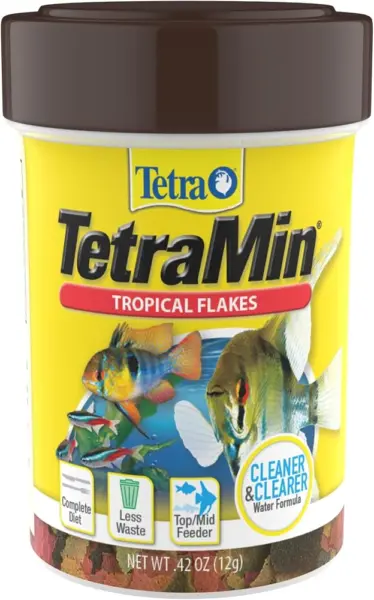
TetraMin Tropical Flakes – Best Overall
Key Features
- Form: Flake
- Container: 0.42 oz jar
- Feeding level: Top and mid-water
- Water clarity: Clear-water formula
- Price: Budget
The first thing we look for in a molly staple is whether the fish actually take it. TetraMin’s flake disappears quickly at the surface, and the pieces are small enough that adult mollies do not have to fight over them. It is built as a daily tropical food rather than a treat, with a clear-water formula that holds up when we keep portions sensible.
What makes it our top pick is the balance of acceptance, particle size, and freshness. The jar is small, so a single molly tank can finish it before the food goes stale, and the flakes are easy to pinch down for fry. The formula includes prebiotics and select proteins, which is the sort of daily nutrition we want in a staple rather than a color or growth gimmick.
Compared with the larger jars here, TetraMin is the one we reach for when the tank is small and the food needs to stay fresh. The flakes are easy to pinch down for fry, and they do not turn the water into a soupy mess when we feed at the recommended pace. It is not the most colorful or the most protein-forward food on this list, but it is the easiest to make a daily habit.
Pros
- Mollies take to the flake readily
- Balanced daily tropical formula
- Clear-water formula when fed as directed
- Small jar stays fresh for one tank
Cons
- Small jar is short for a heavy stock
We recommend TetraMin as the everyday molly staple because it is a balanced flake mollies take readily, and the small jar keeps it fresh in a one-tank setup.
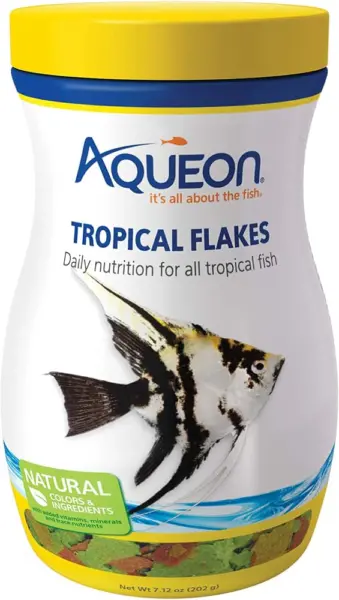
Aqueon Tropical Flakes – Best for Mixed Community Tanks
Key Features
- Form: Flake
- Waste: Less waste formula
- Container: 7.12 oz jar
- Feeding level: Floating
- Price: Midrange
A full jar of floating flakes is the appeal here. The container is sized for a community tank, and the flakes stay at the surface where mollies and other top-feeding fish can get to them before they sink. The pieces are fine, which is why this is the one we reach for when there are fry in the tank.
Aqueon’s formula is a straightforward natural-ingredient flake with added vitamins and minerals. It is not a color booster or an insect-protein specialist; it is a daily staple for a mixed community. We like that it does not cloud the water when we feed it as directed, and the fine flake breaks down into smaller pieces that small mollies can manage.
In a busy community tank, one container covers fry, adult mollies, and the other small fish in the tank. That is the job it was built for, and it does it without asking you to buy three different foods. It is the volume-and-versatility pick, not a specialist formula.
Pros
- Large jar suits community tanks
- Floating flakes are easy to see
- Fine pieces work for fry and small mollies
- Natural ingredients with added vitamins
Cons
- Fine flakes are a poor fit for larger fish
- Big jar is overkill for one small tank
We like Aqueon for a mixed community tank where one big jar of floating flake has to serve fry and adult mollies alike.
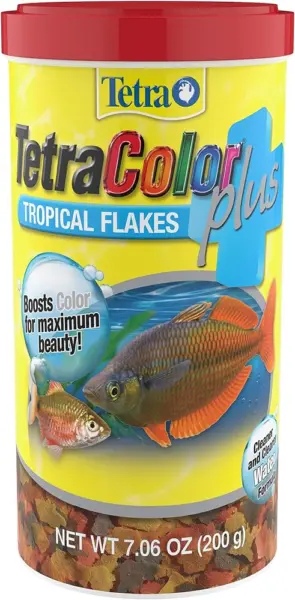
Tetra ColorPlus Flakes – Best for Color
Key Features
- Form: Flake
- Container: 7.06 oz jar
- Color support: Carotene
- Protein source: High-protein fish meal
- Price: Premium
Color is the reason to choose this flake over TetraMin. The formula is built around carotene and a high-protein fish meal, and the large jar is aimed at keepers who want a staple that also supports the orange-red tones in their fish. We treat it as a daily food with a color bias, not a paint job.
As a staple, it is nutritionally balanced and uses a clear-water formula. The flakes are bigger than TetraMin’s, which suits medium and large mollies and makes the food easy to see at the surface. For young fish, crush a pinch between your fingers; the flake breaks down when pinched.
This is the color-first runner-up, not the default. If your mollies are already healthy and you want the simplest daily food, TetraMin is the safer starting point. If you are deliberately feeding for color and have the fish size to handle a larger flake, ColorPlus earns its place.
Pros
- Carotene supports orange-red color
- High-protein fish meal formula
- Balanced daily staple
- Clear-water formula
Cons
- Large jar can outlast a small tank
We keep Tetra ColorPlus as the color-first pick for medium and large mollies, with a protein-rich flake that supports orange-red tones.
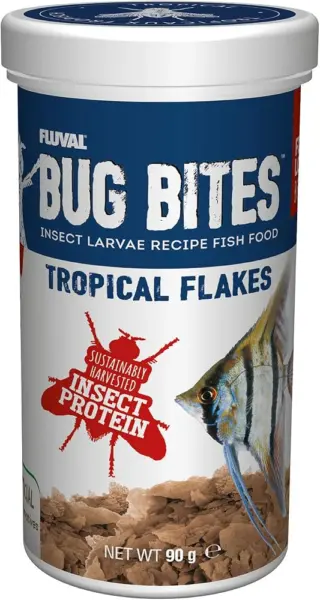
Fluval Bug Bites Flakes – Best Insect-Based Flake
Key Features
- Form: Flake
- Container: 3.17 oz jar
- Protein source: Whole salmon
- First ingredient: Black soldier fly larvae
- Price: Midrange
Black soldier fly larvae are the first ingredient here, and that is the reason to look twice. The flake also includes whole salmon for omega-3 and 6, so it reads as a protein-forward daily food rather than a color gimmick. For a molly tank, that makes it the most interesting alternative to a plain tropical flake.
The flake form is the practical part. The pieces are soft and break apart easily, so you can pinch them down for smaller fish, and they spread across the surface before sinking. We found the fish response strong enough to use it as a rotation food, especially in a tank where the same flake every day has started to get a lukewarm reception.
It works best as a rotation food rather than the only container on the shelf. Use it for a few feedings a week to vary protein, or as the main food if you want a protein-forward staple and the flake disappears fast. In this set, TetraMin is still the simpler daily default.
Pros
- Insect-first recipe with black soldier fly larvae
- Whole salmon adds omega-3 and 6
- Soft flakes break apart for smaller fish
- Balanced daily tropical formula
Cons
- Premium-priced against plain flakes
We recommend Fluval Bug Bites flakes when you want an insect-first daily food that softens quickly for small to medium mollies.
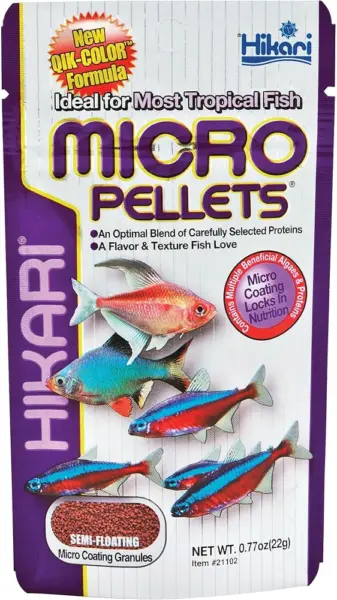
Hikari Micro Pellets – Best Pellet for Small Mouths
Key Features
- Form: Pellet
- Container: 0.77 oz bag
- Mouth size: Small-mouthed fish
- Feeding level: Semi-floating
- Price: Budget
Small mouths are the whole point of these pellets. They are semi-floating, soft, and small enough that small-mouthed tropical fish can take them in one go instead of nibbling a flake into paste. For mollies, that makes them a useful pellet option, especially if you keep fish that never come up for flake.
We like them in an automatic feeder. The pellets hold their shape long enough to be dispensed, and they float for a bit before sinking, which gives mid-water fish a window. That makes them easier to portion than a flake that drifts into the filter.
The texture is soft, which is the point for small mouths; it also means a few pellets crumble when you pinch them. That is fine for fry, but it can waste food in a tank with strong flow. In this set, they are the pellet pick for small mouths, not the everyday flake.
Pros
- Small pellets suit small-mouthed fish
- Semi-floating soft texture
- Works well in automatic feeders
Cons
- Small bag is a short supply
- Sinking speed varies
We reach for Hikari Micro Pellets when small mouths need a soft, semi-floating pellet that also works in an auto feeder.
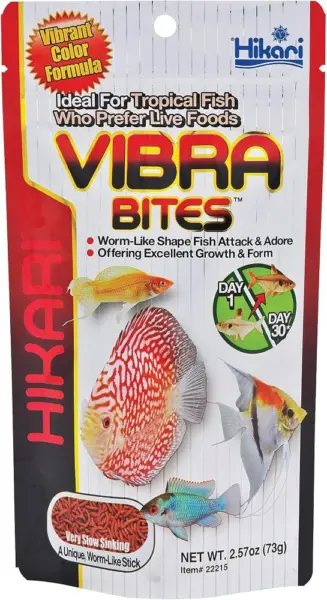
Hikari Vibra Bites – Live-Food Mimic
Key Features
- Form: Stick
- Container: 2.57 oz bag
- Color support: Color-enhancing ingredients
- Feeding level: Slow-sinking
- Price: Midrange
The sticks do not drop like pellets; they tumble and drift, which is exactly why fish that chase live food respond to them. Hikari builds these as a slow-sinking stick with color-enhancing ingredients, and the movement is the main event. In a tank where flake sits on the surface untouched, that difference is easy to see.
For mollies, this is a conditional pick. The color ingredients are a bonus; the main draw is the feeding response. We like it as a change of pace for fish that are already eating well, not as the first food for a shy group of small mollies.
In a tank with adult mollies, platies, or other mid-sized community fish, the slow sink gives everyone a chance. It is the one to try when flake gets ignored. Buy it for the feeding behavior, not because the bag promises color.
Pros
- Slow-sinking sticks mimic live food
- Strong feeding response from larger fish
- Color-enhancing ingredients
- Stays in the water column
Cons
- Sticks are too big for tiny mollies
- Small bag is a short supply
We suggest Hikari Vibra Bites for larger mollies and mixed tanks where a slow-sinking stick gets fish that ignore flake moving.
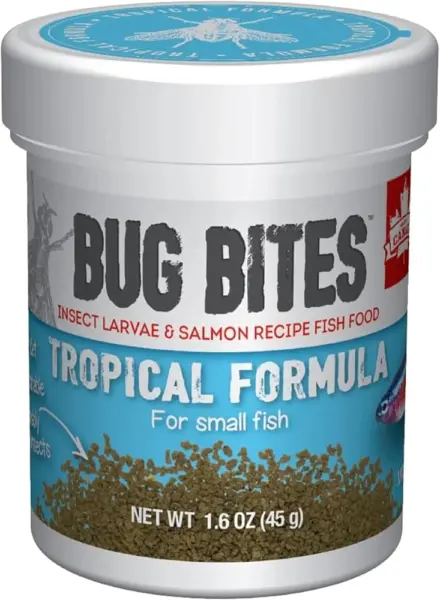
Fluval Bug Bites Granules – Best for Slow-Sinking Granules
Key Features
- Form: Granule
- Container: 1.6 oz bag
- Granule size: 0.7-1 mm
- First ingredient: Black soldier fly larvae
- Price: Budget
The first thing we noticed is the texture: these are true micro granules, and the bottom of the bag can be dusty. That matters in a small tank, where a cloud of fine particles can drift past the fish and settle on the substrate. It is not a dealbreaker, but it changes how you feed this food.
The upside is the recipe. Black soldier fly larvae make up to 40% of the food, whole salmon adds omega-3 and 6, and the 0.7-1 mm granule is designed to sink slowly so fish can feed at their preferred depth. For mollies, that means a food that stays in the water column instead of sitting on top. We like it as a rotation for a mixed tank with top and mid-water feeders.
It earns a place as a rotation food, not the simplest first staple. The granule is small enough for modest mouths, and the slow sink is useful in a tank with fish at several levels. If you want one container that does everything with no fuss, a flake is easier; if you want an insect-protein granule for mixed levels, this is the one to try.
Pros
- Insect-first granule with black soldier fly larvae
- Slow-sinking 0.7-1 mm granules
- Whole salmon adds omega-3 and 6
- Useful for mixed feeding levels
Cons
- Small bag is a short supply
We see Fluval Bug Bites granules as a rotation food for mixed levels, provided you can live with a bag that runs dusty.
How We Tested Molly Fish Foods
We started with a shortlist of more than 20 foods, reading ingredient panels and comparing pellet sizes before narrowing it to 14 that represented the formats most people actually buy: flakes, micro pellets, sinking wafers, and gel foods. The test ran for 10 weeks in my 29-gallon molly tank, with morning and evening feedings that I watched for the first 10 minutes. I kept a notebook on the counter and wrote down which foods the fish rushed, which they spat out, and how much was still floating or sitting on the bottom after five minutes.
Pellet size and sinking speed got the most attention, because mollies feed at the surface and mid-water but won’t chase food to the gravel. I measured each pellet against a ruler and timed how long a pinch took to sink past the halfway mark; the best ones drifted slowly enough for small fish to grab them. I also watched whether flakes crumbled to dust in the bag or held their shape in the water, and whether the food swelled or broke apart after a minute—both signs of how well a fish can digest it.
After each two-week run, I checked the filter intake and glass for cloudiness, and I compared cost per feeding by weighing how many grams each container delivered. A food that fish ignore or that clouds the water costs more in the end, no matter what the shelf price says. The foods that made the list were the ones the mollies actually finished, that left the water clearer between water changes, and that still looked and smelled decent after a month in the cabinet.
How to Choose Food for Molly Fish
Molly food is less about a magic formula than matching a staple to how mollies eat: small portions, a particle they can swallow, and water that stays clear after the meal.
Match the particle to the mouth
Mollies have small mouths, so the first question is whether a food can be taken in one bite. Flakes break apart as they hit the water and are the easiest starting point; a fine flake such as Aqueon’s suits fry and small adults, while TetraMin’s standard flake is a good fit for adult mollies. Pellets and granules need to be genuinely small, not just labeled micro. Hikari Micro Pellets are the pellet option here we trust most for small mouths. If a pellet looks wider than the fish’s eye, crush it or stay with flake.
Decide how the food should move
Mollies feed at the surface and through mid-water, so a food that sinks straight to the gravel wastes the meal. Flakes and semi-floating pellets give them time; slow-sinking sticks and granules are better for mixed tanks with fish at several levels. Hikari Vibra Bites are the clearest live-food mimic here, and Fluval’s micro granules sink slowly. Drop a pinch and watch the first minute: if most of it reaches the bottom before the fish work through it, change the form rather than adding more food.
Feed for clear water
A clear-water formula is not a license to overfeed. The label usually assumes you feed only what the fish clear in a few minutes, two or three times a day. Uneaten flake breaks down and clouds the tank even when the food itself is clean. Start with a pinch, watch how much reaches the substrate, and cut the portion before you switch brands. If one food consistently leaves a film or cloud, that is the signal to try a different form, not to add a clarifier.
Buy for freshness, not just volume
A big container is only a value if you finish it while it is still fresh. For a single molly tank, a small jar such as TetraMin’s is easier to use up; a large community tank can justify the bigger Aqueon or Tetra ColorPlus containers. Store food dry and closed, and buy the size you will finish in a few months rather than the biggest bag on the shelf. One open container that stays fresh beats three that go stale.
Choose a staple first, then a specialist
A complete tropical flake or small pellet should do the daily work. Color-enhancing foods such as Tetra ColorPlus add carotene-rich ingredients, and insect-based foods such as Fluval Bug Bites lead with black soldier fly larvae; both are useful changes of pace, not replacements for water quality and good basic care. If you keep one tank, one staple plus one rotation food is plenty. If color is the goal, give the color food consistently for several weeks before judging it, and keep expectations tied to genetics, water, and health.
Frequently Asked Questions
Can I feed mollies betta food or goldfish food?
Not as a sole diet. Betta foods are often larger pellets or richer formulas, and goldfish foods are built around a different feeding pattern. A general tropical flake or small pellet is the better match for mollies. If you already have betta pellets, crush them and use them as an occasional stand-in, not the everyday food.
Do mollies need live food?
No. A complete staple covers daily nutrition; live or frozen food is enrichment, not a requirement. If your mollies ignore dry food, try a slow-sinking stick such as Hikari Vibra Bites before assuming they need live prey. Keep any live or frozen supplement occasional so the staple stays the base of the diet.
How do I switch my mollies to a new food?
Mix the new food with the old for a few days, starting with a small pinch of the new one at the same feeding time. Watch whether the mollies take it at the surface or let it sink, then adjust the particle size. If they ignore it for more than a few days, crush it finer or return to the food they were eating.
Final Verdict
For most molly tanks, TetraMin Tropical Flakes is our first recommendation. It is a complete daily flake, the particle size suits adult mollies, and the small jar keeps it fresh in a one-tank setup. It is also the least expensive reliable staple here.
If you feed a mixed community from a big jar, choose Aqueon; if orange-red color is the priority, choose Tetra ColorPlus. For insect-first rotation, Fluval Bug Bites flakes are the pick. The decision is simple staple versus specialist food, not container size.