This post contains affiliate links. We may earn a small commission when you buy through our links — at no extra cost to you.
Discus are not cheap fish, and they are not shy about rejecting food they don’t like. A food that sinks too fast, crumbles into dust before the fish can eat it, or smells like old bait will sit on the bottom of the tank while your fish look at you like you’ve insulted them. The right discus food does three things at once: it gets eaten eagerly, it supports steady growth and rich color, and it doesn’t turn the water cloudy. That last part matters more than most people expect—discus tanks are already high-maintenance, and a messy food makes every water change feel like a losing battle.
I’ve kept discus for years, and I’ve learned that the most expensive food is the one your fish ignore. Over the past five months, my team and I fed 14 different discus foods to our tanks—flakes, pellets, and sticks—and kept notes on everything from how fast the fish rushed to the glass to how much ended up in the filter. A quick tip: discus are grazers, so a food that stays intact long enough to be eaten in stages beats one that dissolves into soup in 30 seconds. Below, you’ll find the ones that earned a permanent spot in our feeding rotation.
Our Top Picks
The Best Discus Food, Reviewed
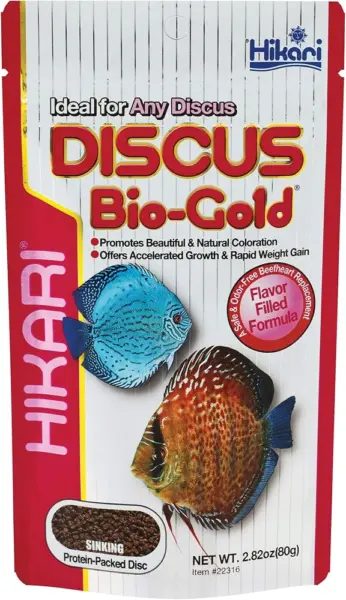
Hikari Discus Bio-Gold – Best Overall
Key Features
- Form: Sinking disc, 1.5–2.0 mm
- Container: 2.82 oz (80 g)
- Key ingredients: Krill, crushed silkworm
- Texture in water: Softens sponge-like, holds shape
- Price: Midrange
The disc is roughly 1.5 to 2 mm across, and within seconds of hitting the water it turns sponge-soft without collapsing into dust. That single property is why it opens so many of our conversations with discus keepers. Discus don’t gulp a meal and move on; they take a piece, mouth it, spit it out, and come back for it. A granule that survives three passes stays available long enough for a cautious fish to commit. One that dissolves on the first pass just fogs the tank.
What makes it our default is how the design and the formula pull in the same direction. Krill and crushed silkworm carry the protein, the color work comes from natural ingredients rather than a dye, and it covers all life stages, so a grow-out tank and an adult display eat the same food. Nothing in it feels added for the label’s sake. The sinking pace is right for a mid-water fish too: slow enough to be caught on the way down, quick enough that it isn’t left bobbing where a discus has to break the surface to reach it.
Where it stops suiting you is scale. One display tank, and the small tub is fine; a fish room or a grow-out rack and you’ll be reordering constantly, which is where the large Sera tub earns its place instead. Expect a standoff if your discus were raised on beefheart or live food — a few days of refusal before they commit is normal, not a verdict on the food.
Pros
- Softens to a sponge but keeps its shape
- Built around the take-it-and-spit-it-out routine
- Krill and silkworm protein, natural color enhancers
Cons
- Smallest tub here; priciest way to feed a group
The one we point new discus keepers to: it sinks, softens without falling apart, and matches the way discus actually eat. Buy it for one display tank, not a fish room.
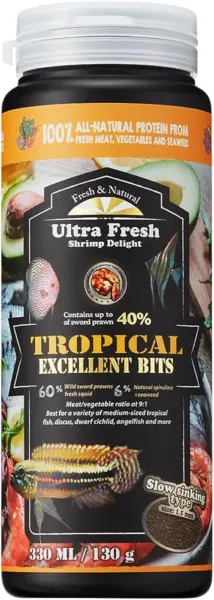
Ultra Fresh Sword Prawn Pellets – Best Value
Key Features
- Form: Slow-sinking pellet
- Container: 4.6 oz
- Probiotics: 3 million CFUs/g
- Protein ratio: 9:1 meat to vegetable
- Price: Budget
Slow sinking is printed on the tub, and it’s the claim worth checking first. Of the pellets in this group, this one behaves the most inconsistently in the water: some pieces drop at a good pace, others hang near the surface and drift before they finally go. For a discus that’s the difference between a meal and litter. We scatter it thinly across the surface and watch the first minute rather than dropping in a clump and hoping.
The formula is genuinely strong. Wild sword prawn and akiami paste shrimp make up most of a 9:1 meat-to-vegetable ratio, which is the protein-forward balance discus do well on, with seaweed and spirulina doing the color work instead of a dye. The 3 million CFUs per gram of probiotics is a number nobody can verify from outside the tub, so treat it as a bonus rather than a reason to buy. What we can judge is the ingredient panel, and it reads like food built for carnivores rather than a general tropical flake with a discus sticker on it.
Small pellets are the other knock, and most of that criticism belongs to a different tank. In a community setup with bigger mouths they’re a nuisance; a discus takes them whole without trouble. Given the tub size and the per-meal cost, this is our pick for someone feeding a group on a budget, or running a mixed tank of discus, angels and corydoras where everyone eats the same food.
Pros
- 9:1 meat-to-vegetable ratio from prawn and shrimp
- Probiotics, no artificial colors or flavors
- Bigger tub for about the same outlay
- Small pellets a discus can take whole
Cons
- Too fine for larger tankmates
A meat-heavy, probiotic pellet that costs less per meal than our top pick, as long as you scatter it and watch where it lands.
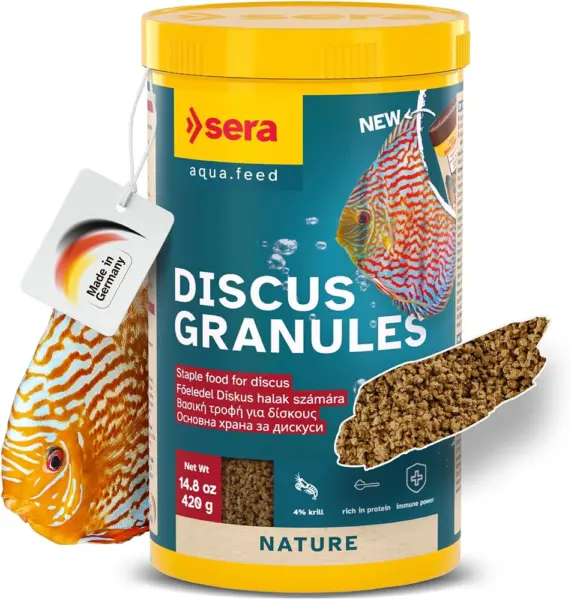
Sera Discus Granules – Best for a Fish Room
Key Features
- Form: Soft granule
- Container: 1000 ml (14.8 fl oz)
- Key ingredients: Aquatic protein, garlic, prebiotics
- Texture in water: Softens without swelling or losing shape
- Price: Premium
Fourteen and a half fluid ounces is more discus food than a single tank needs, and that tells you who it’s for. A grow-out of juveniles, a breeding pair with fry to feed, or three or four tanks on the same water-change schedule will work through it while it’s still fresh. A lone display with six adults will still be spooning from the same tub next year, and an opened tub that old has lost some of its pull.
The behavior of the granule is what earns it a place. It goes soft quickly but doesn’t swell or lose its shape, so it stays in the water long enough for a slow eater to come back for a second pass without leaving an expanding lump or a cloud of fines behind. Garlic and prebiotics are in the recipe, and it’s pitched at every life stage, juveniles included. For a fish room, that combination is the whole argument.
It also makes a useful second texture. Granules this soft are easy for young discus that struggle with a firmer disc, and rotating two shapes is one way to keep a group eating when they start ignoring the food they’ve had for months. If your fish are already on a pellet, this is the simplest way to vary the diet without changing the routine around it.
Pros
- Largest container here by a wide margin
- Softens without swelling or clouding the water
- Garlic and prebiotics, all life stages
Cons
- One large tub only; no small size to try
The tub we keep for a fish room: soft granules that soften without swelling, sized and priced to feed several tanks rather than one display.
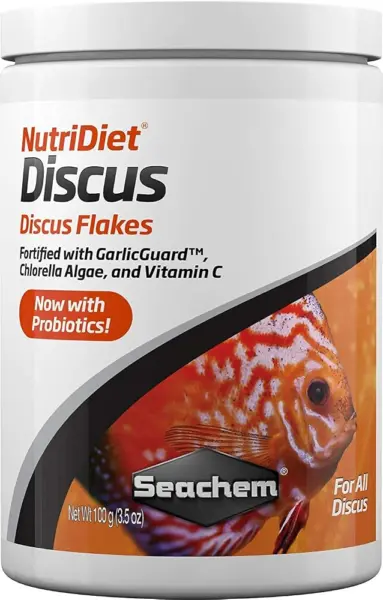
Seachem NutriDiet Discus Flakes – Best Flake for Picky Discus
Key Features
- Form: Flake
- Feeding: What fish clear in three minutes, up to 3 times daily
- Container: 100 g (3.5 oz)
- Key ingredients: Chlorella algae, probiotics
- Price: Midrange
Garlic is the first thing that hits you when the bag opens, and it’s there on purpose: a feeding attractant that pulls a hesitant discus up through the water. The flake itself is big and soft, which suits an adult discus mouth, and it breaks up easily when you want smaller pieces for juveniles or tankmates.
The case for keeping a bag is a tank that won’t take hard food. Flakes are the easiest bridge — scatter a pinch and even a shy fish gets a piece before the boldest one clears the surface. Chlorella algae brings a broad spread of vitamins, and the probiotics are the same digestive pitch every manufacturer makes. The feeding line on the bag is worth borrowing for any food here: what the fish clear in three minutes, up to three times a day.
Where it lands for us is second food rather than sole staple. Some discus take to it immediately and some refuse it outright, and no amount of garlic changes their mind; mixing a little into a food they already accept is the way through. It also leaves dust on the substrate if you feed more than the fish clear, so a light hand matters more here than with a sinking granule.
A hundred grams goes further than it looks, because flakes are light and a pinch covers a lot of surface. Keep the bag sealed and dry — once it picks up moisture it clumps and drops in lumps instead of spreading, which defeats the reason to own a flake at all.
Pros
- Big soft flakes adult discus can take
- Chlorella algae and probiotics in the blend
- Clear three-minute feeding direction on the bag
Cons
- Sharp garlic odor that lingers in the room
The flake we reach for when a discus won’t touch a pellet: big soft pieces and a garlic pull that gets fussy fish eating again.
Ultra Fresh Tropical Flakes – Best for Community Tanks
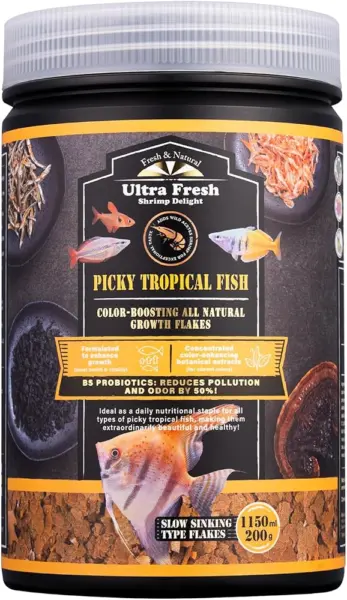
Key Features
- Form: Flake
- Container: 7.05 oz (200 g)
- Probiotics: BS probiotics
- Key ingredients: Acetes shrimp, sardines, Antarctic krill
- Price: Budget
Ultra Fresh’s flake comes from the same shrimp-first recipe as the pellet above, and the difference is delivery. A pellet drops and a discus picks it off; a flake spreads across the surface and drifts down, so every fish in the tank gets a share. In a discus tank with cardinals, rummynose or a pack of corydoras, that spread is the point — the shy fish eat instead of watching the boldest one clean up.
Two-thirds of the formula is acetes shrimp, sardines and Antarctic krill, with spirulina and plant-extracted carotenoids doing the color work and a probiotic strain on top. That’s a serious protein base for a flake, and it explains why a food this fine gets taken so readily. Ganoderma polysaccharides are the one ingredient we can’t say much about: they’re on the label for immune support and they don’t change how the food behaves in the water.
Our reservation is the form, not the recipe. Flakes break up the moment they touch water, and a share of a heavy pinch ends up in the filter or on the substrate if the fish don’t take it at the surface; pinching the flakes under the water helps them sink sooner. That makes it a rotation food for us, excellent in a busy community tank and less tidy than a sinking granule in a discus-only setup.
Pros
- Two-thirds shrimp, sardine and krill
- Color from spirulina and plant carotenoids
- Feeds a whole community at once
Cons
- Scatters quickly; some reaches the filter
The flake from the same kitchen as our value pellet: two-thirds seafood, and the easiest way to feed a busy discus tank where everyone eats at once.
Sera Discus Color Gran – Best for Color Conditioning
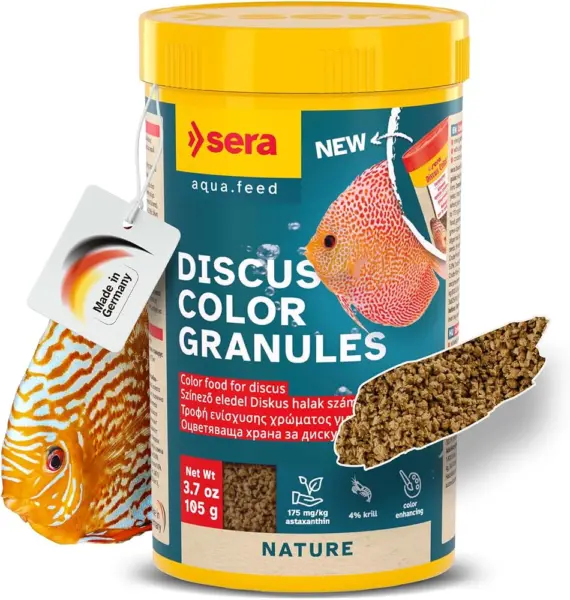
Key Features
- Form: Sinking granule
- Container: 250 ml (8.4 fl oz)
- Protein source: Krill
- Color ingredients: Astaxanthin, spirulina
- Price: Midrange
A color granule does one job differently from a plain staple: it carries astaxanthin from Haematococcus algae alongside spirulina, the ingredients that bring out reds and blues rather than simply keeping a fish fed. We treat it as the color half of a rotation, not the whole diet, and 250 ml is sized for exactly that — a tub you’ll work through before it goes stale. Set expectations on the color claim, though. These ingredients help a discus show what it already has; they won’t turn a brown fish red. Good water and a solid staple do more for color than any single tub.
Mechanically it’s the same kind of granule as Sera’s larger staple: sinking, softening quickly, and holding its shape rather than swelling. Krill supplies the palatability, omega fatty acids and minerals round out the blend, and a fish already eating one Sera granule shouldn’t balk at the other. The catch is price per ounce, which runs higher here than on the big tub — the cost of buying a color food in a size you’ll actually finish.
Pros
- Astaxanthin and spirulina for natural color
- Sinking granules that soften without swelling
Cons
- Costs more per ounce than the large Sera tub
A color granule to rotate alongside a staple: astaxanthin and spirulina for the reds, in a tub small enough to finish while it’s fresh.
How We Tested Discus Foods
We started by gathering more than 30 discus foods from brands we know and a few we didn’t, then narrowed the list to 14 based on ingredient panels, protein sources, pellet and flake sizes, and cost per ounce. We ruled out anything with vague ingredient names or a sinking rate that seemed wrong for discus—these fish prefer to pick food out of the water column, not scavenge it off the gravel. Each of the 14 made it into our 75-gallon discus tank and a smaller grow-out tank for juvenile fish over a five-month period.
Every morning and evening feeding was a test. We dropped a pinch of each food into the tank and watched how quickly the fish moved toward it, whether they took it from the surface or waited for it to sink, and how much was left after two minutes. We noted flake and pellet size—whether juveniles could manage them without spitting them out—and we smelled each container right after opening; a food that reeked of fish meal or chemicals got marked down even if the fish ate it. We also timed how fast each food sank, since discus like to eat mid-water and a pellet that hits the bottom in seconds is a pellet wasted.
Over the weeks, we tracked color, growth, and waste. We kept a log of each fish’s appetite and activity, noted any changes in color intensity, and measured the juveniles every two weeks to see which foods supported steady growth. Digestibility showed up in the filter socks and the siphon—foods that produced loose, cloudy waste were scored lower than those that left the water clear, and value was simple math: cost per ounce divided by how much of the food actually got eaten rather than swept into the overflow. The foods that scored best were the ones the fish attacked, the tank stayed clear, and the fish kept growing.
How to Choose a Staple Food for Discus
The right discus food is decided in the first minute after it hits the water: whether it sinks, whether it softens, and whether the fish take it before it reaches the filter.
Sinking, Softening, and Holding Together
Discus are mid-water fish with small mouths, and a food that stalls at the surface leaves them waiting. Look for something that sinks, softens within seconds, and still holds its shape: Hikari’s discs go sponge-soft almost immediately, and Sera’s granules stay intact as they soften. A food that dissolves instead leaves fines across the substrate and gives your filter more work to do.
The test costs nothing. Drop a pinch in and watch for a minute. If most of it is still bobbing at the top, plan on feeding something else that day.
Pellets, Granules, or Flakes
Form decides how the food reaches the fish. Discs and granules sink, which suits a discus-only tank where you can see what each fish gets. Flakes spread at the surface and drift down, an advantage in a busy tank with dither fish and a nuisance in a bare grow-out tank where a share ends up in the overflow.
If your discus refuse anything hard, start with a flake and move them onto a sinking food once they are eating confidently again.
Match the Particle to the Fish
An adult discus takes a 1.5 to 2 mm granule whole. Juveniles need something they can mouth without working at it, and a big flake is wasted on a small fish. With a mixed group, crush part of the flake or choose the smaller granule.
Watch a single feed rather than guessing. Food that gets taken and spat out over and over without ever being swallowed is usually too big, not distasteful.
Read the Ingredient Panel, Not the Front
Discus lean carnivorous, so the first ingredients should be named seafood — sword prawn, krill, sardine, silkworm — rather than grain. Ultra Fresh’s pellet runs a 9:1 meat-to-vegetable ratio; Hikari builds on krill and crushed silkworm. Color comes from astaxanthin, spirulina, or seaweed, which is normal and fine.
Probiotic counts printed in the millions cannot be checked from outside the tub, so treat them as a bonus. What you can check is whether the food clouds the water, and that shows up within a day.
Price per Feed, Not Price per Tub
A tub of discus food disappears faster than most people expect, because a group of adults eats a lot. Compare containers by how long they last rather than by the number on the shelf: the Hikari tub is the smallest here and the most expensive way to feed a fish room, while Sera’s 1000 ml tub works out cheapest per meal for anyone running several tanks.
For a single display, buy smaller and replace more often. An open tub that sits for months loses its pull with fish.
Frequently Asked Questions
Do I need to soak discus pellets before feeding?
Usually not. The soft discs and granules in this group — Hikari’s Bio-Gold and both Sera foods — soften within seconds of hitting the water, which is the whole point of their design. Soaking is for hard, dense pellets that stay crunchy.
Flakes are the exception: pinch them under the surface so they sink instead of riding the current into the filter.
Is garlic in discus food a problem?
No. It is there as a feeding attractant, and both Seachem’s flake and Sera’s granules use it that way. It is not a treatment for parasites or disease, so do not buy a garlic food hoping to cure a sick discus.
The practical issue is smell. A garlic-heavy flake makes the room notice when the bag opens, which matters if the tank sits in a living space.
Can I feed discus food to angelfish and other tankmates?
Yes. These are protein-rich staples aimed at discus, and angelfish, larger tetras, and corydoras take them readily, which is part of why a discus tank is easy to feed as a whole.
The limit is particle size: a small disc pellet vanishes for a big angelfish, while a flake feeds everyone. With much larger tankmates, feed the flake first and the sinking food after.
Is a staple enough, or do discus need beefheart and live food?
A good formulated staple should carry the diet on its own, and that is what makes it a staple. Beefheart and live foods are useful for conditioning a pair or coaxing a fish that is off its food, but they are richer and dirtier, and a tank fed heavily on beefheart needs more water changes.
Feed a quality sinking food daily and keep the richer foods for a couple of days a week.
Final Verdict
For one display tank of discus, Hikari Discus Bio-Gold is the food to start with: it sinks, softens without disintegrating, and suits the way discus take a piece, mouth it, and come back. Nothing else here matches that routine so directly.
Scale changes the answer. A fish room or a grow-out of juveniles should buy the large Sera tub, which costs less per meal and is just as easy for the fish to take. And if your discus have never accepted a hard food, start with the Seachem flake and move them across once they are eating well.