This post contains affiliate links. We may earn a small commission when you buy through our links — at no extra cost to you.
Guppies are about as low-maintenance as aquarium fish get, right up until you open a tub of food. Drop in the wrong flakes and half of it drifts past their noses to the gravel, where it sits and clouds the water by Thursday. Guppies feed at the surface, they have small mouths, and they will spit out anything they don’t like the taste of — most foods are either ground too coarse for them or milled so fine it dissolves before anyone reaches it.
I’ve kept guppies on and off for years and made most of the beginner feeding mistakes, overfeeding chief among them. Over the past four months, my team and I have fed 16 different flakes, micro pellets, and granules to our own tanks, and the gap between them — how fast the fish rose to the surface, how much ended up on the bottom — surprised me. The good ones share a few traits: a particle a guppy can swallow in one bite, a slow sink that keeps it in the water column, and a cost per feeding that makes sense for a 10-gallon tank. Everything below earned its place at the glass.
Our Top Picks
The Best Guppy Food, Reviewed
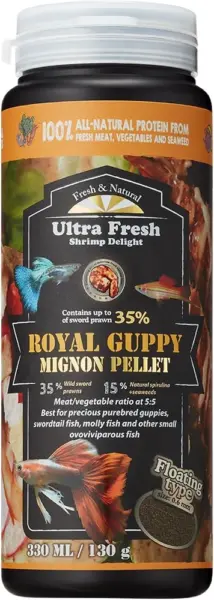
Ultra Fresh Royal Guppy Mignon – Best Overall
Key Features
- Form: Softening granule
- Container: 4.6 oz
- Granule size: 0.6 mm
- Key ingredients: Sword prawn, spirulina, seaweed
- Price: Midrange
The granule runs to 0.6 mm, and that is the whole argument. An adult guppy takes one in a single snap instead of worrying it at the surface until it falls apart, and fry and juveniles work on the same food without anything being crushed first. Compare that with a flake, where the crushing you do between your fingers is what puts half the meal into the water as dust.
That mouth fit is why it earns the top spot. The base is wild sword prawn and spirulina with seaweed and a full spread of vitamins, there are no artificial colors, and the granules soften quickly once they’re wet — the difference between a young guppy managing one and spitting it back out. The 4.6 oz bottle is sized so a small colony finishes it while the food is still worth feeding.
The one behavior to plan around is sinking. Granules pick up water and drop, and in a tank with strong surface movement they can be through the feeding zone before the guppies arrive. Small pinches, one at a time, keep most of it in front of the fish; a full scoop mostly feeds the gravel. We noticed the difference in the first week and haven’t gone back to a single big shake.
Pros
- 0.6 mm granule fits a guppy’s mouth
- Natural sword prawn and spirulina base
- Softens fast for fry and juveniles
- Bottle sized for a small colony
Cons
- Costs more per ounce than bulk flakes
This is the food we hand a new guppy keeper first: a 0.6 mm granule that fits an adult guppy’s mouth whole, in a bottle small enough to stay fresh.
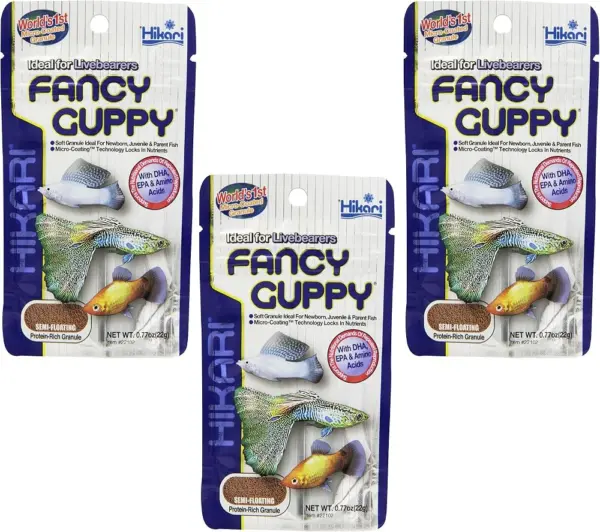
Hikari Fancy Guppy – Best for Breeding Colonies
Key Features
- Form: Fine granule
- Pack: 3 × 0.77 oz
- Key ingredients: Chitosan, vitamin C, seaweed iodine
- Price: Premium
Three small foil bags instead of one big tub is the detail that earns this one a place. Open a bag, keep the other two sealed, and what you’re feeding stays fresh, which matters in a guppy tank where a large container is flat and stale long before it’s empty. Inside is a fine granule built specifically for livebearers, with chitosan, stabilized vitamin C, and iodine from seaweed alongside the protein — the food we reach for when a colony is breeding and we want condition rather than plain calories.
The granules are small enough that fry take them without help, which is rarer than it should be. The catch is volume: three 0.77 oz bags come to less than a big flake tub, so a serious guppy rack burns through a pack fast. It also pours freely, and an automatic feeder set for pellets will dump in far too much. Hand-feed it, or set the feeder to its smallest opening and watch the first few days.
Pros
- Fine granule fry can eat uncrushed
- Sealed bags keep food fresh
- Breeding and growth formula
Cons
- Only 2.3 oz across the three bags
We reach for this one when a colony is breeding — fine granules fry can eat uncrushed, split across three sealed bags that stay fresh.
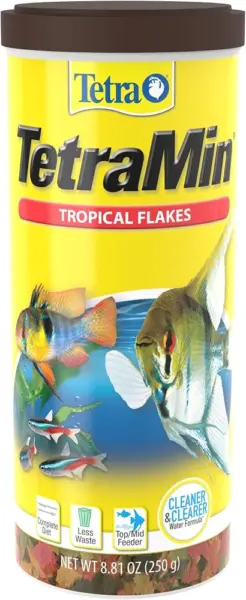
TetraMin Tropical Flakes – Best Bulk Staple
Key Features
- Form: Floating flake
- Feeding: Up to 3 times daily
- Container: 8.81 oz
- Price: Budget
An 8.81 oz tub is months of food for a guppy tank, and per ounce it’s the cheapest way to keep a community fed of anything here. The flakes float, which is where guppies want to eat anyway, and the container is big enough that you stop thinking about running out.
The flakes themselves are large. An adult guppy will mouth a whole one, spit it out, and mouth it again while smaller fish wait their turn, so the useful habit is to pinch a small amount and rub it between your fingers over the tank. The finer pieces then drift down through the water column instead of riding the surface in one lump, and fry get a look in.
As a staple, we think it’s the sensible default for a mixed community that happens to include guppies. It doesn’t cloud the water when you stay inside the three-minute feeding window, fish take it eagerly from the first feed, and the Active Life formula carries antioxidants, selected proteins, and prebiotics rather than just flake and filler.
What it isn’t is guppy-specific. Nothing about the flake is sized or formulated around a livebearer’s mouth, and an eight-ounce tub is a long commitment for one small tank. Buy it when you’re feeding a community, a bigger tank, or several tanks at once; if you keep one small guppy colony, a smaller and fresher container serves you better.
Pros
- Cheapest per ounce of the staples here
- Floats where guppies feed
- Clear water within the feeding window
- Antioxidants and prebiotics in the formula
Cons
- Large flakes need crushing for guppies
Our pick for the cheapest way to feed a community tank, provided you’re willing to crush a pinch for the guppies.
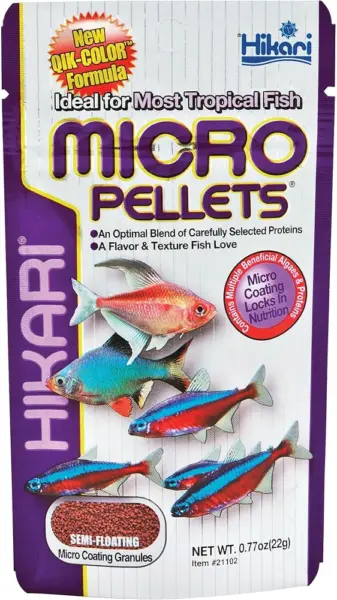
Hikari Micro Pellets – Best for Mixed Small Species
Key Features
- Form: Semi-floating pellet
- Protein: Marine and vegetable
- Texture: Soft, crumbles when pinched
- Container: 0.77 oz
- Price: Premium
Semi-floating, in practice, means the pellet sits at the surface for a beat and then drifts down through the top third of the tank — exactly the band where guppies do their feeding. That window is the reason to choose these over a straight sinking pellet: food that reaches the gravel is out of a guppy’s reach and into the substrate, where it decays.
We like these best in a tank of mixed small species, guppies alongside tetras and rasboras, where nobody has the jaw for a full flake. The pellets have a softer texture than most, so a fish can break one down instead of swimming around with it, and they hold together well enough that an automatic feeder drops them intact rather than turning the tank into soup.
Size is the variable. On the small side they’re right for adult guppies and young fish; on the large side a small female will mouth one and give up, so pinch the bigger ones and they crumble between your fingers. It’s a small-mouthed community food rather than a dedicated guppy diet, and the bag is small enough that a hungry colony works through it quickly.
Pros
- Semi-floating, stays in guppy range
- Soft texture fish can break down
- Runs cleanly in an automatic feeder
Cons
- Premium price for a small bag
We like it for a mixed tank of small species: a soft semi-floating pellet that lingers where guppies and tetras actually feed.
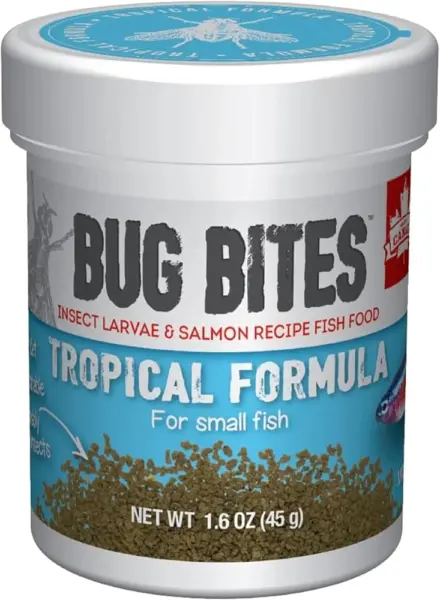
Fluval Bug Bites Tropical Granules – Best Insect-Based Food
Key Features
- Form: Slow-sinking micro granule
- Container: 1.6 oz
- Granule size: 0.7–1 mm
- First ingredient: Black soldier fly larvae
- Price: Midrange
Black soldier fly larvae are the first ingredient here, up to 40% of the formula, with whole salmon behind them for omega-3 and omega-6. That’s an unusual protein base for a tropical food, and it’s why we keep a jar in rotation rather than making it the only thing in the tank: insect meal plus fish protein sits closer to what small fish pick at in the wild than a straight fishmeal flake.
The granules run 0.7 to 1 mm and sink slowly, drifting through the water column rather than dropping like grit, which gives mid-water fish a real chance at them. They hold their shape too, so the ones that aren’t eaten land on the gravel instead of dissolving into the water — far easier to siphon out than a cloud of flake dust.
Here’s the honest limit: 1 mm is at the edge of what a guppy can handle. Adult females manage it; small males and young fish spend the feed chasing granules they can’t swallow. It’s the food we point people to for a mixed community — guppies, tetras, and corydoras all getting something out of one jar — and for anyone who wants a more natural protein source. In a guppy-only tank, the finer granule of our top pick suits better.
Pros
- Insect-first formula, up to 40% larvae
- Salmon brings omega-3 and omega-6
- Works across a mixed community
Cons
- Some jars are more powder than granule
Worth buying for the insect protein and a mixed community; in a guppy-only tank the granule is coarser than we want.
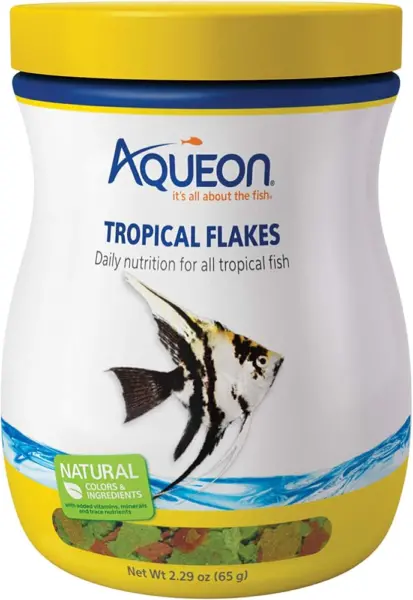
Aqueon Tropical Flakes – Best Flake for Fry
Key Features
- Form: Floating flake
- Container: 2.29 oz
- Key ingredients: Natural ingredients with vitamins and minerals
- Price: Midrange
These flakes come out of the jar small and broken, and in a guppy tank that’s the point. Nothing needs crushing, fry and juveniles can take the pieces as they fall, and the flakes float at the surface where guppies feed. We keep it for small tanks where the fish are too small for a standard tropical flake and a granule is more food than anyone needs.
The formula is straightforward — natural ingredients with added vitamins, minerals, and trace nutrients — and it stays clear when you feed inside the directions. Where it gives ground is quantity: 2.29 oz doesn’t go far once a colony starts breeding, and there’s no larger jar in the same line to move up to. For one small guppy tank that’s a fair trade; for three, it isn’t.
Pros
- Small flakes fry can eat
- Floats for surface feeding
- Stays clear when fed as directed
Cons
- Costs more per ounce than bulk tubs
The flake we keep for tanks with fry: small pieces straight from the jar, no crushing, floating where guppies eat.
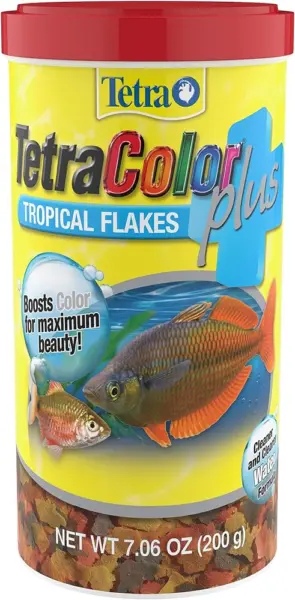
Tetra ColorPlus Tropical Flakes – Color Enhancement
Key Features
- Form: Flake
- Container: 7.06 oz
- Protein source: Specialized fish meal
- Color enhancers: Carotene
- Price: Budget
Color food is the most oversold thing in the aisle, so it’s worth being precise. Carotene doesn’t create new color; it feeds the orange, pink, and red pigments a guppy already carries, and the change shows over weeks of steady feeding rather than days. ColorPlus is built around that idea, with carotene layered over a high-protein fish meal base.
The formula is built on a specialized fish meal and breaks down readily rather than passing through, which matters when you’re feeding it several times a week for weeks on end. It behaves like a staple in the tank — floats, softens, gets eaten — and it doesn’t leave the water cloudy when you keep to the feeding directions.
Where it earns its place is in a rotation. Two or three feeds a week alongside a plain staple is how we use it, and that’s enough to keep the reds pushed without making color food the whole diet. Fed that way, a 7.06 oz tub lasts a long time.
So the recommendation is narrow but real: buy it if you already have a staple you trust and you’re working on a fancy strain where color is the point. If you want one food that covers growth and color in a size that needs no crushing, our top pick does both. This one is the specialist.
Pros
- Carotene supports red and orange pigment
- Digestible high-protein flake base
- Good size tub for several tanks
Cons
- Large flakes; small guppies need them crushed
Think of it as a supplement, not a staple — we feed it a few times a week to deepen the reds and oranges in fancy strains.
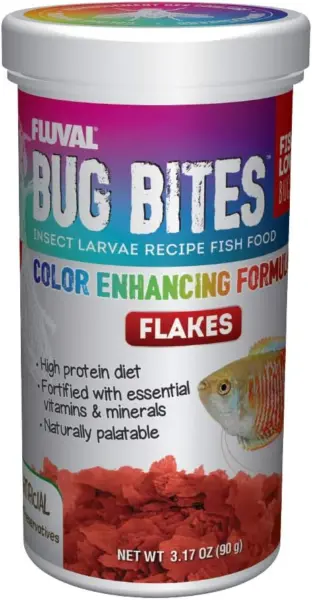
Fluval Bug Bites Color Flakes – Best for Surface Feeding
Key Features
- Form: Flake
- Container: 3.17 oz
- First ingredient: Black soldier fly larvae
- Price: Midrange
Same formula as the Bug Bites granules, different delivery. Where the granule sinks through the water column, this one is a flake that sits at the surface and breaks apart — better for a tank of surface-feeding guppies, less useful if you’re trying to get food down to the bottom.
The flakes are thick rather than papery, and they crumble easily between your fingers, so a pinch rolled and released gives a spread of small pieces a guppy can take one at a time. That’s the routine we settled into with it: roll, release, watch the surface.
Nutritionally it’s the same proposition: black soldier fly larvae first, whole salmon for omega-3 and omega-6, vitamins and amino acids on top, plus the color-enhancing side of the formula. The 3.17 oz canister is a sensible middle size — big enough to be worth buying, small enough that a guppy keeper has a chance of finishing it while it’s still fresh.
If your guppies feed at the top — and most do — this is a good flake to build a rotation around, and it’s the one we suggest to anyone who wants insect protein without switching to granules. If you need food to reach mid-water fish, the granule version of the same formula is the better tool.
Pros
- Insect-first, up to 40% larvae
- Salmon protein and omega oils
- Crumbles into guppy-sized pieces
Cons
- Large, thick flakes out of the canister
If your guppies feed at the top, this is the Bug Bites we keep: same insect formula, in a flake that stays on the surface.
How We Chose and Tested the Best Guppy Foods
We started with roughly 40 foods sold for livebearers and small community fish — flakes, micro pellets, granules, and a couple of gel and freeze-dried options — and thinned the list by reading ingredient panels: a named whole protein near the top, a stated particle size, and a sensible cost per ounce. That left 16 foods, which we bought ourselves and fed over four months across three tanks: a planted 20-gallon community setup, a bare 10-gallon grow-out tank full of fry, and a small desktop tank.
Every food got the same routine — a pinch at 8 a.m. before work and another after dinner, measured with the same scoop so we were comparing like with like. We stood at the glass and counted the seconds before the first guppy hit the surface, watched for anyone mouthing a piece and spitting it back out, and checked where the food sat after five minutes: still drifting mid-water, or already down in the gravel where the shrimp got it instead.
Particle size we judged against the fish, not the label — whether a fry could take a piece whole, whether adults dropped what they couldn’t manage. We timed how long a pinch stayed suspended, rubbed flakes between our fingers to see how much dust clouded the water, and tracked waste and clarity over the next few days as a rough read on how much of it the fish actually digested. Value we calculated per feeding rather than per tub, since food the fish ignore is expensive at any price, and we noted how long an opened container stayed crisp and how many months a single tub lasted on a small tank.
How to Choose Guppy Food
A guppy’s mouth is the constraint everything else has to work around, so start with particle size and let the rest of the decision follow.
Start with the particle, not the label
A guppy handles a granule of roughly a millimeter and struggles past that. The trap is that "for small fish" on a label can still mean a two-millimeter pellet, and a flake sold as a tropical staple is often too big for anything but a full-grown female. Look for a stated millimeter figure: 0.6 mm, like our top pick, sits comfortably inside the range, while 0.7 to 1 mm works for adults and leaves young fish behind.
If you buy flakes anyway — and plenty of good ones exist — plan on pinching a portion and rubbing it between your fingers over the tank. That single habit does more for a guppy tank than switching brands does.
Decide where you want the food to end up
Guppies feed at the surface and through the top half of the water. Floating flakes and semi-floating pellets stay in that zone; slow-sinking granules pass through it, which suits mid-water fish and is wasted on anything sitting on the gravel. Sinking food doesn’t vanish — it decays, and in a small tank that shows up as cloudiness and algae.
Test any slow-sinking claim before you commit to a whole container: drop a pinch into a glass of tank water and watch. If it’s on the bottom in seconds, feed smaller amounts than you planned, or keep it for a tank that has bottom feeders in it.
Pick a role: staple, color, or conditioning
Most guppy keepers need one staple they trust and one or two things to rotate in. Color foods built on carotene deepen reds and oranges over weeks, but they won’t invent color a fish doesn’t already carry. Conditioning foods — the fine granules aimed at breeders — support growth and breeding condition rather than everyday maintenance.
Our preferred pattern is a plain staple for most feeds and a second food two or three times a week. It covers nutrition, keeps the fish interested, and stops one container from going stale before you’re halfway through it.
Buy a size you’ll finish
Opened fish food loses potency, and the vitamins are the first thing to go. A seven- or eight-ounce tub is a fine buy for several tanks or a big community, but for one small guppy setup a 1.6 to 2.3 oz container you finish in a few months feeds better than a bargain bucket you’re still scooping from next year.
Count the fish before you choose. A dozen guppies take months to work through a small bottle, and if you’re also running a grow-out tank for fry, that’s where the bulk container earns its place.
Frequently Asked Questions
Can guppies eat betta food or goldfish flakes?
For a day or two, yes — crush whatever you have until the pieces fit under a fingertip. As a diet it’s a poor fit: betta pellets are generally larger and richer than a guppy needs, and goldfish flakes are coarse and messy in a small tank. Buy a fine flake or small granule sized for guppies and keep the betta food for the betta.
Will an automatic feeder work with guppy food?
With pellets and granules, yes; with flakes, badly, because flakes bridge in the hopper and drop in clumps. Whatever you load, set the feeder to its smallest opening and run it over a sheet of paper for a day before trusting it over the tank — you’ll see exactly how much it delivers.
Do guppies need live or frozen food?
No. A good dry staple covers the basics and most guppies thrive on it. Frozen or live brine shrimp and daphnia are useful for conditioning breeders and getting fry growing, so once or twice a week is a reasonable addition rather than a requirement.
Final Verdict
The Ultra Fresh Royal Guppy Mignon is the food we recommend first because it solves the problem the rest of this list works around: a granule small enough for a guppy to take whole, in a bottle a small colony can finish while it’s still fresh.
Then build around it. Hikari Fancy Guppy for a breeding colony, TetraMin if you’re feeding a community tank and want the cheapest per-ounce staple, and Aqueon if there are fry in the tank and you want a flake that needs no crushing.