This post contains affiliate links. We may earn a small commission when you buy through our links — at no extra cost to you.
The frustrating part of a planted tank is that the plants don’t tell you what’s wrong. They pearl one week, then stall, and the light is usually the first suspect. A good aquarium plant light fixes that: it delivers usable light at the substrate for steady growth, keeps colors from washing out, and gives you enough control to avoid an algae farm. I’ve kept planted tanks for years, and over the past eight months my team and I have run 11 fixtures over low-tech anubias tanks, a CO2-injected carpet, and a shallow propagation tank.
I check for real dimming and a sensible spread, since a light that blasts the center and leaves the corners dim will frustrate you. I also notice how it looks over an open tank, and whether it still behaves after months of daily timers and splashes. Value isn’t the lowest sticker; it’s reliable output and a timer without features you’ll never use. The picks below earned their spot.
Our Top Picks
The Best Lighting for Aquarium Plants, Reviewed
NICREW ClassicLED Plus – Best Overall
Key Features
- CRI: 91
- Control: Built-in timer with 15/30-min ramp
- Spectrum: 6500K white, 450nm blue, 660nm red
- Tank fit: 30 to 36 in
- Price: Midrange
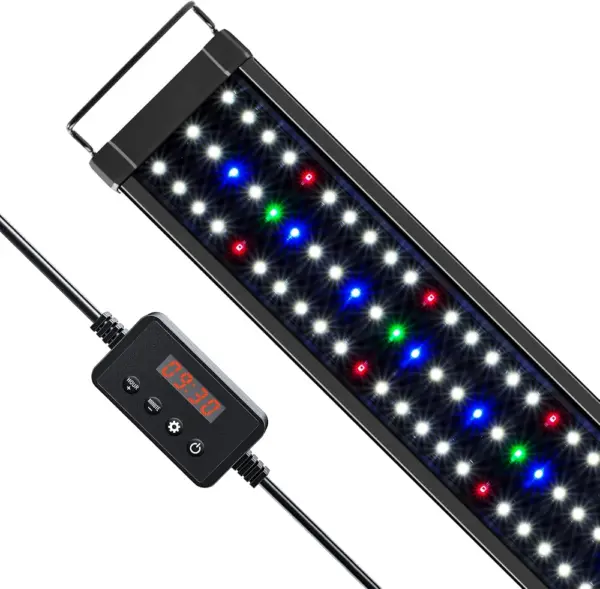
Plenty of aquarium LEDs are white light with a blue channel bolted on for the night setting. The ClassicLED Plus adds a true 660nm deep red to its 6500K white, 450nm blue and green, and that red channel is the part a plant actually uses to build mass. It carries a CRI of 91 as well, so fish and plants keep their own colors instead of picking up a violet cast. We made it the default in this group on the strength of that spectrum, not on a feature count.
What confirms the choice is the schedule. The light ramps up over 15 or 30 minutes, runs, then dims down the same way, so you get a sunrise and a sunset without adding an outlet timer, and the gradual change is easier on fish than a hard snap to full brightness. Brightness is adjustable too, which matters more than most people expect: turn it up to chase growth and you feed the algae just as well. We treat the dimmer as algae control rather than a mood setting.
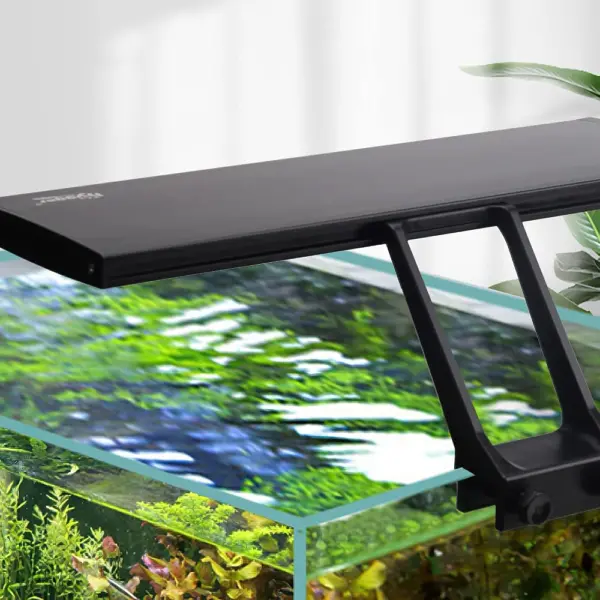
Sliding mounts at both ends take up the difference between a 30 and a 36 inch tank, so the fixture sits flat on a rimmed or rimless edge instead of resting on one corner. Spreading 78 LEDs along the full length also gives a wider pool of light than a short, powerful unit hung in the middle of the same tank. Keep it over a glass or acrylic cover, though: this one is not water resistant, and the aluminum shell is there to move heat, not to shrug off splash.
Pros
- True 660nm red plus 6500K white
- Built-in sunrise and sunset ramp
- CRI 91 for accurate color
- Fits rimless and framed tanks
Cons
- Not water resistant; needs a lid or canopy
- Durability is uneven across units
For a 30-36 inch planted tank this is the one we recommend: a true 660nm red channel, CRI 91 and a built-in sunrise ramp.
hygger Clip On 24/7 14W – Best for Small Tanks
Key Features
- Power: 14 W
- Mounting: Clip, glass under 0.9 in
- Tank fit: 12 to 20 in
- Light output: 817 lumens
- Price: Midrange
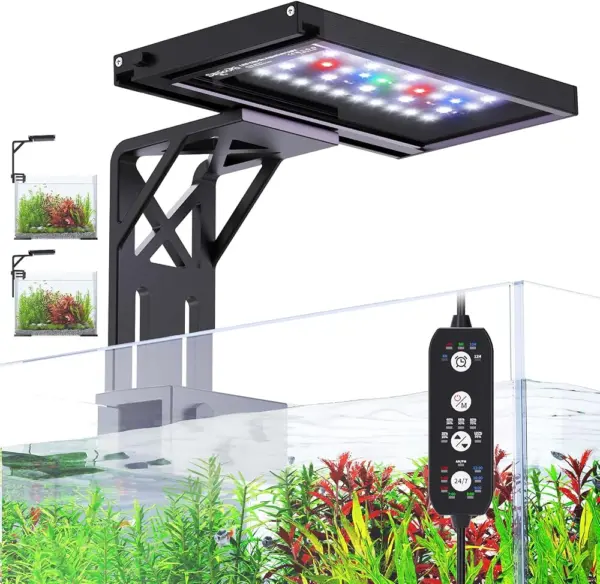
The clamp opens to just under 0.9 inch of glass, and that is the first thing to check: it suits most rimless nano tanks and thin-trimmed ones, and a thick molded frame is where it stops fitting. It screws down as well as clamping, so it holds on a rimmed tank with a flat lip. Past that gate, the HG990 is the most complete small-tank light here, with 14 watts, 68 LEDs and a full 24/7 cycle instead of a plain on-off switch.
That cycle is the feature worth understanding. Out of the box it runs orange from six in the morning, white from about eight until ten at night, then blue moonlight. Ten at night is a long day for a planted tank — roughly fourteen hours of daylight, which is more than most plants can use and plenty for algae. Switch to DIY mode, set the timer to 10 hours and trim the brightness from there: you keep the sunrise and the moonlight without the algae invitation.
At 14 watts over a 12-to-20-inch tank you are in low-to-medium light, which is right for java fern, anubias and cryptocorynes and short of what a demanding carpeting plant wants. What we did not expect at this size is a two-year warranty. It is the longest in this group, and it takes most of the risk out of a clip light.
Pros
- Factory sunrise-to-moonlight cycle
- Five brightness levels, seven colors
- Two-year warranty, the longest here
Cons
- Covers tanks up to 20 inches only
- Output suits low-to-medium plants
Buy it for a rimless tank under 20 inches where you want a real sunrise-to-moonlight cycle, and set DIY mode to ten hours on day one.
SEAOURA Clip On 7-12 in – Best for Nano Tanks
Key Features
- CRI: 90
- Power: 12 W
- Tank fit: 7 to 12 in
- Waterproof: IP68
- Price: Budget
The 7-to-12-inch class is where small lights usually disappoint: too wide for a cube, too dim once anything with roots gets going. The SR-617 is the one we keep coming back to for a 10-gallon or a nano cube. The body is 7 inches, the bracket slides to meet the tank, and 12 watts over that footprint lands in honest low-to-medium light instead of claiming more than it can deliver.
Two details earn it the spot. The first is IP68 sealing on a light this small, which means condensation and the odd splash are not an emergency and the fixture can sit close to the waterline. The second is preview: you can see a color and an intensity before committing it to the 24/7 cycle, which is the difference between setting a schedule once and fighting a menu for an hour.
Ten intensity levels, seven single colors plus full spectrum, five timer options and a memory that survives a power cut add up to more control than most nano tanks need, and none of it is buried in a submenu. The bracket is height-adjustable as well, so a shallow cube can have the light lifted rather than living with a hotspot. That height adjustment is the part we use most on a cube.
Pros
- IP68 sealing on a nano light
- Preview before committing a setting
- Remembers settings through a power cut
- Ten levels, seven colors, five timers
Cons
- 90-day warranty is the shortest here
- Built for low-to-medium light plants
The nano-tank clip light we keep coming back to: IP68 sealing, a preview function that saves bad programming, and honest low-to-medium output.
Aqueon Clip-On LED – Best No-Frills Option
Key Features
- LEDs: 60
- Mounting: Clip or screw mount
- Tank fit: Up to 20 gal
- Light output: 1000 lumens
- Price: Midrange
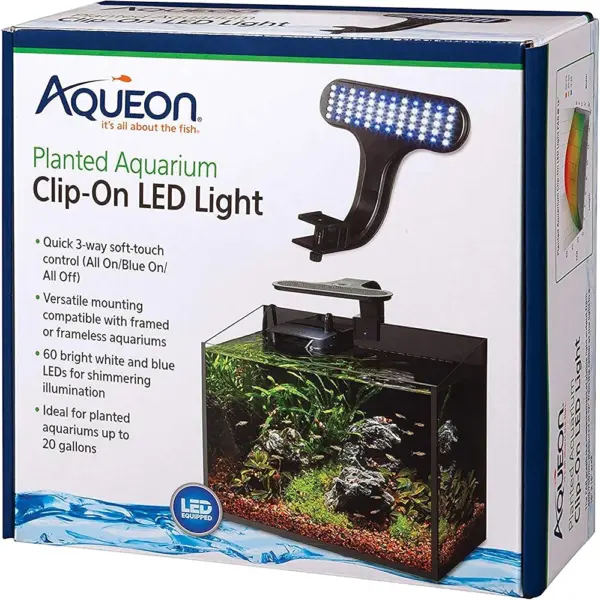
No timer, no dimmer, three buttons: all on, blue on, all off. Next to lights here that schedule a full sunrise and sunset, the Aqueon Clip-On looks like it is missing half its features, and it is. What it has is 60 LEDs putting out 1000 lumens of clean white light over a tank up to 20 gallons, a soft-touch control instead of a plastic toggle, and a clamp that screws down on framed or frameless glass.
There is a real case for that. Nothing to program means nothing to get wrong at midnight, and there is no controller to fail before the LEDs do, which we count as a feature rather than a gap. Add an outlet timer and you have a schedule that survives a power cut and never needs re-entering.
The catch is intensity. A thousand lumens with no dimmer is a lot over a shallow 10-gallon, and the adjustments left are how high you hang it and how much of the diffuser you shade. Over a 20-gallon it sits about right; in a small cube the surplus goes to algae rather than plants, so plan to lift it or cover part of the board.
Pros
- 1000 lumens of clean white light
- Nothing to program or fail
- Clamp fits framed or frameless glass
Cons
- Runs hot on the daylight setting
A bright, simple clip light for low-tech planted tanks up to 20 gallons — no timer, no dimmer, and that is the whole point.
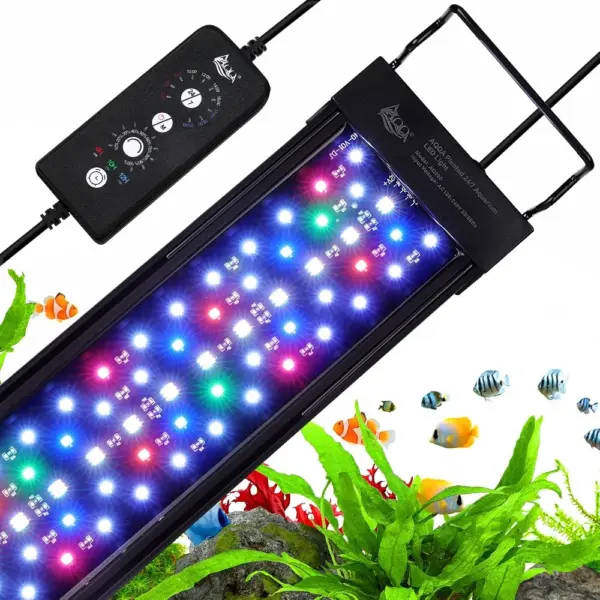
AQQA 24/7 LED 24W – Best for Hooded, Damp Setups
Key Features
- Modes: 24/7 and DIY, 9 colors
- Power: 24 W
- Waterproof: IP68
- Price: Midrange
IP68 is the rating to look for if the fixture lives under a hood, sits on a lid that drips, or gets splashed at water-change time. The AQQA carries it, which puts it in a small group here alongside the SEAOURA clip light. Around that sealing it packs 24 watts into a widened aluminum housing, with a 24/7 sunrise-to-moonlight default and a DIY mode for color and brightness.
The wide housing is the part we appreciate most. A broader aluminum body spreads the LEDs across more surface and moves heat away from the water, which is what you want under a closed hood where the air does not move. Nine colors and an eight-inch bracket make it easy to aim over the part of the tank that needs the light.
Two things to settle before you buy. Brightness is the soft spot: 24 watts is generous over a shallow tank and thin at the bottom of a deep one, so this is a fixture for standard and shallow setups rather than a tall column. And there is no stated tank-length range for the fixture, so measure the body and the bracket against your tank — on this pick, fit is on you to check.
Pros
- IP68 sealing for hoods and lids
- Wide aluminum body spreads heat
- 24/7 cycle plus nine-color DIY mode
Cons
- No stated tank-length range
- Reach is modest in a deep tank
Worth it if the fixture lives under a hood or near splash: IP68 sealing, 24 watts and a 24/7 cycle in a housing that spreads heat.
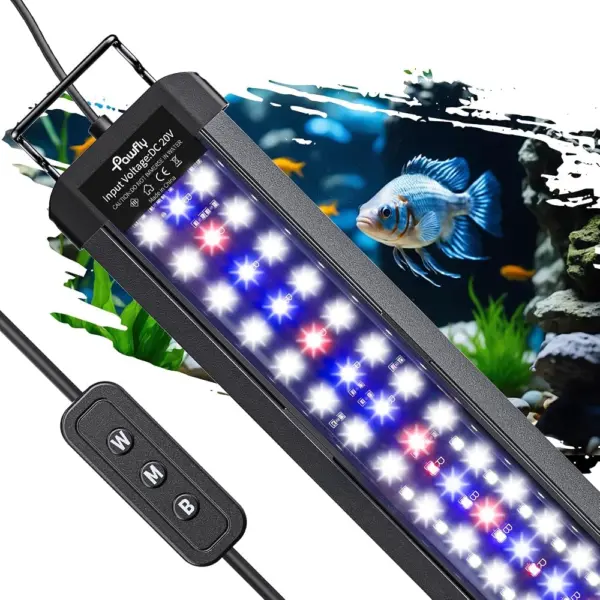
Pawfly 11W LED – Best for Budget Planted Tanks
Key Features
- Modes: Daytime and night
- Power: 11 W
- Tank fit: 12 to 18 in
- Output ratings: LUX: 2500; PAR: 55; CRI: 90
- Price: Budget
PAR 55, CRI 90, a 660nm red channel and 11 watts: those are figures usually attached to a fixture from a tier or two up. The Pawfly lists all of them at the bottom of this group’s price range, which makes it the obvious first look for a small planted tank on a budget.
We were surprised to find separate white-and-red and blue dimming at this price. Six intensity levels, with white and red on one button and blue on another, means you can pull the blue back to warm the look without losing brightness, and that is more control than most budget fixtures offer. There is a daylight mode, a night mode, and an extendable bracket that spans about 11.5 to 20 inches, which covers a 12-to-18-inch tank with room to spare.
Two boundaries are worth knowing. There is no timer, so scheduling means an outlet timer or switching it by hand. And the board is sealed with silicone against moisture and droplets rather than rated for immersion, so this is a light for a covered tank or a spot away from the splash line, not one to drop behind the glass.
Pros
- 660nm red channel at a budget price
- Separate white/red and blue dimming
- Sealed board resists droplets
- Extendable bracket spans 11.5 to 20 in
Cons
- No timer or scheduling
- Splash-resistant rather than waterproof
The budget pick that still lists a 660nm red channel and PAR 55 — for a small planted tank where a timer is a separate purchase.
How We Tested Aquarium Plant Lights
We started by pulling together every aquarium plant light we could find that was sold as a plant light — not a basic kit strip labeled for plants — then filtered by tank size, mounting style, dimming and timer controls, replaceable parts, and price. That left 11 fixtures, which we ran for eight months across a 20-gallon low-tech tank with anubias and java fern, a 40-gallon CO2-injected tank with a carpeting plant, and a shallow 12-gallon propagation tank. Each light stayed on a timer for eight hours a day, and I rotated them between tanks so no fixture got only the easy spot.
To judge lighting quality and brightness, we used a PAR meter at midwater and at the substrate, then grew the same plant species under each fixture for six weeks and photographed new leaves weekly — noting color, internode spacing, and whether the plants pearled. We also watched the glass and substrate for algae blooms, since a light that’s too strong or too wide can grow green dust faster than it grows plants. Appearance got checked in a normal living room, not a blacked-out fish room: I looked at glare, spill onto the wall, and whether the fixture disappeared over an open tank.
Value and reliability were slower burns. We compared what each fixture included — built-in timer, dimmer, mounting legs, replaceable power supply — rather than just the sticker, and we ran them through power cuts and daily on/off cycles to see which ones flickered, buzzed, or lost their settings. For durability, I wiped splash-covered lenses weekly, checked brackets for corrosion, and looked for yellowed housings or cracked seals. The lights that held up are the ones below; the ones that didn’t either drifted out of schedule or needed a new power supply before the eight months were up.
How to Choose Lighting for a Planted Aquarium
The light is the cheapest part of a planted tank and the one that decides whether the plants grow or the algae does, so buy for spectrum and scheduling before you buy for watts.
Spectrum: red and blue do the work
Plants absorb mostly blue light around 450 nanometers and red around 660. A white LED in the 6500K range already carries plenty of blue, which is why a plain white fixture can grow plants perfectly well; what a plant-oriented light adds is a dedicated red channel, ideally a true 660nm one rather than a broad orange tint. The Pawfly and the NICREW both list that channel, and it is the figure we check first.
Color rendering is a different question. The CRI number tells you how the fish and plants will look, not how well they grow, and anything from the mid-80s up reads as natural rather than clinical. Do not pay extra for a high CRI if the spectrum underneath is thin.
Hours beat intensity
Once there is enough light, the photoperiod does more damage than the wattage. Eight hours is a sensible start for a low-tech tank, and most planted setups land between six and ten. The trap is the factory schedule: a 24/7 mode that runs white light from about eight in the morning until ten at night is fourteen hours of daylight, which is more than most plants can use and plenty for algae.
Use the DIY or timer mode to shorten it, and remember that dimming lets you keep the hours without pushing intensity past what the tank can use. A bright, undimmable fixture over a shallow tank leaves shading the diffuser as the only adjustment.
Fit it to the tank, not the gallon count
Match the light’s span to your tank’s length. A 21-watt bar over a 30-inch tank covers the whole footprint; the same light on a 20-inch tank throws half its output at the glass. Clip lights add a second constraint, because the clamp opens to a fixed gap — a thick molded frame or a lip on a rimmed tank is usually where a clip stops fitting, and forcing one on can crack the glass.
On long tanks, two smaller units spaced apart generally beat one long fixture in the middle, since a single central light leaves both ends in shade.
Timers, moisture and heat
A built-in timer earns its place: it keeps the schedule consistent when you are away, and a ramp-up and dim-down is easier on fish than a hard snap to full brightness. An outlet timer does the same job for a plain fixture, which is a fair trade if you prefer not to program anything.
Moisture is the other decision. A fixture rated IP68 can live under a hood or near a lid that drips; a light with no water-resistance rating belongs on a canopy or glass cover with clearance. Whichever you choose, mount it where a hand will not brush the housing when it is hot.
Frequently Asked Questions
Can I use a plain shop light or a hardware-store LED instead?
Yes, for undemanding plants in a shallow tank. A 6500K white fixture will grow java fern, anubias and similar low-light species, and the plants do not care that it was not sold for aquariums. What you give up is the red channel, the sealed housing and any scheduling.
Check two things before you hang it: that the fixture cannot fall in, and that condensation off the lid cannot reach the electronics. An outlet timer covers the scheduling gap.
Can I use one of these lights on a saltwater or reef tank?
No. These are freshwater full-spectrum fixtures, and a reef tank needs far more intensity and a different balance, usually across several units. Running one over coral wastes the light and is hard on the animals.
Moisture ratings do not change that. Two lights here are IP68 sealed, which makes them suitable near water in a freshwater tank, not capable of reef output.
Is a light rated for a longer tank a problem on a smaller one?
Only if it cannot dim. A 30-to-36-inch fixture over a 20-inch tank spills light past the ends, which is harmless, but the intensity over the smaller footprint is higher than the plants can use and the surplus feeds algae.
Choose a fixture with adjustable brightness and run it low, or leave the shorter tank to a clip light sized for it.
Final Verdict
For most planted tanks in the 30-to-36-inch range, the NICREW ClassicLED Plus is the answer. The 660nm red channel, the CRI of 91 and the built-in sunrise ramp cover the three things that decide whether plants thrive: usable spectrum, intensity you can dial back, and a photoperiod that repeats itself without you.
Change the tank and the answer changes. Under 20 inches and rimless, the hygger clip-on fits better and its two-year warranty covers more of the risk. For a nano cube, the SEAOURA SR-617’s IP68 sealing and preview controls earn their place. And if the fixture is going under a hood or near a dripping lid, only the AQQA and the SEAOURA are rated for that moisture.