This post contains affiliate links. We may earn a small commission when you buy through our links — at no extra cost to you.
A planted tank can look lush in the store and then sulk under the wrong light. I’ve watched a healthy Amazon sword stall under a fixture that seemed bright to my eye but gave the leaves nothing useful to work with. The right LED aquarium light fixes that by delivering usable intensity across the tank, a spectrum that supports plant growth, and enough control to keep a steady daily rhythm. It should also be reliable enough that you’re not rescuing a failed strip in the middle of a workweek.
For six months, I ran 12 LED aquarium lights over a 29-gallon planted tank and a smaller nano setup, comparing how each one handled brightness, color adjustment, daily timers, and what came in the box. The lesson that kept repeating? Plants don’t care about lumens on a box; they care about the light that actually reaches their leaves, and you care about whether the fixture still works the same way in month five. The picks below are the ones that earned their place.
Our Top Picks
The Best Led Aquarium Lights for Plants, Reviewed
NICREW ClassicLED Plus 15W – Best Overall
Key Features
- CRI: 91
- Control: Remote, two modes, dimmable
- Wattage: 15 W
- Tank fit: 18–24 in
- Price: Premium
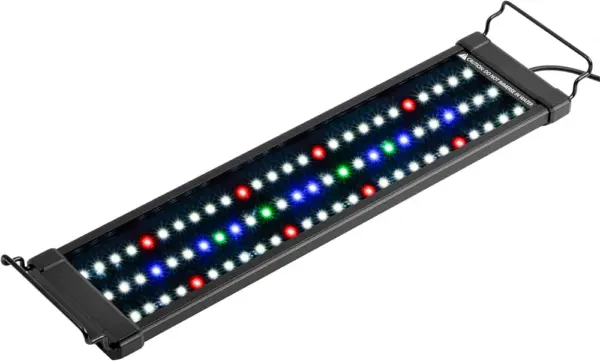
A plant light lives or dies at the red end of the spectrum, and this fixture names it: 660nm deep red alongside 6500K white, 450nm blue and green. That is the combination that drives leaf growth, which is why the ClassicLED Plus is the light we reach for first on a standard rimmed 20-gallon. The 15-watt bar spans 18 to 24 inches on sliding docking mounts that grip framed and rimless tanks alike, so it fits the tank most people already own.
CRI 91 is the figure we appreciate most after a month of looking at it. Reds and oranges in fish and in red plants come back looking like themselves instead of going flat under a blue-white wash, and the tank reads as a bright window rather than an aquarium. The two modes and the 15- or 30-minute ramp are the livable part: the tank comes up like a morning rather than a light switch, which is easier on fish and denies algae the head start a hard blast gives it.
Two conditions are worth knowing before you order. The housing is not rated for moisture, so it belongs over a glass or acrylic lid, or high enough on its brackets that a filter outlet cannot spit at it. And the fit range stops at 24 inches — on a 36-inch tank the ends go dim, which is a two-fixture problem rather than a fault in the light.
Pros
- 660nm deep red plus 6500K white for leaf growth
- CRI 91 keeps fish and red plants natural
- 15- or 30-minute sunrise and sunset ramp
- Mounts fit both framed and rimless tanks
Cons
- Capped at 18- to 24-inch tanks
We recommend this one for the ordinary planted tank: a genuine red channel, the best color rendition here, and mounting that suits rimmed or rimless glass. Start here unless your tank is rimless, oversized, or needs to run itself.
hygger 18W 24/7 LED – Best 24/7 Cycle
Key Features
- Wattage: 18 W
- Tank fit: 18–24 in
- Warranty: 2 years
- LED count: 98
- Price: Premium
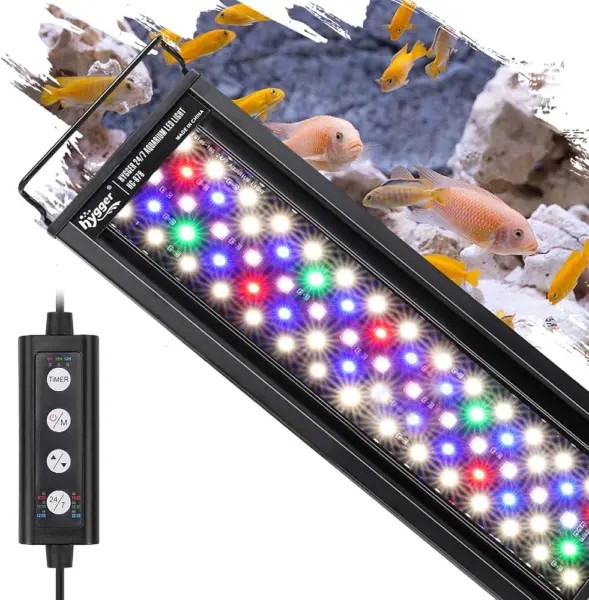
What you are buying here is a clock. The 24/7 mode takes over the whole day: a warm orange gradient from 6 a.m., full-spectrum white through the working hours, then blue moonlight from ten at night. The hardware behind it is ordinary — 18 watts, 98 LEDs, CRI 85 across an 18- to 24-inch bar — but the routine is the feature, and no wall timer pulls it off as gracefully.
We point people to it when the tank has no audience. If work keeps you away, or you are not home until the tank is dark, this keeps the same day running without you, and the sunrise ramp means the fish are not ambushed at full brightness. The DIY mode covers what the default does not: 6-, 10- or 12-hour runs, five brightness steps and seven colors. We were also impressed by the separable power adapter — a dead brick becomes a part instead of a whole new fixture — and by two years of warranty, the longest cover in this group.
Know what the default does before you buy. The cycle starts at 6 a.m. and does not ask, so if your tank time comes after dinner you will be looking at moonlight; DIY lets you move it. Five brightness steps are also coarser than a continuous dim, which shows if you run CO2 and want to nudge intensity rather than jump it.
Pros
- Runs a full sunrise-to-moonlight cycle unattended
- Two-year warranty and a replaceable power adapter
- 98 LEDs across 18 to 24 inches
- DIY mode: 6, 10 or 12 hours, seven colors
Cons
- Default 24/7 cycle begins at a fixed 6 a.m.
- Five brightness steps rather than continuous dimming
For a tank nobody is home to switch on, this is the pick: a set-and-forget sunrise-to-moonlight cycle, two years of cover, and a power brick you can replace on its own.
SEAOURA Clip On 20W – Best Clip-On
Key Features
- CRI: 90
- Wattage: 20 W
- Tank fit: 12–20 in
- Waterproof rating: IP68
- Price: Midrange
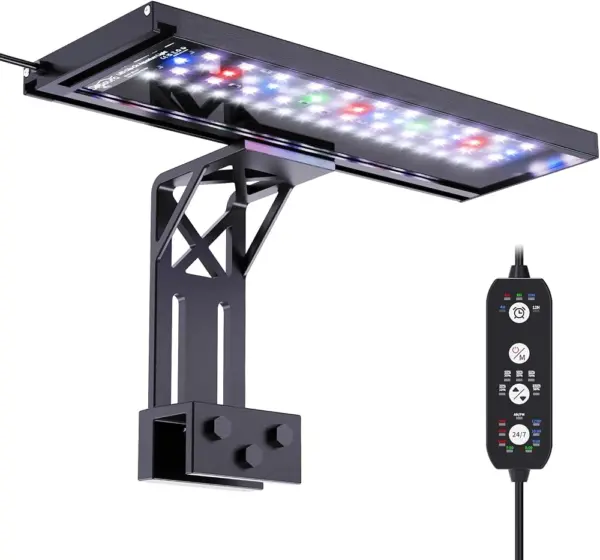
Twenty watts hanging off the back wall of a nano tank is more light than it sounds, and this is the clip-on we fit when the tank is rimless. The arm grips the glass, the housing slides along it and the head angles over the water, so nothing spans the rim and nothing gets knocked into the tank during a water change. CRI 90 keeps colors honest, and IP68 means a splash from the filter outlet is not the end of the fixture.
The feature we did not expect to care about is the preview. You can see a color and an intensity on the tank before committing them to the 24/7 cycle, which is the difference between designing a look and discovering one. Power-loss memory is the other quiet win: after an outage it picks the schedule back up instead of blinking at you until someone notices. Ten intensity levels, five timer settings, and seven single colors alongside the full-spectrum mix give you plenty of room.
The limit matters: the maker rates this for medium-to-low light plants. Anubias, java fern and moss look excellent under it; a high-tech stem tank with CO2 wants more. The clip also wants a slim wall, so measure your trim before ordering — a thick plastic rim is where clip-ons stop being convenient.
Pros
- Brightest clip-on in this set at 20 watts
- IP68 housing with CRI 90
- Preview colors before locking in the cycle
- Holds its schedule through a power cut
Cons
- Rated for medium-to-low light plants only
- Clip suits rimless glass and slim trim
Our pick for rimless and nano tanks: bright, honest color, genuinely splash-proof, and the only clip-on here that lets you preview a look before you commit to it.
hygger Clip On 14W – Best for Small Rimmed Tanks
Key Features
- Wattage: 14 W
- Tank fit: 12–20 in
- Warranty: 2 years
- Light output: 817 lumens
- Price: Midrange
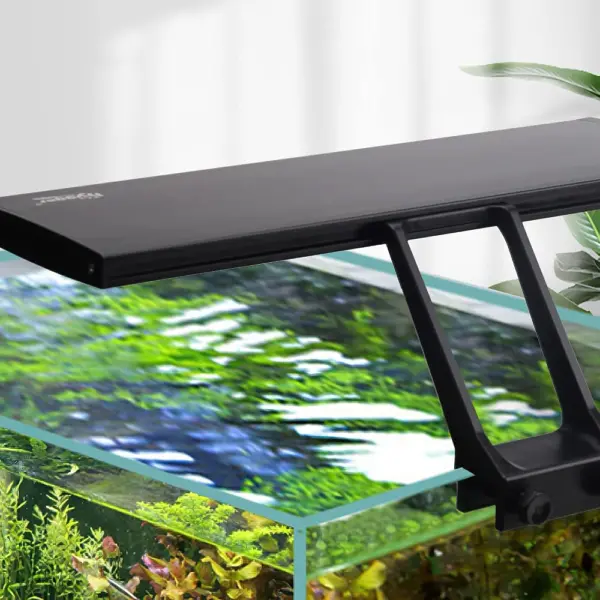
The reason to choose this over the other clip-on is on the warranty card: two years. For a light in this class, that is the most useful line in the listing. The clip screws onto walls under 0.9 inch, the arm bends to set the height, and 68 LEDs put 817 lumens across 12 to 20 inches of tank.
We take it when the tank is low-tech and the owner wants to stop thinking about hardware. The 24/7 gradient is the same orange-to-white-to-blue cycle hygger runs elsewhere, and once it is set, ownership is mostly noticing that the plants are fine. CRI 85 is a step down from the SEAOURA’s 90 — you see it in red fish, which render slightly flatter — but the drop is small enough that it does not change what the tank grows.
Where it gives ground is the mount and the output. The clip wants a slim wall, and on a thick molded rim it takes patience to seat square. At 817 lumens it is also the dimmest of the clip-ons here: plenty over a 10-gallon, thin over a 20-long. For a small rimmed tank holding ferns and a betta, neither is a real obstacle.
Pros
- Two-year warranty, the longest cover here
- 24/7 sunrise-to-moonlight cycle
- Bending arm sets the height over the water
- Aluminum housing at 817 lumens
Cons
- Fits only tank walls under 0.9 inch
- Lowest output of the clip-on picks
Buy this one for a small rimmed tank when the two-year warranty matters more than raw output; it runs itself, colors well, and will not be the thing you worry about.
AQQA 18W LED – Best for Open-Top Tanks
Key Features
- Bracket: 8 in extendable
- Wattage: 18 W
- Warranty: 365 days
- Waterproof rating: IP68
- Price: Premium
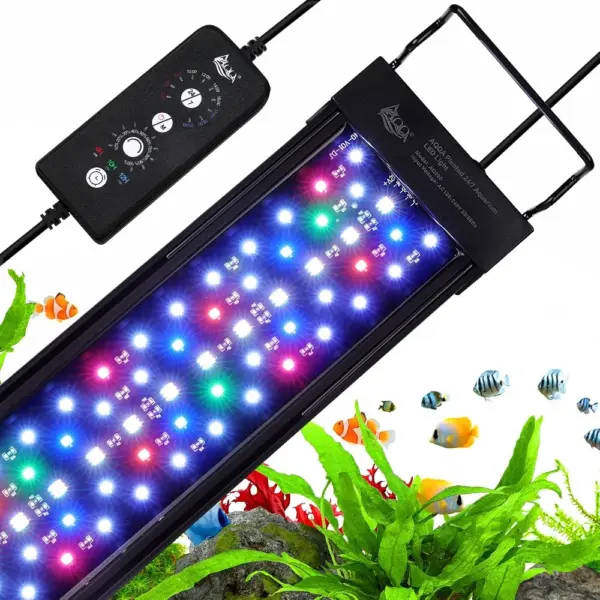
Open-top tanks are the hard case: no lid to catch spray, no hood to hide a fixture, and an outlet that spits. AQQA rates this bar IP68 and says it can be soaked outright, which is the claim we paid most attention to. The housing is widened aluminum for heat, the bracket extends to 8 inches, and the profile is low enough to disappear above a rim.
Programming happens on the cord and is simpler than most: on and off, color, cycle, brightness, timer. The 24/7 mode runs orange sunrise to full spectrum to blue night, and DIY adds nine colors for anyone chasing a particular look. It is the setup we hand to someone who has never programmed a light and does not want to start learning on a Tuesday night.
Brightness is where it gives ground. At full power it is the dimmest of the 18-watt fixtures here, and past a 30-inch tank it reads more like mood lighting than growth lighting. Over a 20-long or a 29, with the whites up and the timer set, it is a good-looking splash-proof bar with a real year of warranty behind it.
Pros
- IP68 housing takes spray and immersion
- 24/7 cycle plus nine DIY colors
- Widened aluminum shell for heat
- 365-day warranty
Cons
- Dimmest of the 18-watt picks at full power
Choose it for an open-top tank that gets splashed: the most moisture-tolerant bar here, straightforward to program, and honest about what it will light.
SEAOURA Submersible LED – Best for Hooded Low-Light Tanks
Key Features
- CRI: 89
- Wattage: 9 W
- Mounting: Suction cups
- Waterproof rating: IP68
- Price: Budget
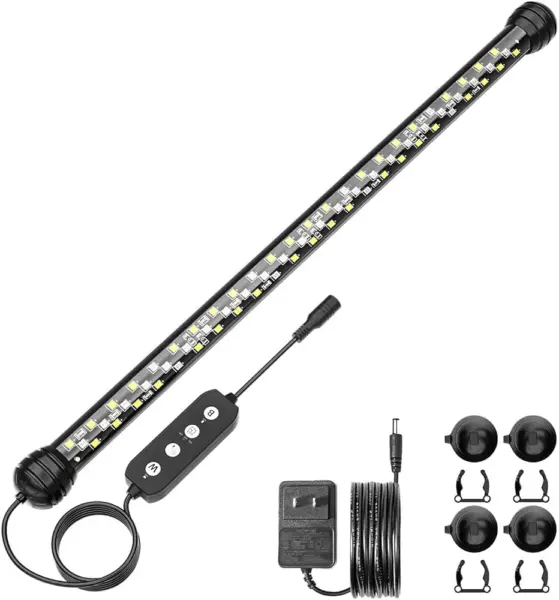
Some tanks cannot take a bar on top: a molded hood, a kit lid, a rack with no clearance. This one goes inside the tank. It is IP68 and fully submersible, 9 watts across three rows of chips in 6500K white plus red, green and blue, and the suction-cup mount drops under a hood or low on the back glass where a bracket has nowhere to sit.
Controls match SEAOURA’s clip-on: 10 brightness levels, 6-, 10- or 12-hour timers, and memory that resumes the schedule after a power cut. Everything runs from the corded controller, so budget a minute to learn the button order. CRI 89 keeps it from looking like a blue party light, and the three-row layout spreads better than a single spotlight-style submersible.
The mount is the honest limit. Suction cups hold on clean glass and give up on glass that is not, and when they let go the light floats. Clean the glass with alcohol, press the cups on dry, and expect to re-seat them now and then. Where they do hold — under a solid hood, low in a back corner — it turns a dim kit tank into something ferns and anubias can use.
Pros
- Fully submersible at IP68
- 10 brightness levels and 6/10/12-hour timers
- Resumes its schedule after a power cut
- Fits under a hood where a bar cannot
Cons
- Suction cups let go on less-than-spotless glass
- All control is on the cord; no remote
For a hooded tank with no room on top, this is the practical answer: submersible, programmable, and cheap enough to add to a kit tank — as long as you accept re-seating the cups.
How We Tested LED Aquarium Lights for Planted Tanks
I started by pulling together every LED fixture I could find that was marketed for planted tanks, then narrowed the list by tank size, mounting style, adjustable spectrum, and whether the light included a timer or dimmer. I also read through owner reviews for repeated complaints about flicker, failing suction cups, and color channels that quit early. That left 12 lights, which I ran for six months.
Each light spent two weeks over my 29-gallon planted tank at the same height, and the strongest contenders also got a few days in a 10-gallon nano tank to see how they handled a smaller footprint. I ran them eight hours a day on a timer and took light readings at the substrate and midwater, because a fixture that looks bright at the surface can leave lower leaves in shadow. I watched for pearling, leaf color, and algae on a fixed photo schedule. For color options, I cycled through every white, red, and blue setting and noted whether plants looked natural or washed out.
Reliability got the boring test: six months of daily on-off cycles, plus power interruptions to see whether timers held their schedule, with notes on flicker, dead LEDs, and dimming. For durability, I wiped off splash marks, checked heat at the housing, and inspected cords and seals. Since many of these lights rely on suction cups, I cleaned the glass, pressed each cup into place, and checked for slipping after a week of routine maintenance. Value came down to what was in the box—timer, dimmer, mounting hardware—and whether the light still performed once the extras were ignored.
How to Choose an Led Light for a Planted Tank
Spectrum and mounting decide whether a light works over plants; wattage is the number everyone quotes and the one that matters least.
Red is the spec that grows plants
A plant light is not simply a bright light. Chlorophyll wants red and blue, and the red is what cheap fixtures leave out: a bar sold on "full spectrum" with nothing but white and blue diodes keeps a fish tank looking bright while a sword plant sits stalled. Look for red at 660nm named on the listing, with 6500K white alongside it, which is what the NICREW and both hygger picks do. CRI is the other figure worth a glance — 90 and up keeps reds and oranges from going muddy under the fixture.
Measure the tank, then measure the ends
Every fixture here is sold against a tank-length range, and the range is real. An 18- to 24-inch bar over a 24-inch tank lights the middle strongly and reaches the corners well enough; the same bar on a 36-inch tank leaves two dim ends where stems sulk and stretch. If your tank is 48 inches, we run two 24-inch fixtures rather than one long bar: better spread across the footprint, and if one dies you are still lit. Two mid-priced bars cost roughly what a single long one does.
A schedule beats a switch
Plants and algae both respond to consistency, and a tank that gets eight hours one day and twelve the next grows algae faster than leaves. There are two fixes: a built-in cycle, like the 24/7 modes on the hygger, AQQA and SEAOURA fixtures, which ramp orange to white to blue with no input from you, or a dimmable bar on an inexpensive wall timer. We take the built-in cycle when the tank’s owner travels, and a wall timer when you already have a dimmer you like. Check when a default cycle starts — several are fixed at 6 a.m.
Mounting is where buyers get caught
Three mounts, three sets of conditions. Sliding brackets sit on the rim and suit framed and rimless tanks both, but a center brace on a long tank means the bar straddles it or you run two fixtures. A clip-on grabs the wall — excellent on rimless glass, fussy on thick plastic trim, and always worth checking against your actual rim. Suction cups are the only option under a solid hood, and the only one that can let go, so clean the glass and press them on dry. On an open-top tank, splash decides it: an IP68 housing like the AQQA or the SEAOURA clip-on copes with spray that a bar rated not water resistant needs kept away from.
Plan on replacing it eventually
Here is the part that does not show up in the specifications. The light is usually the first thing to go in a budget planted tank, and the failure that turns up most often is the fixture that runs beautifully for four months and then halves its output as strings of LEDs drop out. That is an argument for checking the warranty rather than skipping a light altogether. Two years from hygger, 365 days from AQQA, a year from SEAOURA. A separable power adapter, which hygger’s 18-watt has, means a dead brick is a cheap part instead of a whole new fixture. Buy where returns are straightforward, and keep the box.
Frequently Asked Questions
How many hours a day should a planted-tank light run?
Start at six hours and hold it there for two weeks before changing anything. Most planted tanks settle between six and eight hours, and the right number is the one where new leaves look healthy and the glass stays clear. If algae shows up on glass and slow growers, shorten the photoperiod before you dim the light. If plants stretch with wide gaps between leaves, add half an hour at a time.
My tank came with a hood and light. Is a new fixture really worth it?
Kit lights are usually a single white strip with no red channel and no dimming — enough for fish, marginal for ferns and anubias, and not enough for stem plants, which answer by stretching toward the surface with long gaps between leaves. If you are seeing that stretch, or plants simply hold steady without growing, the light is the cheapest thing to change. Keep the hood and fit a submersible light or a low-profile bar under it.
Does a glass lid cut the light my plants get?
Yes, and more than most people expect once condensation and mineral film build up underneath. Wipe the underside weekly with a damp cloth and give the glass a vinegar soak every month or two. If plants stall under a lid, clean it before buying a stronger light. If cleaning does not fix it, move to a splash-rated fixture and run the tank without the lid.
Do I need CO2 to use a light this strong?
No. Light drives growth, while CO2 and nutrients set the ceiling, so a bright fixture in a tank without either mostly grows algae. Run these at mid intensity for six hours, keep up with water changes, and let slow growers like anubias and java fern set the pace. If you add CO2 later, that is when the extra intensity starts paying for itself.
Final Verdict
Start with the NICREW ClassicLED Plus. It carries the spectrum a planted tank wants, the color rendition that makes the tank worth looking at, and mounts that fit the tank you already own. The 24-inch limit is the one number to check against your footprint.
Two cases change the answer. A rimless nano wants the SEAOURA clip-on, which clips instead of spanning and survives a splash. A tank with nobody home to switch it on wants the hygger 18-watt, whose entire job is running itself. Whatever you choose, buy where returns are simple and keep the box — this is the part of a planted tank most likely to need replacing.