This post contains affiliate links. We may earn a small commission when you buy through our links — at no extra cost to you.
Picking a filter for a 20-gallon tank often means choosing between a quiet night’s sleep and a water-clear view – or between a low upfront price and a drawer full of spent cartridges a year later. Most filters that promise "whisper quiet" operation end up humming or splashing within weeks, and the disposable cartridges many rely on can cost more than the filter itself over time.
The real challenge is finding a unit that balances noise control, reliable mechanical and biological filtration, and affordable long-term media. The best designs let you use your own sponge or biomax instead of proprietary refills, and they handle power outages without needing a manual restart. That combination narrows the field considerably.
This guide focuses on filters that deliver on those promises for a standard 20-gallon tank – whether you keep a community of tetras, a planted scape, or a delicate betta. The trade-off between canister capacity and HOB convenience is real, but the right pick avoids both the noise traps and the cartridge treadmill.
Top Picks
Best for Community Tanks
Seachem Tidal 35

Rating: 4.5 ★ | Price: Mid-Range | Flow Rate: 90–450 GPH | Filter Type: HOB | Media: Customizable basket
The Seachem Tidal 35 draws water from inside the tank with an in-tubing pump that self-primes after a power outage, so you never need to fill it by hand. Flow is adjustable from a gentle trickle to a strong current, and the media basket fits custom foam, ceramic rings, or carbon without requiring proprietary cartridges. Noise output is low enough that a 20-gallon community tank in a study or open-plan living area stays unobtrusive.
This filter suits anyone setting up a 20-gallon community tank who wants quiet operation and the freedom to choose their own media. The self-priming feature is especially useful in households with frequent power interruptions. A small number of units stop priming or lose flow early on — this is not a concern for most, but if even a single week of downtime would be a problem, consider a backup or a different model with a longer track record.
Pros
- Self-primes immediately after power loss — no manual refilling needed
- Adjustable flow from 90 to 450 GPH fits both slow-water fish and high-turnover setups
- Large media basket accepts any combination of foam, ceramic, or chemical media
Cons
- Flow adjustment dial can be finicky — finding a precise setting takes a few turns
- Pump may stop working in a minority of units within the first weeks
The Seachem Tidal 35 delivers quiet, adjustable, custom-media filtration at a mid-range price. For a 20-gallon community tank in a noise-sensitive space, it’s the most rounded HOB option available.
Best for Planted Tanks
Fluval 107 Canister

Rating: 4.5 ★ | Price: Premium | Flow Rate: 145 GPH | Filter Type: Canister | Media: Customizable baskets
The Fluval 107 runs near-silently and packs three full media baskets, offering more customization than the top-pick Seachem Tidal 35. That quiet operation and media flexibility suit planted tanks where flow adjustability and biological filtration matter most. However, the canister setup introduces a real tradeoff: the top seal and hose connections can develop leaks after maintenance, so this filter rewards careful reassembly. It’s best for hobbyists who want the quietest possible filtration and don’t mind occasional water spill risk.
Pros
- Near-silent operation — easily the quietest option for a 20-gallon tank.
- Three full media baskets allow customized filtration for planted or sensitive tanks.
Cons
- Motor longevity may fall short of expectations for the premium price.
The Fluval 107 is the right call for planted tank keepers who want whisper-quiet filtration and the flexibility to tailor media, provided they are comfortable with occasional leak checks.
Best for Budget Builds
Tetra Whisper IQ 20

Rating: 4.2 ★ | Price: Budget | Flow Rate: 130 GPH | Filter Type: HOB | Media: Disposable cartridges
The Tetra Whisper IQ delivers notably quiet operation via its sound shield, making it a strong choice for noise-sensitive spaces like bedrooms or living rooms. Compared to the top pick Seachem Tidal 35, it lacks adjustability and a customizable media basket, but the lower upfront cost and effective water clarity suit first-time buyers who don’t need advanced features.
This filter fits first-time buyers on a tight budget and small community tanks where quiet operation is a priority. However, some units may stop working after several months, and the motor box can leak in certain setups, so it’s best treated as an entry-level solution rather than a permanent fixture.
Pros
- Very quiet operation with sound shield keeps tank noise low.
- Good water clarity and cleaning performance for a budget filter.
- Affordable replacement cartridges reduce ongoing cost.
Cons
- Some units may stop running after several months, limiting long-term use.
- Water can drip from the motor box in certain setups, requiring careful placement away from electronics or carpet.
A solid entry-level HOB for those who need a quiet, budget-friendly filter and are comfortable with the possibility of replacing it within a year.
Best for Shrimp Tanks
AQUANEAT Sponge

Rating: 4.7 ★ | Price: Budget | Flow Rate: Variable (air) | Filter Type: Sponge | Media: Sponge + ceramic
The AQUANEAT Sponge Filter provides gentle biological filtration via an air-driven sponge and included ceramic media, making it a natural fit for tanks where strong current would stress bettas, shrimp, or fry. The suction cups that hold it in place may not grip textured glass reliably, and the bubble noise can be adjusted by regulating airflow. This filter is best for low-bioload setups where minimal flow is the goal; for a standard 20-gallon community tank with moderate stocking, a hang-on-back or canister filter delivers more turnover and mechanical filtration.
Pros
- Biological media and sponge included at a budget-friendly price
- Air-driven design creates very gentle water movement
- Easy to take apart and clean — no tools needed
Cons
- Suction cups can release on textured or uneven glass surfaces
- Bubble noise may be noticeable in quiet rooms if airflow isn’t tuned
For low-bioload, low-flow aquariums, this sponge filter offers exceptional value — but if you need stronger filtration for a standard 20-gallon community, the top-pick HOB is a better match.
Best for Canister Value
Penn-Plax Cascade 500

Rating: 4.3 ★ | Price: Mid-Range | Flow Rate: 115 GPH | Filter Type: Canister | Media: 2 media baskets
Quiet and affordably priced, the Cascade 500 brings canister filtration to a 20-gallon tank without the premium cost. It uses two media baskets for mechanical, chemical, and biological media, and fits neatly under most stands with adequate floor space. Assembly requires a gentle hand with the plastic fittings to avoid damage, and the spray bar is less intrusive when kept submerged — but once running, the filter is quiet and maintains good water clarity.
Pros
- Quiet enough for a living room or bedroom setting.
- Delivers clear water with multi-stage media baskets.
Cons
- The pump housing may develop cracks if the fittings are overtightened.
- Spray bar noise above water line may be noticeable in quiet environments.
For hobbyists seeking canister filtration on a budget, this model offers quiet performance and reliable water quality — just handle the plastic fittings with care.
Best for Self-Priming
Aqueon QuietFlow 20

Rating: 4.4 ★ | Price: Budget | Filter Type: HOB | Media: Disposable cartridge
The Aqueon QuietFlow 20 delivers notably quiet operation with reliable self-priming after power outages – a clear advantage over many HOBs in this price range. Compared to the top-pick Seachem Tidal 35, you give up adjustable flow and the ability to customize media without ongoing cartridge costs. Durability can be inconsistent, with some units stopping within months, making this best suited for budget-conscious aquarists who prioritize silence over long-term consistency and don’t need flow control for sensitive species.
Pros
- Very quiet operation – suitable for bedrooms or living areas.
- Effective filtration maintains water clarity.
- Easy setup and good value for the price.
Cons
- No flow adjustment – current may be too strong for shrimp or nano fish.
If silence and self-priming are your top priorities and you’re comfortable with the possibility of early replacement, this is a budget-friendly fit for a 20-gallon community tank.
Best for Bio-Wheel Fans
Marineland Penguin 150

Rating: 4.3 ★ | Price: Budget | Flow Rate: 150 GPH | Filter Type: HOB | Media: Disposable cartridges
The bio-wheel on this filter provides extra surface agitation and supports biological filtration, which helps keep water clear in 20–30 gallon tanks. Setup and cleaning are straightforward, making it accessible for basic setups that already use Marineland cartridges. However, the noise from water splashing can be noticeable in quieter rooms, and the spinning wheel may occasionally stop turning. Replacement cartridge costs add up over time, making the long-term expense higher than adjustable alternatives like the top pick.
Pros
- Bio-wheel improves surface agitation and biological filtration.
- Easy to set up and clean for routine maintenance.
Cons
- In quiet rooms, water splashing noise may be present.
A decent option if you already own Marineland cartridges and aren’t bothered by some filter noise, but the top pick offers quieter operation and lower long-term costs.
Best for Media Custom
Fluval 50 HOB
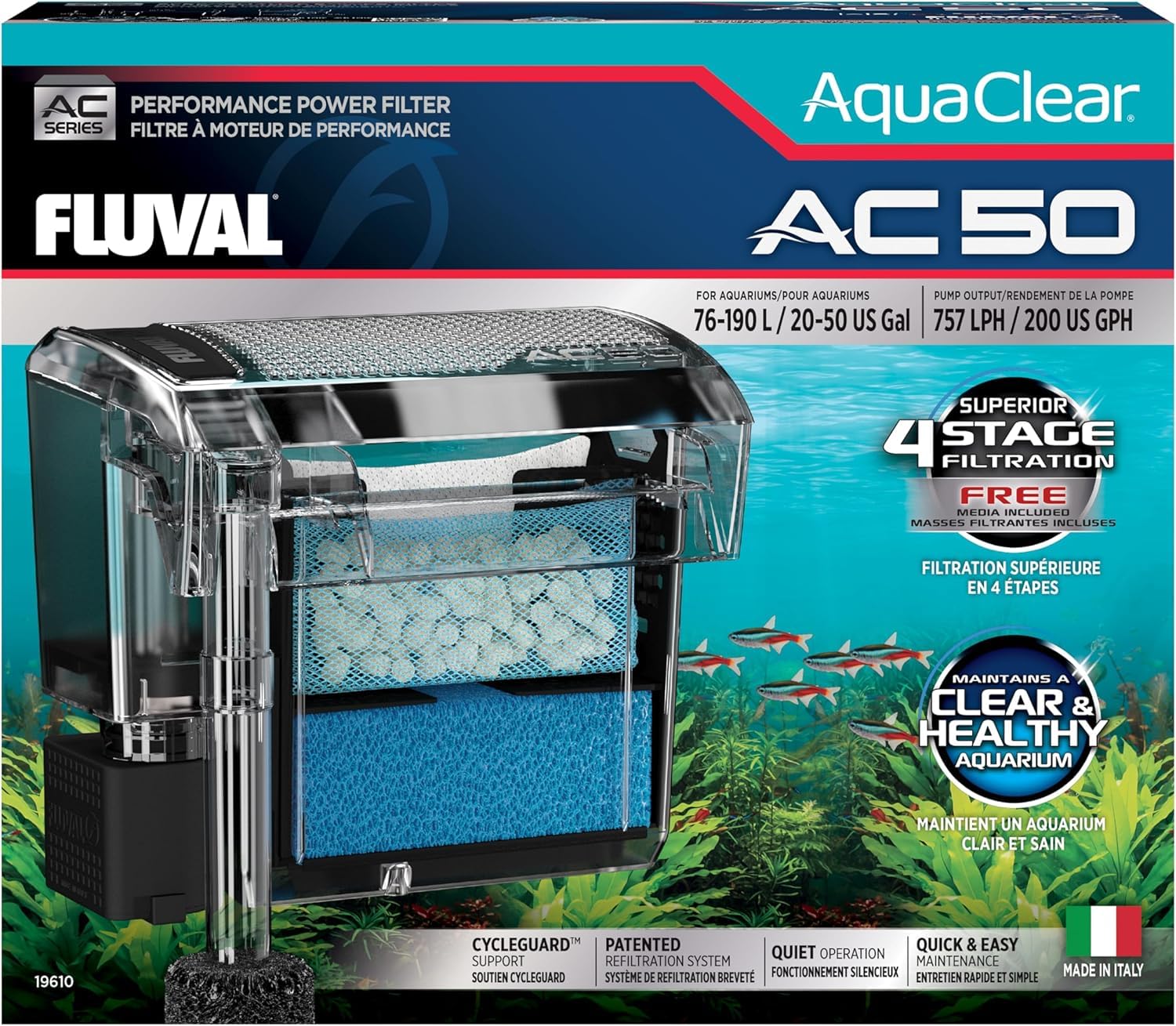
Rating: 4.2 ★ | Price: Mid-Range | Flow Rate: 200 GPH | Filter Type: HOB | Media: Customizable basket
The Fluval 50 offers a large media basket that accepts foam, carbon, and biomax for customizable filtration. Cleaning is straightforward, and value is strong for media flexibility. Motor hum may be noticeable in quieter spaces, and occasional housing cracks have been noted. This works best as a backup filter for a 20-gallon setup where media control is a priority over quiet operation and long-term durability.
Pros
- Large media basket accepts foam, carbon, and biomax for customizable filtration.
- Easy to clean and maintain with simple disassembly.
Cons
- Motor noise and housing cracks have been noted in some units.
Best suited as a backup filter for a 20-gallon tank where media customization matters and occasional noise or durability quirks are acceptable.
Best for Shrimp Tanks
hygger Sponge

Rating: 4.4 ★ | Price: Budget | Flow Rate: Variable (air) | Filter Type: Sponge | Media: 4 sponges + ceramic
hygger’s sponge filter includes four sponges and ceramic balls for robust biofiltration, similar to the AQUANEAT but slightly larger. The suction cups may not hold on all surfaces, and bubble noise without an airstone can be noticeable – best for low-current setups where these tradeoffs are acceptable.
Pros
- Clear water with effective biological and mechanical filtration.
- Cost-effective with reusable sponge and ceramic media.
Cons
- Suction cups may lose grip on textured or uneven surfaces, causing the filter to shift.
A good fit for shrimp or betta keepers who want extra biofiltration in a low-flow tank and can work around the mounting limitation.
Best for Internal Placement
Tetra Whisper Internal

Rating: 4.3 ★ | Price: Budget | Flow Rate: 170 GPH | Filter Type: Internal | Media: Disposable cartridges
The Tetra Whisper Internal runs nearly silently and handles turtle setups effectively – a strong value at entry-level pricing. However, its internal design takes up tank space, and some units may have a shorter service life than external filters, making it a better fit for temporary or extremely budget-conscious builds.
Pros
- Very quiet operation
- Good value with inexpensive replacement filters
Cons
- Some units may require replacement sooner than typical external filters
Best as a temporary solution or for very low-budget setups where silence is more important than long-term reliability.
Best for Undergravel Fans
Penn-Plax Undergravel

Rating: 4.4 ★ | Price: Budget | Flow Rate: Air-driven | Filter Type: Undergravel | Media: Carbon cartridges
The Penn-Plax Undergravel Filter provides effective biological filtration for aquarists who prefer traditional undergravel systems. It demands precise gravel depth and regular vacuuming, which can be a learning curve for those new to this filter type.
Pros
- Effective biological filtration when set up with proper gravel depth.
- Easy to assemble and install.
Cons
- Plastic lift tubes and airstones may arrive cracked or broken in transit — inspect promptly.
Best for budget-conscious aquarists experienced with undergravel setups who can accept the risk of shipping damage and the need for meticulous gravel maintenance.
Best for Extreme Budget
Tetra Whisper EX 20

Rating: 4.2 ★ | Price: Budget | Filter Type: HOB | Media: Disposable cartridges
Tetra Whisper EX 20 is the cheapest HOB filter for 20-gallon tanks and sets up in seconds. Water clarity is decent for the price. But motor hum and splashing may be noticeable, and occasional durability issues make it unsuitable as a long-term primary filter. Best for temporary setups or emergency replacements.
Pros
- Very affordable and easy to find
- Easy to set up
Cons
- Some units may cease operation without prior indication
This filter works for emergency replacements or temporary tanks where saving money upfront outweighs the risk of early failure.
How to Choose
The quietest filter is not always the most reliable, and cartridge costs can exceed the filter price within a year.
Flow Rate
Flow rate determines how many times the tank’s water volume passes through the filter per hour. For a 20-gallon tank, a rate of 100–200 GPH (5–10x turnover) is sufficient for most community setups. Higher rates create stronger current that can stress slow-moving fish like bettas or dwarf shrimp.
An adjustable flow valve lets you dial back a higher-rated filter to match the tank’s inhabitants. Without adjustment, a filter rated for 30–40 gallons may blast fish around or create a waterfall roar. Look for a model with a physical flow control knob or a directional outflow spout.
Type of Filtration
HOB (hang-on-back) filters are the most common: they sit on the rim, pull water through a media basket, and return it via a waterfall. They combine mechanical, chemical, and biological media in one housing and are easy to service. Canister filters sit under the tank and offer more media volume for biological filtration, but require priming and have a higher leak risk.
Sponge and internal filters are gentler and ideal for fry, shrimp, or betta tanks. They rely on an air pump or small powerhead and provide excellent biological filtration without strong current. Undergravel filters use the substrate as a bio filter but demand careful gravel maintenance and are less popular today. Choose based on whether you prioritize ease of access, media volume, or current sensitivity.
Noise Level
Filter noise comes from two sources: the motor and the water splash. Motor noise is a low hum that can be amplified by the tank’s hollow stand; water splash is the sound of water falling back into the tank. Some HOBs include a sound shield or a submerged discharge to reduce this.
A filter that is quiet out of the box can become louder once impellers wear or water level drops. Canister filters are generally the quietest because the motor is enclosed and the return water is submerged. Sponge filters produce a soft bubble sound that can be minimized with a fine-pore airstone.
Ease of Maintenance
Filters that use disposable cartridges require replacement every 2–4 weeks, adding $30–$50 annually to the cost. Models with a reusable media basket let you rinse and reuse sponge, biomax, and carbon, cutting recurring expenses and waste.
Ease of access matters: a filter whose basket lifts out in one piece is far simpler to maintain than one that requires disassembling the motor housing or removing the entire unit. Self-priming models also save time after power outages – they start pumping automatically without manual siphoning.
Self-Priming Capability
After a power outage or during first-time setup, a non-self-priming filter may lose its water column and refuse to restart until manually filled. This can lead to dry-running motor damage or a stalled biological cycle if left unattended.
HOB filters with an in-tank motor design (like the Seachem Tidal) self-prime because the motor stays submerged. Canister filters almost always require manual priming via a button or siphon. If power interruptions are common in your area, a self-priming HOB is the more forgiving option.
FAQ
Why does my new filter make a loud humming noise after a few days?
A humming noise often means the impeller is not seated correctly or has picked up debris. Unplug the filter, remove the impeller assembly, rinse it under tank water, and reinsert it firmly. If the noise persists, the motor may be defective – check the manufacturer’s warranty. For HOB filters, ensure the water level is high enough to submerge the intake.
Can I use a canister filter on a 20-gallon tank without too much current?
Yes, if the canister has an adjustable flow valve or a spray bar that diffuses the output. Canisters like the Fluval 107 and Penn-Plax Cascade 500 both include flow adjustments. Point the spray bar toward the back glass or use a pre-filter sponge on the intake to reduce current for delicate fish.
How often should I replace the media in a HOB filter?
Disposable cartridges should be replaced every 3–4 weeks, but many hobbyists extend that by rinsing them in used aquarium water. For reusable media (sponge, biomax), rinse every 4–6 weeks and replace only when it starts to disintegrate – typically every 6–12 months. Never change all media at once, or you risk crashing your biological cycle.
Is it safe to run a filter rated for 30 gallons on a 20-gallon tank?
Yes, as long as the filter has an adjustable flow or you can tame the output with a spray bar or intake sponge. A larger filter provides more biological capacity and better water turnover, which often leads to clearer water and a more stable cycle. Just avoid fixed-flow models that might produce excessive current for small fish.