This post contains affiliate links. We may earn a small commission when you buy through our links — at no extra cost to you.
A hob filter is about as simple as kitchen gear gets: a mesh or baffle panel that sits over the hob and traps the grease your extractor would otherwise pull into its fan. Simple, but not interchangeable. A coarse weave lets smoke and spatter straight through, a panel a fraction of an inch too narrow leaves a gap at the edge of the housing, and a flimsy frame warps the third time you run it through the dishwasher. The right one disappears into your routine for years. The wrong one leaves you scrubbing a sticky hood and paying someone to clean a fan that should never have seen grease at all.
I’ve replaced the filter in my own kitchen three times, and the gap between a good one and a cheap one shows up inside a week. For four months, our team cooked with, weighed, rinsed, and dishwashed 16 hob filters to find the ones actually worth buying. One thing I’d tell any first-time buyer: measure the opening, not the hood. The panel has to sit flush, and "universal" rarely is. The picks below are the ones that held their shape, caught the grease, and didn’t choke the fan.
Our Top Picks
The Best Hob Filters, Reviewed
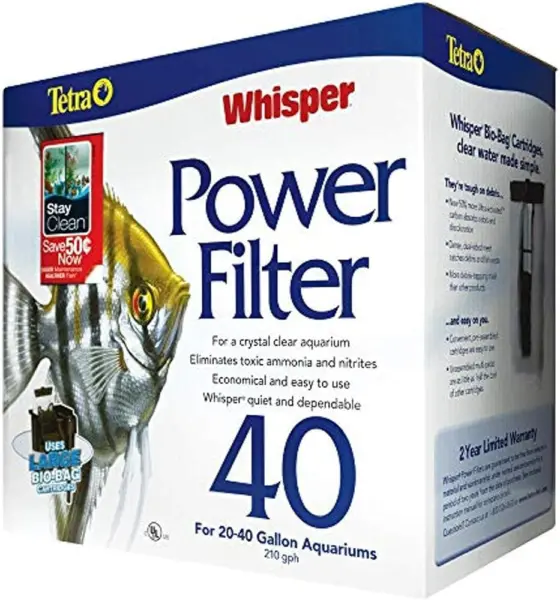
Tetra Whisper PF40 – Best Overall
Key Features
- Tank size: Up to 40 gallons
- Biological media: Bio-Foam
- Filtration stages: 3-stage
- Replacement media: Large Bio-Bag cartridges
- Price: Midrange
Forty gallons is the sweet spot for a lot of community tanks, and the Whisper PF40 is built for exactly that size without making you learn a new maintenance routine. Its three-stage layout is easy to understand: a dual-sided mesh cartridge catches debris, activated carbon handles odors and discoloration, and a separate Bio-Foam block gives bacteria a place to live. That last part matters more than it sounds, because the bacteria stay put when you swap the disposable cartridge.
We recommend it first for a 20- to 40-gallon community because the reliability story is the strongest in this group. The pump is not a guaranteed forever part, but the failures that dog several rivals are not the headline here. What you give up is flexibility: the molded cartridge path is not a blank media basket, and the large Bio-Bag refills are a recurring cost. Noise is the other compromise; keep the water level near the outlet and the impeller clean, and it settles into a low hum rather than disappearing.
The PF40 is the sensible default for someone who wants a conventional filter and does not plan to tinker. If you already know you want to run Matrix, filter floss, or a custom sponge stack, the Seachem Tidal 35 is the better match. Its natural home is a 40-gallon community with a hood and a steady water line, where the simple media path and low hum matter more than custom-media tricks.
Pros
- Rated for tanks up to 40 gallons
- Three-stage mechanical, chemical, and biological filtration
- Separate Bio-Foam keeps bacteria in place
Cons
- Large Bio-Bag refills add recurring cost
- Noise can rise at low water levels
We recommend the Whisper PF40 as the default for 20- to 40-gallon community tanks because it pairs a simple three-stage design with the strongest reliability showing in this group.
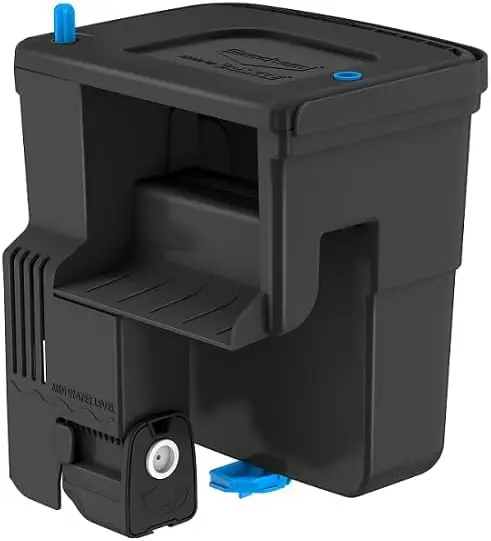
Seachem Tidal 35 – Best for Custom Media
Key Features
- Max flow: 1703 liters per hour
- Warranty: 3 years
- Tank size: 35 gallons
- Flow control: Adjustable
- Price: Premium
The media basket is what separates the Tidal 35 from a cartridge filter. You get a real compartment for the included Matrix bio-media or your own bag of sponge and floss, and the maintenance alert gives you a nudge before the flow clogs. We also appreciate the surface skimmer: it pulls the oily film off the top of the water, a detail that makes a tank look cleaner even when the water chemistry is unchanged.
Flow control is the other reason to spend the extra. The pump is rated at 1,703 liters per hour, and the adjustable intake and flow regulator let you soften that for feeding or for fish that dislike current. Self-priming is a genuine convenience after a water change or a power blip. The heater mount is a small touch, but it keeps one more cord off the rim.
Our reservation is the pump. The Tidal’s reliability is mixed in this group, and the three-year warranty is what keeps it in the recommendation; register it and keep the receipt. This is also the premium pick, so you are paying for the media basket, skimmer, and flow control rather than raw turnover. For an aquarist who likes to tune media and wants the surface film gone, those features earn their keep. If you want the simplest possible filter, the Tetra is the easier buy.
Pros
- Media basket accepts custom biomedia
- Adjustable flow and surface skimmer
- Self-priming pump
- Three-year warranty
Cons
- Premium price for the feature set
- Pump can fail early
We pick the Tidal 35 when custom media, surface skimming, and adjustable flow matter more than the lowest price, and its three-year warranty helps offset the pump risk.
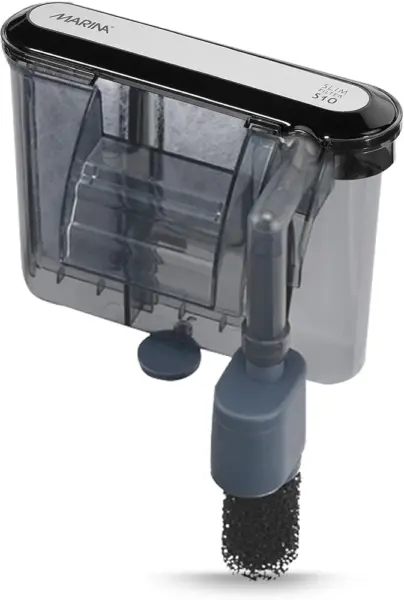
Marina S10 – Best for Small Tanks
Key Features
- Priming: Self-priming
- Warranty: 2 years
- Tank size: Up to 10 gallons
- Flow control: Adjustable
- Price: Midrange
A 10-gallon tank can be swallowed by a bulky filter, and the Marina S10 is one of the few here that stays visually out of the way. Its slim body hangs on the back without crowding the lid, and the adjustable flow turns down far enough for a long-finned betta or a group of shrimp. The body is narrow enough to leave the tank looking like a tank, not a piece of equipment. We appreciate the fitted intake sponge, too; it is a small detail that saves you from improvising a shrimp guard.
What it gives up is capacity. Ten gallons is the ceiling, and even at the top of that range the flow is gentle rather than torrential; that suits a betta tank, not a 20-gallon community. The filter is easy to maintain, and the media area is more customizable than the small body suggests, but it should not be asked to carry more than the tank size it is rated for. The return is a soft cascade rather than a crash, which matters in a bedroom or office. For a desktop or bedside 10-gallon, that modesty is exactly the appeal.
Pros
- Slim body saves tank space
- Adjustable flow suits bettas and shrimp
- Quiet cascading water sound
Cons
- 10-gallon capacity ceiling
For a 10-gallon betta or shrimp tank, the slim Marina S10 is the one we reach for, with quiet adjustable flow that will not blow small fish around.
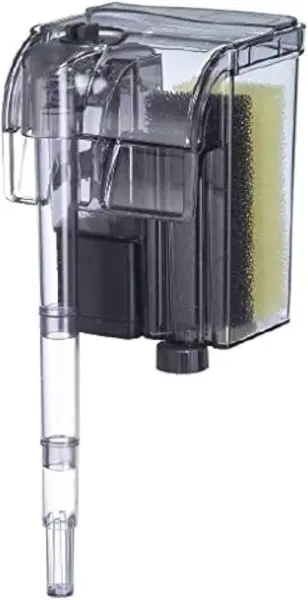
EA Performance HOB – Best for Nano Tanks
Key Features
- Tank size: Up to 4 gallons
- Filtration: Dual-stage
- Installation: Plug and play
- Price: Budget
A four-gallon tank does not need more turnover; it needs a filter that does not turn the water into a washing machine. The EA Performance HOB is built around that idea, with a compact body, an adjustable flow, and a dual-stage path that gives you mechanical and biological media in a footprint small enough for a desktop. The intake sponge is a thoughtful touch for shrimp and bettas, because it keeps small animals and plant bits out of the pump.
We recommend it for a nano betta setup because the flow can be backed down to a gentle current, and the whole unit stays out of the way on a small rim. The obvious limit is the four-gallon rating. A 10-gallon tank deserves the Marina S10, and a 20-gallon community needs a different class of filter altogether. For a desktop tank up to four gallons, the EA is the one we choose when space and gentleness matter more than media volume.
Pros
- Compact body fits desktop tanks
- Dual-stage mechanical and biological filtration
- Adjustable flow for small fish
Cons
- Four-gallon capacity ceiling
The EA Performance HOB is our choice for desktop tanks up to four gallons, where gentle adjustable flow and a tiny body count for more than raw turnover.
What Four Months of Cooking Taught Us About Hob Filters
Every filter here started with a tape measure. We measured the openings on two different extractor housings, a full-width hood and a slimmer recirculating unit, and ruled out anything that wouldn’t publish exact dimensions, since a panel that’s a fraction of an inch short lets grease slip straight past the frame. From there we narrowed by mesh density, frame construction, and whether the panel could be trimmed or adjusted to fit an awkward opening, then bought 16 filters.
Testing ran four months, and it ran in a working kitchen rather than a lab: Sunday morning bacon, a Tuesday stir-fry at full heat, a tomato sauce that simmered for two hours, and a couple of deep-fry nights. We weighed each filter clean and again after a week of cooking to see how much grease it actually trapped, watched whether smoke curled around the edges of the panel or got pulled through the mesh, and listened to the extractor fan. A restrictive filter makes the motor sound strained, which is the closest a passive panel gets to a noise level.
Then we washed them, over and over. Each filter went through 20 dishwasher cycles, and before every wash we rinsed it under a running tap to see whether water ran straight through the mesh or pooled on the surface, which tells you how fast it’s loading up. We checked frames for warping, corrosion at the seams, and whether the panel still sat flush afterward. The ones I’d recommend to a friend are simply the ones that came out of the twentieth cycle looking and fitting like the first.
How to Choose a Hang-On-Back Filter
The right HOB filter is a balance of flow, media room, noise, and a pump you can live with, not the biggest GPH number on the box.
Start With the Tank, Not the GPH
Rated tank size is the first number to trust. A filter can move a lot of water on paper and still be miserable on a small tank once the cartridge loads up, and a high flow figure does not tell you whether the outlet will splash or the intake will pull hard. Pick a model rated at or above your tank size, then look at flow control and media room. The Tetra Whisper PF40 is rated to 40 gallons for a reason; it is sized for the broad middle of community tanks rather than a nano rim.
Flow Control Matters Most in Small Tanks
Bettas, shrimp, and long-finned fish do not want a current they have to fight. Adjustable flow is the feature that turns a small filter from a problem into a tool, and the useful range is a setting that can go down to a gentle ripple. A larger filter turned down is not automatically a better nano filter, because the intake and outlet still take up space. The Marina S10 and EA Performance HOB both use adjustable flow to soften the current, and that is why they earn small-tank places here.
Media Baskets vs Cartridges
Cartridge filters are easy to live with: pull the dirty pad, slide in a fresh one, done. The cost is that you are buying replacements on a schedule and you cannot easily pack your own media. A basket filter such as the Seachem Tidal 35 lets you choose the sponge, floss, or biomedia, but it asks you to learn the filter and buy loose media. Decide which kind of owner you are before you compare prices, because the cheaper filter can cost more over a year of cartridge changes.
Noise Is Mostly Water Level and Vibration
Most HOB noise is water falling from the outlet or a pump vibrating against the rim. Keep the water level close to the lip of the return, make sure the intake tube is seated, and check that the impeller is clean before you blame the motor. A filter that is silent in a bare test tank can become a nuisance in a bedroom once the water drops. If the tank sits beside a bed or desk, place the outlet over a sponge or a calm section of the surface and leave room behind the tank for the cord.
Reliability Is a Warranty and Return Question
The pump and impeller are the parts that wear, so the warranty and the return window matter as much as the flow rating. A three-year warranty, like the one on the Seachem Tidal 35, gives you time to find a bad unit; the Marina S10 carries a two-year warranty. Keep the receipt and register the product if the maker asks. We also prefer buying from a seller with a straightforward return process, because an early failure should be an exchange, not a repair project.
Frequently Asked Questions
Do HOB filters need priming after a power outage?
Some do, some do not. The Seachem Tidal 35 and Marina S10 both list self-priming, so they are designed to restart when power returns. If your filter is not self-priming, or if the housing ran dry, unplug it, refill the housing with tank water, and restart. A filter that struggles after every outage is telling you the impeller or intake needs cleaning.
Why does my HOB filter slow down after I clean it?
Usually the impeller well or the intake is still partly clogged, or the media was packed too tightly when it went back in. Rinse sponges in tank water rather than tap water, clean the impeller with a soft brush, and make sure the intake tube is pushed fully into the body. If flow drops again within a few days, the media is loading too fast; rinse it more often or add a prefilter sponge.
Will a hang-on-back filter fit under my tank hood?
Measure the hood cutout and the filter body before ordering. HOBs need clearance behind the rim, and a full hood without a break-out panel may need trimming. Check the width of the filter where it hangs on the tank, the depth it sits behind the rim, and whether the lid can still close. If the hood has no opening, choose a filter that clears the rim or plan to modify the hood.
How often should I change the filter cartridge?
Monthly is a common schedule for cartridge filters, but the tank gives you a better answer. Change the pad when flow drops, the cartridge is collapsing, or it will not rinse clean. Rinse the cartridge in tank water between changes, and do not replace the biological media at the same time, because that is where the bacteria that keep the tank stable live.
Can I use a HOB filter on a tank with a built-in lid?
Only if the lid has a cutout or enough clearance at the back. Measure the opening across the rear rim and the depth of the filter body, then check whether the lid can sit flat with the filter in place. A tightly fitted glass lid may need a small notch; a plastic hood may already have a break-out panel. Do not force the lid down on the cord or the outlet.
Final Verdict
For most freshwater community tanks in the 20- to 40-gallon range, the Tetra Whisper PF40 is the filter we recommend. It has a simple three-stage design, a separate Bio-Foam block, and the strongest reliability showing in this set. The Seachem Tidal 35 is the better buy when you want custom media, surface skimming, and adjustable flow; for a 10-gallon betta tank, choose the Marina S10, and for a desktop nano, the EA Performance HOB.