This post contains affiliate links. We may earn a small commission when you buy through our links — at no extra cost to you.
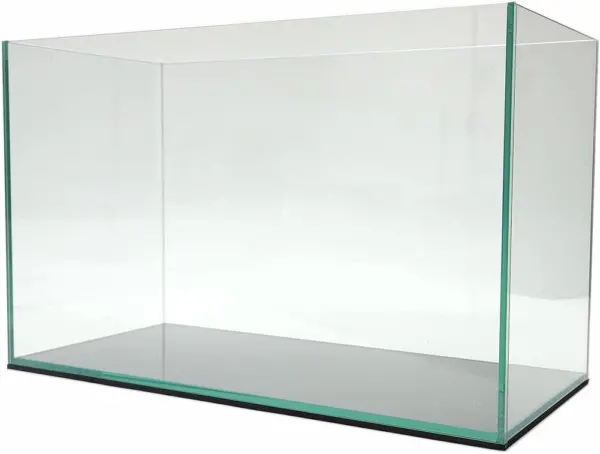
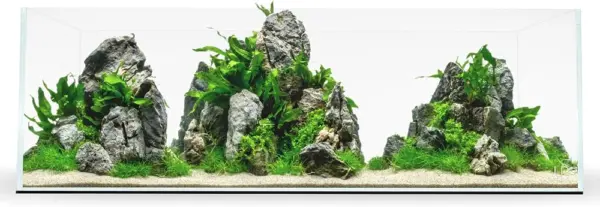
A rimless aquarium is the most attractive way to keep fish — a clean cube of water with nothing between you and the plants. It’s also the version with the least margin for error: no plastic trim hiding the seams, nothing but a bead of silicone holding several hundred pounds of water in place. What you’re paying for is the confidence that the glass was cut, polished, and sealed right — clarity, footprint, and build follow from that.
The difference between a good rimless build and a cheap one shows up in week one — cloudy silicone, a top edge sharp enough to nick a wrist, glass that scratches the first time you drag a magnet across it. Over seven months, my team and I set up and lived with nine rimless tanks, from a nano cube on a desk to a 40-gallon in the living room. One thing nobody tells first-timers: most rimless aquariums are sold as the box alone, so budget for a filter, light, and lid too. The picks below are the ones worth building around.
Our Top Picks
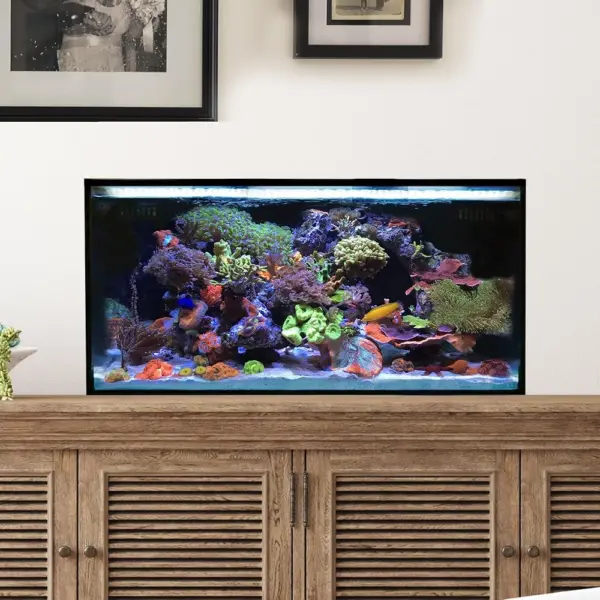
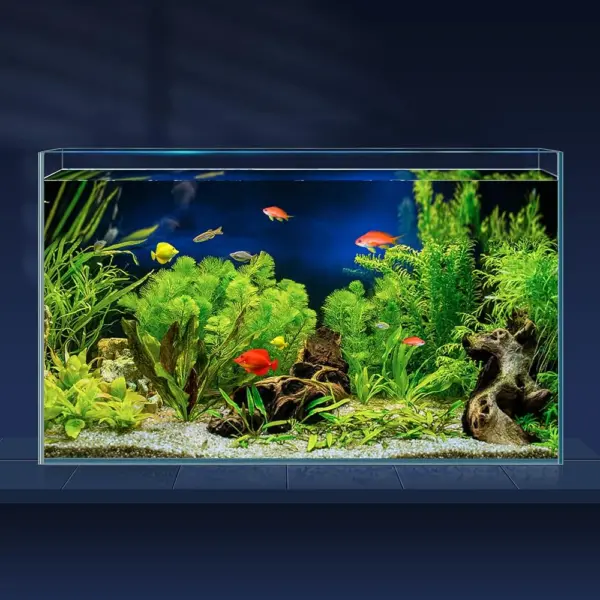
The Best Rimless Aquariums, Reviewed
LANDEN 60P Rimless – Best Overall
Key Features
- Glass: 6mm low-iron
- Footprint: 23.6 x 11.8 x 14.2 in
- Leveling mat: Foam mat included
- Price: Premium
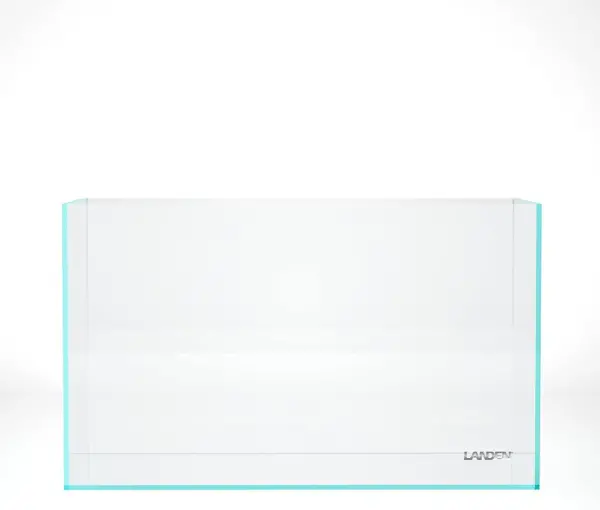
Sixty centimeters long, thirty deep and thirty-six tall — the 60P is the shape most planted-tank photographs you have admired were taken in, and LANDEN gets the proportions right. With water in it, the 6mm low-iron panels read almost colorless; the green cast you accept on ordinary glass simply is not there, and the plants look the color they actually are.
Close up, the work is tidy in the way a rimless tank has to be, because there is no plastic trim anywhere to hide a lazy seam. The edges are polished, the silicone runs even, and the panels meet cleanly at the corners. Dry, it lifts onto a stand without help at 26 pounds, and the foam mat in the box saved us a trip out for something to sit it on. Six millimeters is the usual thickness for this panel length, and the whole thing feels built rather than assembled.
The one thing to know before you fill it: low-iron glass is soft, and a single grain of sand trapped under an algae pad will leave an arc you can see from the sofa. Rinse the pad under the tap every time you pick it up, keep the substrate line an inch below the rim, and the front panel stays as clear as the day it arrived. That caveat aside, this is the size we keep recommending — big enough to plant properly, small enough that a water change is one bucket and ten minutes.
Pros
- Classic 60-centimeter aquascaping footprint
- Low-iron glass with polished edges
- Foam leveling mat included
- Lifts onto a stand at 26 pounds
Cons
- No cover in the box for jump-prone fish
Our pick for most people: the 60-centimeter footprint leaves room for a real aquascape, the low-iron glass is genuinely clear, and the mat you need to sit it level comes in the box.
Lifegard 15 Gallon – Best Value
Key Features
- Glass: 5mm, drillable
- Warranty: 1 year
- Footprint: 23.22 x 11.02 x 13.38 in
- Leveling mat: Black foam pad
- Price: Midrange
Lifegard’s 15-gallon is the one we point people to when they have priced a rimless setup and flinched. At 23 inches long and 13 tall it sits close enough to the top pick’s proportions that a planting plan drawn for one transfers to the other, and the edges and silicone are executed well enough that nothing pulls your eye off the fish.
The flexibility is where it earns its place. The panels are listed as drillable, which is unusual in this bracket and the reason this is the tank we name when someone wants a sump and a proper overflow instead of another hang-on filter. There is a black foam pad in the box, a one-year manufacturer warranty, and enough left in the budget for a light, a filter and a heater — the parts that decide whether the tank looks good six months in, not just on the day it arrives.
Five millimeters is the thinnest glass on any 15-gallon here, and it is the honest reason this costs less than the LYPHARD. For a planted tank on a solid cabinet that trade is fine; if the tank sits where a shoulder might catch it, pay for the thicker panel. Where a seam does give on a tank like this, it gives at a corner, so give the first fill a week somewhere a puddle would not ruin anything.
Pros
- Drillable panels for a sump build
- One-year manufacturer warranty
- Foam base pad supplied
- 15 gallons in a 23-inch length
Cons
- Thinnest glass at this size
The sensible second look: 15 gallons at 23 inches with clear glass, a foam base pad and a year of warranty cover, priced so a good light and filter still fit the budget.
FZONE Anata Shallow 9 – Best Shallow Aquascape
Key Features
- Glass: 6mm, 45° mitered
- Capacity: 9 gallons
- Footprint: 23.6 x 23.6 x 6.3 in
- Leveling mat: Pre-installed foam
- Price: Midrange
Six inches of water changes what a tank is for. FZONE’s Anata is 23.6 inches square and 6.3 inches tall, so you plant it like a tray, light it with a single pendant, and spend as much time looking down into it as through the front glass.
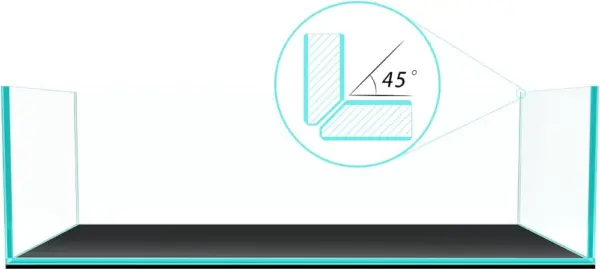
The detail we kept returning to is the corners. The panels are cut at 45 degrees and mitered, so they meet in a fine diagonal line with almost no silicone showing, and the tank reads as a glass case rather than a box with beads of adhesive at every joint. Around that: 6mm NovaClear low-iron glass, a pre-installed foam mat so it can sit straight on a stand, a laser-etched logo that vanishes against a dark background, and a 72-hour water test before each one leaves.
The footprint is the catch. A 24-inch square needs a surface at least 24 inches deep, and most bookshelves and sideboards are not, while six inches of height rules out tall stems, a bulky intake and any fish that wants vertical room. Treat it as a shrimp, snail and small-fish display and it is one of the most interesting tanks in this group; buy it expecting a general community tank and you will run out of water before you run out of ideas.
Pros
- Mitered corners with almost no visible silicone
- 6mm low-iron glass
- Pre-installed foam leveling mat
- Water-tested before shipping
Cons
- Needs a surface 24 inches deep
- Only 6.3 inches tall, so tall plants are out
Buy this if you want to look down into your tank: a 24-inch square only six inches tall, mitered at the corners and water-tested before it ships.
UNS 45L Ultra Clear – Best Nano Tank
Key Features
- Edges: 45° mitered
- Glass: 5mm low-iron
- Footprint: 17.72 x 6.69 x 6.69 in
- Leveling mat: Included
- Price: Budget
At 17.7 inches long and under seven inches deep and tall, the UNS 45L is a strip of water rather than a box. It sits on a shelf, a desk or the end of a kitchen counter without eating the surface, and at about 3.4 gallons it is a shrimp and small-fish tank by design rather than by compromise.
The glass is the reason this brand gets talked about. Low-iron panels with 45-degree mitered corners and an almost invisible silicone line, clear enough that we found ourselves sighting along the front edge to locate the seam at all. The black foam mat comes in the box, the etched logo is small enough to ignore, and the tank is light enough to move empty with one hand while you fiddle with the stand.
Small is the whole trade. Six and a half inches front to back leaves nowhere to hide a filter or a heater, and a tank this volume follows the room — a warm afternoon or an open window shows up in the water. What keeps bringing us back is how much scaping fits in that footprint: a stone, a carpet, a handful of shrimp, and it looks finished rather than unfinished.
Pros
- Clearest glass of the tanks here
- Mitered corners and neat silicone
- Leveling mat included
- Fits a shelf at 17.7 inches wide
Cons
- Tiny water volume follows room temperature
- Shallow depth leaves nowhere to hide equipment
The best small tank here: 17.7 inches long and barely seven deep, with the clearest glass in the group and a leveling mat in the box for a shrimp shelf or a desk.
Innovative Marine Lagoon 25 – Best All-In-One
Key Features
- Glass: 8mm low-iron
- Capacity: 25 gallons
- Footprint: 23.6 x 19.7 x 11.8 in
- Filtration: Rear overflow, 2 return pumps
- Price: Premium
Most rimless tanks are boxes; this one is a box with a filtration system built into the back. Behind the black acrylic overflow wall sit two removable 200-micron filter socks and two adjustable 130 GPH DC return pumps, with an integrated emergency overflow as a backstop. For a reef keeper that is the difference between buying a tank and starting a project — you add a light, a heater and salt water.
The glass is the thickest in this group at 8mm, low-iron and beveled, and the black silicone is a deliberate choice rather than a shortcut: against a dark background it disappears and the view runs edge to edge. The proportions are why we like it. A 23.6 by 19.7 footprint in a tank only 11.8 inches tall gives 25 gallons a lot of floor where rock and coral actually want it.
Two things to plan for before ordering. The packed tank is 62 pounds and the usable display depth drops to 16.9 inches once the overflow is counted, so size the stand for the outside dimensions rather than the swim area. And the overflow does what overflows do: flake food that floats gets pulled into the weir, which a feeding ring solves.
Pros
- Overflow, filter socks and two return pumps built in
- 8mm low-iron glass with beveled edges
- 25 gallons in an 11.8-inch lagoon
- Emergency overflow as a backstop
Cons
- Overflow pulls floating food into the weir
- Costs the most of any tank here
Buy this if you want a rimless tank and a filtration system in one purchase: 25 gallons, 8mm glass, two return pumps and a rear overflow, ready for salt or fresh.
LAQUAL 10 Gallon Kit – Best Kit with a Cover
Key Features
- Cover: Net cover and clips included
- Glass: 5mm low-iron
- Capacity: 10 gallons
- Footprint: 20 x 10.4 x 12 in
- Price: Midrange
Ten gallons, 20 inches long, 5mm low-iron glass — and a box of extras that answers the practical problem every open-top tank has. Four acrylic clips hold three cover segments in place as an anti-jump net, and the kit also includes a floating feeding ring, a siphon, tweezers, sponges and a scraper.
The cover is the part we did not expect to care about. Rimless tanks look better with nothing on top, right up until a betta finds the gap, and having a mesh top in the box means you are not improvising one out of egg crate in the first week. Underneath it the glass is clear and evenly bonded, with edges that feel smooth rather than sharp, and the whole package costs less than a couple of the bare tanks in this guide.
You are paying for the bundle, and on a first rimless setup that is the right trade: the parts you would otherwise buy one at a time are already there, and none of them is the weak link. It is the tank we suggest to anyone whose fish has already jumped once. If you want an unbroken open top for a display, buy glass elsewhere and add a top later.
Pros
- Net cover and clips included
- Feeding ring, siphon and tweezers in the box
- Clear 5mm low-iron glass
- 10 gallons in a 20-inch footprint
Cons
- Cover segments interrupt the clean open-top look
The kit to buy if your fish jumps: a 10-gallon rimless tank that arrives with a net cover, clips, a feeding ring and a box of tools for less than the bare tanks here.
LYPHARD 15 Gallon – Best for Small Rooms

Key Features
- Glass: 6mm low-iron
- Capacity: 15 gallons
- Footprint: 19.6 x 13 x 13.8 in
- Leveling mat: EVA foam included
- Price: Midrange
At 19.6 by 13 by 13.8 inches the LYPHARD is the squarest of the 15-gallons here — less letterbox than the Lifegard, more like a window. In a small room that reads as furniture rather than as a tank pushed against a wall.
Six millimeters of low-iron glass over a shorter span is more than the cheaper 15-gallon uses, and the polished edges give it a substantial feel the price does not prepare you for. The EVA foam mat is in the box, the silicone runs clean and even, and the clarity is in the same league as everything else here — no blue tint, no ripple in the panel when you look along it.
It ships without a lid, so a jumper needs a mesh top made or bought, and if a sump is in your future the Lifegard is the one that lists drillable panels. Neither matters much for a planted tank with a betta in it.
Where this one makes sense is specific: a small room, a thicker panel than the budget option, and no plans to plumb anything. Six millimeters, clean seams and a squarer face for close to what the cheaper 15-gallon asks — for that set of requirements the argument holds up, and it holds up without asking you to compromise on the glass.
Pros
- 6mm low-iron glass over a compact span
- EVA foam mat included
- Squarer 13-inch footprint
- Clean seams and polished edges
Cons
- Priced close to the larger top pick
A well-made 15-gallon with 6mm glass and a foam mat, worth a look when the Lifegard is out of stock and you want a squarer face on the tank.
HIRO Nano 0.5 Gallon – Desk Wabi-Kusa
Key Features
- Glass: 5mm low-iron
- Capacity: 0.5 gallon
- Footprint: 7.9 x 7.9 x 3.15 in
- Price: Budget
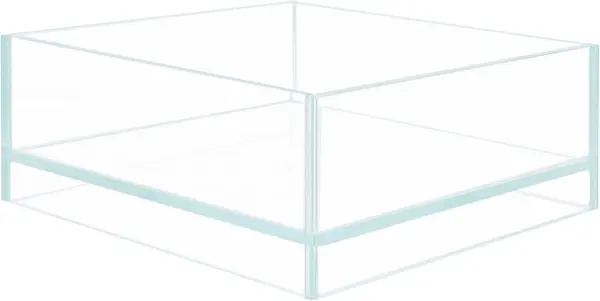
Three inches of water in an 8-inch square of 5mm low-iron glass — the ES20A is closer to a tray than an aquarium, and that is exactly why people buy it.
Used as a wabi-kusa dish, a shrimp cube or a terrarium base, it does what a jar cannot: you see the planting from the side as well as the top, and the glass is clear enough that the waterline almost disappears. The cuts are even, the silicone is applied neatly rather than sloppily, and the whole thing looks like a specimen dish rather than a budget tank.
It is also sized to sit on the bamboo base of the maker’s own 5W nano LED, a small convenience that removes one fiddly decision from the setup. Expect the light, the plants and the hardscape to cost more than the glass does, and plan the planting before you fill it, because there is no room to rearrange once the water is in.
Half a gallon is the limit. Water disappears faster than you expect, and a tray this shallow follows the room’s temperature, so a jug of dechlorinated water kept on the shelf turns topping up into a ten-second habit. Add the lid and it drops inside the rim, shaving the volume you have least of, which is why most of these run open. It is the cheapest entry into rimless glass here, and the one we reach for when someone wants to try aquascaping on a desk.
Pros
- Even cuts and tidy silicone
- 5mm low-iron glass
- Fits a desk at 7.9 inches square
- Sized for the maker’s nano LED
Cons
- Half a gallon needs constant topping up
- Optional lid sits inside the rim
A shallow 8-inch glass tray for wabi-kusa or a shrimp colony, and the least expensive way to try rimless aquascaping on a desk.
How We Tested Rimless Aquariums, From Seams to Scratches
We started with every rimless tank we could find from the brands that specialize in them, then cut the list by glass thickness, seam quality, footprint, and what came in the box — a bare tank and an all-in-one with a filter and light are two different purchases. Anything without published glass specs or clear photos of its silicone corners didn’t make the cut. Nine tanks went into testing, and each ran for seven months in a real room: a living room, a home office desk, and a kitchen counter, with plants, shrimp, and small fish.
For the first 72 hours, every tank sat on a towel with a paper towel tucked under each seam, so a slow weep would show up before we trusted it with a full load of water. We lifted each one empty first to feel whether the seams were even and the edges properly polished, checked the silicone with a fingernail for soft spots, and measured glass thickness with calipers. Clarity got a printed card taped to the far side — green tint shows up fast through a rimless pane. A rimless tank is furniture, so we also looked at each one from across the room with the lights on.
Then we put them to work. Algae scrapers and magnetic cleaners went over the front pane in the same corner every week to see how easily the glass marked; the included filter, or a matched one where none was included, ran continuously while we watched for dead spots, noise, and how often it clogged. We also priced out each tank as a complete setup — glass, filter, light, lid — because the sticker on the box is rarely the whole bill.
How to Choose a Rimless Aquarium
With rimless tanks the glass is rarely the hard part; the footprint you can live with and the surface that can carry it decide more than any line on the box.
Measure the footprint before the gallon count
Two tanks can hold the same volume and suit completely different rooms. The 60-centimeter footprint of our top pick is a long letterbox that sits against a wall; the FZONE shallow is a 24-inch square that needs a surface at least that deep, which rules out most shelves and sideboards. Cut a cardboard template at the outside dimensions, not the swim area, and leave it in place for a day.
If the template overhangs the surface, or the surface gives when you press it, the tank belongs somewhere else. A rimless tank carries its weight on four narrow edges of glass, and there is no plastic trim underneath to forgive a hollow spot.
Glass thickness and the joinery that shows
Thickness scales with panel length. Five millimeters is normal on a 15-gallon, 6mm is what a 60-centimeter tank generally uses, and 8mm starts to feel like furniture. What you actually see is the joinery: mitered 45-degree corners meet in a fine diagonal with almost no silicone showing, and they look superb, but they are less forgiving than a polished butt joint with an even bead of adhesive.
Sight along a front edge where you can. A wavy seam or a bubble in the silicone on day one does not improve with age, and on a rimless tank there is nothing to hide it behind.
Bare tank or complete kit
A bare tank is the cheapest way in and the most work, because you still need a filter, a light, a heater and a lid, and those are the parts that decide how the finished thing looks and runs. A kit spreads the decision out for you.
Judge a kit on the components you cannot easily replace. An all-in-one with a molded overflow and matched pumps, like the Innovative Marine, is worth paying for in saltwater; a bundle of clip-on tools and a cover, like the LAQUAL, is worth it in freshwater. Assume you may upgrade the light and the heater either way.
The open top is the feature and the problem
No rim means no lid, and no lid means evaporation, dust and jumpers. Bettas, gobies and plenty of small schooling fish will find a gap you would swear was too narrow. Decide before you order whether you want a cover, because most of these tanks arrive with nothing on top and a cut-to-size mesh lid with corner clips is a separate purchase.
A cover does dull the look slightly, and an open tank with a pendant light and planting above the waterline is the whole reason to go rimless. Buy the mesh top, then take it off when people come round.
Frequently Asked Questions
How much does a filled rimless aquarium weigh?
Plan on roughly 8.3 pounds per gallon of water before you add anything else. A 15-gallon tank with its glass, substrate and rock lands somewhere near 165 pounds, and the 25-gallon lagoon here goes well past 250 once rock is in.
That takes a normal bookshelf out of the running and makes a purpose-built stand or a solid cabinet the right answer. Check the load rating before you fill, not after.
Can I drill a rimless tank for a sump?
Only if the maker states the panels are drillable — the Lifegard is the one here that lists it. Most display tanks are not, and drilling tempered glass shatters it with no warning.
If a sump is the plan, buy a tank that says drilling is fine, or skip the hole saw entirely and buy an all-in-one with the overflow already built into the back.
How do I stop low-iron glass from scratching?
Assume it will mark if anything abrasive touches it. Rinse an algae pad or magnet under the tap every single time before it goes near the glass, keep the substrate line an inch below the rim, and use a plastic blade rather than a metal one.
A magnet holding one trapped grain of sand will carve a permanent arc in a low-iron panel, and nothing polishes it out.
Does a rimless tank need a leveling mat?
Yes, unless the base is perfectly flat, and most of these ship with one — foam or EVA, trimmed to the footprint. The mat spreads point loads, keeps glass off a hard surface and stops the tank sliding when you lean on it.
If one arrives without a mat, a sheet of closed-cell foam cut flush with the base does the same job for very little.
Final Verdict
For most people the answer is the LANDEN 60P. It is the size aquascapers actually plant, the low-iron glass is as clear as anything here, and 6mm is the usual thickness for a panel that length — just keep a clean scraper for that soft front pane.
If the budget is tighter, the Lifegard 15-gallon leaves room for a better light and filter and can be drilled for a sump. If you want the filtration designed in from the start, build the reef in the Innovative Marine lagoon.