This post contains affiliate links. We may earn a small commission when you buy through our links — at no extra cost to you.
A fish tank looks like the simplest purchase in the pet aisle: a glass box, some water, a fish. Then week two arrives, the water clouds up, the filter hums loud enough to hear from the couch, and the calming centerpiece becomes a chore. Most of that grief traces back to the tank itself — the wrong size, a filter that can’t keep up, a light that either does nothing or turns the room blue. Get the setup right and the hobby mostly runs itself: you feed, you watch, you top off the water.
I’ve kept tanks on a kitchen counter, in a home office, and in a kid’s bedroom where noise mattered most, and the ones that stay in use are the ones that arrived complete and ran quiet. We’ve had 13 going over the past six months, from nano desktop kits to full starter setups, and the gaps between them show up within days. One thing nobody tells a first-time buyer: a bigger tank is usually easier to keep than a tiny one, because more water forgives small mistakes. The picks below are the ones we’d keep running.
Our Top Picks
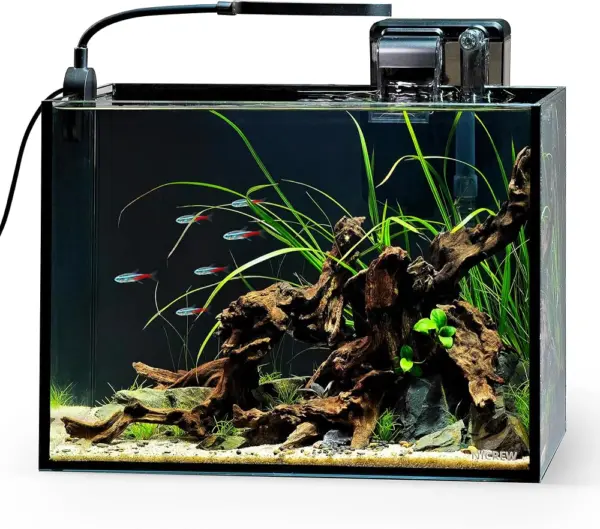
The Best Fish Tanks, Reviewed
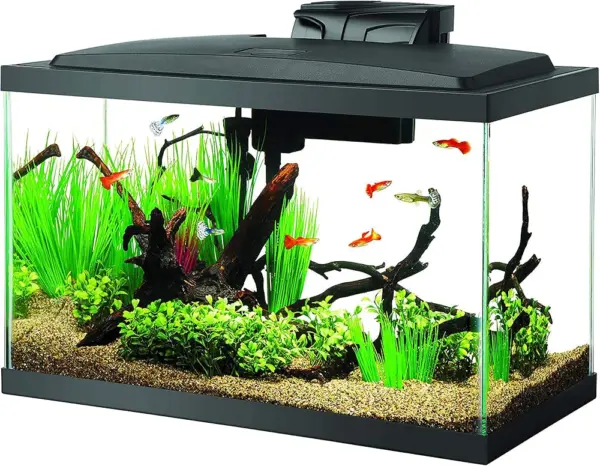
Aqueon 10 Gallon Starter Kit – Best Overall
Key Features
- Heater: Included, preset
- Lighting: Low-profile LED hood
- Dimensions: 20.25"L x 10.5"W x 13.31"H
- Tank volume: 10 gallons
- Price: Midrange
The heater is the reason we send beginners to this kit. Most of the tanks here ship without one, and a tank without heat rules out bettas, tetras and most of what people picture when they decide to keep fish. Aqueon puts a preset submersible heater in the box along with the low-profile LED hood, the QuietFlow filter and cartridge, a thermometer, a net, food and water conditioner. We opened it and the only things left to buy were gravel, décor and somewhere to put it.
Ten gallons is also the size we point first-timers to even when the budget runs higher. Water chemistry drifts slowly in ten gallons, so a missed feeding or a hurried water change doesn’t become an emergency the way it does in a 3- or 5-gallon. At 20.25 inches wide and 13.31 tall it still sits on a normal dresser top, and the low hood keeps it from looming.
Two things to check before you stock it. The heater decides whether the kit works: run the tank for a day with the thermometer in and confirm it settles where you want it, because a preset unit that runs cool leaves you buying a second one. And inspect the seams and corners the day the box lands — a 10-gallon glass tank is heavy, and a chipped edge is much easier to sort out before it’s full of water.
The niggle we came away with is the gap where the hood meets the filter housing, exactly the kind of opening a betta finds. It’s small enough to ignore until it isn’t. Otherwise this is the least dramatic way into the hobby: nothing to match, nothing to upgrade in week one, and a tank that will still be the right size once you know what you’re doing.
Pros
- Preset heater, hood, filter and thermometer included
- Ten gallons is forgiving for a first tank
- Fits a dresser top at 20.25 inches wide
Cons
- Preset heater can run cool in some units
The kit we point first-time fish keepers to: a 10-gallon glass tank with a heater, hood and filter in the box, and nothing critical to buy on day one.
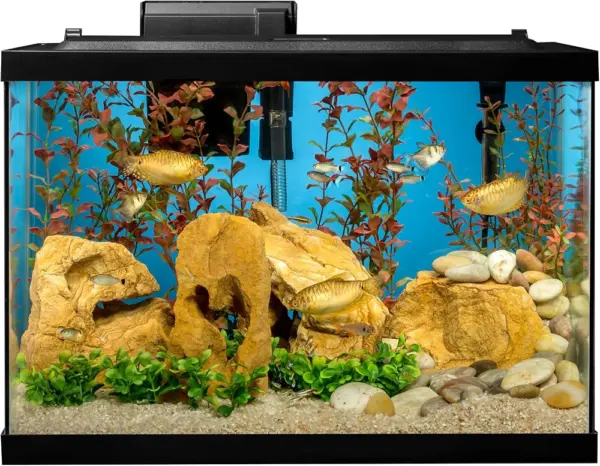
Tetra 20 Gallon Complete Kit – Best for a Bigger Tank
Key Features
- Heater: Included
- Lighting: LED under hinged hood
- Dimensions: 24.2"L x 12.4"W x 16.7"H
- Tank volume: 20 gallons
- Price: Midrange
Twenty gallons is where a tank stops being one fish’s apartment. The 24.2-inch footprint takes a small school, a bottom feeder and a few plants without the weekly scramble of a small tank, and at 12.4 inches deep and 16.7 tall it runs along a living-room wall like a piece of furniture rather than sitting on a desk.
What makes it a pick rather than simply a bigger box is the contents: hinged hood, LED, internal filter and a heater all in the box, which makes it the only 20-gallon kit here that’s ready for tropical fish the day it arrives. We rank it just behind the Aqueon 10 for a first purchase because it asks more of you — more water to change, more gravel to buy, more fish before the space stops looking empty.
The filter is the part to think about. It’s the loudest of the kits in this group, and it’s also the component that can quit and leave you buying a replacement within weeks. Beside a sofa it fades into background noise; beside a bed you’ll hear it cycling all night, and that difference decides where the tank goes more than any spec does. If you want 20 gallons without that risk, the Tetra 55 gives you the glass with nothing attached — at the cost of buying every accessory yourself.
Pros
- Heater, hood, LED and filter in the box
- Two-foot footprint suits a community
- Straightforward assembly from the box
Cons
- Internal filter is the loudest here
- Filter can fail early; budget a replacement
Twenty gallons with a heater, hood and filter already in the box — the pick when you want a community tank rather than one betta, and you accept a noisy filter for the space.
Tetra 55 Gallon Aquarium – Best for a Large Build
Key Features
- Material: Glass
- Dimensions: 48"L x 13"W x 20"H
- Tank volume: 55 gallons
- Included equipment: Tank only
- Price: Premium
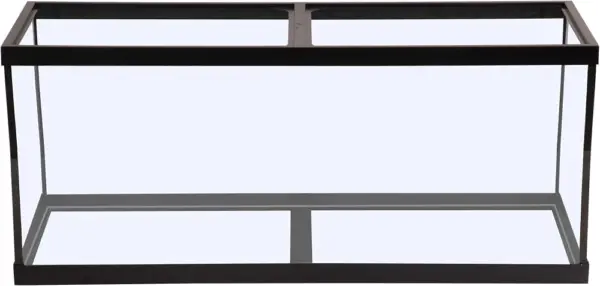
This is a tank for someone who has already decided on a big setup and wants to pick the filter, the light and the heater personally. It arrives as glass, a plastic rim and a sticker, and every accessory on the product page is sold separately. That isn’t a shortcoming to work around; it’s the entire proposition, and it’s why we keep it in the roundup for anyone past their first tank.
Forty-eight inches of length is the number that matters — the difference between fish that can swim in a line and fish that circle. It’s also furniture. Plan the stand around the load, because 55 gallons of water is roughly 450 pounds before gravel, rock and glass, and check the seams on a level surface before you fill it; a big glass tank is unforgiving of a floor with a twist in it, and a leak means 55 gallons on the carpet.
The sticker is on the inside of the glass, which is a genuinely odd place to put one, and it takes a razor blade and patience before the tank is ready for anything. Beyond that the build is plain and solid — thick glass, tidy silicone, no drama — which is exactly what you want from the one part of a large aquarium you can’t easily replace.
Pros
- 48-inch length gives real swimming room
- Solid, level build with clean seals
- You choose every accessory yourself
Cons
- Tank only: filter, light, heater and hood extra
The tank for someone who has decided on a big setup and wants to choose the filter, light and heater personally: 48 inches of glass and nothing else.
Aqueon LED MiniBow 5 Gallon – Best for Easy Maintenance
Key Features
- Material: Acrylic
- Dimensions: 15"L x 10.67"W x 15.44"H
- Tank volume: 5 gallons
- Water changes: SmartClean, under 2 minutes
- Price: Midrange
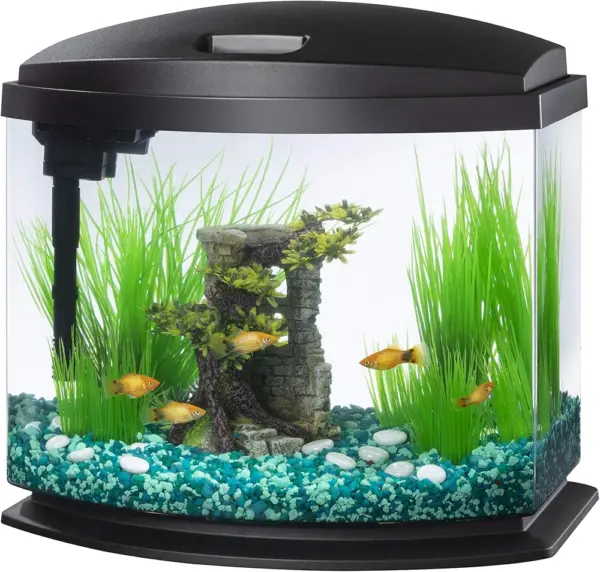
The SmartClean valve is the whole idea here. Instead of hauling a filled 5-gallon to a sink or dragging a bucket and a siphon out of a cupboard, you use the valve in the base to drain what you need and refill without moving the tank — Aqueon puts the job at under two minutes. After a couple of weeks it stops being the chore you postpone, and a small tank that gets its water changed is a completely different tank from one that doesn’t.
The rest of the kit holds up: hood and elevated base, a power filter with a cartridge, fish food, water conditioner and a setup guide, in an acrylic body molded in one piece with a rounded front. The raised base and curved face give it more presence on a shelf than a molded tank usually manages, and the white LED under the hood is enough for fish and for you to see them.
The filter decides whether this stays a good tank. It’s strong for five gallons — strong enough that a long-finned betta gets pushed around the glass — and it’s the component that ends these setups: when the pump stops, you’re matching a replacement to a molded housing rather than dropping in any off-the-shelf filter. That’s the weak link in an otherwise easy tank, and the reason we still point most beginners at the 10-gallon Aqueon first.
Put it where you’ll actually do the two-minute change — a kitchen counter or a desk you walk past — and it earns its keep. Against the Marineland Portrait, both are five gallons; the Portrait is the better-looking object, and this is the one that’s easier to live with.
Pros
- Water changes without moving the tank
- Quiet enough for a bedroom or office
- Hood, filter, food and conditioner included
Cons
- Filter is the part that fails first
- Five gallons limits you to one betta or a few small fish
The 5-gallon that makes maintenance easy: SmartClean changes water in about two minutes, the filter is quiet, and everything but gravel comes in the box.
NICREW 2.5 Gallon Nano Kit – Best Small Desktop Tank
Key Features
- Lighting: Clip-on LED
- Material: Rimless glass
- Dimensions: 11.8"L x 6.3"W x 8.66"H
- Tank volume: 2.5 gallons
- Price: Budget
Rimless glass is the reason to look at this one. There’s no black trim running around the corners and no silicone band across the front, so almost everything you see is water. The 91.2% transmittance figure the manufacturer quotes is the sort of number that sounds like marketing until the tank sits next to a molded plastic one on the same counter.
It’s the small tank we rate highest here, and the footprint is why: 11.8 inches wide, 6.3 deep and 8.66 tall, so it tucks beside a monitor without taking the desk. The pre-glued leveling mat is the detail that convinced us it was designed by someone who actually keeps tanks — it grips the surface, keeps the glass off a hard top and saves you hunting for foam on day one.
Two things to plan around. There’s no heater in the box, and 2.5 gallons loses heat quickly, so a small preset heater is the first purchase rather than the last. And the fittings are the fragile part: the clip that holds the light and the filter body are the pieces to handle gently and to check within the first month, because after the glass they’re what the whole tank depends on.
Pros
- Rimless glass with polished edges
- Filter runs close to silent
- Leveling mat included for a desk top
Cons
- No heater in the kit
- Light clamp and filter body feel fragile
The best small tank here — rimless glass, a near-silent filter and a clip-on LED — for a betta, a few shrimp or a planted desktop.
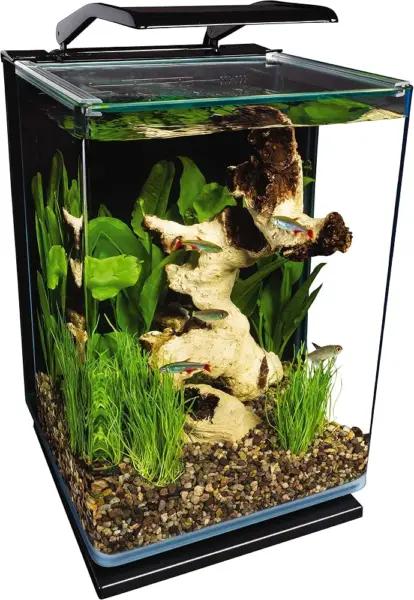
Marineland Portrait 5 Gallon – Best for Small Showpiece Tanks
Key Features
- Lighting: White and blue LEDs
- Dimensions: 9.99"L x 9.67"W x 17.2"H
- Filtration: Hidden 3-stage
- Tank volume: 5 gallons
- Price: Premium
Nearly ten inches square and 17.2 inches tall, this is the tank that reads as a column of water rather than a box on a shelf. The rounded corners and the sliding glass canopy do most of that work, and the effect is a tank that looks bigger than five gallons from across the room — worth something if it’s going in a living space rather than a spare room.
Filtration hides behind the back panel in three stages, out of sight, and the hinged LED lifts out of the way for feeding, which matters more than it sounds when you’re doing it twice a day. Reaching the bottom with a gravel vacuum is the awkward part: the base is narrow, and there isn’t much room to turn your hand once the gravel is in.
Looks alone earn it a place here — the blue LED gives a genuinely pleasant evening light — but the daylight setting is thin over plants, and the pump is the piece that decides how long the tank lasts. Check it in the first week, because a filter that quits early is far easier to sort before there are fish in the water. It’s also the most expensive 5-gallon in this group, and what you’re paying for is glass and shape rather than equipment.
Pros
- Rounded glass column looks the part
- Three-stage filter hidden out of sight
- Blue moonlight LED for the evening
Cons
- Narrow base makes vacuuming awkward
- Daylight LED is dim for plants
The 5-gallon to buy when the tank is furniture: a tall rounded glass column with the filter hidden away and a genuinely nice moonlight setting.
Vimvins 10 Gallon Glass Tank – Best for Aquascaping Bare Tanks
Key Features
- Included: Leveling mat
- Material: Frameless glass
- Dimensions: 19.68"L x 10.23"W x 11.81"H
- Tank volume: 10 gallons
- Price: Midrange
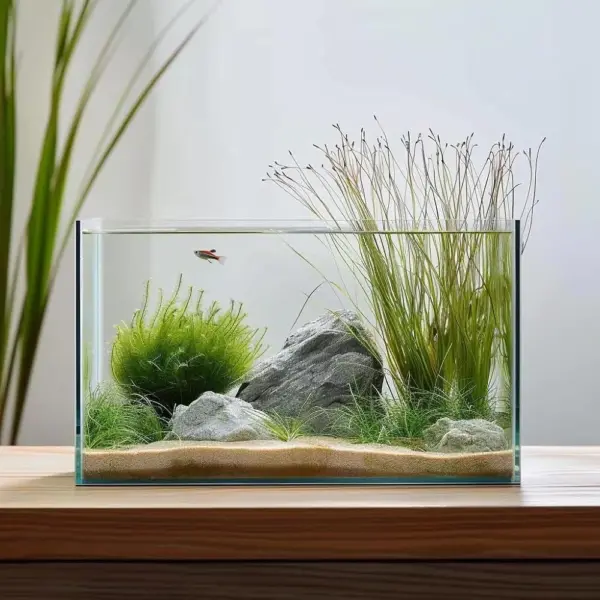
Same ten gallons as our top pick, opposite philosophy: no hood, no filter, no heater, no cartridge. What comes out of the box is 10 gallons of frameless glass with polished edges and a mat to sit it on, and everything else is a decision you make yourself.
The shape is the part we like. At 19.68 inches long, 10.23 deep and 11.81 tall it’s low and wide rather than tall, which gives more floor for planting and more surface area at the top — proportions an aquascaper wants and a beginner doesn’t know to ask for. The polished edges are the sort of detail you notice when you’re leaning over it with tweezers, and the glass is as clear as anything in this group.
That clarity costs you the accessories. You’re buying a filter, a light, a heater and a lid separately, and by the time all four are in place you’ve spent more than a complete kit costs. The open top has consequences too: water evaporates faster in a dry room, and a jumper has nothing to stop it.
We recommend it to the second-tank buyer — someone who already knows which filter they want and resents paying for a bad one. For that person the glass is the whole point, and the mat is the detail we appreciated most: it grips the surface, so a bare-bottom scape stays exactly where you put it while you plant.
Pros
- Frameless glass with polished edges
- Low, wide footprint suits planting
- Leveling mat included
Cons
- Tank only: filter, light, heater and lid extra
- Open top speeds evaporation and invites jumpers
A bare frameless 10-gallon for someone who already knows which filter and light they want — the clearest glass here, with a mat in the box.
How We Tested (and Lived With) 13 Fish Tanks
We started with a long list of kits sold as complete setups and narrowed it by what actually comes in the box — tank, filter, heater, light, lid, thermometer — alongside footprint, price, and whether replacement filter media is easy to find a year later. Anything that needed a separate heater, lid, or stand to run got flagged, since a bargain tank with three add-ons isn’t a bargain.
Then we set up 13 of them and lived with each for six months, on a kitchen counter, a home office desk, a kid’s bedroom dresser, and a living room console, running daily feeds, weekly water changes, and at least one full teardown and rebuild per tank. We timed unboxing and assembly solo with a stopwatch, and held the box contents against the listing photo, writing down missing lids, flimsy thermometers, and filters shipped without media.
Noise was measured the way you’d actually notice it: a decibel reading from three feet away at night with the house quiet, then again a week later once the filter had broken in. We watched the lighting at dusk to see whether it washed out fish colors, fed algae on the glass within days, or left the back of the tank too dim to see. For filtration, we tracked how clear the water stayed between changes and how often media needed rinsing, and for durability we checked seams, lids, and filter motors after months of weekly use rather than out of the box.
Appearance is subjective but not invisible — we noted which tanks looked like furniture and which looked like plastic tubs, and how much cord, tubing, and filter housing you could see from across the room. Value came last: what the kit cost against what we still had to buy separately to keep fish healthy.
How to Choose a Fish Tank
The glass is rarely the expensive decision — the filter, heater and light attached to it are what make a tank work, and most kits get one of the three wrong.
Start with gallons, not looks
Small tanks sell on charm and get bought by people who then discover that 2.5 gallons is a chemistry set with a fish in it. The smaller the volume, the faster temperature and waste swing, and the less room you have for error. Ten gallons is the smallest we recommend for a first freshwater tank; twenty is more forgiving still, and the difference in effort is smaller than the difference in price.
Nano tanks like the NICREW are genuinely lovely — just stock them with a single betta or a group of shrimp and expect to test the water more often, not less.
Check the box for a heater
Tropical fish need stable warmth, and a heater is the item kits quietly leave out. Two of the tanks here include one, the Aqueon 10 and the Tetra 20; the rest don’t, so a small preset heater is your first extra purchase. Preset heaters aren’t adjustable, which suits most beginners fine — you’re aiming for a steady tropical range, not a dial to fiddle with.
Whatever the box says, plug in and confirm the temperature with a thermometer for a day before any fish go in.
The filter is where kits are won and lost
Every kit here uses a cartridge filter, and cartridges are the recurring cost of the hobby: you replace them rather than rinsing one forever. What separates a good kit filter from a bad one is whether it moves enough water for the volume and whether the pump lasts more than a few weeks.
If you buy a kit with a weak filter, price a replacement of your own choosing into the purchase instead of fighting it. Flow that’s too strong is its own problem — a long-finned betta in a 5-gallon gets pushed around by a filter sized for a bigger tank.
Measure the spot, not just the tank
Tank dimensions tell you less than the space the whole setup needs: hood clearance to open, a couple of inches behind for cords and the filter, and somewhere to stand a bucket. Height matters too — a tall narrow tank looks impressive but gives fish less swimming length than a low wide one of the same volume.
And a big tank needs a stand built for it. Fifty-five gallons of water is about 450 pounds before you add gravel, rock and glass, so a dresser is not a stand.
Glass or acrylic, and what you’re paying for
Glass is heavier, scratches less easily and stays clear for years. Acrylic is lighter, molded into shapes like the MiniBow’s rounded front, and more prone to fine scratches from a gravel vacuum. Rimless glass, as on the Vimvins and the NICREW, is about clarity and looks, and it usually means buying the light and lid yourself.
None of this changes how well fish do. Pick the material that suits the room and the maintenance you’ll actually keep up with.
Frequently Asked Questions
How long before I can put fish in a new tank?
Weeks, not days. A new tank has to grow the bacteria that process fish waste, and until it does, ammonia builds up and burns anything living in the water. Add a source of ammonia, test every couple of days, and wait until ammonia and nitrite both read zero and nitrate starts to appear.
That usually takes four to six weeks. A bottled bacteria starter can shorten it, but it doesn’t replace testing.
Why is my filter so loud?
It’s usually vibration rather than the motor. Check that the impeller is seated properly, fill the tank so the water sits above the intake, and make sure the filter body isn’t touching the hood or the glass.
Then set the filter or air pump on something soft — a folded cloth or a piece of foam — and most of the buzz from a pump rattling on a hard table disappears.
Can I fill a new tank with tap water?
Yes, with a dechlorinator. Chlorine and chloramine in municipal water kill the bacteria you’re trying to grow and stress fish, and a conditioner neutralizes both; the Aqueon and MiniBow kits include a sample bottle, and one bottle treats a lot of water.
Use water near room temperature and skip softened water from a household softener, which trades calcium for sodium.
Final Verdict
If you’re setting up your first tank, buy the Aqueon 10-gallon starter kit. The heater, hood, filter and thermometer in the box mean there’s nothing to match up on day one, and ten gallons is the smallest volume that forgives a beginner’s mistakes. Add gravel, a stand and a test kit and you’re running.
If you already know you want a big tank and your own equipment, the Tetra 55 is the better long-term buy: 48 inches of swimming room and nothing in the box you’ll want to replace. And if the tank is going on a desk rather than against a wall, the NICREW nano is the one that looks like it belongs there.