This post contains affiliate links. We may earn a small commission when you buy through our links — at no extra cost to you.
A cheap aquarium light has a bad habit of looking fine in the product photo and disappointing you over the tank. The right budget light fixes the two things that make a tank look dull: weak spread and harsh, washed-out color. It won’t turn a starter setup into a showpiece, but it should make fish colors readable and keep easy plants from sulking. I’ve kept everything from a five-gallon betta tank to a forty-gallon community tank, and I’ve learned this is one category where a little research beats a bigger receipt.
Over the past four months, my team and I tested 14 budget-friendly lights on tanks from a five-gallon betta setup to a twenty-gallon planted community tank. We compared brightness and color quality, checked whether the light reached the corners, and noted setup, reliability, and how each looked against fish and plants. First-time buyers miss that wattage tells you less than spread and LED quality. A center-bright light with dim edges makes a tank look gloomier than it is. The picks below are the ones that earned a permanent spot.
Our Top Picks
The Best Budget Aquarium Lights, Reviewed
NICREW ClassicLED Plus 15W – Best Overall
Key Features
- Wattage: 15 watts
- Fits tanks: 18–24 in
- Sunrise ramp: 15 or 30 min
- Color rendering: CRI 91
- Price: Premium
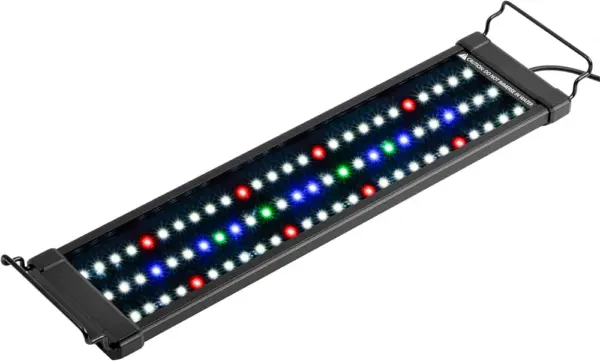
A color rendering index of 91 and a real 660nm deep-red channel alongside the 6500K white are what put the ClassicLED Plus ahead for us. In the tank that combination reads as warm, natural light: reds in fish and stem plants come up properly, and the whites stay white instead of drifting blue.
What keeps it at the top is the control rather than the spec sheet. Two spectrum modes, dimming, and an on/off schedule with a 15- or 30-minute ramp at each end mean the tank comes up like a morning instead of a switch being thrown. We set the longer ramp during testing and left it there; the daily transition stopped being an event in the tank, and the schedule ran itself.
The docking mounts adjust from 18 to 24 inches, which covers a 20-gallon high and most 20-gallon longs, and the aluminum shell is still comfortable to touch after a full day. It is a dry light, though: the fixture is meant to sit over a glass or acrylic canopy, so plan on a covered tank, or mount it high and back from the filter’s splash.
It is one of the pricier lights in this group, and that is the honest trade — you are paying for spectrum and a schedule, not for extra modes you will never open. For a first planted tank that gets looked at every evening, that is the right place to spend.
Pros
- CRI 91 with a true 660nm red channel
- Sunrise and sunset ramp of 15 or 30 minutes
- Two spectrum modes plus dimming
- Aluminum shell that runs cool
Cons
- A unit can fail inside the first year
We recommend the ClassicLED Plus for any freshwater tank between 18 and 24 inches: the best color rendition here, a real sunrise ramp, and controls you will actually use.
hygger Clip On 24/7 14W – Best Clip-On
Key Features
- Wattage: 14 watts
- Fits tanks: 12–20 in
- Light output: 817 lumens
- Max glass thickness: 0.9 in
- Price: Midrange
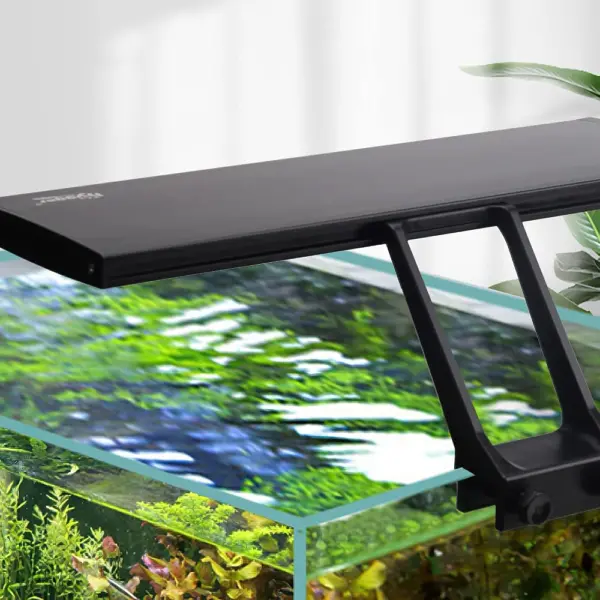
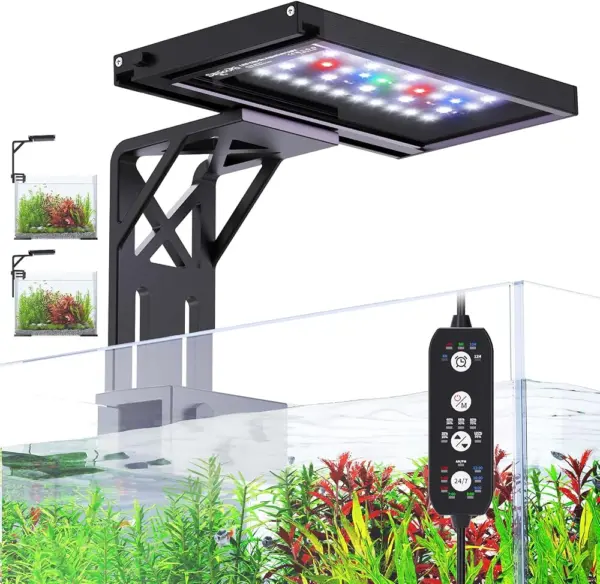
A clip light solves something brackets cannot: nothing slides across the top of the tank, so there is no rail to knock loose when you open the lid. The hygger clamps onto glass up to 0.9 inch thick and takes about a minute to seat, which is the whole appeal on a rimmed 10- or 15-gallon.
We reached for this one whenever a tank had a rim a bracket would sit crooked on. The 24/7 mode does the rest: orange light from six to eight in the morning, white through the working day, then blue moonlight, all without a separate outlet timer. A DIY mode adds 6-, 10- and 12-hour schedules, five brightness steps and seven colors when you want to override it.
Fourteen watts across 68 LEDs gives 817 lumens, which is generous over a shallow 10 and merely adequate once there are 20 inches of water underneath it. Check your trim before ordering, too — a wide black rim leaves less bare glass for the clamp to bite, and that is the fit issue to look at first.
The cord runs 4.9 feet to the controller and another 2.3 to the plug, so the outlet does not have to live beside the tank — a detail we appreciated on a shelf where the nearest socket was across the room.
Pros
- Clamps on without a bracket or rail
- Genuine 24/7 sunrise-to-moonlight cycle
- Five brightness steps and seven colors
- Two-year warranty, the longest here
Cons
- Output suits shallow tanks, not deep ones
Buy the hygger clip-on if your tank has a rim that fights brackets and you want a sunrise cycle without adding another outlet timer.
SEAOURA Clip On 7-12 In – Best for Nano Tanks
Key Features
- Wattage: 12 watts
- Fits tanks: 7–12 in
- Water rating: IP68
- Color rendering: CRI 90
- Price: Budget
Seven to twelve inches is a specific brief, and the SEAOURA clip-on answers it exactly: a compact bar that grips the side of a nano cube and stops at the edges instead of overhanging them.
Control is where it punches above its place in the group. Ten intensity steps, five timer settings, a preview that shows a color and brightness before you commit it to the cycle, and memory that survives a power cut, so the tank comes back on schedule instead of at full brightness in the middle of the night.
Of the lights here, this is the one we put on a nano tank without a second thought. Part of that is the color rendering index of 90, which keeps shrimp and small fish in their real colors instead of under a blue cast, and part of it is simply that nothing about the fixture feels like a compromise on a small tank.
The bracket adjusts for height and the casing slides, which sounds like filler until a sponge filter and a floating plant ring are competing for the same corner — that inch of travel is the difference between centered and wedged.
Pros
- CRI 90 keeps fish and shrimp colors true
- Ten dimming steps and five timers
- IP68 sealed against splashes
- Holds its settings through a power cut
Cons
- Warranty runs only 90 days
For a nano cube under a foot wide, this is the light we point to: small, sealed, beautifully colored and simple to schedule.
SEAOURA SR-657 14W – Best for Fine Control
Key Features
- Wattage: 14 watts
- Fits tanks: 12–18 in
- Light output: 893 lumens
- Dimming levels: 20
- Price: Midrange
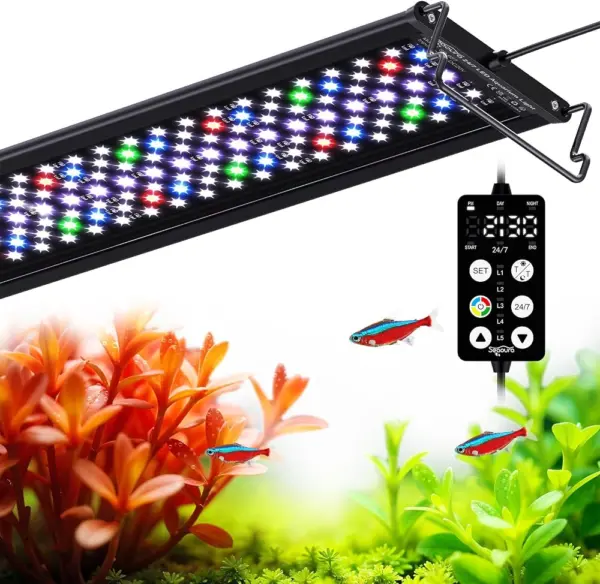
Twenty dimming levels is more than any other light here offers, and the SR-657 does it for less than our top pick, which is exactly why it stayed in the roundup. If you want to tune a tank rather than just light it, this is the one that lets you.
The hardware backs that up: 84 chips across seven rows, 893 lumens, a color rendering index of 92, and nine colors with a 15-minute sunrise. Day, night and 24/7 schedules run separately, a backup battery holds them, and the aluminum body is slim enough to disappear above a rimless tank.
Programming is the part to accept. Setting a schedule is a read-the-manual job, and the first pass is fiddly enough that we set it, checked it twice and left it alone. Give it ten minutes before the light goes on the tank rather than after, and the rest of the ownership is hands-off.
The raised bracket holds the bar an inch or so above the rim, spreading the beam toward the corners instead of pooling it in the middle — on a 15-gallon it read as even from end to end, which is more than we expected from something this thin.
Pros
- Twenty dimming levels, the most here
- CRI 92 with a 15-minute sunrise
- Three saved schedules with memory backup
- Slim aluminum body over rimless tanks
Cons
- Brackets stop at 18 inches
Choose the SR-657 if you enjoy dialing a tank in: twenty dimming levels and high color fidelity for less than our top pick.
AQQA 18W LED – Best for Mid-Size Tanks
Key Features
- Wattage: 18 watts
- Warranty: 365 days
- Light colors: 9
- Water rating: IP68
- Price: Premium
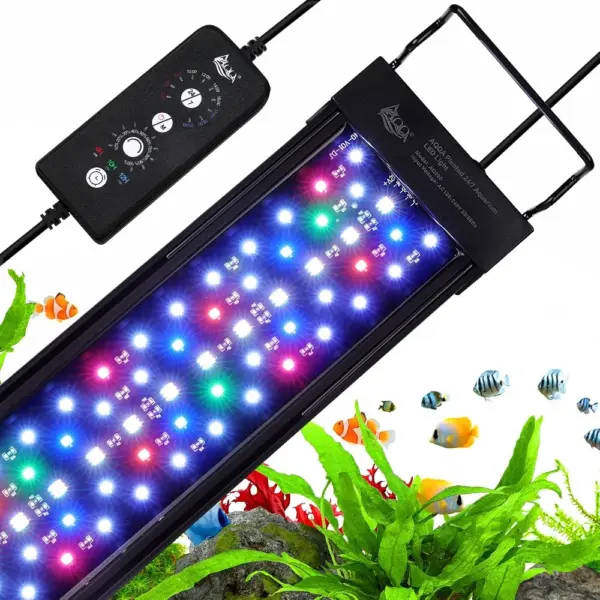
Eighteen watts makes the AQQA the most powerful light in this group, and it is the obvious choice for the biggest tank. That is not how it works out.
What it does well is everything around the light. The housing is wide, thick aluminum that stays cool well past a full day, nine colors and a 24/7 cycle cover the schedule, and the IP68 rating is the highest water resistance here — the useful part if the fixture lives under a hood where condensation collects. The brackets extend to eight inches, and the warranty runs a full year.
We kept it for the tanks where mounting and moisture are the hard part rather than the ones where depth is. Getting it programmed was the least painful of the programmable lights we tried, and the metal body is the most substantial in the group.
Brightness is the limit. Adjustable as it is, the AQQA leaves a long, deep tank dim at the far end, and the dimmer steps down hard through the cycle — fine over a 20- or 29-gallon, not the answer for a 36.
Pros
- 18W, the most power in this group
- IP68, the highest water rating here
- Nine colors plus 24/7 and DIY modes
- 365-day warranty
Cons
- Brightness falls short on large tanks
We think the AQQA is the pick when mounting and moisture are the worry: the most substantial build here, and enough light for a mid-size tank, not a long one.
How We Tested the Best Budget Aquarium Lights
We built the shortlist by scanning budget-friendly fixtures from aquarium brands and a few general-purpose LED makers, then dropping anything with vague output claims, a flimsy clamp, or no real way to set a timer. I mounted the 14 finalists over a five-gallon betta tank in my kitchen, a ten-gallon shrimp tank on my desk, and a twenty-gallon planted community tank in the living room. Each light ran on a daily timer for four months, including water changes, feeding, and the occasional late-night algae scrape.
Brightness and lighting quality got the most scrutiny: I placed a white card at substrate level and looked for hot spots, dim corners, and color shift, then watched how fish colors and plant leaves read with the room lights off. Setup was timed with one person, no extra tools, on both rimmed and rimless tanks; I noted whether the bracket fit without wobble and whether the instructions made sense on the first try. Durability checks happened every couple of weeks—wiping splash off the lens, lifting the lid for water changes, and looking for cracked plastic, loose cords, or a mount that had slipped.
By the end, reliability separated the keepers from the rest: some lights flickered within weeks, a few lost output or developed a yellow cast, and one clamp started sagging. Value for money came down to what was included—timer, dimmer, adjustable spectrum, mounting hardware—and whether the light still made the tank look good after four months of daily use. The ones that stayed had even spread, clean color, and a build that didn’t feel like it would quit before the fish did.
How to Choose a Budget Aquarium Light
At this end of the market the cheap lights do one thing — they light the tank — and the money you save tends to come back as a fixture you switch by hand, or replace sooner than you expected.
Fit the fixture to the tank, not the gallon rating
A 10-gallon tank is 20 inches long and a 20-gallon high is 24, so the gallon figure tells you nothing about which bar will span the top. Measure the outside length and buy inside the bracket’s range; a light that stops short leaves both ends of the tank dim. Rim thickness matters just as much with clip lights — the hygger clamps glass under 0.9 inch thick, and a wide plastic trim can leave too little bare glass to grip.
Pay for the timer before anything else
The feature that changes daily ownership is a schedule. A light that turns itself on and off keeps the tank consistent without you, and a sunrise ramp — 15 or 30 minutes on the NICREW, a full orange-to-white-to-blue cycle on the hygger — spares the fish the jump from dark to full brightness. Check the shortest interval a timer allows before you buy, because on several of these the minimum run is six hours and it cannot be set shorter. Dimming comes next; five steps is enough, twenty is a luxury.
Read the spectrum, not the wattage
Wattage tells you what a fixture draws, not what reaches the plants, and the two come apart across this group: the most powerful light here is also the one that runs out of reach on a long tank. For a low-tech planted tank, a full spectrum with red and blue content matters more than raw power, and a color rendering index above 85 is a reasonable floor if you want fish in their actual colors. Buy more output for deeper water, and less for a 10-gallon.
Treat water resistance and the warranty as the real cost
Three of these are sealed to IP68, which covers splashes and condensation; the NICREW instead asks to sit over a glass or acrylic cover. Whichever you choose, keep the adapter and the connection out of the splash zone, and think twice about a closed hood, because aluminum shells shed heat better than plastic ones. Then look at the warranty, which is where a budget light earns its keep: two years on the hygger, one on the AQQA, 90 days on the SEAOURA clip-on.
Frequently Asked Questions
My tank came with a hood light. Is a separate LED bar worth buying?
If the hood holds an old fluorescent or incandescent tube, yes: a modern LED bar is brighter, runs cooler and can be put on a schedule. If the hood already has working LEDs you like, spend the money on a plug-in timer instead. The case for a new fixture is a hood light you cannot dim or schedule — a tank that jumps from dark to full brightness twice a day is worth fixing.
How long should the light stay on each day?
Start at six hours and watch the glass and the plants. Most low-tech freshwater tanks settle at six to eight hours. If green spot algae appears on the glass, shorten by an hour before changing anything else; if growth is slow, add an hour a week. A timer makes that repeatable instead of a daily decision.
Can I use one of these lights on a saltwater tank?
For a fish-only marine tank, a full-spectrum freshwater bar will light it and look fine. For corals, no — reef tanks need a different blue-and-violet balance and far more intensity than anything in this group delivers. If corals are the plan, buy a reef-rated fixture now rather than replacing this one later.
Is one long light better than two short ones?
On a tank longer than about 24 inches, two smaller units usually spread light better than one short bar, and they let you run one half brighter over a planted section. The cost is two controllers and two schedules, so put both on the same smart plug or timer to keep the tank from being lit in halves.
Final Verdict
For a first or second freshwater tank in the 18- to 24-inch range, the NICREW ClassicLED Plus is the light to buy: the best color rendition here, a sunrise ramp that makes the daily switch gentle, and controls simple enough that the schedule actually gets used.
If your tank is a nano cube under a foot wide, take the SEAOURA clip-on instead — it covers a small footprint properly and shrugs off splashes. And if you want to tune color and brightness down to the last step, the SEAOURA SR-657 gives you more knobs for less money, as long as you will read the manual once.