This post contains affiliate links. We may earn a small commission when you buy through our links — at no extra cost to you.
The worst part of setting up a planted shrimp tank isn’t the aquascaping—it’s the moment you fill the tank and the water turns milky. Or worse, a week later when shrimp start dying. A good substrate solves both: it gives plant roots something to grab and feed from, and stays chemically inert so water stays clear and shrimp stay healthy. Over the past five months, I’ve cycled 14 different substrates at home and at the office, from fine sands to coarse gravels.
Some looked beautiful in the bag but clouded the water for days. Others grew plants like crazy but sent ammonia spikes that killed shrimp. Some plants loved finer sands; others needed coarser grains. The keepers rinsed clean in a few passes, didn’t tint the water, and held their shape without compacting. Substrate is the foundation of your tank’s water chemistry—it can buffer or crash your pH, feed or starve your plants, and shelter or stress your shrimp. The best are below.
Our Top Picks
The Best Aquarium Substrate for Plants and Shrimp, Reviewed
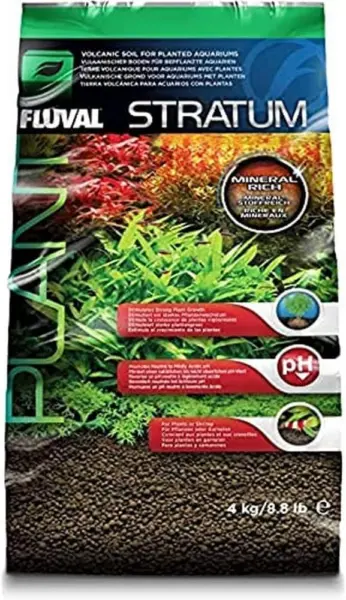
Fluval Plant & Shrimp Stratum – Best Overall
Key Features
- Form: Porous soil granules
- Bag weight: 8.8 lb
- Water chemistry: Neutral to slightly acidic
- Price: Midrange
Setting up a first planted tank with shrimp in it means one bag has to do two jobs: hold and feed rooted plants, and give newborn shrimp somewhere to disappear into. This is the bag we point at that job, because it does both without a second product or a dosing routine in the first months.
What settles it for us is how the granules behave at planting time. They’re light and porous, so a stem pushed into a damp bed stays where you put it, and roots spread through the gaps instead of stopping at a hard surface. That same open structure is the shrimp half of the argument — shrimplets vanish into it, which is exactly what you want when you’re building a colony rather than keeping a handful.
Cloudy water on the first fill is the part to plan for. Rinse the bag in a bucket until the runoff is hazy rather than muddy, pour onto a plate instead of straight onto the bed, and run filter floss for a day. It clears, and the haze has no bearing on how the tank runs a month later.
The water chemistry deserves a thought before you order. It’s designed to sit at neutral to slightly acidic, which is where most tropical community fish and the caridina-type shrimp people put in planted tanks want to be. If your tap is hard and alkaline and you keep neocaridina because they tolerate it, this will nudge the tank away from what those shrimp are used to, so test pH over the first few weeks rather than assuming.
Pros
- Feeds rooted plants without root tabs at setup
- Porous granules shelter newborn shrimp
- Sits at neutral to slightly acidic for most setups
Cons
- Light granules shift when you siphon or replant
- One bag gives a shallow bed in a 10-gallon
For a planted tank with shrimp in it, this is the bag we recommend: roots feed, shrimplets shelter, and the pH lands where most community tanks want it.
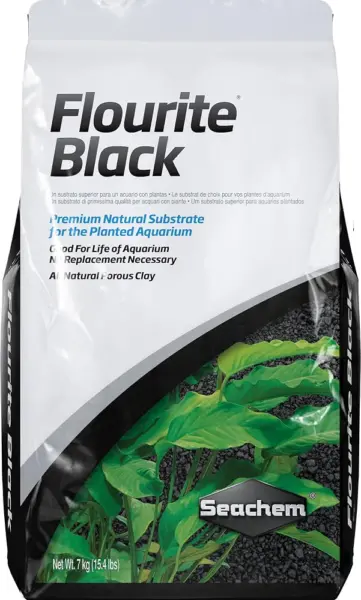
Seachem Flourite Black – Best for Large Tanks
Key Features
- Form: Fracted porous clay gravel
- Structure: Will not soften or decompose
- pH effect: Does not alter pH
- Bag weight: 15.4 lb
- Price: Premium
The one thing this gravel will not do is move your pH. Where the Fluval soil pulls water slightly acidic, Flourite Black is inert clay, so the water you put in is the water you keep. For a tank whose tap chemistry is already where you want it — hard, stable water with neocaridina, say — that isn’t a limitation, it’s the reason to choose it, and it’s why we rank it this high despite a fussier setup.
It’s a fracted porous clay gravel, angular rather than rounded, and the pores do the work: roots grip, water moves through the bed instead of going stale, and the granules don’t soften or break down into mud the way a soil eventually can. At 15.4 lb it’s the biggest bag here, which makes it the practical choice for a four-foot tank where a small soil bag would barely cover the front glass.
Two things to know. It arrives dusty and the runoff is gritty, so rinse it in a bucket outdoors rather than in a sink. And it isn’t a nutrient-loaded aqua-soil — treat root tabs as part of the plan for heavy feeders, which also means you decide how much fertilizer goes in rather than inheriting a soil’s charge.
Pros
- Won’t shift pH in either direction
- Porous clay holds roots and keeps its structure
- Biggest bag here — one purchase covers a large tank
Cons
- No nutrient charge; root tabs do the feeding
For a big tank, or a shrimp keeper who wants the water to stay exactly as it comes out of the tap, Flourite Black is the substrate we steer people toward.
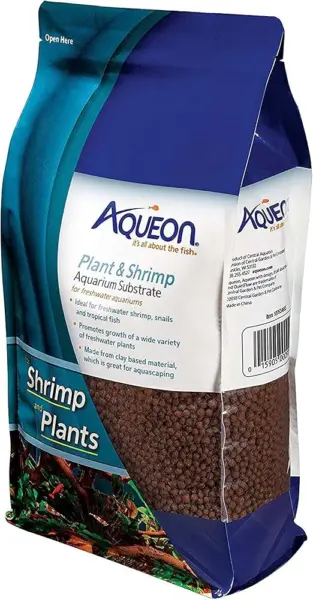
Aqueon Plant & Shrimp Substrate – Best for Nano Tanks
Key Features
- Form: Spherical pellets
- Material: Clay
- Bag weight: 5 lb
- Price: Midrange
Five pounds is a nano-tank amount, and that’s the honest framing for this bag: it covers a 10-gallon at a shallow depth, and a 5-gallon gets a proper bed from two. If you’re setting up a small cube on a desk, that math is convenient. If you’re filling a 40-gallon, it isn’t.
What’s in the bag is clay formed into round pellets rather than a dusty soil, and the round shape is the point. The pellets hold their structure over time, they rinse and vacuum without half of them coming up the tube, and the rounded form is the reason this one is sold for shrimp and snails as much as for plants.
Where it earns its place next to the Fluval bag is the beginner’s small tank. We appreciated how forgiving it is: you can push a plant in, pull it out and redo the layout without the bed collapsing into soup, which is what you want while you’re still learning where things look right. The catch is that small round pellets don’t lock together, so a steep slope slumps back toward level. Let your hardscape do the retaining.
Pros
- Round pellets are easy on shrimp and snails
- Rinses and vacuums without turning to mud
- Bag size suits a 5- to 10-gallon tank
Cons
- Small pellets, so steep slopes slump
The friendliest choice for a first nano planted tank: round clay pellets that are easy to plant into and clean, as long as you don’t expect them to hold a steep slope.
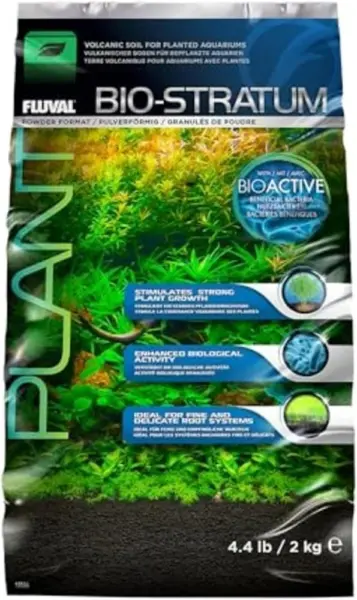
Fluval Bio Stratum – Best for Carpeting Plants
Key Features
- Form: Volcanic soil
- Bacteria: Dormant nitrifying organisms
- Bag weight: 4.4 lb
- Granule size: 1 mm powder
- Price: Premium
The granules are 1 mm — powder, essentially — and that single figure explains the product. This is a fine, dense bed for delicate roots, the closest thing here to the powdered soils people reach for when they’re trying to get a carpet to knit across the foreground.
We rate it as a specialist rather than a default. For carpeting plants and fine-rooted species, the powder gives roots more contact than the chunkier Fluval Stratum does, and the soil arrives infused with dormant nitrifying organisms that activate on contact with water — a genuine help in a brand-new tank where nothing is established yet. It’s also the most expensive way here to fill a given footprint, so it has to be your planting plan that justifies it.
Dust is the trade-off. Disturb the bed — replanting, uprooting, an enthusiastic siphon — and fine particles go into the water column and settle on leaves and glass. A thin sand cap over the top solves most of it, and slow, careful planting solves the rest. If you rescape constantly, a coarser soil will annoy you less.
Pros
- 1 mm granules suit carpets and fine roots
- Ships with dormant nitrifying organisms
- Helps with ammonia at startup
Cons
- 4.4 lb covers only a small footprint
A fine-grained soil for carpeting plants and delicate roots, with the bacteria startup built in — pick it for the planting plan, not for the value.
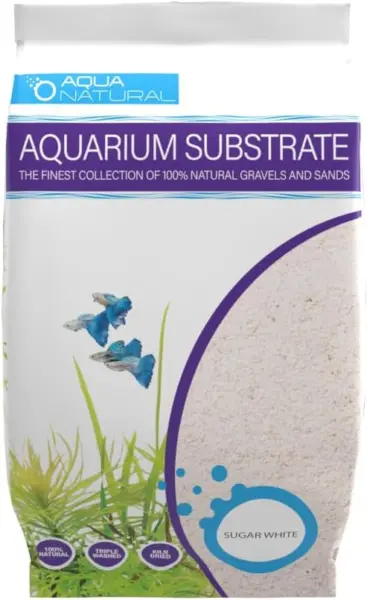
Aqua Natural Sugar White Sand – Best Sand Cap
Key Features
- Color: Off-white
- Bag weight: 10 lb
- Grain size: 0.5 – 1 mm
- Preparation: Triple washed and kiln dried
- Price: Midrange
The job we gave this sand was capping. Spread thin over a nutrient soil, it holds the soil down, keeps the water from going muddy every time you replant, and gives the tank a floor that reads as riverbed rather than gravel. It does that better than anything else here, because the grains are dense and 0.5-1 mm across, so they stay put when you refill or rescape instead of drifting up into the water column.
Get the color right before you order. It’s an off-white with a warm cast, not the icy white of the product photos, and against dark shrimp and green plants that warmer tone looks better than pure white would — more natural, less like painted gravel. If you’re matching a bright white background or silicone, expect a visible difference.
Triple-washed and kiln-dried means the rinsing is short. A couple of changes of water and the loose dust is gone, and what’s left settles out within a few hours of filling.
On its own it feeds nothing, so it belongs over soil or alongside root tabs — that’s the role, not a flaw. In that role we rate it above the black sands here, because a light floor makes shrimp color and plant greens do more of the work.
Pros
- Dense 0.5-1 mm grains resist washing away
- Short rinse and quick clearing
- Light floor sets off shrimp and plants
Cons
- Color is warm off-white, not bright white
Our pick for capping a soil or brightening a shrimp tank: dense fine grains that stay where you put them, in a warm off-white rather than a stark white.
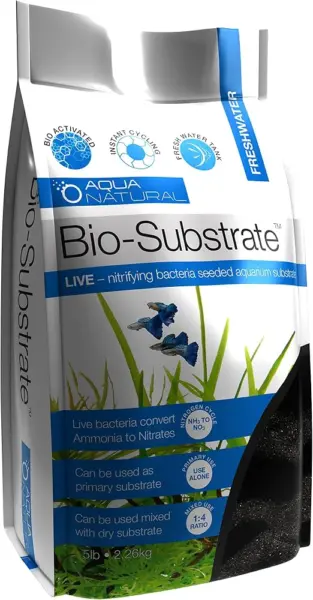
Aqua Natural Bio-Substrate – Best for Starting a Cycle
Key Features
- Form: Live bio-active sand
- Rinsing: Do not rinse
- Bag weight: 5 lb (wet)
- Mixing ratio: 1 live to 4 dry
- Price: Midrange
Do not rinse is the instruction on the bag, and it’s the whole idea. This is wet sand seeded with live nitrifying bacteria, and washing it would send the useful part down the drain. We like it as a supplement rather than a full bed — a bag stirred through an existing substrate, or into a new one, to give the cycle a head start.
The directions ask for one part live to four parts dry, which tells you what you’re buying: a starter, not a substrate you buy by the volume. Mixed into a dry sand or gravel it disappears into the bed; added to a running tank it settles in with some clouding, which is normal for anything wet and fine going into water, and clears.
Shrimp sift through the fine grains and plants root in it without complaint, which is the case for putting it where the animals actually are. Because it’s a living, wet product, look the bag over before it goes in — a hitchhiking snail is possible rather than a disaster, but you want to know before it’s in the tank.
Pros
- Seeded with live nitrifying bacteria
- Needs no rinsing at all
- Mixes into an existing substrate
Cons
- Can’t be rinsed, so there’s no cleanup first
- A supplement; one bag won’t make a full bed
Buy it as a starter rather than a whole substrate: live bacteria to help a cycle along and fine sand shrimp can sift, with no rinsing permitted.
Fantian Black Aquarium Sand – Best for Budget Nano Tanks
Key Features
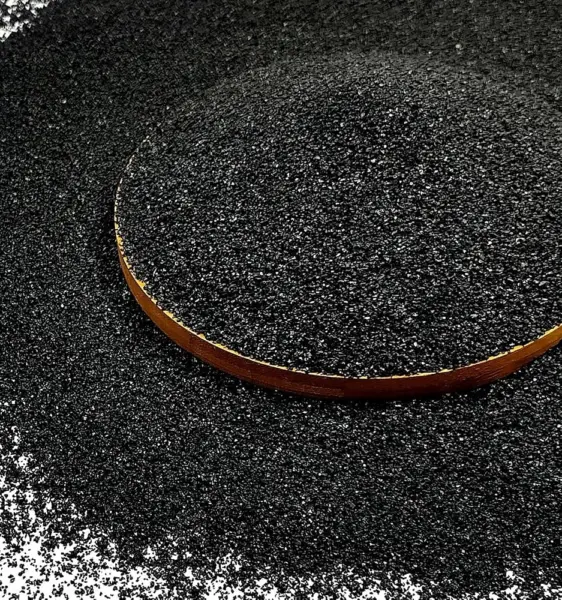
- Color: Glossy black
- Bag weight: 5 lb
- Grain size: 0.4 – 0.8 mm
- Price: Midrange
Black sand comes with a chore, and this bag is upfront about it: wash it, several times, until the water runs clear before it goes anywhere near the tank. The grains are 0.4 to 0.8 mm and dense, so once it’s in, it stays in. It’s the rinsing beforehand that eats an evening.
What we watched for was whether the bed stayed put. At this grain size, topping off the tank doesn’t lift it, gravel-vac work doesn’t scatter it, and waste sits on the surface where you can siphon it instead of sinking out of reach.
Black floors are unforgiving — every pale crumb and algae spot shows — and this one earns its place anyway: shrimp color reads well against it, plant greens look greener, and being able to see the waste at water-change time is a real advantage in a shrimp tank. Five pounds is a small-tank amount, enough for a nano at a shallow depth rather than a 20-gallon.
Pros
- Dense 0.4-0.8 mm grains stay in place
- Black floor makes shrimp and plants pop
- Holds a gentle slope without scattering
Cons
- Inert; rooted plants need root tabs or soil
- Five pounds covers only a small footprint
For a nano tank, this is the black sand that stays put and makes shrimp color read — a finishing layer, not a meal for your plants.
How We Tested the Best Aquarium Substrates for Plants and Shrimp
We started by researching the most widely available substrates marketed for planted tanks and shrimp, narrowing the field by grain size, nutrient content, price, and whether the manufacturer claimed shrimp safety. That left 14 substrates, which we tested over five months. Each one went into its own 10-gallon tank with identical filters, heaters, and lighting, set up in my home and office.
Before filling the tanks, I rinsed every substrate in a 5-gallon bucket, changing the water until it ran clear, and recorded how many passes it took. I noted whether the water stayed cloudy or took on a tint after 24 hours. Once the tanks were running, I tested ammonia, nitrite, and pH weekly for the first month, then every other week.
I planted each tank with the same mix of Java fern, Anubias, and a stem plant, then added a group of Neocaridina shrimp. Over five months, I counted new leaves, checked root spread, and noted which plants struggled or thrived in each substrate. I watched shrimp for stress, molting problems, and survival. I also compared each substrate’s color and grain consistency in the tank, and checked for compaction after a month.
How to Choose a Substrate for a Planted Shrimp Tank
The substrate decision comes down to two questions — what your plants eat from, and what your water does — and the right answer changes with your tap water and the size of the tank.
Soil, sand or gravel: what feeds the plants
Nutrient soils — the Fluval and Aqueon bags here — carry food for rooted plants, which is why they suit heavy feeders, carpets and anyone who wants a simple start. Inert materials such as Flourite and the sands hold roots but feed nothing, so root tabs become part of the routine.
We don’t think either approach is wrong. A soil is simpler at the start; an inert bed lets you control exactly what goes in, and it never turns to mud. If shrimp are the deciding vote, let them decide: a buffering soil suits caridina types, an inert bed suits keepers who want their tap chemistry left alone.
Grain size decides more than you expect
Fine grains give roots more contact, give shrimplets more to sift, and hold a slope. Coarse gravel leaves gaps that food falls into and roots struggle to cross. The trade is dust — the finer the material, the longer it hangs in the water when the bed is disturbed, which is why a 1 mm powder often wants a thin sand cap over it.
Our rule: fine for carpets and shrimp, coarser for tanks you rescape often. Angular gravels are the worst of both worlds in a shrimp tank, because there is nothing for small animals to pick over.
Test your water before you buy a buffering soil
A buffering soil pulls pH toward neutral-to-slightly-acidic and holds it there. That is a gift if your tap is hard and you keep caridina shrimp, and a nuisance if you keep neocaridina in water they already thrive in. An inert clay or sand does nothing, so what comes out of the tap is what the tank keeps.
Check pH and hardness first, not after. The substrate is the hardest thing in a running tank to change later, and a mismatch shows up as molting trouble rather than as an obvious mistake.
Depth, coverage and the rinse
Two to three inches at the back sloping to one at the front is the usual target, and that decides how many bags you need far more than the tank’s stated volume does. One five-pound bag gives a 10-gallon a thin layer; the 15.4 lb bag here does a genuinely deep bed in the same footprint.
Then budget an evening. Rinse soils and gravels until the runoff is hazy rather than muddy, and fill onto a plate so you aren’t digging a crater. Live, bacteria-seeded products are the exception — rinsing those defeats the point of buying them.
Frequently Asked Questions
How long does a planted substrate last before I have to replace it?
The granules themselves last for years — porous clay and sand don’t wear out. What fades is the nutrient charge in a soil, usually over a year or two, and root tabs bring it back without a rebuild.
Replace the bed when it turns to mush under your fingers or compacts so hard that water won’t move through it. If plants still root and the water clears, it has life left.
How soon can I add shrimp to a tank with a bacteria-seeded substrate?
A seeded substrate is a head start, not a finished cycle. Test for ammonia and nitrite and add shrimp only when both read zero and stay there after a small feed — often a few weeks, sometimes longer in a cold room.
Start with a small group rather than the whole colony. Shrimp are far less forgiving of an ammonia spike than the fish you cycled the tank with.
Can I vacuum a sand substrate without sucking it up?
Yes, if you work above it rather than into it. Pinch or kink the siphon hose to slow the flow, hover the tube an inch over the surface, and let it lift the mulm without digging in.
Dense fine sands hold their place; it’s the light, dusty grades that travel up the tube. If yours keeps coming through, your flow is too strong, not the sand.
Can I add a plant substrate to a tank that’s already running?
Yes, and it’s a messy afternoon rather than a rebuild. Siphon half the water into a bucket, move the shrimp and fish there with the filter media kept wet, add the substrate, cap it with sand, then refill with the old water.
Test ammonia daily for a week afterward. Disturbing an established bed can kick off a mini-cycle, and shrimp are the first to notice.
Final Verdict
For one planted tank with shrimp in it, our money goes on the Fluval Plant and Shrimp Stratum: it feeds roots, shelters shrimplets, and settles at a pH most community tanks like.
If your tank is large, or your tap water is already exactly where you want it, Seachem Flourite Black is the better buy — inert, generous, and honest about needing root tabs. If a carpet is the whole point, the 1 mm Bio Stratum is worth the extra.