This post contains affiliate links. We may earn a small commission when you buy through our links — at no extra cost to you.
Automatic dosing pumps promise consistency for your reef or planted tank, but many budget models drift in calibration or stop working within months. The gap between marketing claims and real-world performance can leave you questioning your purchase.
The real decision isn’t about features alone — it’s about which trade-offs you’re comfortable with. Do you prioritize low upfront cost and accept occasional monitoring, or pay more for a smoother experience with fewer surprises?
This guide breaks down the options by your actual dosing needs, tank size, and tolerance for maintenance. The right pump keeps your system stable without becoming a project itself.
Top Picks
Best for Budget Multi-Channel
Jebao DP-4

Rating: 4.2 ★ | Price: Budget | Channels: 4 | Programmability: Timed, 24 events/day | Dosing Accuracy: Good above 5ml | Build & Reliability: Mixed, some fail months | Setup Ease: Manual confusing, videos help
The Jebao DP-4 provides four independent dosing channels with programmable schedules spanning up to 30 days and 24 timer events per channel per day. For the price, this is the most affordable way to automate multiple additive doses in a reef tank. Initial calibration and setup require patience — the manual is poorly translated and many users rely on online video guides — but once configured, daily operation is simple and hands-off.
This pump is best suited for budget-conscious hobbyists who enjoy tinkering and don’t mind periodic maintenance. Unit-to-unit variation means some pumps develop calibration drift or pump head issues within months, so regular verification is advisable. Low-volume dosing under 5ml can be inconsistent, making this a better fit for mid-to-large dose volumes or diluted additive solutions. For reef keepers willing to monitor and adjust, the DP-4 offers unmatched channel capacity per dollar.
Pros
- Four independent channels at entry-level pricing — strong value for multi-additive dosing
- Programmable schedule with up to 24 daily events per channel and 30-day cycles
- Large online community with guides and troubleshooting resources for setup and calibration
Cons
- Dosing accuracy is limited at volumes under 5ml, requiring dilution or verification for small doses
- Unit consistency varies — some pumps develop calibration drift or pump head issues within months of use
The DP-4 delivers four-channel programmability at a price that undercuts competitors, making it the best value for reef keepers who are prepared to periodically calibrate and monitor their dosing system.
Best for Premium App System
Chihiros 4-Ch Doser
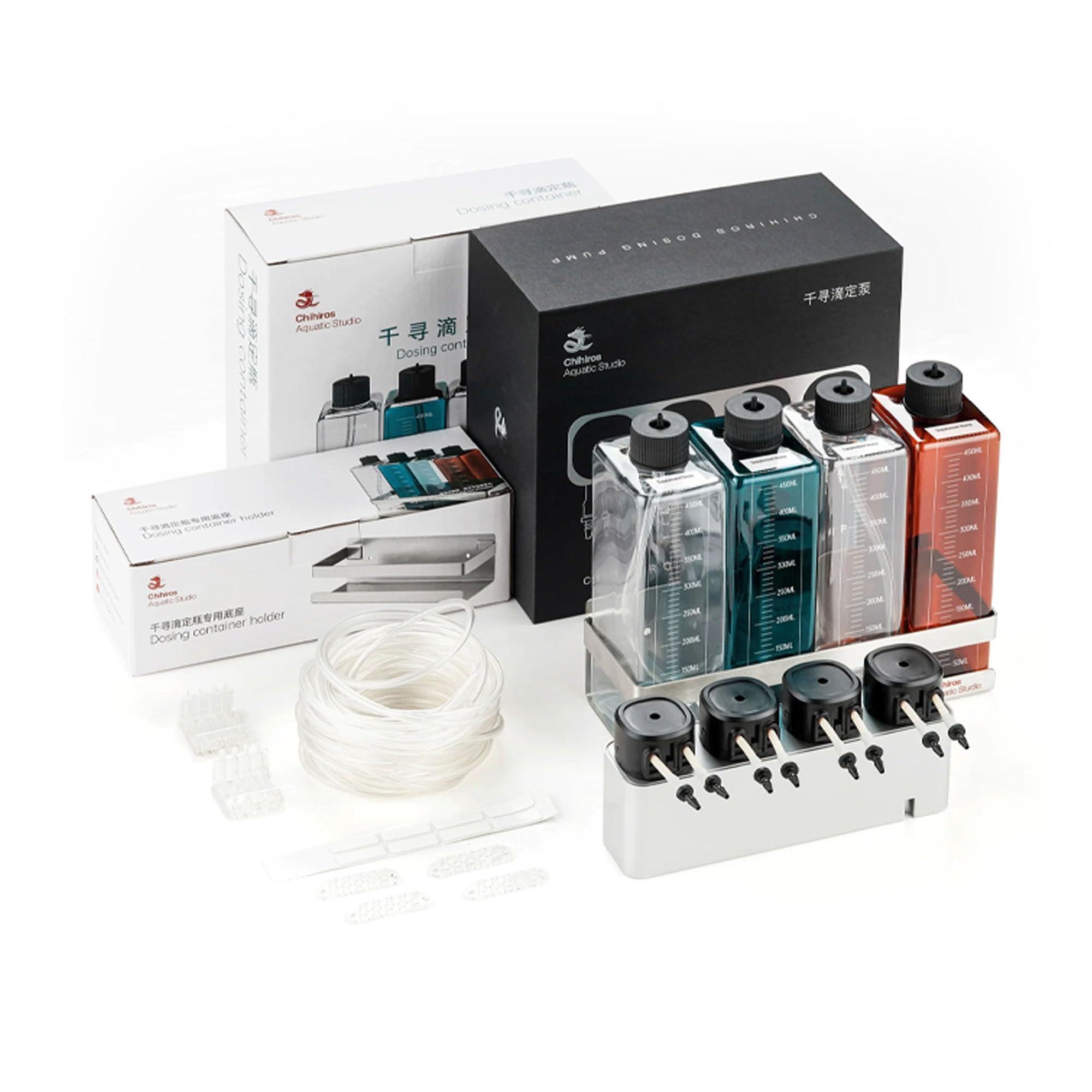
Rating: 4.4 ★ | Price: Premium | Channels: 4 | Programmability: App control | Dosing Accuracy: Good, limited feedback | Build & Reliability: Seems high, early days | Setup Ease: Very easy, app guided
The Chihiros Dosing Pump arrives as a full system: four pump heads, 450ml containers, tubing, and a sturdy holder. Setup involves attaching tubing and connecting the mobile app — no separate timer or calibration routine. The app allows scheduling per channel in ml increments, with a 999.9ml container limit in the software. This system suits aquarists who want a turnkey solution without sourcing additional parts. The tradeoff: the app’s 999.9ml cap means larger reservoirs won’t register accurately, and the system’s long-term track record is shorter than the Jebao’s.
Pros
- Complete all-in-one package with containers, holder, and tubing included – no extra parts to buy
- App-controlled dosing with intuitive scheduling and per-channel volume adjustments
- Sturdy build quality with well-designed pump heads and containers that feel solid on the holder
Cons
- Software container volume limit capped at 999.9ml – not suitable for users with larger dosing reservoirs
- Occasional reports of pump head issues out of the box – worth testing each channel upon arrival
For those who value a complete, hassle-free setup and can work within the app’s container limit, the Chihiros delivers consistent daily performance with a modern touch.
Best for Budget 3-Channel
Jebao DP-3

Rating: 4.0 ★ | Price: Budget | Channels: 3 | Programmability: Timed, 24 events/day | Dosing Accuracy: Similar to DP-4 | Build & Reliability: Mixed, failure reports | Setup Ease: Manual errors, moderate
Three channels at a budget-friendly price make the DP-3 an entry-level automated dosing pump. Its programming is manageable after initial fiddling, though the manual contains errors that slow setup. For small-volume dosing, calibration may drift over time, and the pump’s internal timing can lose accuracy after several months of use. This is a reasonable choice for hobbyists on a tight budget who are willing to occasionally check and recalibrate their dosing schedules.
Pros
- Good value for a 3-channel programmable pump
- Easy to program once understood
Cons
- In long-term unattended use, the pump may lose time or stop working after several months
- Dosing small volumes (under 5ml) can show calibration drift between channels
If you need exactly three channels and can accept occasional monitoring, the DP-3 is a cost-effective way to start automated dosing.
Best for Diy High-Flow
Kamoer KCP PRO2
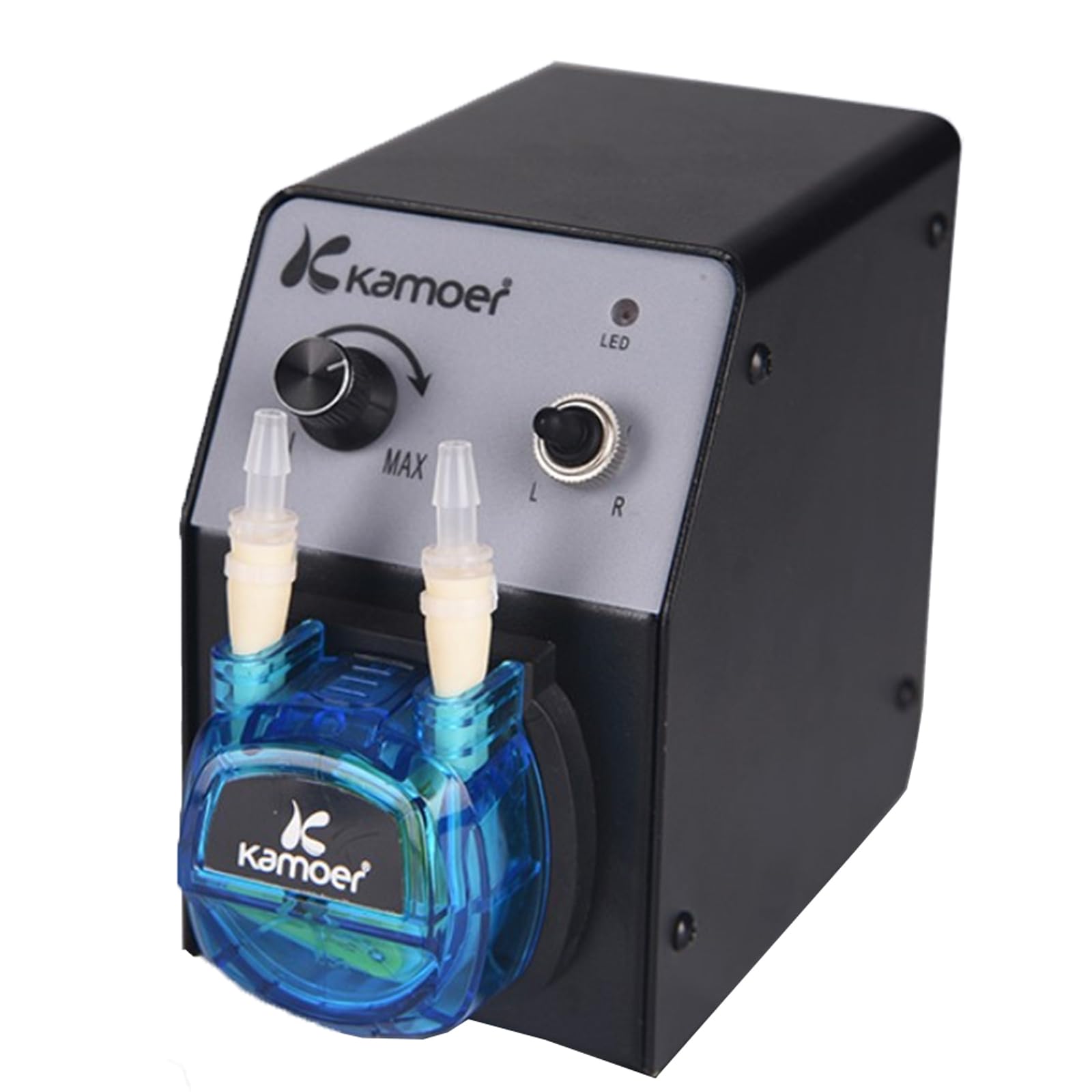
Rating: 4.0 ★ | Price: Mid-Range | Channels: 1 | Programmability: Manual knob, external timer | Dosing Accuracy: Too fast for micro-dosing | Build & Reliability: Stainless steel, durable | Setup Ease: Simple but no instructions
The Kamoer KCP PRO2 pairs a stainless steel housing with Norprene tubing for long-term chemical resistance, making it a rugged choice for custom dosing setups. Its variable speed knob allows flow from 40 to 210 ml/min, suited for larger tanks where volume per event exceeds 10 ml — think fertilizer or chlorine injection. Unlike the top pick’s built-in programmability, this pump requires an external timer or controller for automation, which suits hobbyists comfortable with DIY wiring and relay control. The minimum flow rate (~40 ml/min) rules out micro-dosing under 1 ml, so it’s not a fit for precision reef additive dosing.
Pros
- Metal housing and Norprene tubing resist chemicals and wear.
- Wide flow range covers bulk dosing needs for larger systems.
Cons
- Minimum flow rate (~40 ml/min) is too high for doses under 1 ml.
- No built-in timer or programmability — relies on external controller.
For aquarium keepers wanting a turnkey dosing pump, this isn’t it. But if you’re building your own automated system for high-volume dosing and want a durable pump head, the KCP PRO2 delivers.
Best for Ultra-Budget Diy
INTLLAB Peristaltic

Rating: 4.0 ★ | Price: Budget | Channels: 1 | Programmability: None, manual knob | Dosing Accuracy: Inconsistent, not precise | Build & Reliability: Tubing wears quickly | Setup Ease: Basic, no automation
The INTLLAB is the cheapest way to move small volumes of liquid, and it works fine for occasional tasks like chlorine dosing or resin transfer. But the tubing can wear quickly if left running, and the motor’s inconsistent flow at low speeds makes it a poor fit for automated aquarium dosing. If you need reliable, programmable multi-channel dosing, this pump isn’t the tool.
Pros
- Very low price makes it accessible for basic liquid transfer projects.
- Serves well for intermittent DIY use like occasional dosing or resin transfer.
Cons
- Motor may struggle to maintain consistent flow at low speeds, limiting precision.
Only consider this pump for one-off DIY liquid movement where precision and automation aren’t needed, and where run times are short.
Best for Diy Small Projects
Kamoer NKP

Rating: 4.4 ★ | Price: Budget | Channels: 1 | Programmability: None, external controller | Dosing Accuracy: Flow varies with voltage | Build & Reliability: Compact, no durability data | Setup Ease: Requires external controller
The Kamoer NKP is an ultra-compact 12V peristaltic pump at a rock-bottom price, ideal for simple DIY liquid transfer like plant watering. No built-in timer or automation — external controller required. Flow varies with voltage, so precision dosing is not possible. Best for low-stakes projects, not aquarium automation.
Pros
- Extremely compact and affordable – fits tight spaces and a tight budget.
- Works well for intermittent, low-stakes liquid transfer tasks.
Cons
- No built-in timer or programming – requires an external controller for automated dosing.
The NKP suits DIYers who want a cheap, compact pump for occasional manual liquid transfer — not for automated aquarium dosing.
Best for Hydroponic Ph Control
Milwaukee MC720

Rating: 4.1 ★ | Price: Luxury | Channels: 1 | Programmability: pH setpoint control | Dosing Accuracy: Prone to overdosing | Build & Reliability: Inconsistent QC | Setup Ease: Straightforward for pH
This Milwaukee combo integrates a pH controller and peristaltic pump for automated pH adjustment in hydroponic setups — it keeps pH stable once calibrated. However, it’s a single-purpose device: those needing to dose calcium, alkalinity, or magnesium separately need a multi-channel pump. Overdosing can occur if pH solution concentration or probe placement isn’t optimal.
Pros
- Maintains stable pH in hydroponic reservoirs once dialed in.
- All-in-one controller and pump saves space and simplifies setup.
Cons
- Single-channel pH-only design cannot handle multi-parameter reef dosing.
This kit works for hydroponic pH control or kalkwasser-only dosing, but reef keepers needing Ca/Alk/Mg dosing should look elsewhere.
Best for Water Change Pump
Kamoer KCPA600

Rating: 4.5 ★ | Price: Mid-Range | Channels: 1 | Programmability: Manual knob, external timer | Dosing Accuracy: Too fast, not for additives | Build & Reliability: Loud, no instructions | Setup Ease: No instructions, unlabeled
If you’re automating water changes in a 200+ gallon reef, the KCPA600 moves water quickly at a reasonable price. But for dosing small amounts of additives, look elsewhere – it’s loud and imprecise. Expect to figure out the connections yourself.
Pros
- High flow rate (180-520 ml/min) for efficient water changes and large volume transfer.
- Cost-effective for the flow capacity offered.
Cons
- Minimum flow of 180 ml/min is too high for precise additive dosing in reef tanks.
Best reserved for automating water changes in large systems where high flow matters and noise is acceptable.
How to Choose
The best dosing pump for your aquarium depends on how many additives you dose, the volumes you need, and your tolerance for tinkering.
Number of Channels
Most reef tanks need separate channels for calcium, alkalinity, and magnesium. A 3- or 4-channel pump handles the big three plus trace elements. Single-channel peristaltic pumps require an external controller to automate, adding cost and complexity.
If you only dose one additive — like kalkwasser or iron — a single pump with a timer might suffice. But multi-channel pumps save space and wiring, and let you adjust each schedule independently.
Programmability
Full programmability means you set the dose volume, time, and frequency per channel. Budget pumps like the Jebao DP-4 offer 24 timer events per day and a 30-day schedule. App-controlled systems let you tweak from your phone, but require a stable Bluetooth or Wi-Fi connection.
Pumps without built-in timers — common among cheap peristaltic models — need an external device like a smart plug or Arduino. That adds setup time and a second point of failure. For most hobbyists, an all-in-one programmable pump is simpler from day one.
Dosing Accuracy at Low Volumes
If you dose less than 5ml per event, accuracy matters. Peristaltic pumps rely on tubing compression, and small errors become large percentages at low volumes. Budget pumps often require you to dilute additives to increase volume, or to verify output weekly with a measuring cylinder.
Premium systems like the Chihiros use better tubing and motor control, but even they benefit from periodic calibration checks. If your tank is sensitive (e.g., SPS corals), invest in a pump that can reliably dose 1-2ml.
Build Quality and Reliability
Dosing pumps run 24/7, often in humid cabinets under tanks. Plastic pump heads and cheap tubing degrade faster, leading to calibration drift or complete failure within months. Metal-bodied pumps with reinforced tubing (e.g., Norprene) last longer but cost more.
Reading owner forums reveals that even popular budget pumps have a meaningful failure rate after 6-12 months. Factor in the cost of potential replacement when comparing initial prices. A mid-range pump that lasts two years often beats a budget pump replaced yearly.
Ease of Setup and Calibration
Some pumps arrive with cryptic manuals or errors, forcing you to search YouTube for setup guides. Others include clear instructions or an intuitive app that walks you through calibration. The difference can be an hour of frustration versus ten minutes of straightforward work.
If you are new to dosing, prioritize a system with app-based setup or clear printed instructions. Verify dosing volumes after installation and again after a week — tubing can seat differently after initial use.
FAQ
Why does my Jebao dosing pump lose time and stop dosing correctly?
Some Jebao units have a known clock drift issue due to internal capacitor aging. After weeks of operation, the internal timer may run fast or slow, shifting dosing times. The fix is to sync the clock weekly or upgrade to the Chihiros system which uses app-synced time. If the problem recurs, a replacement unit may be necessary.
Can a cheap peristaltic pump be used for automatic aquarium dosing?
Not without an external controller. A peristaltic pump without a built-in timer just runs when powered. To automate dosing, you need a smart plug, Arduino, or relay timer — adding cost and complexity. For most hobbyists, a dedicated multi-channel dosing pump is simpler and more reliable.
How often should I replace the tubing on a dosing pump?
Every 3–6 months for budget peristaltic pumps, or when you notice flow rate changes. Norprene and silicone tubing degrade from constant compression, gradually altering dose volume. Mark the tubing installation date and replace proactively to avoid under- or over-dosing.
Is a pH controller dosing pump useful for reef tank calcium and alkalinity?
No — a pH controller like the Milwaukee MC720 only manages pH by dosing acid or alkaline solutions. It cannot dose multiple additives like calcium, alkalinity, and magnesium. If your goal is reef additive dosing, choose a multi-channel programmable pump instead.