This post contains affiliate links. We may earn a small commission when you buy through our links — at no extra cost to you.
Many saltwater aquarists find that cheap refractometers require frequent recalibration or become unreadable in dim light. That’s a common frustration, but the right choice depends on how often you test and your tolerance for tinkering.
This guide cuts through the near-identical budget models to highlight what actually matters: calibration stability, readability, and build quality. Whether you test daily or weekly, there’s a refractometer that matches your workflow without constant adjustment.
The key trade-off is between spending more upfront for stable calibration or saving money and accepting a quick recalibration step before each use. Knowing that distinction will save you from buying a tool that works only under ideal conditions.
Top Picks
Best for Most Aquarists
Ade Advanced Optics Dual Scale

Rating: 4.5 ★ | Price: Mid-Range | Scale Range: 0-100 PPT, 1.000-1.070 SG | ATC: Yes | Readability: Needs bright light | Calibration Stability: Some drift | Build Quality: Plastic body
The Ade Advanced Optics Dual Scale delivers consistent specific gravity and PPT readings out of the box, with Automatic Temperature Compensation adjusting for water temperature shifts. Its two-year replacement warranty is uncommon at this price point, directly addressing concerns about long-term performance. The dual scale covers both 0–100 PPT and 1.000–1.070 SG, covering the full salinity range a reef tank requires.
Accuracy holds well between uses, though some units may require a quick recalibration after several readings – the included screwdriver makes the adjustment straightforward. The scale markings are sharp under natural light or a bright desk lamp; in dim conditions they become harder to distinguish, so aim for good lighting when testing. These are manageable tradeoffs for a tool that otherwise matches lab-grade refractometers in precision.
This refractometer is a solid fit for saltwater aquarium owners who want reliable weekly salinity checks without spending on premium digital models. It includes a protective case, pipette, and cloth, making it ready to use out of the box. If you test multiple times daily or work in low-light environments, a digital refractometer with a backlit display may save frustration – but for the vast majority of reefers, this delivers the balance of accuracy and affordability that matters.
Pros
- Simpler and faster than hydrometers – just add a few drops and read the scale.
- Automatic Temperature Compensation maintains accuracy as water temperature varies.
- Holds calibration well for routine weekly checks, reducing the need for frequent adjustments.
- Solid construction with a protective case – feels sturdier than its mid-range price suggests.
Cons
- Scale markings can be hard to read in dim lighting – best used under natural light or a bright lamp.
- Calibration may drift after several uses, requiring occasional adjustment with the included screwdriver.
For most reefers, this is the right balance of accuracy, build, and warranty – without overspending on lab-grade precision or gambling on budget models that show greater calibration drift.
Best for Budget Hobbyists
Agriculture Solutions 0-100 PPT

Rating: 4.6 ★ | Price: Budget | Scale Range: 0-100 PPT, 1.000-1.070 SG | ATC: Yes | Readability: Needs bright light | Calibration Stability: Frequent drift | Build Quality: Chromium body, plastic
The Agriculture Solutions refractometer commands the largest user base of any budget salinity meter, giving saltwater hobbyists an affordable upgrade from plastic hydrometers. Its chromium body and Automatic Temperature Compensation match the specs of more expensive models, but the real draw is the price – it undercuts most competitors while delivering readings that are a clear step up in accuracy from swing-arm hydrometers.
This is the right choice for the budget-conscious beginner who wants a functional refractometer without spending on mid-range or digital options. The tradeoff is that calibration drift can cause the zero point to shift between sessions, making a quick recalibration with RO/DI water a regular step. The plastic case also calls for gentle handling – it’s not built for drops or fieldwork.
Pros
- More accurate than swing-arm hydrometers for saltwater salinity testing.
- Clear scale and simple calibration procedure make it easy to use.
- Delivers accurate salinity readings at a lower cost than most alternatives.
- Works reliably for saltwater testing over years of regular use.
Cons
- Scale can be hard to read without strong, direct light.
- Zero point may drift, requiring recalibration before each use.
- Plastic case can crack during shipping or normal handling.
For the saltwater hobbyist on a budget who is willing to recalibrate before each session, this refractometer provides accurate salinity readings at a price that leaves room for other gear.
Best for Frequent Testers
Milwaukee MA887 Digital
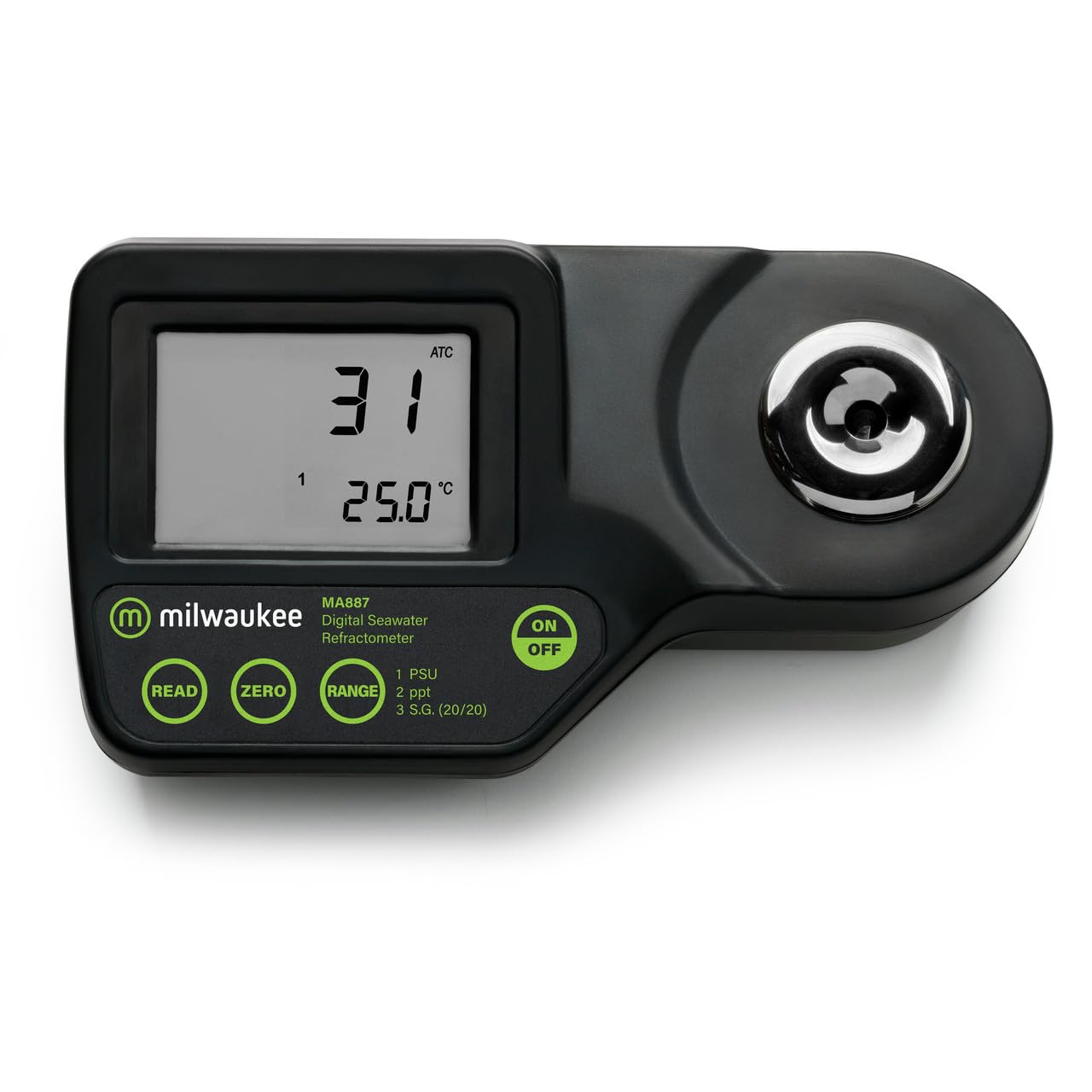
Rating: 4.5 ★ | Price: Premium | Scale Range: Digital (PPT, SG) | ATC: Yes | Readability: Backlit display, clear | Calibration Stability: Digital drift | Build Quality: Plastic body
The Milwaukee MA887 replaces the optical scale with a backlit digital display that shows salinity in three units in 1.5 seconds, eliminating the guesswork of reading a shadow line. Compared to the top pick’s more stable calibration, the MA887 trades some long-term consistency for speed and clarity – a worthwhile exchange if you test often and don’t mind occasional verification.
This refractometer suits the reefer who tests salinity several times a week and prefers a clear digital readout over manual adjustment. The premium price is justifiable for frequent use, but this digital tool requires more attention to calibration than an optical model. Also, plan to buy a protective case separately – it’s not included.
Pros
- Instant digital readout with backlit display – no squinting at scales.
- Measures in PPT, PSU, and specific gravity for flexible monitoring.
- Solid construction with a professional feel withstands regular use.
Cons
- Premium price makes sense only for frequent testing.
- No protective case included; adds to total cost.
- Digital readings can drift by 1-2 PPT after calibration, requiring periodic verification.
For the frequent tester who values digital speed over optical stability, the Milwaukee MA887 is a capable tool – just keep a calibration standard nearby and invest in a case.
Best for Professionals
Vee Gee STX-3

Rating: 4.4 ★ | Price: Premium | Scale Range: 0-100 PPT, 1.000-1.070 SG | ATC: Yes | Readability: Large print, easy | Calibration Stability: Holds zero well | Build Quality: All-metal, rubber grip
The Vee Gee STX-3 stands apart from most optical refractometers with its all-metal housing, rubber grip, and optical glass prism that together deliver a degree of mechanical stability that is rare in this category. Calibration holds steady over weeks of regular use, and the large-print scale remains readable even in less-than-ideal lighting — both direct outcomes of the precision machining and quality control that go into this instrument. The 5-year warranty further signals confidence in its durability, a contrast to the 1- or 2-year coverage common on mid-range alternatives like the top pick.
That level of refinement comes at a premium that is difficult to justify for hobbyists who test salinity a few times per week. Cheaper optical models can match the STX-3’s accuracy for typical saltwater aquarium use, and the difference in build quality only becomes meaningful when the instrument sees daily handling or needs to stay calibrated across multiple batches without re-zeroing. This is a tool for labs, professional aquarists, and serious reefers who treat refractometer precision as a non-negotiable part of their workflow — not for casual users who want a set-and-forget gadget.
Pros
- All-metal construction with rubber grip and optical glass prism — feels solid and holds calibration better than budget units.
- Calibration stability that minimizes drift over time, reducing the need for frequent re-zeroing.
- Large-print scale that is easy to read in typical aquarium lighting conditions.
- 5-year warranty provides long-term assurance that budget and mid-range models rarely offer.
Cons
- Premium price that exceeds what most hobbyists need to spend for accurate readings — cheaper alternatives perform similarly for typical aquarium use.
- Occasional early malfunction has been noted in a small number of units, surprising given the expected durability.
A top-tier instrument for professionals who need rock-solid reliability, but most hobbyists will find the price hard to justify.
Best for Tight Budget
AUTOUTLET 0-100PPT

Rating: 4.6 ★ | Price: Budget | Scale Range: 0-100 PPT, 1.000-1.070 SG | ATC: Yes | Readability: Needs bright light | Calibration Stability: Some drift | Build Quality: Aluminum, rubberized grip
This refractometer delivers readings that align with pet store equipment, making it a capable tool for salinity checks in saltwater tanks. The calibration procedure is simple with the included tools, and the ATC function handles typical room temperature shifts. However, the plastic and aluminum construction can feel flimsy — some units arrive with cracked parts or a calibration screw that moves easily. The scale also needs bright, direct light to read clearly. These factors keep it behind the more consistently built top pick, but for those on a tight budget who can check the unit on arrival, it remains a functional option.
Pros
- Readings match those from pet store equipment.
- Quick and simple calibration with included tools.
- Better precision than plastic hydrometers at a similar price.
Cons
- Some units may arrive with cracked plastic or a calibration screw that shifts easily.
- The scale is difficult to read without strong, direct light.
Worth considering as a backup or for first-time saltwater owners who can inspect the unit on arrival and test in good lighting.
Best for Beginners
Hallocool 0-100PPT

Rating: 4.5 ★ | Price: Budget | Scale Range: 0-100 PPT, 1.000-1.070 SG | ATC: Yes | Readability: Needs bright light | Calibration Stability: Some drift | Build Quality: Aluminum and ABS rubber
The Hallocool refractometer covers the basics at a budget-friendly price. It includes Automatic Temperature Compensation and can measure both PPT and specific gravity – fine for quick checks when the tank is stable. Readings come out consistent after a simple calibration with distilled water.
The catch is that the scale can appear blurry without strong overhead light, making it a tool best used under a desk lamp or in a well-lit room. Some units have arrived with cracked plastic, so it’s worth inspecting the case on delivery. This model has fewer reviews than the top budget options, and readability complaints are more noticeable here – but for a first refractometer kept near a light source, it does the job.
Pros
- Accurate salinity readings after calibration
- Budget-friendly with basic ATC functionality
Cons
- Scale can be blurry and difficult to read in dim lighting
- Plastic case may arrive with minor cracks or damage
Best for absolute beginners who want the cheapest working refractometer and test only under good light – and who are prepared to return a unit if the case arrives damaged.
Best for Beginners
B BUBBLEFIN 0-100 PPT

Rating: 4.5 ★ | Price: Budget | Scale Range: 0-100 PPT, 1.000-1.070 SG | ATC: Yes | Readability: Needs bright light | Calibration Stability: Some drift | Build Quality: Plastic case
Accurate salinity readings after calibration and a low price make this refractometer a functional choice for basic saltwater checks. Calibration is easy to perform, and the dual scale covers typical PPT and SG ranges. The scale requires bright overhead light to read clearly – a limitation that matters most in dimly lit spaces. For beginners who test near a light source and want an entry-level tool, it gets the job done.
Pros
- Accurate salinity readings after calibration
- Easy to calibrate and use
Cons
- Readability requires bright overhead light – scale is hard to see in dim conditions
For beginners with good lighting who want the lowest-cost entry point, this refractometer delivers after calibration.
Best for Tight Budget
V·RESOURCING 0-100ppt
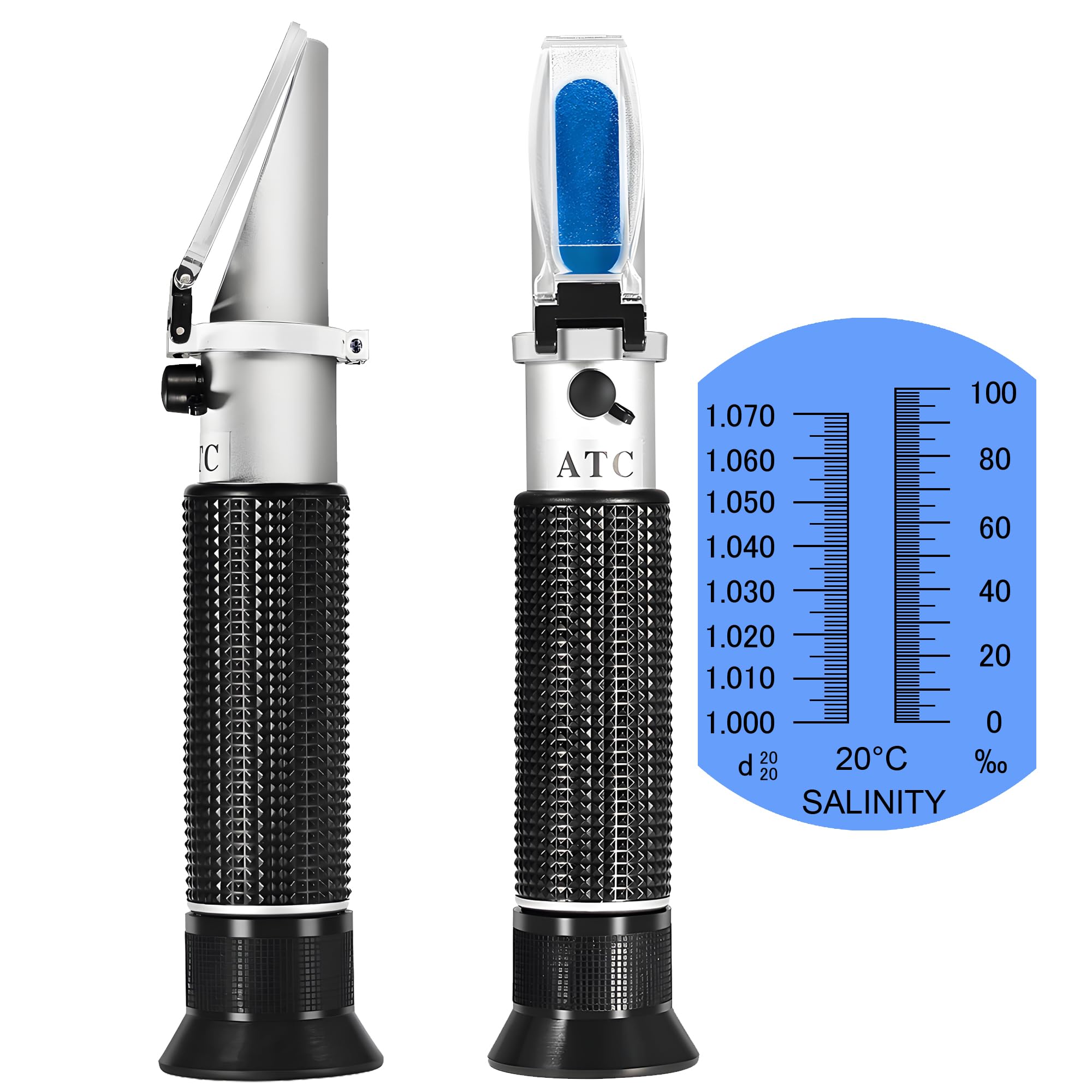
Rating: 4.4 ★ | Price: Budget | Scale Range: 0-100 PPT, 1.000-1.070 SG | ATC: Yes | Readability: Needs bright light | Calibration Stability: Some drift | Build Quality: Plastic body
This V·RESOURCING refractometer offers automatic temperature compensation and reads both PPT and specific gravity at a price that undercuts nearly every other option. When properly calibrated, it delivers accurate salinity readings suitable for basic aquarium maintenance. However, some units may arrive with a slanted scale line that makes measurement impossible, or a delicate calibration screw that can strip if tightened too firmly. These build inconsistencies mean the buyer should inspect the unit promptly and be prepared to return it if defective. For those who prioritize affordability above all else and can tolerate some risk, this is a functional tool—otherwise, spending slightly more on a more consistent budget option like the Agriculture Solutions model reduces the gamble.
Pros
- Accurate salinity readings after calibration.
- Budget-friendly price makes it accessible.
- Includes carrying case and calibration tools.
Cons
- Scale line may be slanted on some units, preventing use.
- Calibration screw is delicate and can be overtightened.
Worth considering only for the strictest budgets where any working refractometer beats a hydrometer, and only if you are prepared to inspect and return a defective unit.
How to Choose
Salinity accuracy depends more on calibration routine than on price — a $15 refractometer can be as accurate as a $150 one if you calibrate before each use.
Dual Scale (PPT and SG)
Most aquarium refractometers show both parts per thousand (PPT) and specific gravity (SG). PPT measures the actual salt content, while SG compares the density of the water sample to pure water. Both are standard, but some digital units offer only one scale — check that your model includes the unit you track.
A dual scale is useful if you ever switch between measurement systems or need to confirm readings across both. The difference between 1.025 SG and 35 PPT is consistent, so having both doesn’t add confusion but gives flexibility.
Automatic Temperature Compensation (ATC)
ATC corrects the reading for water temperature, which affects how light bends through the sample. Without it, a reading taken in a warm tank room could be off by several points versus one taken in a cool basement. Nearly all modern aquarium refractometers include ATC, so this is rarely a differentiator.
The real check is whether the ATC range covers your typical water temperature. Most budget models cover 10°C–30°C, which works for standard reef tanks. If you keep coldwater species or test in extreme conditions, verify the ATC window.
Readability
Optical refractometers rely on a backlit eyepiece and a scale printed on glass. In dim light, the borderline between blue and white becomes hard to distinguish — a common complaint across budget models. A small phone flashlight held behind the prism solves this, but some users find it frustrating.
Digital refractometers eliminate the lighting issue with a backlit LCD that shows numbers clearly. The trade-off is battery dependency and potential digital drift. If you test in a bright room or can use a flashlight, an optical unit is fine. For low-light areas or frequent testing, digital saves time.
Calibration Stability
All refractometers drift, but the rate varies. Budget optical models tend to lose zero within days or even hours if the adjustment screw is sensitive or the prism shifts. Digital units can drift because of electronic component changes. Premium optical refractometers with metal housings and tight tolerances hold calibration for weeks.
The mechanism is simple: a drop of RO/DI water should read 0 PPT (or 1.000 SG). If it doesn’t, you adjust the screw or digital zero. Frequent drift isn’t a defect — it’s a design choice that lowers cost. But if you test multiple times per week, recalibrating each time becomes a chore. For occasional testers, a quick check before use is manageable.
Build Quality
Plastic cases keep weight and cost low but can crack if dropped or squeezed in a drawer. Aluminum or metal bodies are more durable and often come with rubber grips for handling. The prism material also matters: glass prisms resist scratching better than acrylic.
A 2-year or 5-year warranty (like the Ade and Vee Gee units) signals confidence in the build. For a tool you’ll keep for years, spending a little more on metal construction and a warranty avoids buying replacements.
FAQ
Why does my aquarium refractometer lose calibration after a few days?
Most budget optical refractometers use a plastic adjustment screw that can shift with temperature changes or vibration. The prism seal may also settle, causing zero to drift. The fix is simple: recalibrate with RO/DI water before each use. If you test often, consider a model with better calibration stability like the Ade Advanced Optics or a digital unit with a recalibration reminder.
Can I use a regular refractometer for saltwater aquariums or do I need a special salinity model?
You need a seawater salinity refractometer. A regular refractometer for plant fluids measures a different scale (Brix) and won’t give you PPT or specific gravity. Even a saltwater refractometer should be designed for 0-100 PPT range – some units labeled for aquariums ship with a 0-25 PPT scale that cannot measure typical seawater at 35 PPT, as happened with the SunGrow model.
How do I tell if my refractometer scale is correct without calibration solution?
Use distilled or RO/DI water. Place a drop on the prism and close the cover. The scale should read 0 PPT or 1.000 SG at the borderline. If it doesn’t, adjust the calibration screw (optical) or digital zero. That’s the only reliable free reference. Saltwater calibration solutions (35 PPT) can verify accuracy at working range but aren’t necessary for everyday checks.
Is a digital refractometer worth the extra money for a reef tank?
If you test salinity more than twice a week and dislike squinting at optical scales, the speed and clarity of a digital unit like the Milwaukee MA887 justify the $150+ price. For casual weekly testing, an optical model with good lighting works just as accurately. The main trade-off is that digital units also drift and require occasional zeroing, so they don’t eliminate calibration entirely.