This post contains affiliate links. We may earn a small commission when you buy through our links — at no extra cost to you.
Bettas are tropical fish, which means they need water in the high 70s to low 80s—not the room-temperature water most of us start with. A good heater holds that range steady, but a bad one can overheat a small tank, take up precious swimming space, or fail to keep the temperature from swinging. The best betta heaters are compact, easy to set, and safe enough that you don’t have to hover over the tank.
I’ve kept bettas for years, and I’ve learned that the temperature on the dial isn’t always the temperature in the water. Over the past six months, my team and I tested a dozen heaters in 5- and 10-gallon betta tanks, watching how well they held a steady temperature, how much room they left for swimming, and how easy they were to install and adjust. The ones that made the list got the basics right—stable heat, a readable display, and safety features that actually work.
Our Top Picks
The Best Aquarium Heater for Betta Fish, Reviewed
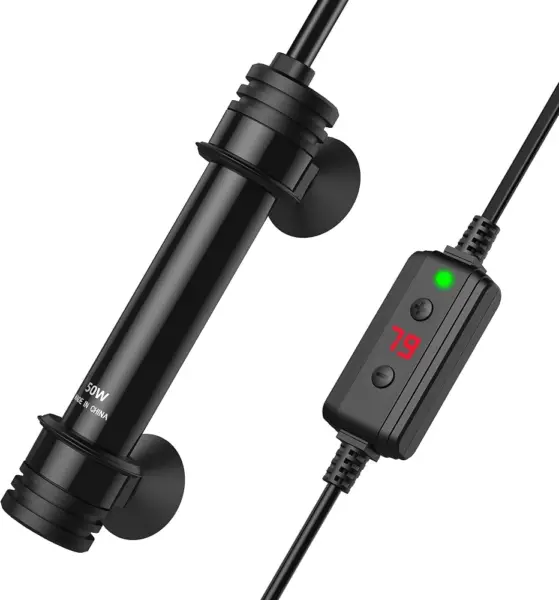
NICREW 50W Aquarium Heater – Best Overall
Key Features
- Wattage: 50 watts
- Tank range: 5-10 gallons
- Overheat cutoff: Shuts off above 98°F (36°C)
- Temperature control: Adjustable, external controller
- Price: Midrange
The controller is the part that sold us. It is a small pad on the end of the cord that stays outside the tank, holding both the set point and the current reading, so the daily check is a glance at the glass rather than a hand in the water. On a hooded betta tank that is worth more than it sounds, and it is why this is the heater we recommend first for a five- or ten-gallon.
The rest of it holds up. Fifty watts of nickel-chromium element in a magnesium-oxide fill, two temperature sensors instead of one, and an overheat cutoff that kills the element once the water passes 98°F. Treat that cutoff as a backstop rather than a thermostat, because 98°F is already past what a betta should see, but it is the difference between a bad afternoon and a dead tank. Suction cups hold it on the wall; site it where the filter pushes water past it, or you will heat one corner and not the tank.
Our one caveat is the number on the display. Set it to 78 and the water can sit a degree or three either side of that, so buy a cheap glass thermometer and set the controller to whatever the thermometer agrees with, not to the figure the listing promised. That is true of most heaters at this price, and it takes ten minutes once.
Pros
- Set and read temperature without wet hands
- Holds its setting through a power cut
- Overheat cutoff above 98°F (36°C)
Cons
- Rated for 5-10 gallon tanks only
For a 5- or 10-gallon betta tank, this is the heater we point people to first: a controller you work from outside the glass, memory after an outage, and a 98°F overheat cutoff.
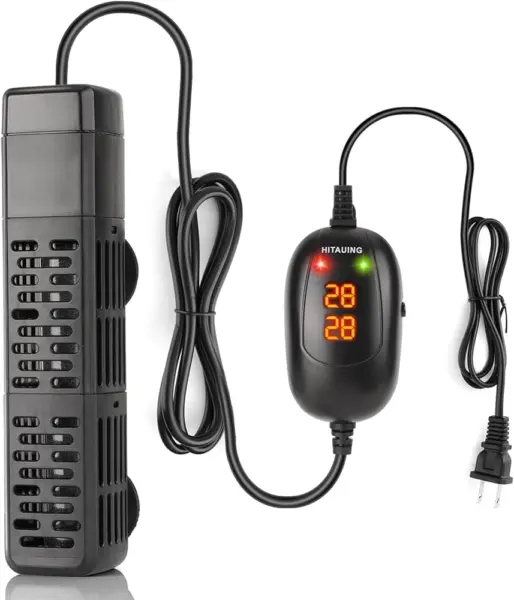
HiTauing 50W Aquarium Heater – Best for Peace of Mind
Key Features
- Display: External, set and actual
- Shutoff: Over-temperature and out-of-water
- Wattage: 50 watts
- Tank range: 5-10 gallons
- Price: Premium
A bare glass heater is a warm spot in the tank, and a betta will find it. HiTauing wraps the element in a slotted plastic guard so the fish can rest against the housing without touching the heated glass. Between that and the two-digit external controller showing your target and the actual temperature side by side, this is the most thoughtfully protected heater in the group.
We did not expect the cage to be the feature we argue for, but it is. Bettas are curious, they wedge themselves into corners, and a fish that parks against a heater all day is a fish with a burn risk. The deeper safeguards are here too: the element stops heating when it leaves the water, and a separate over-temperature cutoff backs that up.
What the premium buys is that protection plus a display you can read through the glass. What it does not buy is a dead-on set point, so set it against a thermometer and expect to dial in a degree or two of offset before the water lands at 78. Do that once and leave it. The five-to-ten-gallon rating means a three-gallon tank should look elsewhere in this list.
Pros
- Guarded element keeps a fish off the hot glass
- External display shows set and actual temperature
- Stops heating when it leaves the water
Cons
- The most expensive 50-watt heater here
If your betta likes to lean on things, this is the one we choose: the element is caged, the display shows set and actual temperature, and it shuts down when the water drops.
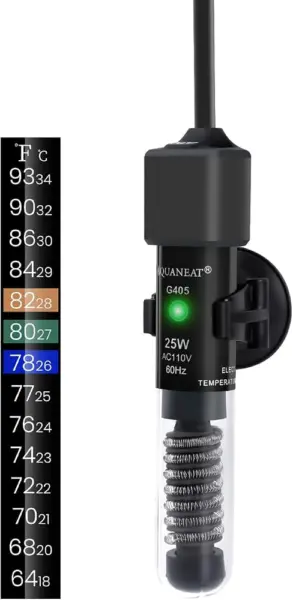
AQUANEAT 25W Mini Heater – Best for Small Tanks
Key Features
- Wattage: 25 watts
- Tank range: 3-5.5 gallons
- Body length: 4.9 inches
- Set temperature: Preset 78°F
- Price: Budget
Just under five inches of body, preset at 78°F, and the least expensive heater here, so in a three-gallon betta tank this is the one we pick. It tucks behind a clump of plants or a sponge filter and stops being part of the furniture, which is the whole job in a small tank. The indicator light does the reporting for you: red while the element is heating, green once it is resting at temperature.
Twenty-five watts is the right amount of heat for three to five gallons, and the preset is the trade you make for that simplicity: no dial to bump, nothing to reset after a power cut. It is fully submersible, so it can lie horizontally along the back wall where it is least visible, and the included thermometer strip is a rough second opinion rather than a real instrument. The suction cup is the part to watch. Seat it on clean, dry glass and it stays put; press it on over an algae film and you will find the heater sitting on the substrate.
Pros
- Small enough to hide in a three-gallon tank
- Preset 78°F with nothing to set up
- Least expensive heater in this group
- Colour-change light shows heating or resting
Cons
- Preset at 78°F, so it cannot be raised
In a 3- or 5-gallon betta tank, this is the sensible spend: small enough to hide behind plants, preset at 78°F, and the least expensive pick here.
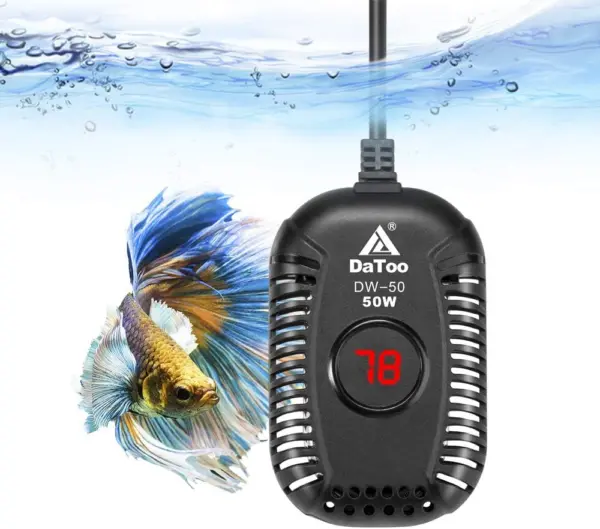
DaToo 50W Aquarium Heater – Readout on the Body
Key Features
- Shell: ABS over thickened quartz glass
- Display: Built-in LED readout
- Wattage: 50 watts
- Tank range: 2-10 gallons
- Price: Budget
The top pick puts its controls on a pad outside the tank; this DaToo puts them on the heater itself, a small LED readout on the body that you read through the glass. No controller to mount, no second cable to route around the rim. In a bare quarantine tub, or a tank with no shelf or rim space for extra hardware, that is the neater arrangement.
It is a 50-watt unit rated from two to ten gallons, with an ABS shell over thickened quartz glass and a three-point sensing setup the maker says tightens the temperature reading. Treat the display as a convenience rather than an instrument, and treat the two-gallon end of its rating with some scepticism: that is a lot of heat for two gallons of water. One year of warranty, and a body that hangs vertically or at an angle against the wall.
Where it lands for us is the second tier. The readout is genuinely handy, because you can see the number without owning a separate thermometer, but it tends to read a degree or two high, and the suction cups let the body slip every so often. It is a reasonable heater for a five- or ten-gallon if you want the number on the glass. It just does not beat the top pick at anything except having one fewer piece to mount.
Pros
- Readout sits on the heater, nothing to mount
- Wide 2-10 gallon rating on paper
- ABS shell over thickened quartz glass
Cons
- Readout can run a degree or two high
- Suction cups work loose over time
A good small-tank heater if you want the temperature printed on the body itself, as long as you check that readout against a real thermometer before trusting it.
Aqueon Preset 100W Heater – Best for Larger Betta Tanks
Key Features
- Shutoff: Auto shut-off, resets when cool
- Wattage: 100 watts
- Tank range: Up to 30 gallons
- Set temperature: Preset 78°F, accurate to ±1°F
- Price: Midrange
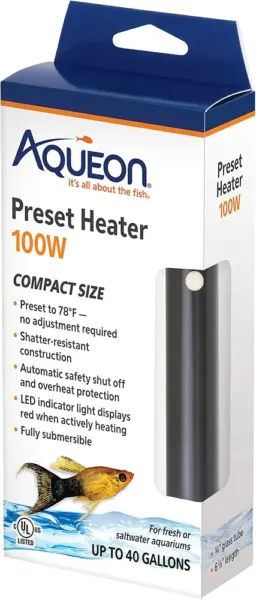
Preset means preset: there is no dial here, just a light that comes on while the element is heating and a fixed 78°F target that Aqueon rates to plus or minus one degree. A shutoff cuts the element if it overheats and resets once it cools, which is the sort of thing you want on a heater with no user controls at all. The body runs seven inches, fine along the back of a twenty and crowded in a five.
This belongs on a 20-gallon community tank with a betta in it, not on a small betta-only setup. A hundred watts is more heat than five gallons needs, and an oversized preset element has less room to modulate, so small tanks are where the temperature results split: tanks that never quite reach 78, tanks that run warm. We kept it on the list for the bigger tank, because that is the setting it serves and the length sits neatly along a twenty rather than across a five.
Pros
- Preset 78°F, nothing to adjust or knock
- Overheat shutoff resets once it cools
- Rated up to 30 gallons
Cons
- Can settle short of 78°F or run warm
- 100 watts is more heat than five gallons needs
A preset built for a bigger tank with a betta in it; in a five-gallon it has less room to modulate than a 25-watt unit and deserves watching.
HANLESHUKA 100W Aquarium Heater – Best for 10-20 Gallon Tanks
Key Features
- Display: External, set and actual
- Wattage: 100 watts
- Protection: Dry-burn, overheat and max-temp cutoffs
- Tank range: 10-20 gallons
- Price: Premium
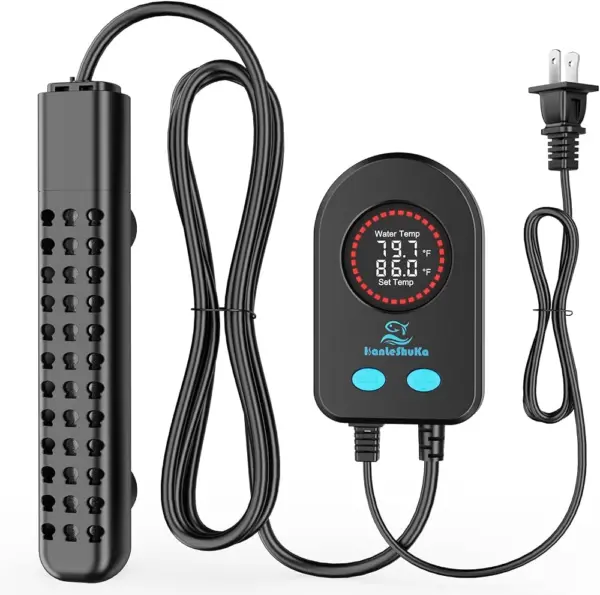
Start with the range, because it decides everything else: this is a ten-to-twenty-gallon heater, a hundred watts, with a body and controller to match, so it belongs in a ten-gallon at the very smallest. The upside is that a ten-gallon is a perfectly good betta tank, and at that size you have room for a controller, a cord and a mounting cup without crowding the fish.
The safety package is the most elaborate in the group: a dry-burn cutout that stops the element when it leaves the water, an overheat cutoff, an absolute maximum temperature stop, and a shell-patterned guard around the 2mm quartz tube. On top of that the external controller shows the set point and the current temperature at once, with red digits while it is heating and green when it is holding.
For a ten-gallon with a betta that treats the heater like furniture, this one earns its keep, because the guard and the dry-burn shutoff cover the two accidents people actually have. It is also the heaviest unit here at a pound and a third, and hanging that on suction cups takes a properly clean patch of glass. Below ten gallons, spend the money on a smaller heater instead.
Pros
- Dry-burn, overheat and max-temp shutoffs
- Guarded element for a fish that rests on it
- External display shows set and actual temperature
Cons
- Rated 10-20 gallons, oversized below a ten
- Heaviest unit here at 1.3 pounds
The safest package here for a 10-gallon betta tank, and overkill for anything smaller, because the guard and dry-burn shutoff earn the extra size and cost.
How We Tested Betta Fish Heaters
To build our shortlist, we researched the heaters that show up most often in betta forums and reviews, then narrowed by size (under 6 inches), adjustable temperature range (including 78–82°F), and safety features like auto shut-off and shatterproof casing. We also weighed value—whether a higher price actually bought better temperature control or a more durable build.
We ended up with 12 heaters—a mix of preset and adjustable models, with and without digital screens—and ran them continuously for six months in 5- and 10-gallon betta tanks in our homes. I kept two tanks on my desk, and a colleague kept one in a living room, so we could see how they performed at different room temperatures. We installed each one according to the instructions, noting how easy it was to mount with suction cups or clips, and whether the cord reached an outlet without an extension. We set each to 78°F and checked the water temperature twice a day with an independent thermometer, logging any swings.
Safety was a priority: we noted whether the heater shut off automatically when exposed to air during water changes, and we checked that the casing stayed cool enough to touch. We also measured how much space each took up in a 5-gallon tank—some models are too bulky for a small setup—and tested the display’s readability from a few feet away. To assess durability, we cleaned each heater monthly and inspected cords and suction cups for wear. After six months, the ones that held a steady temperature without any fuss stood out.
How to Choose a Betta Heater
A betta heater is a cheap device doing a job with no margin for error, so the decision comes down to matching wattage to your water and then buying the protections that cover the failure you cannot sit and watch for.
Wattage Follows Water, Not the Box Label
Twenty-five watts suits three to five gallons, fifty covers five to ten, and a hundred is for ten gallons and up. The trap is the wide rating printed on the box: a heater advertised for two to ten gallons is one the maker will stand behind across that span, not one that behaves gracefully at both ends. A fifty-watt element in two gallons of water cycles hard and overshoots.
If you are between sizes in a small tank, take the smaller heater and keep the room warm. Buying headroom in a betta tank is how people end up with a tank that swings four degrees twice an hour.
Preset or Adjustable: The Treatment Question
A preset 78°F heater removes a decision, and 78°F is the right number for a betta. Adjustable earns its place when you need to move the water: a course of heat treatment for ich usually means holding the tank in the low eighties, and a preset heater cannot go there. It also lets you trim the set point in a room that runs hot in summer or cold in winter.
Decide this before anything else, because it splits the field cleanly. Simplicity is a real feature; so is the ability to turn the dial when something goes wrong.
Placement, Guards, and the Fish That Leans
Bettas rest on things, and a bare glass heater is the warmest object in the tank. A caged element, or a body mounted low and horizontally along the back wall, cuts the chance your fish decides the heater is furniture. Site it where the filter moves water past it; a heater in a dead corner warms that corner and leaves the rest of the tank cool.
In a five-gallon there is little room to spare, so a short body does nearly as much good as a guard. A bulky unit eats the open water your betta actually swims in.
Shutoffs Are a Backstop, Not a Thermostat
Overheat cutoffs, dry-burn sensors and out-of-water shutoffs are worth paying for, and they are what turn a near-miss into a story you tell later. Read the trigger temperature, though: a cutoff that fires in the high nineties has already let the tank get warmer than a betta wants.
The check that actually protects the fish is a separate thermometer read at the same time every day, plus the habit of unplugging the heater before any water change that exposes the element.
Buy Assuming It Will Fail Eventually
Heaters at this end of the market stop heating, and one that sticks on is worse than one that quits. Keep a spare on the shelf, and swap it in the moment the temperature stops holding rather than waiting to see whether it comes back. In a small tank, a day of drift is already a problem.
Frequently Asked Questions
Do I really need a heater for one betta?
If the room is not already tropical, yes. Bettas do best between 78 and 80°F, and an unheated five-gallon in a house that sits near 68°F runs about ten degrees cold, which is the difference between a fish that eats and one that sulks on the bottom.
Test it before you buy: float a thermometer in the tank and read it first thing in the morning for a few days. If the water holds 78 through the night on its own, you have your answer.
Will a heater fit in a five-gallon tank with a hood?
Measure from the water line down to the substrate, not the outside of the tank. Every heater here has to sit fully submerged, and a hooded tank with a deep sand bed leaves less usable depth than the exterior dimensions suggest.
A short body is the easy answer, and a unit with an external controller keeps the bulky part out of the water entirely.
Does a small heater add much to the electricity bill?
Not much. A 50-watt heater running flat out for a month would use roughly 36 kWh, and in a normal room it cycles on and off rather than running continuously. Running cost is not the reason to choose between these picks; how the thermostat behaves and what happens when it fails are.
Final Verdict
The heater we recommend for most betta tanks is the NICREW 50W. It is built for the two sizes that matter, five and ten gallons, you can set and read the temperature without putting a hand in the water, and the 98°F cutoff is the backstop a small tank needs.
If your betta spends its day pressed against the glass, move up to the caged HiTauing. If the tank is three gallons, the little AQUANEAT is the right size and the right money.