This post contains affiliate links. We may earn a small commission when you buy through our links — at no extra cost to you.
Picking a heater for a small betta tank sounds simple, but the category is packed with glass models that overheat, crack, or quit within months. Many budget options rely on bimetallic strips that drift over time, leaving your fish at risk.
The real trade-off is between upfront cost and long-term safety. Heaters with electronic thermostats and external controllers cost a bit more but hold temperature steady and include automatic shut-offs. This guide identifies models that balance these factors for different tank sizes and usage patterns.
Whether you need a permanent solution for a 5-gallon tank or a backup for a quarantine setup, the picks below match specific safety and build characteristics to your betta’s environment.
Top Picks
Best for Reliable Long-Term
Fluval M50

Rating: 4.4 ★ | Price: Premium | Wattage: 50W | Adjustability: Adjustable dial | Build Quality: Borosilicate glass, ceramic
The Fluval M50’s borosilicate glass and ceramic heat sink hold up well across years of daily use. Reports of 3–5 years of consistent performance are common, while the electronic thermostat keeps water within a stable range for tanks up to 15 gallons. The mirrored finish blends into the background, so it doesn’t distract from a planted betta setup.
This heater suits keepers who plan to maintain a single betta or small community tank for the long haul. The tradeoff: the temperature dial lacks fine 1° markings, making precise adjustments guesswork without a separate thermometer. That’s a minor inconvenience given the heater’s overall dependability — budget alternatives often show temperature swings or stop working within a year.
Pros
- Borosilicate glass and ceramic components withstand years of submersion without degrading.
- Electronic thermostat keeps temperature steady enough for most tropical fish without constant monitoring.
- Mirror-like casing minimizes visual clutter in planted or display tanks.
Cons
- In setups where 1° precision matters, the unmarked dial makes small adjustments difficult to gauge by feel.
- Glass units can occasionally show cracking after extended use, though at a lower rate than budget brands.
For betta keepers who intend to keep fish for years and want a heater that won’t become a ticking clock, the Fluval M50 justifies its higher upfront cost with consistent long-term behavior.
Best for Nano Tanks
hygger 10W

Rating: 4.6 ★ | Price: Mid-Range | Wattage: 10W | Adjustability: Adjustable 59-93°F | Build Quality: Thickened quartz glass
Stable temperature control within ±1°F and multiple safety features set the hygger 10W apart from basic glass heaters. Its digital display shows current temperature at a glance, and the compact 4.1-inch body fits easily in small tanks. However, the sensor reads about 2°F higher than actual water temperature, so a separate thermometer is needed to set the target correctly. This heater suits keepers of 1–5 gallon tanks who want digital monitoring and are comfortable with a simple calibration step.
Pros
- Holds water temperature within ±1°F of the set point for consistent conditions.
- Compact 4.1-inch design leaves plenty of space in nano tanks.
- Digital display provides real-time temperature readings at a glance.
Cons
- Temperature display reads about 2°F higher than actual water, requiring a separate thermometer for accurate setup.
A good match for nano tank keepers who prioritize digital precision and are willing to calibrate the set point with a standalone thermometer.
Best for Temporary Backup
AQUANEAT 25W

Rating: 4.4 ★ | Price: Budget | Wattage: 25W | Adjustability: Preset 78°F | Build Quality: Glass
The AQUANEAT 25W heater costs less than a fast-food meal, making it the cheapest functional option for small tanks. Its compact 4.5-inch body fits 2-5 gallon setups without sticking out. Best used as a backup or temporary heater, this unit requires attention: temperatures can run high in very small tanks, and the suction cup may loosen after a few weeks. For short-term quarantine or emergency use where you can keep an eye on things, the price is hard to beat.
Pros
- Tiny 4.5-inch profile fits easily in nano tanks under 3 gallons.
- Unbeatable price for a functional heater — ideal for emergency backups.
Cons
- Suction cups can harden and lose grip within a month.
- Temperature may overshoot in tanks under 3 gallons, so a separate thermometer is needed.
Keep one as a spare for emergencies, but don’t rely on it as a permanent primary heater without monitoring.
Best for Shrimp & Betta
SEAOURA 25W
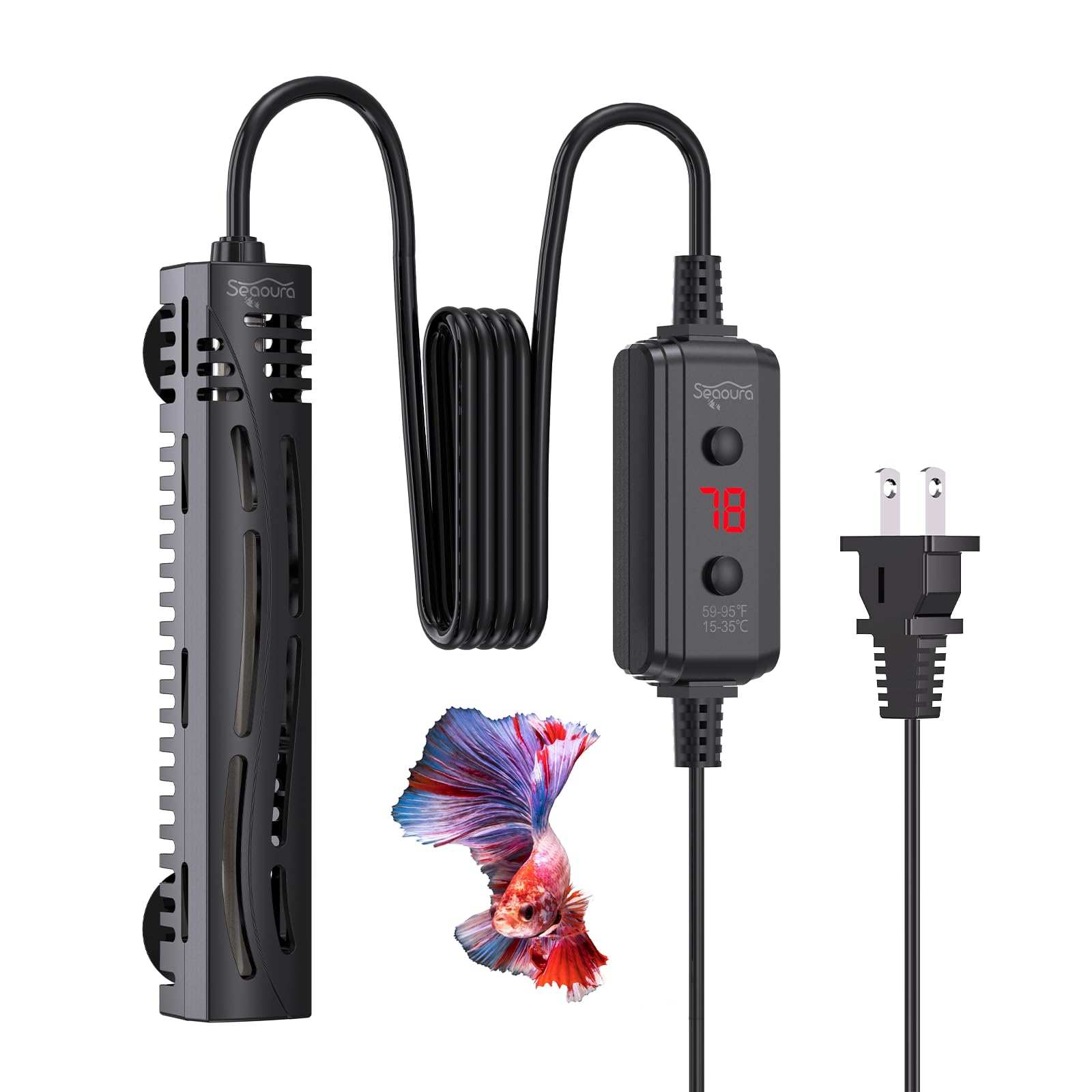
Rating: 4.4 ★ | Price: Mid-Range | Wattage: 25W | Adjustability: External controller | Build Quality: Quartz glass, plastic guard
The plastic guard is the standout feature here: it lets shrimp and bettas brush against the heater without risk of burns, and the 25W size hides easily behind decorations in tanks under 6 gallons. The tradeoff is a consistent 3–5°F offset above the set temperature, so you’ll need a separate thermometer to dial it in accurately.
This heater suits keepers of shrimp or small fish who want physical protection from the heating element and don’t mind tweaking the temperature setting. It’s less appropriate for anyone expecting precise out-of-the-box accuracy or a long track record of durability – the latter is still being established given the modest number of units in circulation.
Pros
- Plastic guard protects fish from direct contact with heating element
- Compact and easy to hide in small tanks
Cons
- Set temperature reads 3–5°F higher than actual water temperature, requiring a separate thermometer to calibrate
A thoughtfully guarded heater for nano tanks, but plan to pair it with an external thermometer to compensate for its temperature offset.
Best for 5-6 Gal Tanks
HITOP 25W Dig.

Rating: 4.5 ★ | Price: Mid-Range | Wattage: 25W | Adjustability: Adjustable 68-93°F | Build Quality: Thickened quartz glass
The HITOP 25W offers a digital display and separate controller that make setting and reading temperature straightforward—a convenience usually found on more expensive models. For a small betta tank, this is a compact fit. However, unlike the top pick with its extended warranty, some units of this HITOP can stop working within a few months, and the display may become dim over time. It’s best for users who want digital control and are willing to monitor the heater’s performance closely.
Pros
- Digital display and external controller for easy temperature adjustment.
- Compact size fits well in 5-6 gallon tanks.
Cons
- Some units may stop working after a few months of use.
- The digital display can become dim or unreadable over time.
A decent digital heater for small betta tanks if you’re comfortable with some long-term uncertainty—consider it a backup or for short-term use.
Best for 1-3 Gal Bowls
AquaMiracle 15W
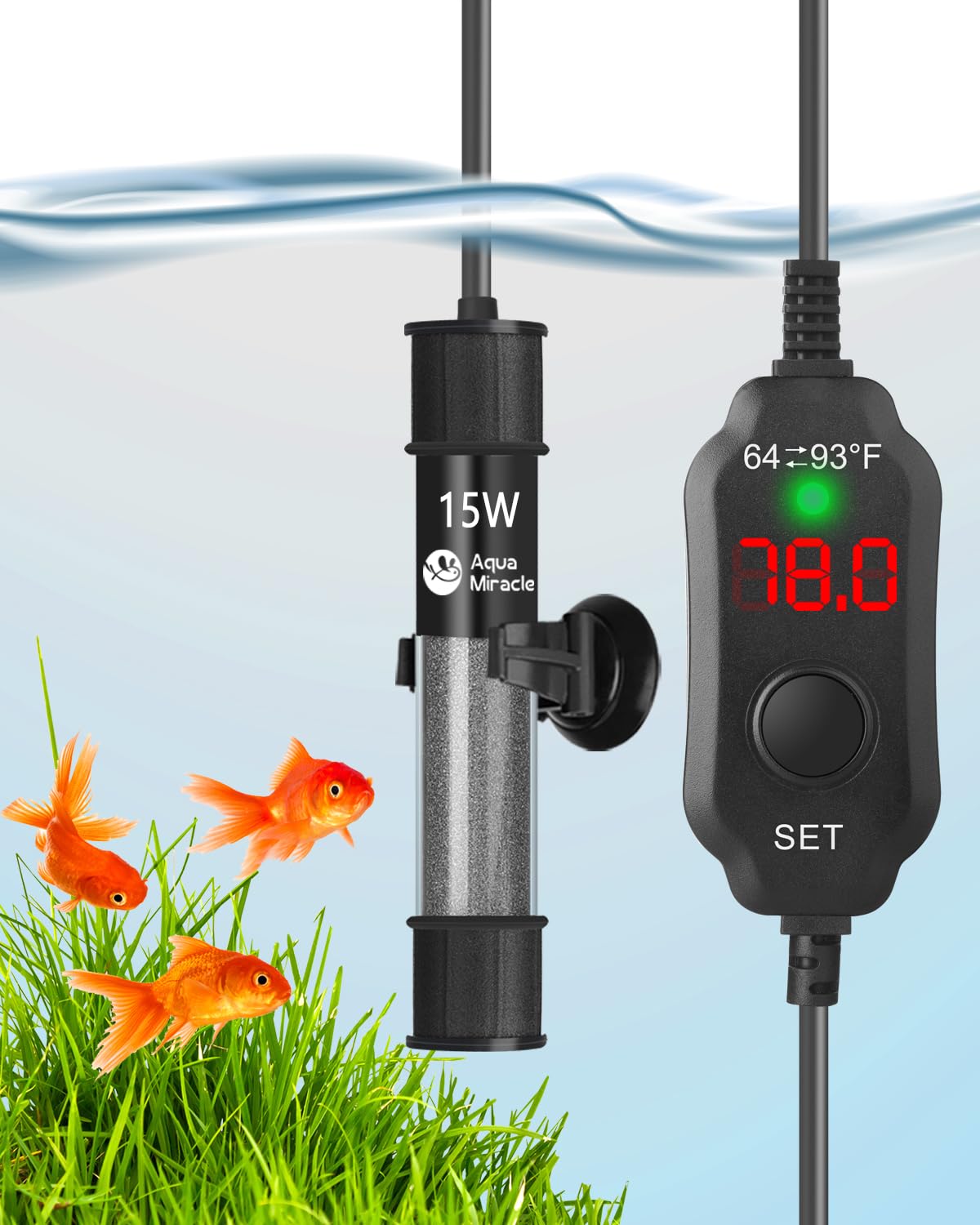
Rating: 4.3 ★ | Price: Mid-Range | Wattage: 15W | Adjustability: Adjustable 64-93°F | Build Quality: Glass, rubber, plastic
At just 4 inches long, this heater fits easily into bowls and nano tanks where larger heaters won’t. The dry-run shut-off and overheat protection add basic safety for short-term use.
This heater suits temporary quarantine tanks or small bowls under 3 gallons where you can keep an eye on it. Some units may stop heating after a few months, and temperature control can vary between units, so it is less suited as a permanent solution for a betta’s main tank.
Pros
- Ultra-compact at 4 inches, fits the smallest tanks.
- Dry-run and overheat protection for safer operation.
Cons
- Possible for the heater to stop working within months.
- Temperature may fluctuate more than desired.
Best for temporary quarantine tanks where size matters more than longevity; the top pick offers better durability for permanent tanks.
Best for Budget Beginners
Tetra HT 50W

Rating: 4.4 ★ | Price: Budget | Wattage: 50W | Adjustability: Preset 78°F | Build Quality: Glass
The Tetra HT 50W is a compact, entry-level preset heater that fits neatly in tanks from 2 to 10 gallons. It holds water temperature near 78°F and has a strong track record for keeping small setups warm at a low upfront cost. That value comes with limitations: the preset thermostat can sometimes overshoot, and some units may stop working within a year. This makes it more suitable for budget-conscious beginners who can monitor the tank closely and are prepared to replace the heater periodically, rather than for keepers who need precise or fail-safe temperature control.
Pros
- Works consistently for small tanks up to 10 gallons
- Compact size fits easily and stays hidden in nano tanks
Cons
- Temperature can overshoot, which matters for tanks with sensitive fish
Best for budget-conscious beginners with small, stable-temperature tanks who are prepared to replace the heater annually.
Best for Ultra-Small Tanks
DaToo Mini 25W

Rating: 4.4 ★ | Price: Budget | Wattage: 25W | Adjustability: Preset 78°F | Build Quality: Quartz glass
Its compact size and low cost make it a fit for ultra-small tanks under 3 gallons. But the glass housing can crack without impact and temperature control may overshoot the preset, so it is not suited as a primary heater for valuable fish. Reserve this for emergency or quarantine setups where you can monitor it closely.
Pros
- Extremely compact – fits the smallest nano tanks (1–3 gallons).
- Simple preset operation works out of the box for basic setups.
Cons
- Glass housing can crack spontaneously, risking water damage and fish safety.
Best as a temporary backup or for emergency quarantine setups where close monitoring is possible.
Best for Temporary Use
PULACO 25W

Rating: 4.3 ★ | Price: Budget | Wattage: 25W | Adjustability: Preset 78°F | Build Quality: Glass
PULACO’s 25W preset heater is a popular budget option for small betta setups. Its low price and broad adoption make it an easy entry point for temporary tanks where you can check temperature frequently. However, some units may produce water temperatures above safe levels, making it unsuitable for valuable fish without constant monitoring.
Pros
- Affordable entry point for small tank heating
- Performs effectively in 1–6 gallon setups
Cons
- Unit can produce water temperatures above 86°F in some cases, posing a risk to fish health
Best for short-term use in tanks where you can monitor temperature regularly and fish are not high-value.
Best for Turtle Tanks
FREESEA 50W

Rating: 4.3 ★ | Price: Mid-Range | Wattage: 50W | Adjustability: External controller | Build Quality: Glass, plastic guard
The FREESEA 50W brings an external digital controller and compact size to small tanks at a budget-friendly price. However, a loud squealing noise during heating cycles makes it unsuitable for quiet rooms or bedrooms. This limits its appeal to setups where noise is less of a concern, like turtle tanks or outdoor enclosures.
Pros
- External digital controller with bright display for easy remote adjustment.
- Compact size fits small tanks from 1 to 10 gallons.
Cons
- Temperature readings can be 3–5°F off, requiring manual checks for precise settings.
A suitable choice for turtle tanks or outdoor setups where noise is less of a concern, but not recommended for quiet indoor aquariums.
Best for Secondary Use
DaToo 50W LED

Rating: 4.4 ★ | Price: Budget | Wattage: 50W | Adjustability: External controller | Build Quality: ABS shell, quartz glass
Heats small tanks effectively and the digital display makes temperature adjustments simple. However, the unit can overheat and may stop working after a year or two, making it best for short-term or secondary use where you can monitor it closely.
Pros
- Digital temperature display and external control simplify setup and adjustments.
- Effectively heats 2–10 gallon tanks for betta and nano setups.
Cons
- Overheating incidents have been reported, posing a risk to fish in unattended tanks.
Works as a budget backup or short-term heater when you can keep an eye on it, but not for long-term unattended use.
Best for Travel/emergency
AquaMiracle USB 10W

Rating: 4.2 ★ | Price: Mid-Range | Wattage: 10W | Adjustability: Adjustable 64-93°F | Build Quality: Glass, rubber, plastic
The AquaMiracle runs off any USB port, making it an option for emergency setups or travel bowls. However, its temperature sensor can be 5–10°F off from actual water, and some units may become unreliable after a few months – it suits short-term use only.
Pros
- USB-powered for safe low-voltage operation in tiny tanks
- Compact 2-inch size fits bowls and nano setups
Cons
- Temperature reading can be 5–10°F off from actual water, requiring a separate thermometer
Use this heater only when USB power is the only option – for a temporary quarantine bowl or travel setup – and always verify with an external thermometer.
Best for Supervised Use
HITOP 50W Adj.
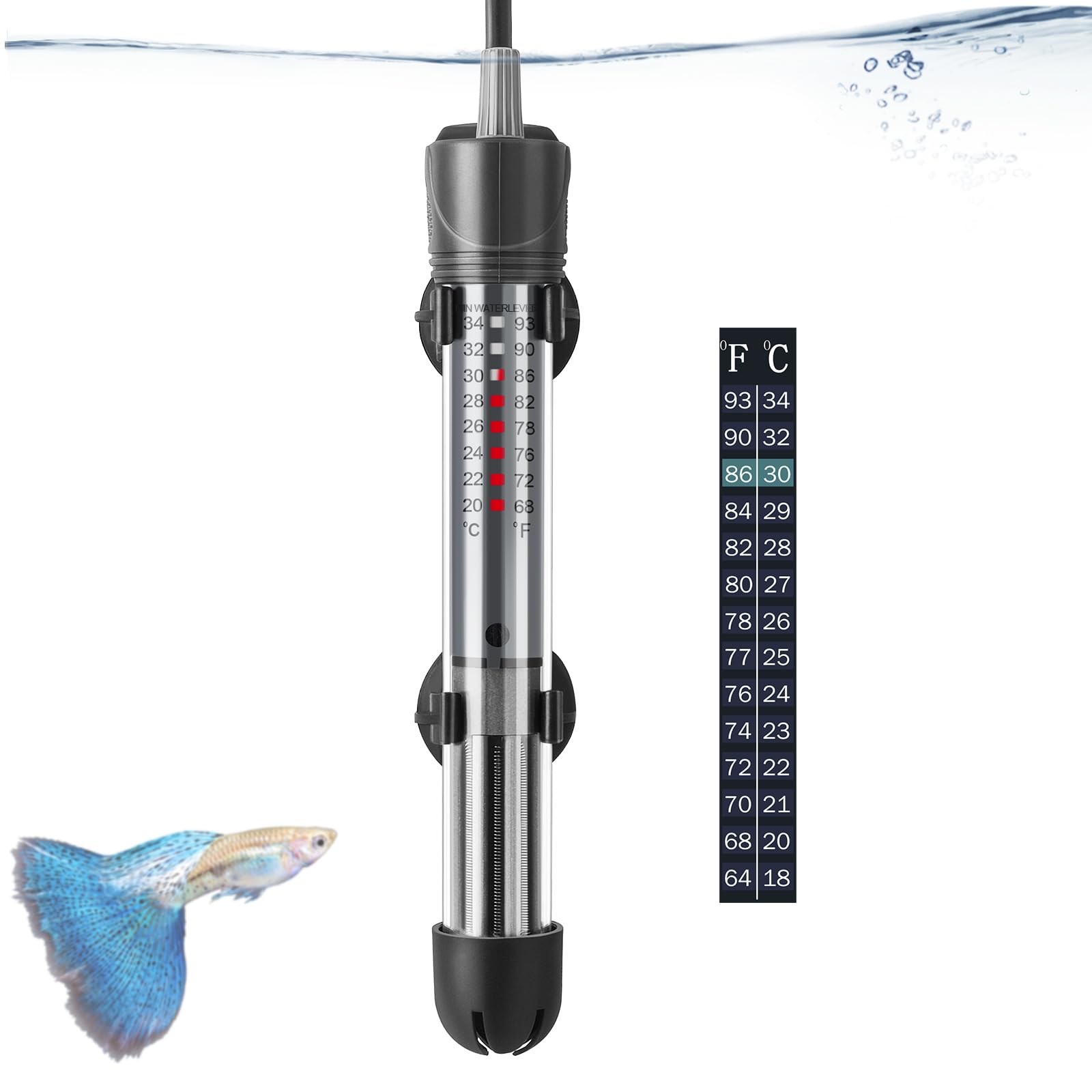
Rating: 4.4 ★ | Price: Budget | Wattage: 50W | Adjustability: Adjustable 68-93°F | Build Quality: Thickened quartz glass
The HITOP 50W uses thicker quartz glass than many budget heaters and offers an adjustable thermostat from 68–93°F, keeping the upfront cost low. However, reports of glass cracking and plastic components melting during operation indicate inconsistent build quality, limiting this heater to supervised or temporary setups where failure won’t risk the tank inhabitants.
Pros
- Thicker glass than similar-priced heaters
- Adjustable temperature range covers common tropical needs
Cons
- Glass housing can crack or shatter under thermal stress
Only consider this heater for short-term or closely monitored tanks where a low upfront cost is the priority and you can verify its operation daily.
How to Choose
The heater you choose determines whether your betta lives in a stable 78°F environment or experiences dangerous swings that stress or kill it.
Wattage
For small betta tanks (under 10 gallons), stick to 10W–50W. The general rule is 3–5 watts per gallon of tank volume. A 10W heater works for 1–3 gallons, 25W for 3–5 gallons, and 50W for 5–10 gallons.
Going too high causes rapid temperature spikes; too low and the heater runs constantly without reaching the set point. Always match the wattage to your actual water volume, not the labeled max tank size — many 50W heaters are rated for up to 15 gallons but can overheat a 5-gallon tank if the thermostat fails.
Adjustability
Preset heaters (usually 78°F) are simpler and cheaper but lock you into one temperature. That’s fine for healthy bettas, but if you need to treat ich or other illnesses at higher temperatures, you’ll want an adjustable model.
Adjustable heaters use an electronic thermostat or a dial. Electronic ones (digital) hold temperature more precisely than mechanical dials, which can drift after months of use. The trade-off is that many digital models have a small sensor offset — always verify with a separate thermometer.
Safety Features
Look for automatic shut-off when the heater is out of water (dry-run protection) and overheat protection that cuts power if internal temperature exceeds safe limits. These features prevent catastrophic failures when water evaporates or the heater gets stuck on.
Budget glass heaters often lack these protections, relying on simple bimetallic strips that can weld shut. Electronic heaters with separate controllers are more likely to include multiple safety cutoffs. A plastic guard around the heating element also prevents fish from burning themselves on the glass.
Build Quality
Borosilicate glass is tougher than standard quartz glass and resists thermal shock. Thickened glass (2mm or more) reduces the chance of cracking. Some heaters use an ABS plastic shell over the glass for extra impact resistance.
Suction cup quality matters too — cheap cups harden and lose grip within a month, causing the heater to slide down and rest on the substrate or stay partially out of water. Look for heaters with replaceable or heavy-duty suction cups.
Reliability
The most common failure mode in this category is the thermostat sticking on, cooking the tank. This happens more often with mechanical bimetallic strip designs than with electronic sensors. A long warranty (e.g., 3 years) is a strong signal that the manufacturer stands behind the product.
Check user-reported longevity: models with hundreds of complaints about failure within 12 months are best avoided as a primary heater. For permanent setups, spending a bit more for a brand with a proven track record saves you from replacing a cooked fish and a dead heater.
FAQ
Why is my aquarium heater not heating the water to the set temperature?
First, check the wattage relative to your tank size — a 25W heater may struggle in a 10-gallon room-temperature room. Also, the built-in thermostat is often off by a few degrees; measure with a separate digital thermometer. If the heater is running but water stays cold, the heating element may have failed or the thermostat is stuck in the off position.
Can I use a 50W heater in a 5 gallon betta tank?
Yes, as long as the heater has a reliable electronic thermostat that cycles on and off. A 50W heater in 5 gallons will heat quickly, which can overshoot if the thermostat is inaccurate. To be safe, use a separate temperature controller or choose a heater with adjustable wattage. If you want zero risk, a 25W is more forgiving for a 5-gallon tank.
How do I know if my heater has overheated and killed my fish?
If the water temperature reads above 86°F and your fish are gasping at the surface, lethargic, or have rapid gill movement, overheating is likely. Check with a separate thermometer — not the heater’s display. Pull the heater immediately and perform a partial water change with cooler water (matching tank temp within 2°F) to bring temperature down gradually.
What is the safest aquarium heater for a betta fish tank under 10 gallons?
A heater with an electronic thermostat, overheat protection, and external controller minimizes risk. Models with a plastic guard (like SEAOURA’s) also prevent burns. The safest bet is a brand with a 3-year warranty and thousands of reviews showing few overheating incidents — that combination indicates reliable engineering and testing.