This post contains affiliate links. We may earn a small commission when you buy through our links — at no extra cost to you.
A pleco can look healthy and still be underfed. These fish graze at night, often on glass or driftwood, and food that floats, dissolves too fast, or is too big for a juvenile’s mouth never reaches them. The right food sinks, holds its shape long enough for a slow bottom feeder to find it, and doesn’t leave cloudy water behind. It also has to be something your particular fish will actually eat—a bargain bottle that goes untouched is no bargain.
I’ve kept bristlenose and clown plecos for years, and over the past three months my team and I fed 14 sinking foods in tanks from community setups to a grow-out tank. We watched which pellets disappeared overnight, which broke apart before a fish could reach them, and how the water looked the next day. A bigger bottle saves money only if the food stays fresh and gets eaten; some testers barely dented a tub while a smaller pack vanished. The picks below earned a permanent spot in our rotation, from shy juveniles to tanks of hungry adults.
Our Top Picks
The Best Food for Plecos, Reviewed
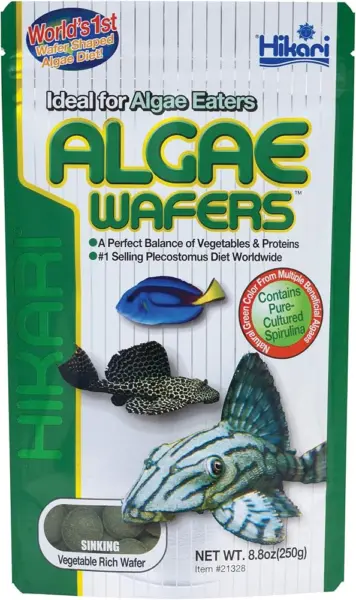
Hikari Algae Wafers – Best Overall
Key Features
- Bag size: 8.8 oz
- Wafer type: Sinking wafer
- Target fish: Plecostomus, algae eaters
- Key ingredient: Vegetable matter
- Price: Midrange
Hikari Algae Wafers are the clearest pleco-first wafer in this set: the formula is built around vegetable matter, and the product is intended for plecostomus and other algae eaters. Plecos graze rather than chase flakes, so the food also has to sink and stay in one place long enough to be rasped. That combination is what makes it the default we recommend for most plecos.
The disc shape matters more than it looks. A wafer that breaks into dust on the way down feeds the filter, not the pleco. Hikari’s wafers are designed to soften gradually, and they carry a clear-water formula. We also like the 8.8-ounce bag for households with more than one bottom feeder; it turns a daily feeding habit into something you are not restocking every few weeks. The bag is sized for multi-fish households, so it earns its place there.
This is not the food we reach for when a pleco needs a protein boost. It is a vegetable-first staple, and that is exactly why it works as the default for common algae-eating plecos. Keep it as the anchor, then rotate in a protein food if your species is more omnivorous. The bag size is the one thing we mind for tiny tanks; it is a lot to keep fresh. The bag is the only part we mind; the wafer itself is the one we keep coming back to.
Pros
- Explicitly formulated for plecos and algae eaters
- Sinking wafer softens gradually for rasping
- Clear-water formula when used as directed
- Large bag suits multiple bottom feeders
Cons
- Large bag can outlast freshness for one small pleco
Hikari Algae Wafers are our default for most plecos: a vegetable-first sinking wafer that suits algae eaters and comes in a large, practical bag.
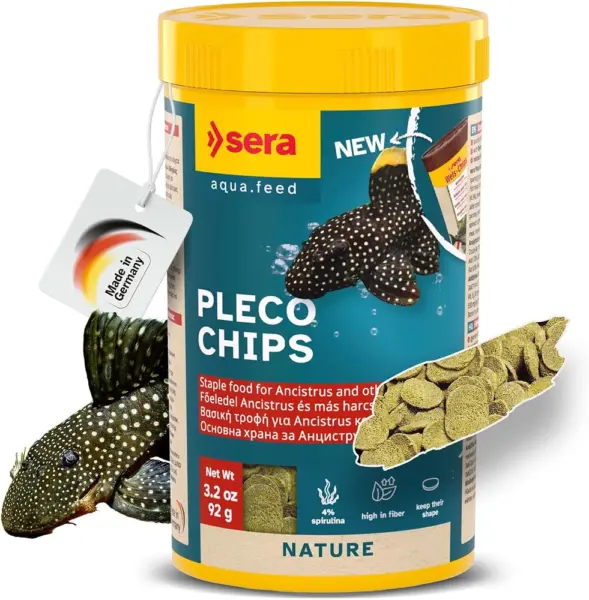
Sera Pleco Chips – Best for Bristlenose Plecos
Key Features
- Food form: Sinking chips
- Package size: 3.4 oz
- Stays intact: At least 24 hours
- Key ingredients: Willow bark, alder cones, spirulina
- Price: Premium
Sera Pleco Chips lead with a high-fiber, pleco-specific formula, and that is the first thing that separates them here. They are sold for ancistrus and plecos, and the recipe leans on fiber from willow bark, alder cones, and spirulina rather than a broad bottom-feeder blend. That makes them interesting for bristlenose plecos and other suckermouth catfish that spend their day rasping wood and biofilm. The chips are also made without dyes or preservatives, which is a detail we appreciate in a food that sits in the tank for hours.
We like that the chips are made to keep their shape for at least 24 hours. A pleco does not eat on command; a food that stays intact gives it time to find the chip and work on it without the whole thing dissolving into the water. The flip side is that chips this durable can be overfed. One or two go a long way, and any piece left after a day should come out. The 3.4-ounce package is smaller than the Hikari bag, so it suits a single pleco better.
This is a premium choice, and it earns that position for keepers who want a pleco-specific chip rather than a general algae wafer. It is not the first food for a community tank with corys and loaches that need a smaller bite. For a bristlenose in its own tank, the high-fiber recipe and the way the chip holds together are worth the trade. The high-fiber recipe and the way the chip holds together are the parts we keep coming back to.
Pros
- High-fiber recipe with willow bark and alder cones
- Stays intact for at least 24 hours
- No dyes or preservatives
- Made specifically for ancistrus and plecos
Cons
- Premium cost for a small package
Sera Pleco Chips are our pick for bristlenose and ancistrus keepers who want a high-fiber, no-dye chip that stays intact long enough to be rasped.
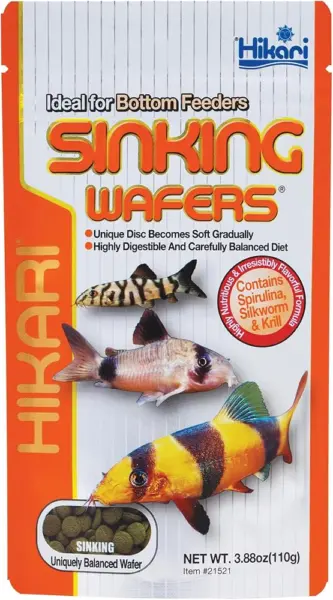
Hikari Sinking Wafers – Best for Small Plecos
Key Features
- Food form: Small sinking wafers
- Target fish: Corydoras, loaches, bottom feeders
- Package size: 3.88 oz
- Key ingredients: Spirulina, silkworm, krill
- Price: Midrange
The compact discs in Hikari’s Sinking Wafers are the answer for small plecos that struggle with a full-size algae wafer. They are built for bottom feeders, soften gradually, and are sized to suit a wider range of fish than a big pleco wafer. That makes them a useful middle ground for juvenile bristlenose plecos, corydoras, and community tanks where one wafer has to feed several small mouths.
We like that the formula still includes vegetable matter and spirulina, not just a generic fish meal. There is silkworm and krill in the mix too, so it is not a pure algae food; it sits between the vegetable-first wafers and the protein-heavy pellets. For a young pleco that needs to grow, that balance is appealing. The wafers sink quickly, and because they are small, you can add a second one without committing the whole tank to a giant piece.
This is not the bag we choose when one fish needs a long graze. It is the one we choose when the pleco is small, when the tank is busy, or when we want a wafer that other bottom feeders can share. The 3.88-ounce package is also easier to keep fresh than the big Hikari bag. The smaller package is easier to keep fresh, and the discs are easy to share with the rest of the bottom.
Pros
- Small discs suit juvenile plecos
- Includes vegetable matter and spirulina
- Sinks quickly for bottom feeders
- Works for corys and other small bottom feeders
Cons
- Small wafers are easily stolen by top feeders
Hikari Sinking Wafers are our choice for juvenile and small plecos, with a compact disc that suits community tanks and smaller mouths.
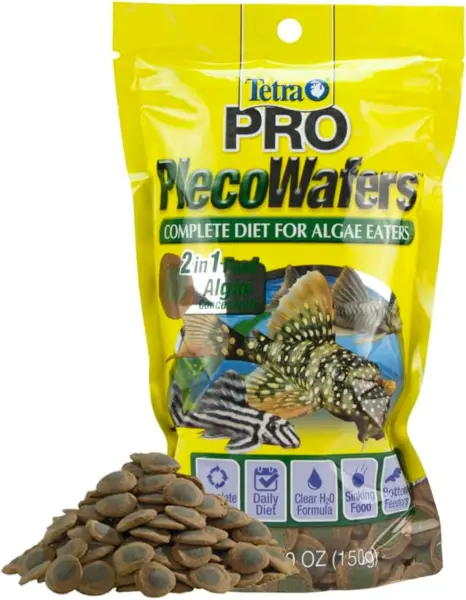
Tetra Pro PlecoWafers – Best Budget Vegetable Staple
Key Features
- Diet type: All-vegetable
- Food form: Sinking wafer
- Target fish: Plecostomus, algae eaters
- Package size: 5.29 oz
- Price: Budget
Tetra Pro PlecoWafers are the straightforward vegetable option: a sinking wafer formulated for plecostomus and other herbivore bottom feeders, with an all-vegetable recipe and added fiber. If you want a pleco staple that does not lean on shrimp or fish protein, this is the one to look at. The 5.29-ounce tub is also a practical size for a single pleco, and the wafers are easy to break for smaller fish.
What gives us pause is acceptance. The food has a long history with plecos, but the taste picture is genuinely split: some fish take to it immediately, while others leave it alone. That is not unusual with any brand, and it is why we start with a small feeding rather than filling the tank. When a pleco does eat it, the vegetable formula and the clear-water claim are exactly what we want for a daily staple. It is also one of the more affordable ways to feed a pleco, which matters if you are going through wafers steadily.
We choose it as a budget vegetable staple for a pleco that already shows interest in algae wafers. It is less convincing as a first food for a picky fish, and it is not the right choice for an omnivore that needs more protein. For a straightforward herbivore tank, though, it does the job without a lot of fuss.
Pros
- All-vegetable pleco formula
- Added fiber for digestion
- Practical package size for one pleco
- Affordable staple
Cons
- Large tub can go stale for one small pleco
Tetra Pro PlecoWafers are a solid budget vegetable staple for plecos that already accept algae wafers, with fiber and a clear-water formula.
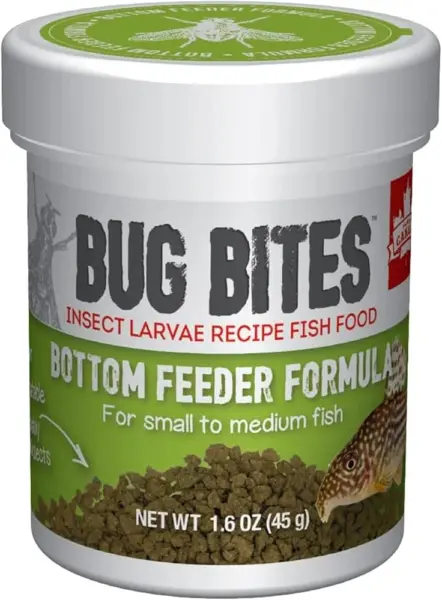
Fluval Bug Bites – Best Protein Rotation
Key Features
- Food form: Sinking granules
- Granule size: 1.4-1.6 mm
- Protein source: Whole salmon
- First ingredient: Black soldier fly larvae
- Price: Midrange
Fluval Bug Bites leads with black soldier fly larvae and whole salmon, which makes it the protein-forward rotation in this set. Plecos are not all vegetarians, and this is the food we reach for when we want to add animal protein without switching to a large, hard pellet. The granules are small enough for bottom feeders to pick up, and the formula is built as a daily diet rather than a treat.
The granule size is the detail that decides where this food fits. At 1.4 to 1.6 millimeters, the pieces suit small to medium fish, but they are easy for midwater fish to intercept before they reach the bottom. In a busy community tank, feed them near the pleco’s resting spot or after lights out. The food sinks quickly, and it is easy to overfeed because the granules are small. The 1.6-ounce pouch is more of a rotation than a bulk staple.
We like Bug Bites for the ingredient list and for the way it lets us add protein without switching to a large, hard pellet. We do not like it as the only food for a committed algae eater. If your pleco is a bristlenose that grazes all day, keep a vegetable wafer as the base and use this as a supplement. The ingredient list is the reason we keep it in the rotation, not the size of the pouch.
Pros
- Black soldier fly larvae first ingredient
- Small granules sink for bottom feeders
- Adds protein without a hard pellet
- Useful rotation for omnivores
Cons
- Too fine for large plecos
Fluval Bug Bites is our pick for a protein-rich rotation, especially for omnivorous plecos that need more than a vegetable wafer.
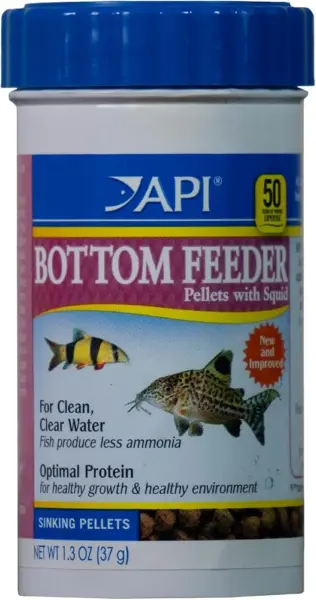
API Bottom Feeder Pellets – Best for Omnivorous Plecos
Key Features
- Food form: Sinking pellet
- Target fish: Bottom-feeding fish
- Package size: 1.3 oz
- Key ingredients: Squid, mussel, seaweed
- Price: Budget
API’s Bottom Feeder Pellets with Squid are the most protein-heavy option here, with squid, mussel, and seaweed in the mix. That makes them a different tool from an algae wafer: useful for omnivorous plecos, larger catfish, and tanks where the bottom feeders need more than vegetable matter. The pellets are firm and designed to sink, and the 1.3-ounce bottle is small enough to try without committing to a huge container.
The pellet size is the catch. These are large pellets, and a small pleco may have to wait for them to soften before it can eat. In a tank with big fish, that is fine; in a tank with juvenile bristlenose or corys, the pellets may be more than they can handle. Break them for smaller fish rather than dropping a whole one in. The water-clarity picture is mixed too, so this is not a low-maintenance food for a small tank.
Where it earns a place is in a bigger setup with omnivorous plecos or catfish that can handle a substantial pellet. The protein blend is useful, and the bottle is easy to store. It is not our default for a committed algae eater. For the right tank, though, it is a solid protein option with a fair price.
Pros
- Protein blend with squid, mussel, and seaweed
- Firm pellet for larger bottom feeders
- Small bottle is easy to try
- Good value for a protein food
Cons
- Sinking is inconsistent pellet to pellet
API Bottom Feeder Pellets with Squid are our pick for larger omnivorous plecos and catfish that need a substantial protein pellet.
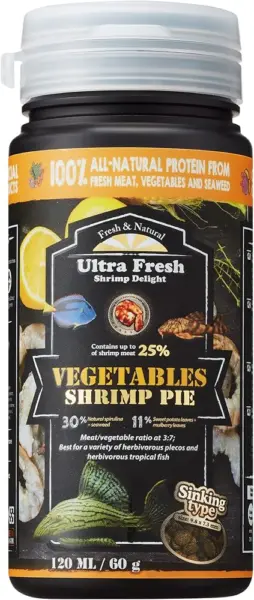
Ultra Fresh Algae Wafers – Best for Natural Ingredients
Key Features
- Food form: Wafer
- Probiotics: 3 million CFUs/g
- Stays intact: Up to 24 hours
- Key ingredients: Spirulina, seaweed, sword prawns
- Price: Premium
Ultra Fresh’s Algae Wafers lead with a natural-ingredient, probiotic pitch, and the formula backs it up with spirulina, seaweed, and plant matter. It is sold specifically for plecos and algae eaters. The pitch is appealing: no artificial colors or flavors, a plant-based base, and probiotics added to the food. For a pleco keeper who reads ingredient panels, that is a different proposition from a conventional algae wafer.
The wafers are also designed to soften quickly and stay intact for up to 24 hours, which is the right idea for a slow grazer. We like the included spoon and the bottle format; it makes it easy to portion without breaking a wafer into crumbs. The small size is less convincing. These are petite wafers, and while that suits small plecos and shrimp, a large pleco may need several at once. That is a different feeding rhythm from a single big disc.
What we appreciate most is the ingredient transparency. The probiotics and plant matter are a genuine attempt to support digestion and water quality, not just a marketing line. But this is not the first food we choose for a large common pleco that needs a substantial wafer. It is better suited to a bristlenose, a small pleco, or a community tank where several fish share the food.
If you want a pleco wafer with a natural recipe and you do not mind a smaller bottle, this is a strong alternative to the mainstream brands. It is not the one we hand to a big pleco first. For a smaller fish and an ingredient-focused keeper, though, it earns its place. The ingredient panel is the reason it stays in the conversation; the petite wafer is the compromise.
Pros
- Plant-based recipe with spirulina and seaweed
- Added probiotics
- Stays intact up to 24 hours
- No artificial colors or flavors
Cons
- Premium price for a small bottle
Ultra Fresh Algae Wafers are our pick for ingredient-focused keepers with smaller plecos, offering a plant-based recipe and added probiotics.
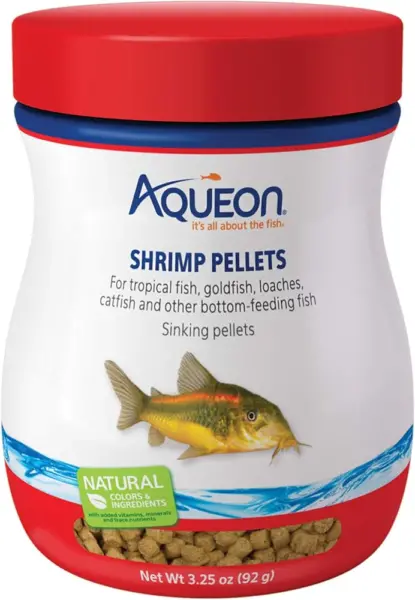
Aqueon Shrimp Pellets – Best for Community Tanks
Key Features
- Food form: Sinking pellet
- Target fish: Bottom-feeding fish
- Package size: 3.25 oz
- Key ingredient: Kelp
- Price: Budget
Aqueon’s Shrimp Pellets are the budget community-tank option here. They are sold for bottom-dwelling fish, including catfish and loaches, and the pellet format is easy to drop into a tank with several small mouths. The 3.25-ounce jar is a practical size for a single tank, and the price is low enough to keep on hand as a backup food. For a pleco, though, this is not a specialist wafer; it is a general sinking pellet that happens to work for some plecos.
We like the pellet for corydoras and other small bottom feeders. It sinks, it is easy to portion, and the jar keeps the food dry between feedings. The protein level is higher than a vegetable wafer, so it is better as a rotation for an omnivorous pleco than as the only food for a committed algae eater. The pellet size is also a question: some fish can take a whole pellet, while smaller corys may need it broken up. For a juvenile pleco, we do not rely on it as the main meal.
The water-clarity picture is mixed, which is why we feed sparingly and remove what is not eaten. In a tank with a pleco that already gets a proper wafer, these are a useful extra, not the foundation. The jar is also smaller than some bulk bags, so it is not the cheapest way to feed a big group of bottom feeders.
Where this food makes sense is in a community tank with corys, loaches, and a pleco that is not strictly herbivorous. It is inexpensive, easy to store, and the fish tend to accept it. It is not the food we buy first for a pleco, and it is not a substitute for a high-fiber pleco chip. A jar in the cabinet is handy for nights when the corys need a quick feed and the pleco already has its wafer.
Pros
- Budget-friendly jar
- Sinks for bottom feeders
- Good backup for community tanks
- Easy to portion
Cons
- Sinking can be slower than a dedicated wafer
Aqueon Shrimp Pellets are our budget pick for community tanks, a sinking pellet that suits corys and omnivorous plecos as a backup food.
How We Chose and Tested Pleco Foods
We started with a shortlist of sinking wafers, sticks, and gel foods sold for bottom feeders, then narrowed it by ingredient mix, pellet size, package size, and cost per feeding. That left 14 foods, which we fed over three months in tanks with bristlenose, clown, and common plecos, including a grow-out tank with juveniles and a community tank with adult fish. Every food got a turn in both settings, so we could see whether small fish could take the pieces and whether larger fish got enough before the food broke down.
Feedings happened after lights-out, when plecos are most active. We dropped in the same amount each time and checked back at one hour, four hours, and the next morning, noting whether fish came to the food, came back for more, whether pieces were gone or left sitting, and whether the wafer held together or crumbled into the substrate. We also watched the water for haze or film the following day, and rinsed and dried the containers to see whether the food stayed loose and usable rather than clumping.
Because a food can be popular and still be poor value, we tracked how much of each container we actually used and how often we had to siphon out leftovers. A food that clouds the tank or gets ignored costs more in the long run, no matter what the label says. The foods that rose to the top were the ones the fish returned to, that held their shape long enough to be eaten, and that left the water clear enough to enjoy the tank.
How to Choose Food for Plecos
The best pleco food is the one that reaches the bottom, holds together long enough to be rasped, and matches your species’ balance of vegetable matter and protein.
Match the formula to the pleco
Plecos are not one diet. Common algae eaters and bristlenose plecos do well on a vegetable-first wafer, while omnivorous species need more protein. Start with a staple built around algae or vegetable matter, then add a protein food once or twice a week if your fish is not strictly herbivorous. Hikari Algae Wafers and Tetra Pro PlecoWafers are the vegetable anchors here; Fluval Bug Bites and API Bottom Feeder Pellets are the protein rotation. Do not buy a high-protein pellet as the only food for a committed algae eater.
Sinking is only half the job
A wafer that sinks and then breaks into dust is not feeding the pleco; it is feeding the filter. Look for a disc or chip that softens gradually and stays in one piece long enough for a slow grazer to rasp. Sera Pleco Chips are the extreme example, holding shape for at least 24 hours. In a tank with current, drop food near a cave or corner where the pleco already rests. If the food drifts, the pleco may never find it.
Size the food to the mouth
A large pellet can be too much for a juvenile bristlenose, while a tiny granule disappears before a big pleco gets a meal. Match the format to the fish: small discs for juveniles and community tanks, larger chips for adult plecos, granules for omnivores that pick at the bottom. Breaking a wafer is fine; crushing it to powder is not, because the pleco cannot rasp dust. Hikari Sinking Wafers are the small-disc choice here; API Bottom Feeder Pellets are the large-pellet choice.
Watch the water, not just the fish
Sinking food sits in the tank, so overfeeding shows up as cloudiness, waste, and ammonia. Feed only what the fish consume within a few hours, and remove what is left. A food that claims not to cloud the water still needs portion control. If your tank turns murky after feeding, cut the amount before you change brands. The food is not necessarily the problem; the amount often is.
Buy for your feeding routine
A large bag is a bargain only if you can keep it fresh and use it before it goes stale. One pleco in a small tank does better with a smaller bottle; a group of bottom feeders makes the bulk bag worthwhile. Premium pleco chips cost more per feeding, but they may last longer because a single chip goes further. Decide how often you feed, how many fish share the food, and how much storage space you have.
Frequently Asked Questions
How often should I feed a pleco?
Once a day is a common starting point, with one fasting day a week for a healthy adult. Feed only what disappears within a few hours; if food is still there the next morning, cut the portion or skip a day. Growing juveniles and breeding females need more regular feeding than a mature adult in a quiet tank.
Can I feed the same food to my pleco and corydoras?
Many sinking wafers and pellets work for both, but size decides whether the corys actually get a meal. A large pleco chip can be too much for a small cory, while a tiny granule can vanish before a big pleco finds it. Hikari Sinking Wafers and Aqueon Shrimp Pellets are easier shares; Sera Pleco Chips suit the pleco alone.
How do I know if my pleco is getting enough food?
Watch the belly and the wafer. A healthy pleco should have a rounded belly after feeding, and the food should be gone within a few hours. If the fish looks thin or food is left, adjust the portion. A pleco that grazes algae all day still needs a sinking staple, especially in a clean tank with little biofilm.
Final Verdict
For most plecos, we recommend Hikari Algae Wafers. They are vegetable-first, intended for plecostomus and other algae eaters, and the large bag makes a daily staple easy to keep on hand. If you keep bristlenose or ancistrus plecos and want a more specialized chip, Sera Pleco Chips are the upgrade; they cost more per feeding and come in a smaller package, but the high-fiber recipe and long-lasting chip suit a slow grazer. For a juvenile pleco in a community tank, Hikari Sinking Wafers are the easier size.