This post contains affiliate links. We may earn a small commission when you buy through our links — at no extra cost to you.
A canister filter is the one piece of aquarium gear that can quietly flood your living room — or quietly keep a 75-gallon tank clear for months. That’s a lot of trust to put in a plastic bucket with a pump. Most of us move to a canister because hang-on-back filters clog, rattle, and leave the water hazy; the promise is more media, stronger flow, and a tank you can actually see through. The catch is that the difference between a great one and a frustrating one shows up in the details: how it primes, how loud it hums at 2 a.m., and whether the seals hold after the fifth time you open it.
I’ve kept tanks in living rooms and home offices, and I’ve learned that the flow number on the box tells you very little. Over the past nine months, my team and I ran 11 canister filters through water changes, media swaps, and midweek impeller cleanings. Some were whisper-quiet and bone-dry; others dripped onto the stand or buzzed through the cabinet door. The picks below are the ones that earned their spot — clear water, easy cleaning, and no surprises.
Our Top Picks
The Best Canister Filters, Reviewed
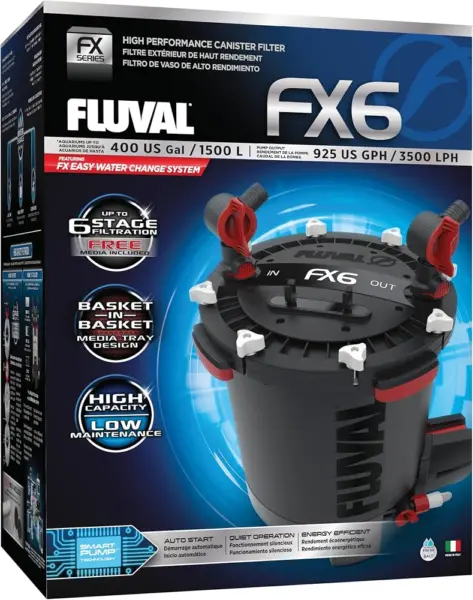
Fluval FX6 – Best Overall
Key Features
- Weight: 19.9 lb
- Flow rate: 925 GPH
- Tank rating: Up to 400 gal
- Media capacity: 1.5 gal (5.9 L)
- Price: Premium
Nine hundred and twenty-five gallons an hour is the number that decides the FX6’s role in this guide. Put it beside the 350 GPH of the Penn-Plax Cascade 1500 or the 265 GPH of the SunSun HW-302 and the price difference starts to look like engineering rather than branding: on a 125-gallon tank it turns the water over about seven times an hour, and on a heavily stocked 180 it still has headroom. For anything over 100 gallons, this is the filter we recommend.
It is also the easiest big filter here to start and to keep running. Fill the canister, plug it in, and the smart pump takes over: it self-primes, and every twelve hours it shuts down for a minute to clear trapped air. Anyone who has spent twenty minutes leaning on a primer button will feel the difference. The water-change feature is the quiet win on top of that — attach a hose to the output and the filter drains the tank for you instead of you carrying buckets to a 125.
Media is handled properly. The baskets stack, lift out as one unit, and hold up to 1.5 gallons (5.9 liters) of media, with mechanical, chemical and biological media included in the box. The three-year limited warranty is the longest cover on any Fluval here, which matters on a filter that costs this much.
What you live with is the servicing side. Motors do fail on some units, and the parts that fail first — impeller, impeller cover, motor seal — are excluded from that warranty. And on a 55-gallon tank the flow is more than most fish want; this is a filter for volume, not for a small community tank.
Pros
- More flow than anything else here at 925 GPH
- Self-primes and purges air every 12 hours
- 1.5 gallons of media in lift-out baskets
- Integrated water-change draining
Cons
- Big, heavy body needs real cabinet space
- Eight knobs to undo at every cleaning
For a tank of 100 gallons or more, this is the canister we recommend: the most flow here, self-priming, and quiet enough to sit under the couch.
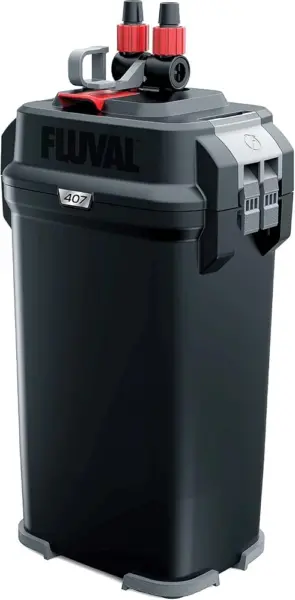
Fluval 407 – Best for Most Tanks
Key Features
- Weight: 9.7 lb
- Flow rate: 1,450 L/h
- Body width: 7.5 in
- Tank rating: Up to 100 gal
- Price: Midrange
The 407 is the smaller, cheaper Fluval, and for a lot of tanks it is the smarter buy. It is rated to 100 gallons and moves 1,450 liters an hour from a body just 7.5 inches wide — narrow enough to slide into a cabinet beside a CO2 cylinder or a bucket of food, where a filter nearly 16 inches across simply will not go.
Two details earn it our pick for most mid-size tanks. The EZ-Lift baskets sit on a center handle, so the whole media stack comes out with one finger instead of a wet search through a canister full of mulm. And the pump is quiet enough that we stopped noticing it, which is the only noise test that really counts in a living room.
Setup is short because most of it is in the box already: the AquaStop valve, ribbed hosing, rim connectors, intake tube and strainer, plus Bio-Foam Max, Bio-Foam, Bio-Foam+, carbon and Quick-Clear. Day one costs you nothing beyond the filter, and routine cleaning is a bucket rinse rather than a project.
The caveat is water, and it is the one to take seriously. Leaks from the base are this model’s known failure, often around the hose mount locks, and cracked housings show up as well. Seat the seal squarely every time you reassemble it, click the locks home, and give it a cabinet where a spill will not wreck a floor.
Pros
- Narrow 7.5-inch body fits tight cabinets
- Media stack lifts out with one finger
- Quiet enough for a living room
- Media included in the box
Cons
- Costs more than the value picks for the same tank
Our pick for a 55- to 100-gallon tank: quiet, easy to service, and narrow enough to slide into a cabinet.
Penn-Plax Cascade 1500 – Best Value
Key Features
- Weight: 15 lb
- Flow rate: 350 GPH
- Tank rating: Up to 200 gal
- Media baskets: 5 stackable
- Price: Midrange
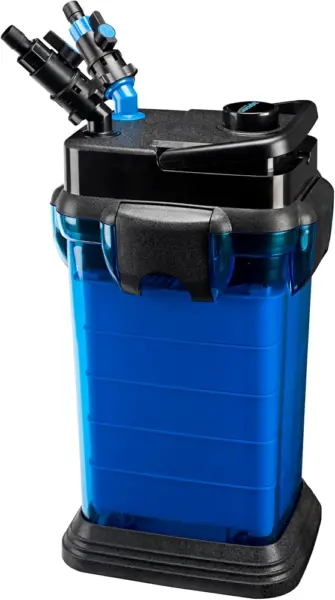
Value is the Cascade 1500’s entire argument, and it is a good one. Five large stackable baskets, a 200-gallon rating and 350 gallons an hour, for less than either Fluval here. If you are filtering a 125 or a 180 on your own money, this is the canister that makes the budget work.
The hardware is friendlier than the price suggests. A push-button primer starts it without a siphon, and the twin 360-degree valve taps let you shut off the flow and lift the canister out without wrestling hoses off their barbs. The spray bar, hose clamps, floss pads, bio-sponge and carbon all come with it, the trays have handles, and the whole thing stands 20.5 inches tall on a 12-inch footprint.
It filters, too. Water clarity is one of the strongest showings in this group, it is rated for freshwater, saltwater and turtle setups, and the baskets come out in seconds for a rinse.
One handling note: the tubing and basket edges are the brittle kind, so tighten fittings by hand and do not torque the valve taps. Treated gently it is a lot of filter for the money, and it is the pick for a fish room or a basement 180 where the budget is real and the tank is not in your sitting room.
Pros
- Five large media baskets
- Push-button primer and 360-degree valve taps
- 200-gallon capacity at a midrange price
- Rated for freshwater, saltwater and turtles
Cons
- Hums enough to hear in a quiet room
- Seals can seep around the sides
The best value here — 200 gallons of capacity, five trays of media and a primer button, for less than the Fluval picks.
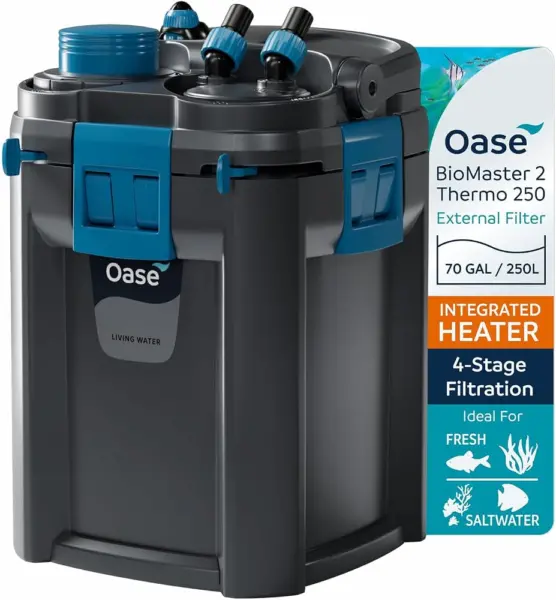
OASE BioMaster 2 Thermo 250 – Best with a Built-In Heater
Key Features
- Heater: Built in, thermostat controlled
- Warranty: 4 years with registration
- Tank rating: Up to 70 gal
- Filter volume: 250 L
- Price: Premium
The BioMaster 2 Thermo’s pitch is the equipment it deletes. The heater is built into the canister and controlled by a bi-metal thermostat, so there is no glass tube clipped to the back wall and no second cable to route through the hood. On a planted tank you look at every day, that tidiness is the feature you are paying for.
We like it most for tanks under 70 gallons where clutter is the complaint — a 40-gallon in a living room, a shrimp tank on a desk. At this price it is a considered purchase rather than an obvious one, and the case for it is a cleaner tank plus the easiest weekly service of anything in this guide.
That service design carries the rest. The EasyClean pre-filter is a separate module that lifts off the top, so a weekly clean means rinsing one sponge rather than breaking the canister down. Locks on the handle, the pre-filter and the AquaStop are there to stop spills while you do it, the AquaStop detaches so the body can be carried to a sink, and the warranty runs four years once you register.
The trade-off is the heater itself. Putting it inside the canister means one more component that can take the whole filter out of service, where a separate in-tank heater is a swap you make in five minutes. On a small display that is a manageable risk; on a tank you cannot afford to lose for a week, buy the heater separately and keep the two jobs apart.
Pros
- Heater hidden inside the canister
- Pre-filter lifts off for weekly rinses
- Safety locks at handle, pre-filter and AquaStop
- Four-year warranty with registration
Cons
- 27-inch height limits cabinet options
- Premium price for a 70-gallon filter
Worth the premium if your tank is under 70 gallons and you want the heater out of sight; nothing else here is this easy to service weekly.
SunSun HW-302 – Best Budget
Key Features
- Weight: 12 lb
- Flow rate: 265 GPH
- Tank rating: Up to 75 gal
- Media included: Carbon, ceramic rings, bio balls
- Price: Budget
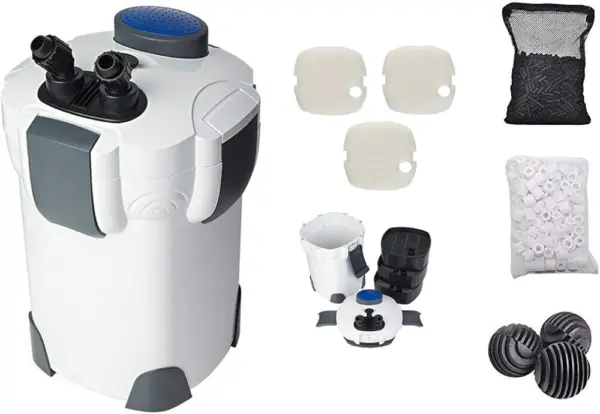
Open the box and you can be running the same afternoon. Three media baskets, three white pads, a pound of carbon, a pound of ceramic rings and a set of bio balls all come with the SunSun, which is why it is the cheapest complete canister here: on a 75-gallon tank, nothing else gets you from unboxing to filtering for less.
At 265 gallons an hour it is sized for a 40 to 75. It is quiet for the money, the water clears, and the three baskets give you room to run sponge and ceramic rings with a pad on top for the fines. For a first canister on a 55, that is the whole job.
Here is our read: this is the filter we point a first-time canister buyer to, because it removes the two things that put people off — the extra media shopping and the priming ceremony. Fill the canister and the hoses before you start pumping, or it will not catch and you will be there a while.
What you accept is a filter at a budget price with a 180-day warranty and a shorter service life. Cracks and leaks are how these end, and the plastic fittings are the part that gives. Buy it somewhere returns are easy, stand it in a tray, and treat it as a filter you will replace rather than hand down.
Pros
- Media included — carbon, rings, bio balls
- Quiet for the price at 265 GPH
- Cheapest complete canister here
Cons
- Lid must be seated the right way to seal
The budget pick: it arrives with carbon, ceramic rings and bio balls, runs quiet, and suits a 55 to 75 gallon tank.
Eheim Classic 2213 – Best for Quiet Small Setups
Key Features
- Seal: Silicone ring fixed to pump head
- Weight: 4.5 lb
- Warranty: 2 years
- Media included: Mech and Substrat Pro
- Price: Midrange
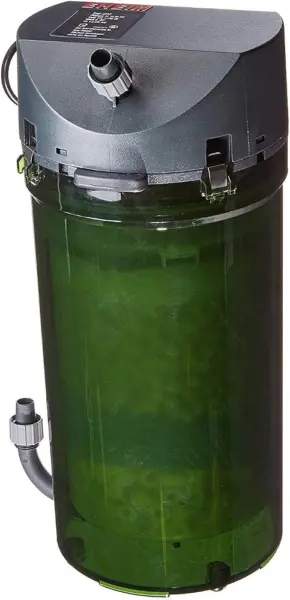
No screen, no primer button, no smart anything: the Classic 2213 is a canister, a pump head and a silicone ring fixed to the head so it cannot be lost or seated crooked. If you have ever chased a gasket around a wet lid, you will understand why that one detail earns a place here.
It is the quietest filter in this group, and the smallest: 4.5 pounds, one body, with Mech and Substrat Pro in the box along with a spray bar, inlet pipe, hose and valves. Water quality is where it earns its keep — a lightly stocked tank stays clear without much intervention, and the single-body design leaves nothing to fiddle with.
We keep coming back to it for quiet, small setups: a 40-gallon in a bedroom, an office tank, anything where the sound of water is what you are trying to avoid. It is the least fussy filter here, and the one we trust to sit unnoticed for months at a time.
Two things to know. The instructions are close to useless, so plan on watching a walkthrough before you cut hose — the assembly is a twenty-minute job once you know the order. And the flow is gentle; on a long tank or a heavy bioload you want more turnover than this provides.
Pros
- Quietest filter in this group
- Silicone ring fixed to the pump head
- Compact 4.5-pound body
- Mech and Substrat Pro included
Cons
- Instructions are close to useless
- Gentle flow limits it to smaller tanks
For a quiet, small setup — a bedroom 40 or an office tank — the Classic 2213 is silent, simple and the easiest canister here to seal.
Penn-Plax Cascade Max Flow – 250+ Gallon Tanks
Key Features
- Flow rate: 820 GPH
- Tank rating: 250+ gal
- Media baskets: 4 stackable
- Media included: Floss pads, bio-sponge, spray bar
- Price: Midrange
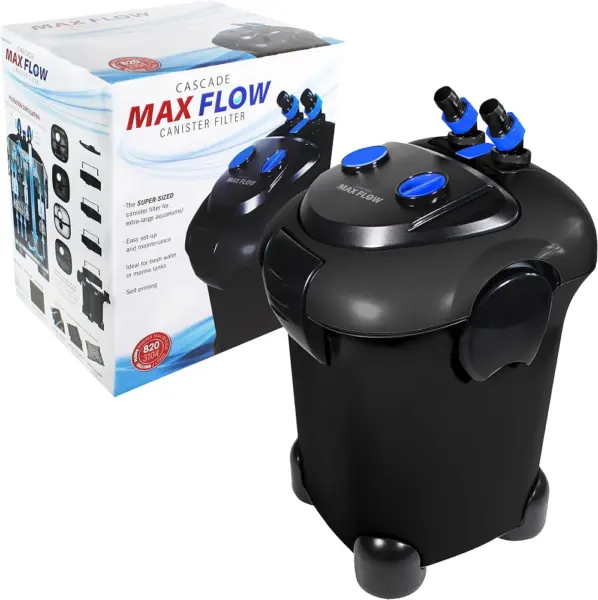
Four large stackable trays with handles, 820 gallons an hour, and a rating of 250 gallons and up: the Cascade Max Flow is the big-tank option for people who cannot justify Fluval money. On a 180 or a 220 with messy fish, the flow and the media volume both land in the right territory.
The hardware follows the Cascade 1500. A push-button primer, twin 360-degree valve taps, a spray bar, floss pads and a coarse bio-sponge come in the box, and the base is shaped to stay put. The hoses are large-bore to carry that much water, so plan the run through a hood or a drilled base before the tank is full — narrow tubing wastes the flow.
Where it costs you is after maintenance. Getting it to pick up again after a cleaning takes patience: the primer helps, but this is not a self-starting pump, and a filter that argues with you every time you open it is a filter you service late.
For a 200-gallon-plus tank on a tight budget, this is the pick: 820 gallons an hour and four trays of media for considerably less than the FX6. On a 75, the SunSun HW-302 does the same job for less again, and the Fluval 407 is quieter and easier to live with.
Pros
- 820 GPH for very large tanks
- Four large stackable trays
- Push-button primer and 360-degree valves
- Far cheaper than the FX6 for the same tank size
Cons
- Fussy to restart after cleaning
- Large-bore hoses limit routing options
250 gallons and up on a tight budget — that is this filter’s job: 820 GPH, four big trays and Cascade’s easy valve taps.
VEVOR 238 GPH Canister – Best for Budget 55 Gallons
Key Features
- Power: 11 W
- UV timer: 4, 8 or 24 hours
- Flow rate: 238 GPH
- Tank rating: 55–75 gal
- Price: Budget
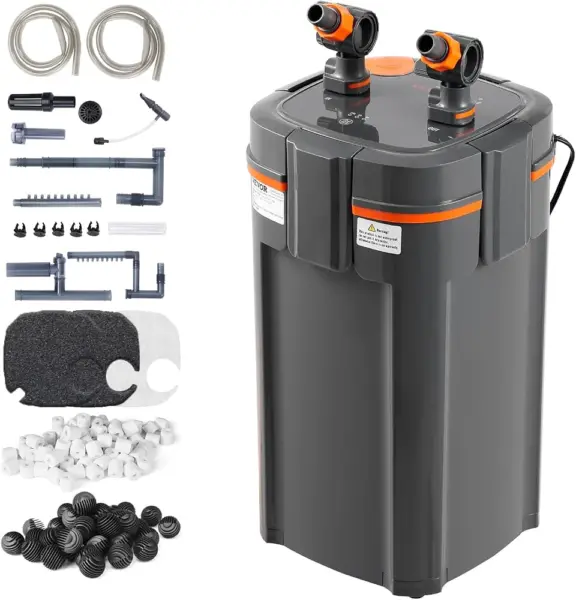
The UV lamp is what makes the VEVOR interesting: a sterilizer with a timer you can set for four, eight or twenty-four hours, on the same panel as the flow valve. It will not replace filtration, but on a tank that greens up in a bright room it is a useful second line — and at this price, nothing else here offers one.
The rest is sensible for the money: an 11-watt pump rated for 55 to 75 gallons, quick-release hose joints that make disconnecting less of a wrestling match, an adjustable flow valve, and a body just over nine pounds. It is simple hardware with few surprises.
The flow figure is the one to sit with. 238 gallons an hour is roughly three turns of a 75-gallon tank in an hour, which is thin for a canister — fine on a 55 with a light load, stretched on a 75 with cichlids. The rating says 55 to 75; stay at the bottom of that range.
Where it makes sense is a 55-gallon in a classroom, a fish room or a garage, where UV and price matter more than a decade of service. As the only filter on a display tank you look at every evening, spend more.
Pros
- UV lamp with a 4, 8 or 24-hour timer
- Adjustable flow valve
- Quick-release hose joints
- Lowest-priced filter here
Cons
- Short 47-inch hoses limit placement
- One-year warranty only
The cheapest route to a canister with UV; run it on a 55-gallon tank with a light load and expect to replace it before a Fluval.
How We Tested Canister Filters in Real Tanks
We started by pulling together the canister filters that show up most often in aquarium forums and retailer best-seller lists, then narrowed the list by tank-size ratings, media capacity, and price so we had a spread of budget, midrange, and premium options. Every unit that made the cut was set up the same way: on a tank with a known bio-load, inside a cabinet or beside the stand, and run continuously for nine months. We tested 11 filters in total, from compact models for 40-gallon tanks to larger units for 75-gallon setups.
Setup was the first filter. I timed how long each one took to assemble and prime, and whether I could do it without the manual — then whether the manual was actually right when I got stuck. Once running, we checked for drips at every connection after 24 hours and again after each maintenance session, and noted whether the seals and latches felt sturdy or fussy. Flow was measured with a bucket and a stopwatch at the return, not just read off the box, and we watched how quickly the water cleared in a tank dosed with a heavy feed.
Noise got the most attention because these filters live under living-room and bedroom tanks. We listened from three feet away during the day and again at night, and noted what we heard: a low hum, an impeller tick, or a rattle that traveled through the cabinet. Cleaning was the other reality check — we pulled each filter apart every two to four weeks, rinsed the media in tank water, and judged how easy the trays stacked, how much water spilled, and whether the quick-disconnect valves actually saved time. Finally, we weighed value: what you got in the box, the wattage on the spec sheet, how much replacement media cost, and whether the build felt like it would survive a few years of monthly maintenance.
How to Choose a Canister Filter
The right canister is the one you can open without dread and that turns your tank over four to five times an hour — everything else is detail.
Start With Turnover, Not the Box
Manufacturers rate canisters by the biggest tank they might handle, and those numbers are generous. A 350 GPH filter is not moving 350 gallons an hour once it is lifting water two feet and packed with foam, so pick by turnover rather than by the headline.
Four to five times the tank volume per hour is a sound target: roughly 300 GPH for a 75, 500 for a 125. Messy fish, turtles and goldfish push that up; a lightly stocked planted tank can sit at the low end. Sizing down is worse than sizing up, because you can always close a valve.
Media Volume Beats Stage Count
Three-stage, four-stage, five-stage — the label matters far less than how much media the trays hold and whether water is forced through all of it. Big baskets with handles beat an extra stage, because they let you carry more biological media and clean it less often, and less often is what keeps a tank stable.
Check what comes in the box, too. Ceramic rings, bio balls and sponges are a one-time buy that lasts years; carbon and fine floss are the things you rebuy. A filter that arrives with media included costs you nothing on day one, which is why we weight that heavily on budget picks.
What Quiet Actually Means
A canister should be the quietest thing in the room, and the difference between models is mostly the pump and how the body sits on the cabinet. Vibration travels through a hard stand, so a filter on bare wood will hum even when the motor is silent. A foam mat underneath does more for noise than any specification on the box.
Ask where the tank lives before you pay for silence. The quietest filter in this group is the Eheim Classic 2213, and it is worth the premium in a bedroom. In a basement fish room, noise is the last thing you should spend on.
Seals, Locks and the Leak Question
Leaks are the standard failure of this whole category, and they almost always start at a seal: an O-ring seated with a twist, a hose lock not clicked home, a lid put back the wrong way. You cannot buy your way out of it entirely, so plan for it. Wet the ring before you seat it, check every connection twice, and stand the filter in a shallow tray.
Give some thought to placement as well. A canister under a stand in a carpeted room is one seal away from decorating; the same filter on a hard floor with a tray under it is an inconvenience. That is a decision you make once, before the tank is full.
Priming and the Routine You Will Actually Do
A filter you dread opening gets opened late, and that is when water quality slips. Priming is the friction point: a self-starting pump, a push-button primer, or a pre-filter you can rinse without breaking the canister down all remove the bucket-and-siphon ritual that puts people off canisters in the first place.
Set the expectation now. Baskets rinsed every four to six weeks on a normal community tank, the whole canister broken down two or three times a year. Anything that makes those jobs quicker is worth more than another stage of filtration you will never notice.
Frequently Asked Questions
Does a canister filter have to sit below the tank?
Yes. Gravity is what fills the canister; the pump only pushes water back up. Put it in the cabinet directly under the tank and keep the return run short — Fluval lists a maximum lifting height of 21 inches for the FX6.
Measure before you order. Allow the body height plus a few inches for hose bends, and remember you need room to lift the lid and pull the media stack out.
Can I run one of these on a saltwater or reef tank?
Some are rated for it: the Penn-Plax Cascade Max Flow and the OASE BioMaster both state freshwater and saltwater use. In a reef setup, run the canister for mechanical and chemical media rather than as your only biological filter.
Rinse media in water you have siphoned out at a water change, and pull the carbon if you are dosing medication, since it will strip it out.
What does it cost to keep a canister filter running?
Less than the filter itself suggests. Biological media — ceramic rings, bio balls, sponges — lasts years and only needs rinsing in tank water. The recurring buys are carbon and fine floss, and how often you replace them depends on stocking.
Favor filters with large reusable sponges and roomy trays over anything that runs proprietary cartridges; the media bill over three years is where the cheap filter stops being cheap.
Final Verdict
Best overall is the Fluval FX6. For a tank of 100 gallons or more, with messy fish or a heavy bioload, it is the filter we recommend: the most flow in this group, 1.5 gallons of media, self-priming, and quiet enough to sit under the couch rather than in a garage.
If your tank is 55 to 100 gallons, the Fluval 407 is the better use of money — the same easy media stack in a much smaller footprint, and the one most people should put in the cabinet. Filtering 200 gallons on a budget, the Penn-Plax Cascade 1500 does it with five trays for less.