This post contains affiliate links. We may earn a small commission when you buy through our links — at no extra cost to you.
The goldfish my sister brought home from a school fair stayed exactly the same size for a year, which had less to do with the fish than with what we were sprinkling on the water. Growth is mostly a feeding problem: a goldfish that gets food it actually swallows, in a portion it can finish, puts on length and depth within a season and keeps its orange instead of fading toward white. The rest comes down to whether that food stays in the water long enough to be eaten or turns the tank cloudy first.
Most goldfish are overfed and undernourished at once, which sounds like a contradiction until you watch one chase a mouthful of dust around the glass. I’ve kept tanks for years, and for the past four months my team and I have fed 14 goldfish foods to ours twice a day — flakes, sinking pellets, gel — checking which ones the fish actually finish and which ones just foul the water. The gap shows up within a week. These are the ones that held up.
Top Picks
Best for Fancy Goldfish Tanks
Saki-Hikari Fancy Goldfish

Rating: 4.7 ★ | Price: Midrange | Form: Granule | Size: 7.05 oz | Formula: Hikari-Germ probiotic | Special ingredients: Astaxanthin, cultured spirulina
The bag leads with color, which nearly put us off, because for growth we want protein and digestibility rather than a show-fish tint. Spend time with it and the case changes: this turns out to be the best growth food in this group. It is a granule built specifically for fancy goldfish, with astaxanthin and cultured spirulina for color and a probiotic yeast, Hikari-Germ, that the maker says helps fish use more of what they eat and leaves less behind.
Two things put it at the top. The pellets sink rather than float, so fish feed at their own depth instead of coming up to snap at the surface, and that matters with fat-bodied fancies that are prone to buoyancy trouble. And of everything here, this is the food where size and color gains turn up together most consistently.
It is also the least fussy premium food we handled. A pinch at a time, twice a day, and the granules are gone before they reach the filter; nothing needs crumbling or soaking first. The 200 g bag is sized for a tank of fancies rather than a pond, and that is the honest boundary of what it is for.
Pros
- Formulated for fancy goldfish, not pond fish
- Sinking pellets let fish feed at depth
- Color and size gains arrive together
- Probiotic formula aims at less waste
Cons
- Pellet size suits some fish better than others
If you keep fancy goldfish and want one food that supports real growth without clouding the tank, this is our recommendation: a sinking pellet formulated for goldfish rather than ponds.
Best for High-Protein Growth
Fluval Bug Bites Goldfish

Rating: 4.7 ★ | Price: Budget | Form: Slow-sinking granule | Container: 1.6 oz | Granule size: 1.4-1.6 mm | First ingredient: Black soldier fly larvae
Black soldier fly larvae are the first ingredient here, up to 40% of the formula, with whole salmon behind them for omega-3 and 6. That is the most protein-forward recipe in this group by a clear margin, and it is why this is our pick when the goal is putting size on young goldfish.
The granules are listed at 1.4 to 1.6 mm and they do not behave uniformly: some drop, some hang in the water. We ended up liking that, because it lets fish feed at whatever depth they are comfortable at instead of crowding the surface, though it does mean slow sinking is a loose description rather than a promise.
Where it sits against our top pick is a question of what you are feeding. The Saki-Hikari is a goldfish-specific formula with a probiotic built in; this is a protein-first recipe that happens to suit goldfish. While the fish are young enough that growth is the whole point, the ingredient list here is the more direct argument, and once they are grown the balance shifts back.
Pros
- Protein-first insect and salmon recipe
- Feeds fish at several depths
- Goldfish go for it fast
Cons
- Granules run fine for full-grown fancies
- Small jar empties quickly with several fish
Buy this when you are growing out young or small goldfish and want the most protein-forward food here; for full-grown fancies the granules are smaller than they would like.
Best for Ponds and Big Tanks
Tetra Goldfish Flakes 2.2 lb
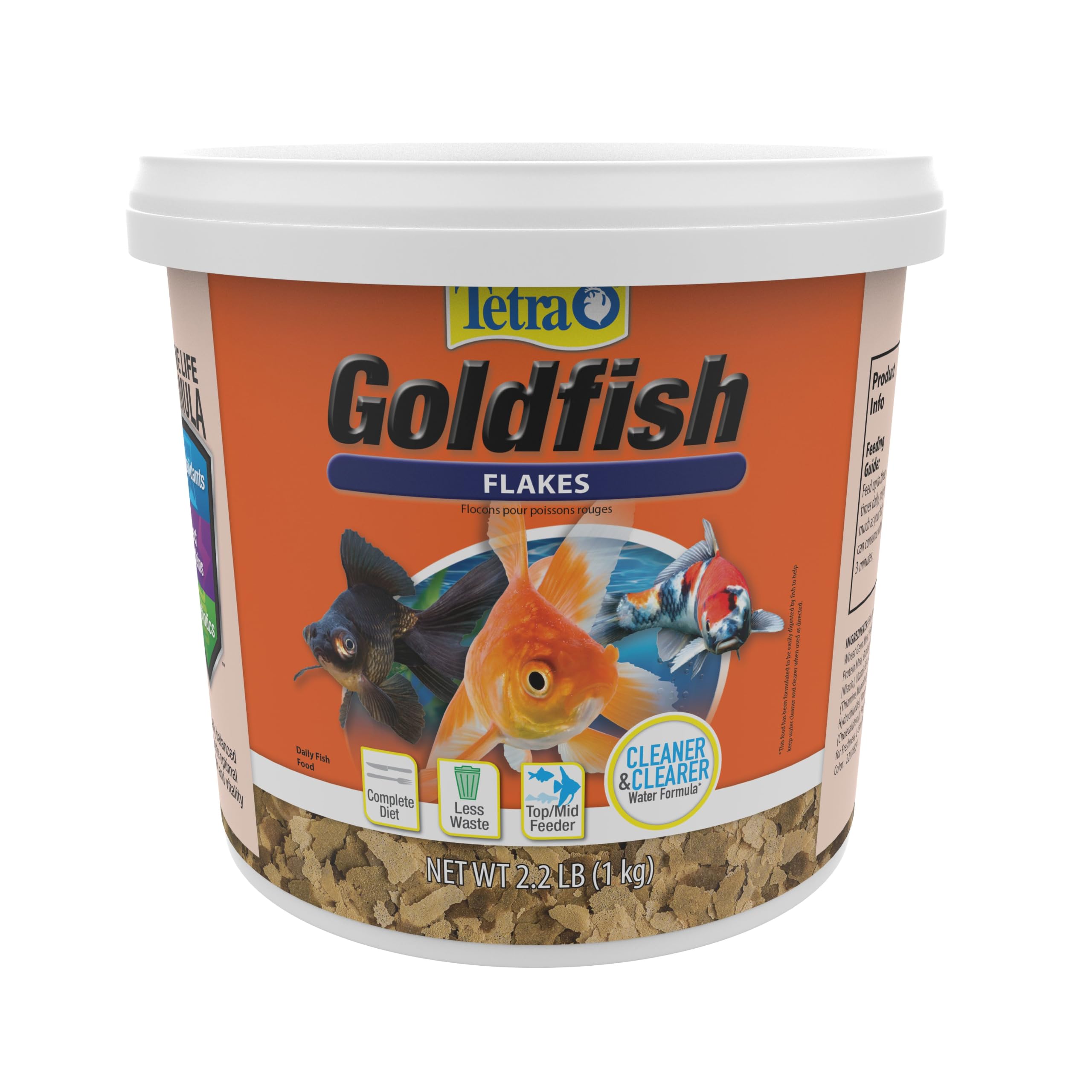
Rating: 4.8 ★ | Price: Premium | Form: Flake | Size: 2.2 lb | Water clarity: Won’t cloud water when used as directed | Special ingredient: Prebiotic
Two and a quarter pounds of flake food is an odd purchase for one tank and an obvious one for a pond. Nothing else here comes close on volume, the tub keeps going long after every other food in this test ran out, and at this size the cost per feeding is the lowest in the group by a wide margin.
It is a flake, so it floats, and comets and pond fish come up for it eagerly. The flakes are big, one pinch covers a lot of surface, and the formula carries a prebiotic and antioxidants alongside the usual vitamins.
Water clarity is the catch, and it is the one place this food divides. Fed heavy it clouds and tints; fed a pinch at a time it behaves. Our money is on portion rather than recipe, because flakes break down fast and whatever the fish do not clear is what turns the water.
Keep the lid sealed and the tub dry and out of the sun. Flakes pull moisture from the air and lose their appeal faster than pellets do, which is the real argument for decanting a few weeks’ worth into a smaller jar and leaving the rest closed.
Pros
- Lowest cost per feeding here
- Tub lasts months, not weeks
- Prebiotic and antioxidant formula
Cons
- Far more food than a single tank uses
The right buy for a pond or a fish room, where two pounds of flake at the lowest cost per feeding in this group makes complete sense.
Best for Everyday Flake Feeding
TetraFin Plus Goldfish Flakes

Rating: 4.8 ★ | Price: Midrange | Form: Flake | Size: 7.06 oz | Formula: ProCare | Key addition: Algae flakes
The algae flakes are what separate this from Tetra’s big tub, and they are why it is our everyday flake. The extra vegetable matter is aimed at digestibility, the ProCare formula carries the immune-support claim, and potato turns up in the ingredient list, which is not what we expected from a flake food and a reminder that these recipes are more than fishmeal and coloring.
At 7.06 oz the jar is the right size for one tank: big enough to be economical, small enough to finish while the flakes still smell fresh. The flakes themselves are large, so surface feeders get a proper mouthful, and crushing a pinch between your fingers handles smaller fish without making a cloud of dust.
Compare it honestly with the 2.2 lb tub: same brand, same format, but this one adds algae and comes in a size one household can finish. That makes it the flake we actually buy for a single tank, and the one we hand to someone setting up a first goldfish aquarium.
Pros
- Algae adds vegetable matter for digestion
- ProCare immune-support formula
- Single-tank size stays fresh
Cons
- Flakes float, so some food reaches the filter
Our everyday flake for a single goldfish tank: algae for digestion, an immune-support formula, and a jar size you will actually finish while it is fresh.
Best for Fry and Juveniles
Hikari Goldfish Gold Baby Pellets
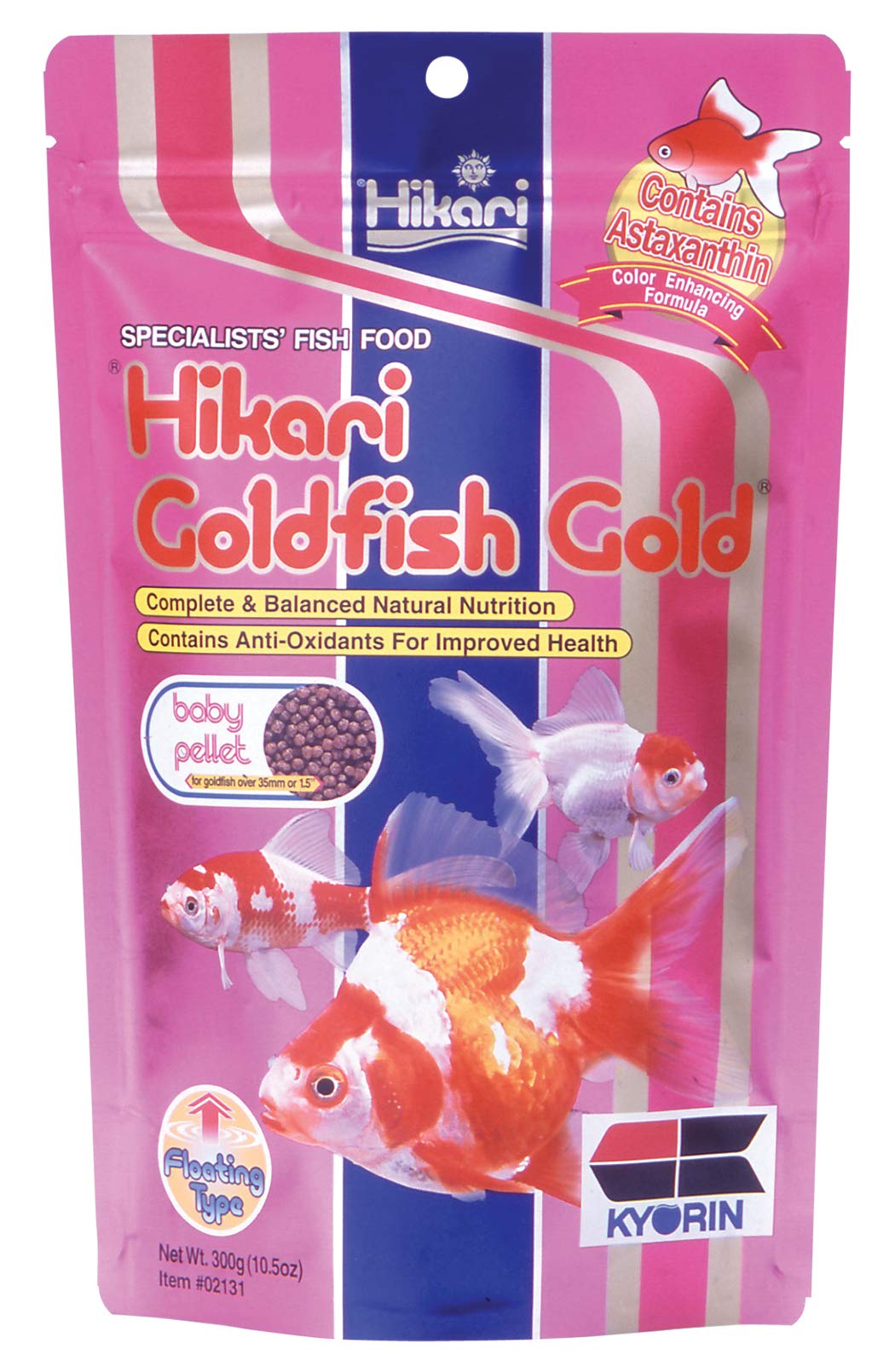
Rating: 4.7 ★ | Price: Midrange | Form: Floating baby pellet | Color: Carotene | Container: 10.5 oz (300g) | Pellet size: 1.7-2.0 mm
At 1.7 to 2.0 mm, these are pellets for small mouths. Hikari aims them at fry, young goldfish, and baby koi, and the size is the whole point: a crumbled flake is half dust by the time a two-inch fish finds it, while a pellet this size is a meal it can take in one go.
The carotene is there for color, and the floating format suits a pond, where you can see what has been eaten and skim off what has not, and where young fish learn quickly to come up at feeding time. That visibility is underrated with a batch of fry, because you can tell within a minute whether the food is being taken.
What it has over the Saki-Hikari is quantity: 10.5 oz against 200 g, in a bag that suits a grow-out tub or a pond rather than a display tank. The pellets are consistent in size, which matters more than it sounds when you are feeding fish that cannot yet handle a bigger mouthful.
So this is the grow-out pick rather than the display-tank pick. Buy it when the fish are small enough that a two-millimeter pellet is a full meal, keep the bag closed between feeds, and move them onto a sinking food as they put on size.
Pros
- Small pellets sized for fry and juveniles
- Carotene supports natural color
- Floating pellets suit pond feeding
Cons
- Floating pellets keep fish feeding at the surface
Our pick for fry, juveniles, and pond grow-outs: a small floating pellet that young goldfish can take whole while they are doing their fastest growing.
Best for Automatic Feeders
Aqueon Goldfish Granules

Rating: 4.4 ★ | Price: Budget | Form: Slow-sinking granule | Size: 5.8 oz | Main ingredient: Soybean meal
Granules instead of flakes is the right instinct for goldfish, and this jar is the cheapest way into that format. It is also the food here that goes in an automatic feeder, because the granules meter out of a hopper in a way flakes never manage.
Goldfish take to them readily, the strongest showing on fish preference in this group, and the 5.8 oz jar suits common goldfish, orandas, and small koi. Feed in small pinches directly over the fish rather than one dump, and more of it gets eaten.
What it is not is a growth formula. Soybean meal leads the recipe, the claims are about general nutrition rather than size, and the jar is built for everyday maintenance in a pond or a big tank. That is a useful job, just not the one this guide is about, and as a cheap staple for a feeder-fed pond it earns its shelf space.
Pros
- Works in an automatic feeder
- Goldfish take to the granules readily
- Cheapest way into granule feeding
Cons
- Granules sink faster than the slow-sinking label suggests
A practical, inexpensive staple for a feeder-fed pond or a tank of common goldfish, though the recipe is built for maintenance rather than growth.
Best for Trial-Size Feeding
Aqueon Goldfish Flakes

Rating: 4.6 ★ | Price: Budget | Form: Flake | Size: 1.02 oz | Main ingredient: Spinach
The smallest and cheapest jar here, and for a quarantine tank or one small fish that is reason enough to keep it on the shelf. Set it beside the 2.2 lb Tetra tub and the trade is obvious: the same idea of a flake, in a fraction of the food.
The flakes themselves are the problem. They run small and crumbly, and a good part of the jar is closer to dust than flake, which floats, sinks, and feeds the filter rather than the fish. In a tank where you are trying to grow something, that is food that never arrives.
It is a plain formula with spinach in it and no claims beyond nutrition, and there is a place for that: a hospital tank, a first fish, a child’s bowl that will be upgraded in a month. The 1.02 oz jar tucks into a cabinet, which is really its best argument.
Pros
- Cheap way to try a flake food
- Plain formula suits a quarantine tank
- Small jar stores easily
Cons
- Crumbles into dust that fouls the water
- Tiny jar holds little food for the money
Keep one for a quarantine tank or a single small fish, but the crumbly flakes and tiny jar make it a stopgap rather than a food to grow goldfish on.
How We Tested Goldfish Foods for Growth
We started by reading ingredient panels rather than the front of the can: crude protein percentage, whether the first ingredient was a named fish meal or a grain, and fiber levels, since goldfish need plant matter alongside protein. Then we filtered by form and package size — flakes for surface feeders, sinking pellets for deep-bodied fancies, gel for anyone who wants zero waste — and by price per ounce. Price per ounce isn’t the same as value, though: an opened container loses vitamin potency, so a tub that outlasts its freshness is money in the bin.
The 14 foods went into four tanks in my home — a 55-gallon with two grown comets, a 29-gallon of fancies, and two smaller grow-out tanks — twice a day for four months, each food getting a full week on its own. At every feeding I noted whether fish took it in the first 30 seconds, spat it out, or ignored it, and how much was still floating or sitting on the gravel five minutes later. I timed sinking speed with a stopwatch, watching whether pellets reached mid-water or dropped straight to the substrate, and checked whether pieces were small enough for juveniles to take without softening first.
Twelve and 24 hours after each feeding I photographed the water against a white card to compare cloudiness and surface film, and checked how much had caked on the filter intake. Portion size got its own test: how many pinches or scoops it took to feed a 55-gallon, and how long a container lasted at twice-daily feeding. I smelled each container on arrival and again a month in, and weighed flakes to see how much shattered into dust. Fish were measured and photographed monthly to track length and color.
How to Choose a Goldfish Food for Growth
Growth comes down to two things a label cannot fully show you: how much protein reaches the fish, and how much food is left over to foul the water.
Read the ingredient list before the protein number
Crude protein on the front of the tub is a minimum, not a promise, and it says nothing about where the protein comes from. Ingredients are listed by weight, so the first two or three names are the useful part: whole fish, fish meal, salmon, or insect larvae at the top usually points to a growth-oriented recipe, while a formula that opens with soybean meal or a grain is a maintenance diet. Our top pick leads with insect larvae and salmon; the Aqueon granules lead with soybean meal, which is exactly why they sit lower here.
Pellets feed goldfish better than flakes
Flakes float, break up, and drift into the filter. A sinking pellet or granule puts a measured amount in front of the fish and keeps them from feeding at the surface, which is where fancy goldfish gulp air and run into buoyancy trouble. Flakes still have a job, since they are the fastest way to feed a pond of surface-feeding comets, but for a tank of fancies a sinking food is the better default.
One warning: slow sinking is a claim, not a guarantee. Drop a pinch in and watch where it actually goes before committing to the big container.
Match the particle to the fish in front of you
The right size is the one your fish can take in a single mouthful without spitting it out. Small and medium goldfish and juveniles do well on granules in the 1.4 to 1.6 mm range; Hikari’s baby pellets run 1.7 to 2.0 mm and are aimed at fry and young fish. Too fine and the food scatters before anyone gets it; too coarse and it gets mouthed, released, and left to rot. Watch the first feed. A fish that takes a piece, holds it, and lets it go is telling you the food is too big.
Judge the water, not the label
Cloudy or tinted water after a feed is usually a portion problem wearing a food’s name. Whatever is not eaten breaks down and feeds the bacteria that turn water milky, and flakes plus fine granules produce more of that debris than a firm pellet. The Fluval jar’s own instruction is a good rule for any of these foods: as much as the fish clear in two minutes, two or three times a day. If a new food seems to cloud your tank, halve the pinch for a week before blaming the recipe.
Buy the size you will finish
Cost per feeding and freshness pull in opposite directions. The 2.2 lb Tetra tub is the value leader here and the right buy for a pond, a fish room, or several tanks; in a single-tank home, two pounds of flakes lose their appeal long before the tub empties. One tank with a few fish: a 200 g to 7 oz jar. Store any of them sealed, dry, and out of sunlight, and never top up an old jar with new food, because the older flakes sink to the bottom and go stale first.
Frequently Asked Questions
Will a growth food make my goldfish grow bigger?
Food supports growth; it does not set the ceiling. Adult size is decided mostly by how much water the fish has, how many fish share it, and how often that water is changed, so a goldfish in a crowded tank stays small whatever you feed it. Improve the tank first, then feed a protein-first food. Young fish put on size fastest, and growth slows once they reach adulthood.
Does color-enhancing food really change a goldfish’s color?
It supports color the fish already has rather than creating new color. Astaxanthin, spirulina, and carotene feed the pigments in the skin and scales, so reds and oranges deepen while a white fish stays white. Genetics and light do the rest. Give any color food several weeks before judging it, and do not expect it to override the fish’s natural pattern.
Can I feed goldfish food to koi or my other fish?
Small koi and pond comets eat goldfish food happily, and several of these are labeled for both; the Tetra flakes and the Hikari baby pellets each name small koi. Particle size is what changes. A koi past a few inches needs a bigger pellet than a 1.5 mm granule, and bottom feeders such as corydoras take whatever sinks. Do not go the other way and feed pond sticks to fancy goldfish, which cannot mouth food that large.
Final Verdict
Buy the Saki-Hikari if you keep fancy goldfish and want one food that does the growth work: it is the sinking, goldfish-specific pellet with the most consistent size and color results in this group.
If your fish are young and you want the most protein-forward recipe here, the Fluval Bug Bites granules are the better fit. Feeding a pond or a fish room? The 2.2 lb Tetra tub is the economical answer, as long as you will finish it.