This post contains affiliate links. We may earn a small commission when you buy through our links — at no extra cost to you.
Marine aquarium lights under $130 deliver surprising PAR for corals, but reliability and build quality vary dramatically. Some units fail within months due to poor fans or LED drivers, and mounting brackets often seem like an afterthought. Understanding the common pitfalls upfront prevents costly mistakes.
The core trade-off is between raw output and long-term dependability. High-wattage fixtures can handle demanding SPS corals but may require DIY mounting or early replacement, while lower-watt lights are more reliable but limited to soft corals and LPS in shallow tanks. The right choice depends on your priorities: power now versus reliability over time.
This guide matches five popular lights to specific reef scenarios: nano tanks, budget soft coral setups, mixed LPS/SPS, and high-PAR SPS systems. Each pick balances performance and known weaknesses, so you can choose confidently based on your tank size, coral goals, and tolerance for tinkering.
Top Picks
Best for Budget Reef Keepers
VIPARSPECTRA V165 165W
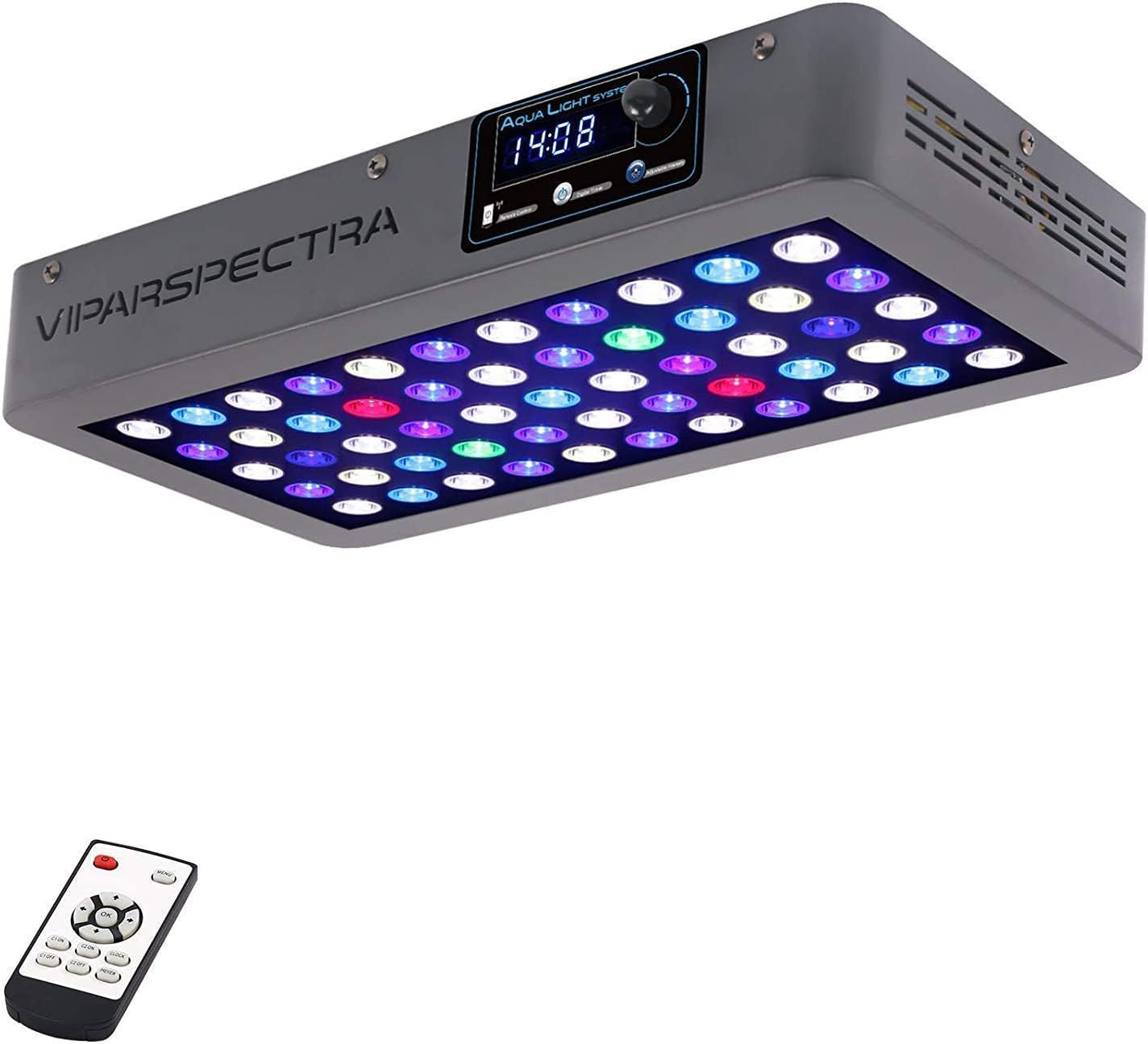
Rating: 4.5 ★ | Price: $$ | Wattage: 105W | Channels: Dual blue/white | Control: Remote + manual knob | Spectrum: Full spectrum blue/white | Coverage: 24×24 inch
The VIPARSPECTRA V165 delivers 105 watts of actual output with a full spectrum that brings out vivid coral colors. Users report healthy growth in LPS and soft corals, and even some SPS like acropora show positive response under this light. The white channel is intense at low blue settings, so balancing the two channels is needed to avoid a harsh look. While most units perform well, occasional fan or driver issues can affect long-term operation — something to keep in mind when buying at this price point.
This light is a strong match for reef keepers running 24-to-30-inch tanks who want solid coral growth without spending three times as much. It works well for LPS and soft coral setups, with some SPS potential for those willing to dial in placement. The basic remote and knob controls provide on/off and intensity only — there is no sunrise/sunset ramp or app integration. If precise spectrum scheduling or gradual lighting changes are a priority, this isn’t the right fit.
Pros
- Deep blue and purple spectrum makes corals fluoresce vividly.
- Costs significantly less than comparable 105W fixtures while delivering similar PAR.
- Supports growth in LPS and some SPS like zoas and acropora.
Cons
- White LEDs can appear excessively bright when blue channel is low, requiring careful balancing.
- Fan or driver problems can arise, potentially affecting long-term operation for some units.
Best for budget-minded reef keepers who can accept basic controls and the occasional unit variance in exchange for strong coral growth and vibrant color.
Best for Budget Beginners
NICREW 32W Saltwater

Rating: 4.4 ★ | Price: $ | Wattage: 32W | Channels: Dual white/blue | Control: 2-channel timer | Spectrum: Blue 445/460nm, 10K white | Coverage: 30-36 inch
The NICREW 32W Saltwater light delivers a decent blue spectrum and a built-in timer at a price that undercuts most competitors, making it a natural choice for first-time saltwater keepers on a tight budget. Soft corals and fish-only setups up to 36 inches will show good color under the actinic blue LEDs, though the white channel leans warmer than the crisp 10K look some expect. The timer programming requires patience — instructions are vague and settings reset if the power is cut — and unit-to-unit reliability has been noted as a gamble. This light is best suited to beginners who are willing to work through the setup quirks and can accept that a small percentage of units may arrive or become non-functional.
Pros
- Budget-friendly entry point with a dual-channel timer included
- Actinic blue LED array brings out color in soft corals and LPS
- Adequate brightness for shallow tanks and fish-only display
Cons
- Timer programming is unintuitive and resets when unplugged — expect to spend time dialing it in
- Some units may not power on or stop working within weeks, making reliability a concern
A solid starter light for soft corals if you can accept the timer learning curve and the chance of early failure — otherwise, spending more on the top pick buys greater peace of mind.
Best for Nano Reef Owners
Fluval Marine Nano 20W
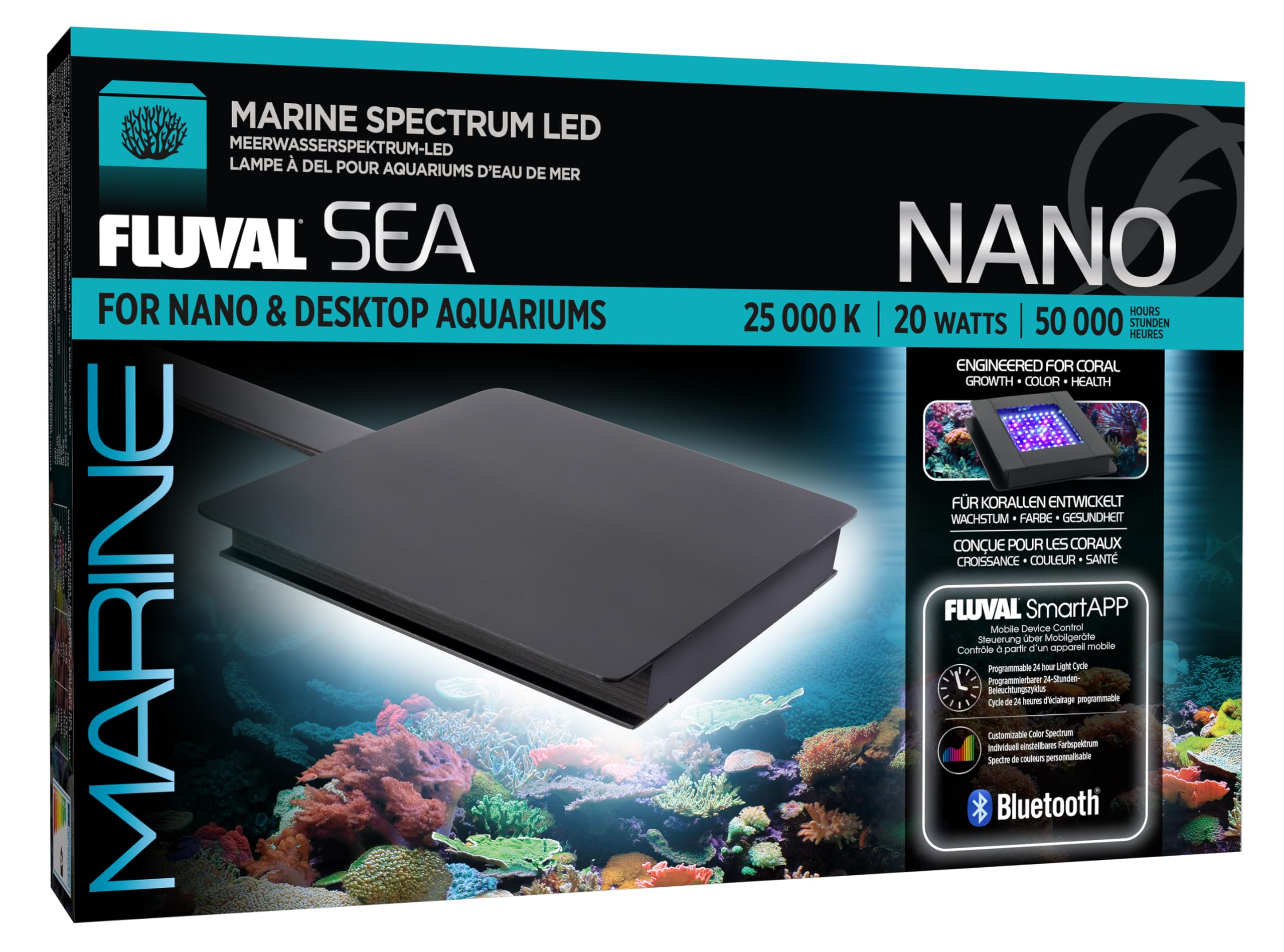
Rating: 4.5 ★ | Price: $$$ | Wattage: 20W | Channels: 7 band independent | Control: Bluetooth app | Spectrum: 7 band waves, independent | Coverage: Up to 10 gal
The Fluval Marine Nano brings app-based 24-hour lighting cycles to rimless nano reefs, with independent control over seven color channels and gradual sunrise/sunset transitions. Its sleek over-the-glass mount and compact 20W design make it a natural fit for 5-10 gallon rimless tanks where aesthetics matter as much as coral growth.
This light suits nano reef owners who want programmable light schedules and are comfortable using a phone app. Bluetooth pairing can be inconsistent, and the mount only works with rimless glass up to 8mm thick — rimmed tanks or larger setups are out. Some units may arrive with power-on issues, so checking functionality upon delivery is wise.
Pros
- App provides a fully customizable 24-hour cycle with realistic sunrise, midday, sunset, and moonlight phases.
- Compact design and adjustable mount blend neatly into rimless nano reef displays.
- Sufficient PAR for soft corals and low-light LPS in shallow tanks up to 10 gallons.
Cons
- Bluetooth connection can drop or fail to pair on the first try, requiring reattempts.
- Mount only fits rimless tanks with glass up to 8mm thick — rimmed or larger aquariums need a different light.
Best for nano reef hobbyists who want app-based lighting control and have a rimless tank; the Bluetooth quirks are manageable if you don’t mind occasional re-pairing.
Best for Sps Coral Growers
SMATFARM G5 95W

Rating: 4.4 ★ | Price: $$ | Wattage: 95W | Channels: Multi-channel | Control: Touch + remote | Spectrum: Full spectrum, DIY modes | Coverage: 20-28 inch
For reefers targeting acropora growth without the premium price, the G5 provides strong light output that rivals models costing three times as much. It suits budget-conscious DIY enthusiasts comfortable with programming complex schedules and modifying the bracket. The mounting system may need reinforcement, and some units may require early maintenance. The full spectrum with independent channels and sunrise/sunset modes offers fine control, though the touch interface and manual can frustrate those seeking plug-and-play.
Pros
- Produces enough PAR for demanding SPS corals at moderate depths
- Exceptional value compared to premium reef lights with similar output
- Independent spectrum channels allow fine-tuned blue, white, and moonlight control
Cons
- Mounting bracket may be difficult to attach and can feel unstable without modification
- Some units may become unresponsive or require repair within the first few months of use
Choose the G5 if you prioritize raw PAR output over plug-and-play convenience and are comfortable with a bit of tinkering — it rewards hands-on reefers on a budget.
Best for Extreme Budget
Hipargero A036 36W

Rating: 4.2 ★ | Price: $ | Wattage: 36W | Channels: Dual channel | Control: Touch control | Spectrum: Blue, violet, white | Coverage: Up to 20 gal
The Hipargero A036 is exceptionally bright for its cost, making soft corals glow in nano tanks. However, the touch controls can be unresponsive, and the unit’s long-term durability is uncertain — better suited as a temporary or extreme-budget light than a permanent fixture.
Pros
- Very bright for its size; makes corals glow and colors pop
- Exceptional value for money; one of the cheapest reef-capable lights available
Cons
- Touch controls may be unresponsive, and the unit’s longevity is uncertain in a permanent setup
Only worth considering if you need a temporary or quarantine light and accept the possibility of replacing it within months.
How to Choose
The most critical factor in a marine aquarium light is matching its PAR output and spectrum to your tank depth and coral type, not its marketing specs.
Wattage and PAR Output
Wattage gives a rough idea of power, but actual PAR (photosynthetically active radiation) depends on LED efficiency, lens optics, and distance from corals. A 100W light may have lower PAR than a 60W one with better optics. For soft corals and LPS, 30-60W is often enough for shallow tanks. SPS corals typically need 80W or more for moderate depths.
Always cross-check user reports of coral growth for your tank depth. A light that grows acropora in a 12-inch tank may struggle in a 20-inch deep tank. Ignoring this leads to disappointing coral health.
Control Channels
Independent blue and white channels let you tune color temperature and intensity. More channels (e.g., separate moonlight, UV, red) offer finer control but add complexity. For most reefers, a dual-channel setup (blue/white) is sufficient to balance coral coloration and visibility.
Single-channel lights force you to accept a fixed spectrum, which may not suit both fish viewing and coral growth. The ability to dim channels independently is especially important for reducing algae and creating a natural dawn/dusk effect.
Control Method
Manual knobs and remotes are simple but lack programmability. Timers add basic on/off scheduling but often have confusing interfaces or reset when unplugged. App-based controls offer the most flexibility with sunrise/sunset cycles and multiple presets, but can suffer from Bluetooth range or connectivity drops.
Choose based on your daily routine: if you want set-and-forget, a reliable timer is key. If you enjoy tweaking, app control gives you full customization. Avoid touch-only controls without physical buttons, as they are prone to unresponsiveness.
Spectrum Composition
The ratio of actinic blue to white LEDs directly affects coral fluorescence and growth. High-blue (e.g., 445nm, 460nm) promotes coral color and photosynthesis; white LEDs provide a more natural daylight look but can appear harsh if too bright. Most reef lights target a 2:1 or 3:1 blue-to-white ratio.
Full-spectrum lights with UV and violet wavelengths can enhance coral pigmentation, but the exact benefit depends on the specific diodes used. Check for independent control of blue and white channels to adjust the look without sacrificing growth.
Tank Size and Mounting
Coverage area and mounting compatibility are often overlooked. A light that covers a 24×24 inch spread adequately is different from one designed for a 36-inch-long tank. Rimmed tanks with thick frames may not fit clamp-on mounts meant for rimless glass. Verify the mount’s maximum glass thickness and whether it can be adjusted.
Some lights include hanging kits or adjustable brackets that allow flexible positioning. If the included mount is poor, factor in the cost and effort of a third-party bracket or DIY solution. A light that can’t be properly mounted or positioned will underperform regardless of its specs.
FAQ
Why do my aquarium lights stop working after a few months?
Early failures are often caused by inadequate cooling or low-quality LED drivers. Lights with small fans can overheat, leading to driver burnout. Look for models with good ventilation and read negative reviews for failure patterns. If you buy a budget light, consider an extended warranty or purchase from a retailer with easy returns.
Can I use a freshwater LED light for a saltwater reef tank?
Freshwater lights typically lack the high-actinic blue wavelengths that corals need for photosynthesis. While some soft corals might survive under a very bright freshwater light, they will not thrive or develop good coloration. For proper growth and coral health, use a light specifically designed for marine/reef aquariums with proper blue and violet LEDs.
How do I program the timer on my NICREW saltwater light?
The NICREW timer requires a specific sequence: plug in the light, press the mode button until the timer icon flashes, then use the up/down buttons to set on and off times. The manual is vague; search for video tutorials online. Note that the timer resets if the power is disconnected, so avoid turning it off at the wall.
What is the best way to mount a SMATFARM G5 light on a rimmed tank?
The included bracket is designed for rimless tanks and often doesn’t fit rimmed tanks with thick frames. Many users build a DIY mount using aluminum L-brackets or purchase a third-party adjustable bracket. Alternatively, the light has hanging holes for a ceiling mount, which is the most reliable solution for larger tanks.