This post contains affiliate links. We may earn a small commission when you buy through our links — at no extra cost to you.
A reef tank can look completely different under two lights: one makes the fish pop and the corals glow, the other leaves everything flat and washed out. But appearance is only half the job. The right marine aquarium light also has to deliver the spectrum, spread, and intensity corals need to grow without frying them or leaving dark corners. That combination—good-looking lighting and a stable, repeatable day—is what separates a fixture you tolerate from one you actually enjoy.
Over the past nine months, my team and I have run seven marine aquarium lights on real reef tanks, from a shallow frag system to a mixed reef. We cared about brightness and color, but also the daily stuff: whether the timer held its schedule, how easy programming was to set up, whether the remote control worked from across the room, and how securely each mount held the fixture. A light can look incredible for a week and still be a headache by month three. The picks below are the ones that earned their spot above the water.
Top Picks
Best for 24-Inch Reef Cubes
VIPARSPECTRA V165
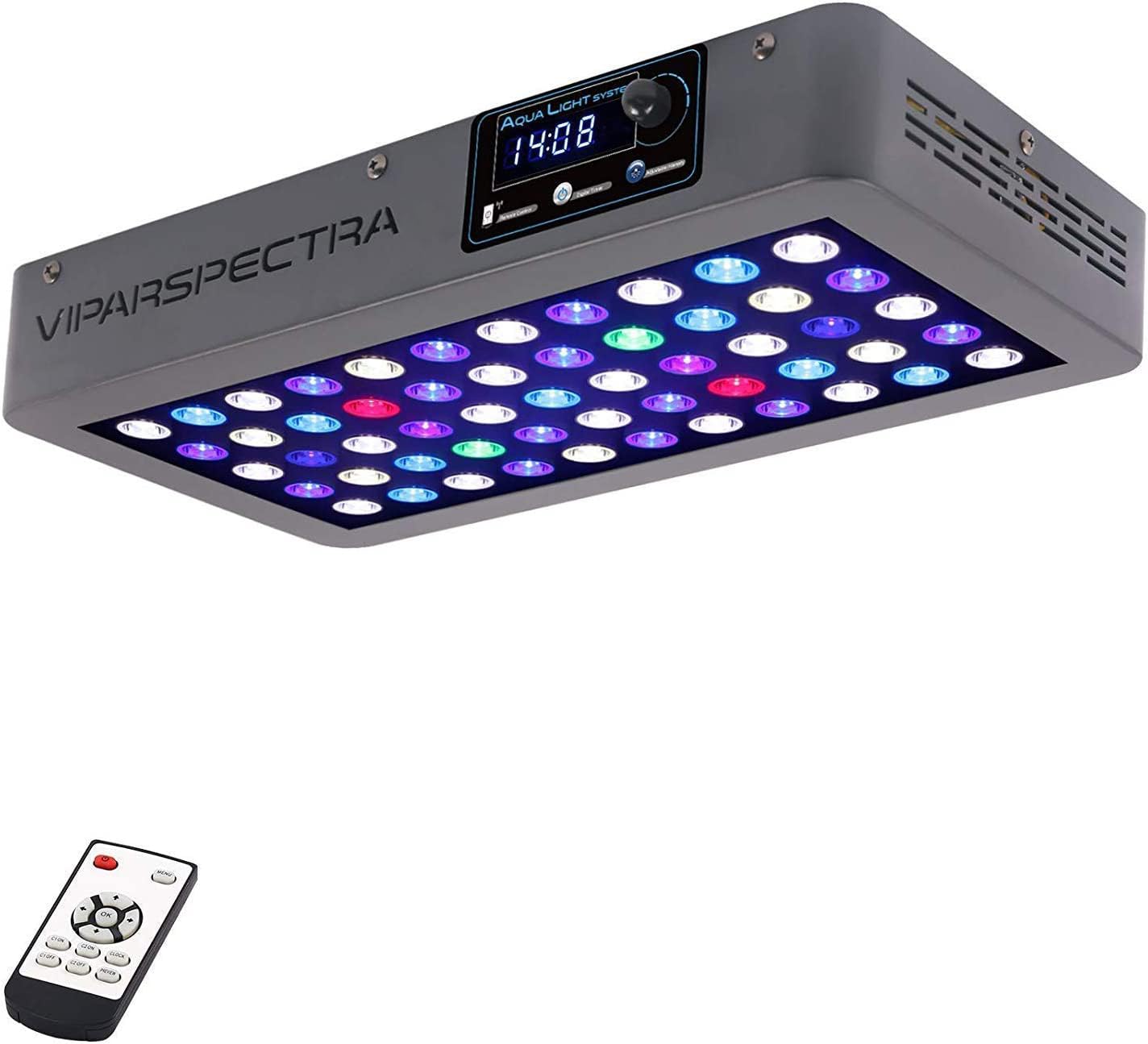
Rating: 4.4 ★ | Price: Midrange | Wattage: 105 watts | Channels: Two dimmable channels | Coverage: 24 x 24 in | Mounting: Hanging kit
The V165 makes its case with a 24-by-24-inch coverage claim, and that footprint is why it sits at the top of this list. It uses two dimmable channels, so you can run the blues low for dusk and bring the whites up for the middle of the day. In our testing, the output was strong enough that corals needed a slow ramp; we started low and raised intensity over a few weeks. That acclimation habit matters with any reef light this punchy.
What separates it from the other 24-inch options here is balance. The spread is even enough to avoid a dark edge, and the two channels give you more control than a single-dial fixture. Coral growth is the strongest story in this group, which is the point of a reef light. We recommend it first for a 24-inch mixed reef because it delivers the two things that matter most: usable spread and enough intensity for LPS and many SPS.
The controls are where the V165 shows its age. The timer and remote can be fiddly, and the built-in schedule is less dependable than a simple external timer. We treat that as a workaround rather than a dealbreaker: set the channels where you want them and put the fixture on a timer you trust. The light itself is the reason to buy it.
Pros
- Strong 24 x 24 coverage
- Dual dimmable channels
- Coral growth is the standout
- Hanging kit included
Cons
- No app or WiFi control
- Not water-resistant
For a 24-inch mixed reef, we recommend the V165 first: it has the spread, punch, and dimming control to grow corals without overcomplicating the tank.
Best for Nano Tanks
Fluval Sea Marine Nano
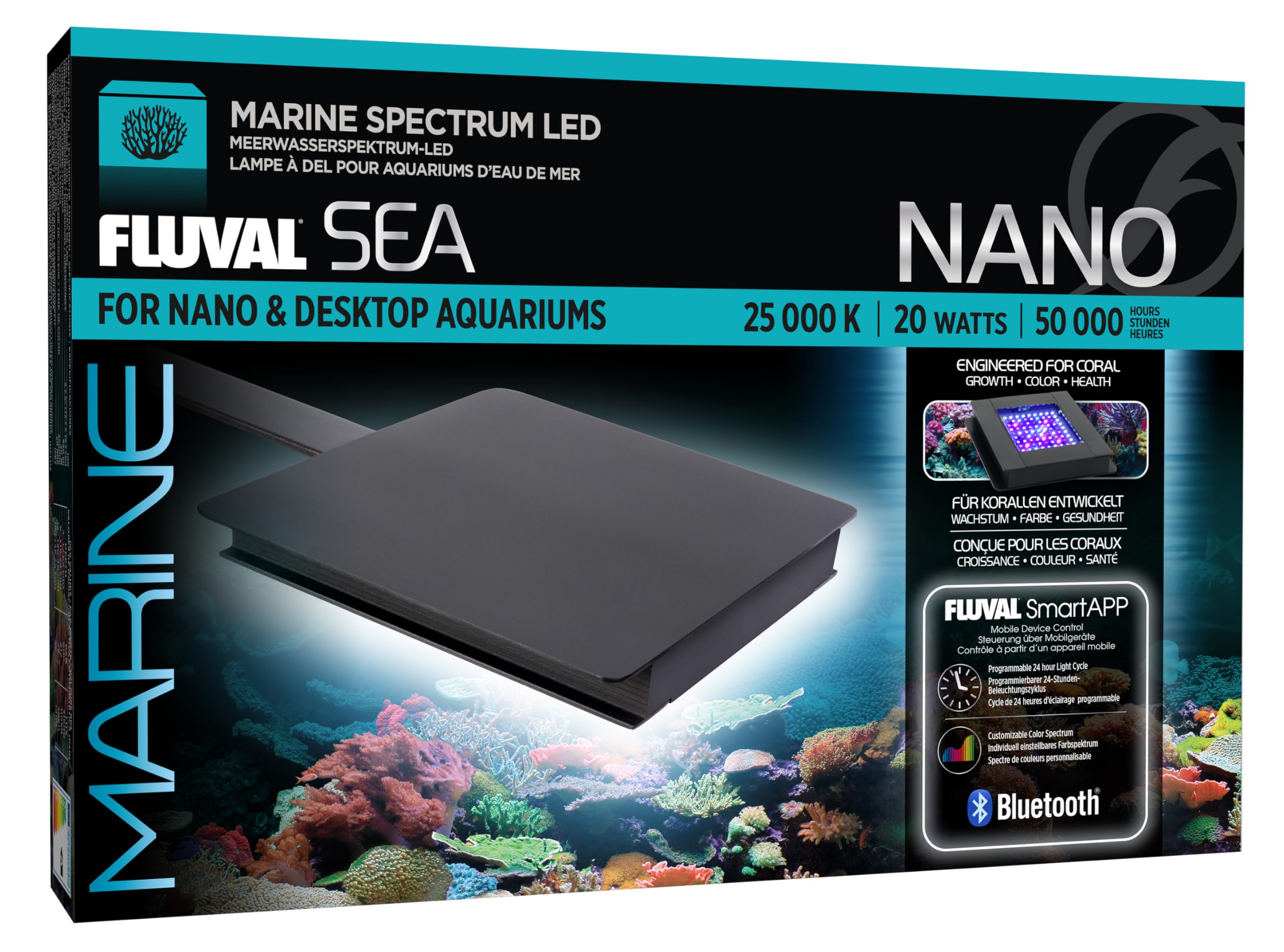
Rating: 4.5 ★ | Price: Midrange | Control: Bluetooth app | Wattage: 20 watts | Mounting: Over-the-glass | Dimensions: 7.28 x 5.12 x 0.87 in
Nano reefs are where the Fluval Sea Marine Nano feels at home. At 20 watts and just over seven inches long, it is built to sit over a small cube rather than stretch across a four-foot tank. We recommend it first for a 10-to-15-gallon reef because it gives you a programmable 24-hour cycle without asking for a lot of space. The 120-degree lenses spread light wider than the fixture’s size suggests, so the tank does not get a bright center and dark corners.
The app is the part we appreciate most. You can set sunrise, midday, sunset, and moonlight, then adjust individual colors when a coral looks washed out or too blue. It is the kind of control that usually costs more and takes up more room. For soft corals, LPS, and a few easy SPS near the top, the output is enough; we do not treat it as a high-light SPS fixture.
The over-glass mount is the one thing to check before ordering. It wants a rimless or thin-rimmed tank, and a thick brace can get in the way. If your tank has a wide rim, measure the glass and look at the bracket first; that is the difference between a clean install and a return.
Pros
- App-controlled 24-hour cycle
- Compact over-glass design
- Bright for nano tanks
- Independent color control
Cons
For a nano reef, we recommend this first: the app makes a full light cycle simple, and the compact fixture stays out of the way.
Best for 20-36 Inch Reefs
PopBloom RL60
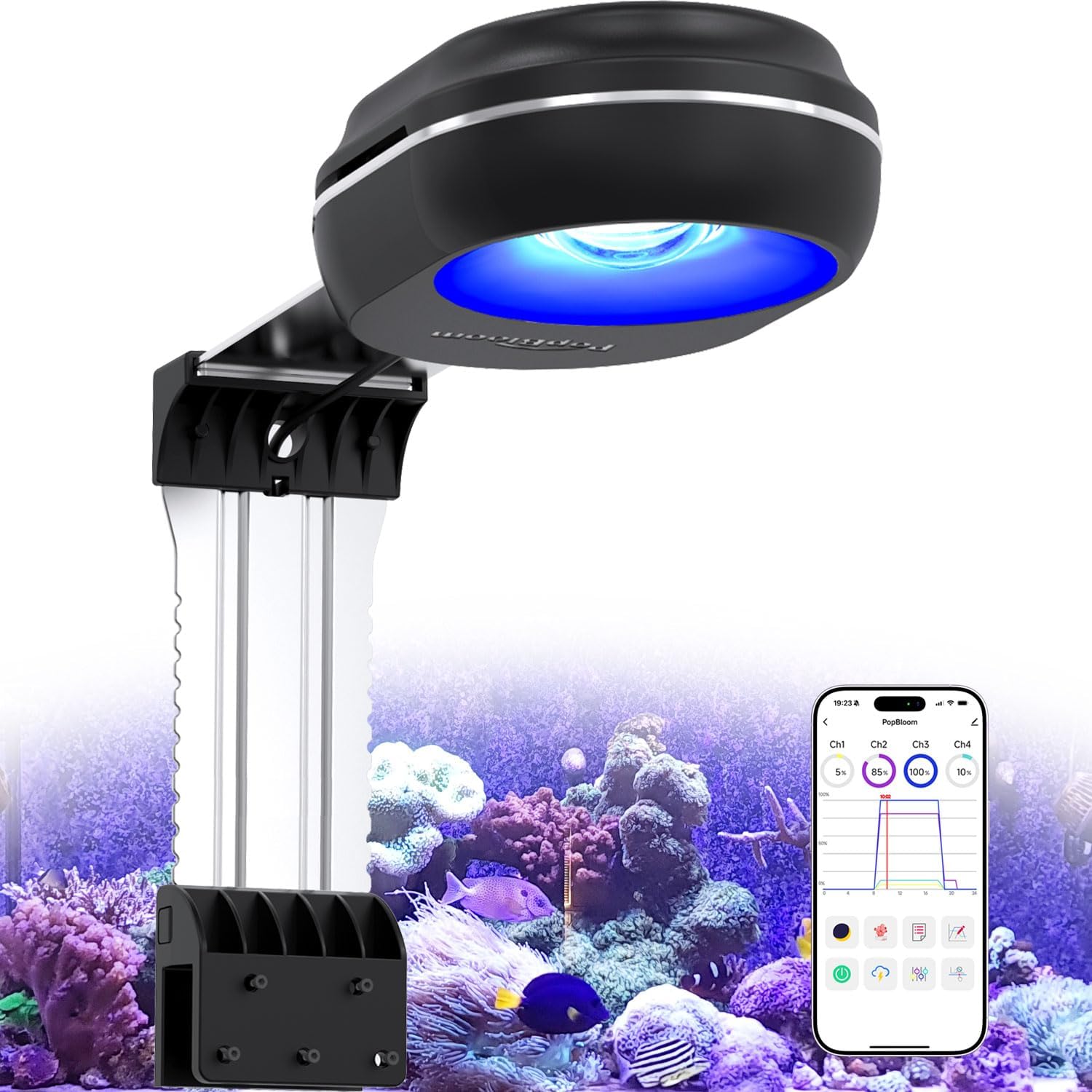
Rating: 4.4 ★ | Price: Midrange | PAR: >130 at 20 in; >100 at 24 in | Control: WiFi app | Wattage: 65 watts | Coverage: 20-36 in length
The RL60’s 20-to-36-inch range is the first thing to check, because it decides whether the rest of the light matters. It is a 65-watt fixture with a WiFi app, channel control, and a rated PAR above 130 at 20 inches and above 100 at 24 inches. That is a realistic power band for a mixed reef, not a headline wattage that cooks a nano tank.
The app is the reason we reach for it over a remote-only fixture. You can set a 24-hour cycle, add sunrise and sunset, and tune the channels without standing over the tank with a remote. The arm bracket slides to fit a range of tanks, and the two-year warranty is longer than most here. For a 20-to-36-inch tank with soft corals, LPS, and some SPS, the balance is right.
We recommend it for that 20-to-36-inch mixed reef because it gives you the control and depth-rated output without forcing you into a hanging kit. It is not the fixture for a 48-inch tank, and a demanding SPS cube will want more power. For the middle of the marine market, it is the easiest light to schedule and live with.
Pros
- WiFi app scheduling
- Useful PAR at 20-24 inches
- Covers 20-36 inch tanks
- Two-year warranty
Cons
- Wide arm can crowd narrow AIO rims
For a 20-to-36-inch mixed reef, this is the pick we recommend: WiFi scheduling, useful PAR, and enough channels to tune a mixed tank.
Best for Long Tanks
Current USA Orbit Marine

Rating: 4.2 ★ | Price: Premium | Control: IR remote and LOOP | Wattage: 48 watts | Coverage: 48-60 in | Lighting: 24-hour sunrise/sunset
Long tanks need spread more than raw wattage, and the Orbit Marine is built for that job. The 48-to-60-inch version is a thin strip with sliding legs, 215 LEDs, and a 48-watt draw. It sits low over the tank instead of hanging in a canopy, which makes it easier to live with in a living room. The trade-off is that the light is spread across a long run rather than concentrated in one hot spot.
We recommend it for fish, soft corals, and LPS because the built-in sunrise, daylight, sunset, and moonlight programs do most of the work. The actinic blues bring out color at night, and the LOOP controller can also run a wave pump, which cuts down on separate controllers. For a 48-to-60-inch tank, that combination is more useful than a bare fixture with a single dimmer.
The remote is the weak point. It can be fussy, and programming a custom schedule takes patience; the preset modes are the easier path. If you keep demanding SPS, plan on two fixtures or a higher-output model, because one 48-watt strip over a 60-inch tank is a moderate-light setup.
Pros
- Covers 48-60 inch tanks
- Built-in sunrise and sunset
- Low-profile design
- Controls a wave pump
Cons
- Not water-resistant
For a 48-to-60-inch tank of fish, soft corals, or LPS, this is the long fixture we recommend for its even spread and built-in sunset cycle.
Best for Mid-Size Hanging
SMATFARM G5

Rating: 4.3 ★ | Price: Midrange | Noise: Under 44.7 dB(A) | Control: Remote, touch, group | Wattage: 95 watts | Mounting: Suspension
The G5 is a 95-watt fixture with a suspension mount, and the mount is the part that needs planning. It is designed to hang over the tank, so you need a ceiling anchor or a sturdy stand rather than a rim clamp. That is not a flaw in the light, but it changes the install. If you want a fixture that sits on the tank, look at the bracket-mounted picks.
The light itself is easy to like. It dims from 0 to 100 percent, runs sunrise and sunset, and gives you remote, touch, and group control. The fans are rated under 44.7 dB(A), which is quiet enough for a living room. The spectrum has enough blue and violet to make LPS and soft corals pop, and the 95-watt output is a good match for a mid-size tank.
We recommend it when you want a quiet, controllable fixture over a mid-size tank and do not mind hanging it. The remote and touch panel are fine once you learn them, and the 0-to-100-percent dimming gives you room to acclimate new corals. If you run more than one tank, group control is the feature that makes the G5 worth considering.
Pros
- Quiet fans under 44.7 dB(A)
- Remote, touch, and group control
- 95W for mid-size tanks
- Smooth 0-100% dimming
Cons
- No app control
For a mid-size reef where quiet operation and group control matter, the G5 is our pick, with smooth dimming and a spectrum that suits mixed corals.
Best for High-Output Reefs
SMATFARM G6

Rating: 4.3 ★ | Price: Premium | Control: Touch, remote, group | Wattage: 140 watts | Channels: Six channels | Mounting: Bracket or hanging
The G6 is the more powerful sibling of the G5, and the difference is not just wattage. It runs 140 watts through six channels, adds a bracket mount for glass from 0.2 to 1.5 inches, and keeps the same group-control approach. If the G5 is a mid-size fixture, the G6 is the one you choose when the tank is deeper or the coral load is heavier.
The body is only 1.7 inches thick, which is slim for a 140-watt reef light. The aluminum heatsink and smart fan are sized to keep the LEDs in their working range, and the fixture can be hung or mounted on the tank. We like that flexibility because a 140-watt light often ends up over a tank with a brace or a canopy.
The controls are remote and touch, with group control for multiple fixtures. There is no app, so you set schedules on the fixture rather than your phone. That is a simpler system, and it is less dependent on a stable WiFi connection. The six channels give you more tuning room than the G5, especially if you want to push blue and violet without washing out the tank.
We recommend the G6 when you need more headroom than a 95-watt fixture gives you and want it in a slim package. It is not the light for a nano tank. Where the tank is deep enough to use the extra output, the power and channels are worth the step up.
Pros
- 140W six-channel output
- Slim 1.7-inch body
- Group control with remote or touch
- Bracket or hanging mount
Cons
- One-year warranty
For a larger cube or a mixed reef that needs more punch, the G6 is our high-output pick; it stays slim and gives you six channels without app dependence.
Best for 16-20 Inch Tanks
hygger 36W Reef Light

Rating: 4.4 ★ | Price: Budget | Control: Timer and dimmer | Wattage: 36 watts | Coverage: 16-20 in | Light output: 3,600 lumens
The 36W hygger is built for the narrow end of the reef market: 16 to 20 inches. We recommend it for a small cube because it puts serious light over a tiny footprint without a hanging kit. The 3,600-lumen output and 60-degree lens give it more punch than the size suggests, and the aluminum housing keeps it from feeling like a toy.
The timer is simple: choose 6, 9, or 12 hours, then set brightness at 10, 32, 55, 77, or 100 percent. That is less flexible than an app, but it is also harder to mess up. The 6700K white and 90 CRI make the tank look natural rather than overly blue, while the royal blue and violet channels bring out coral color. For a small mixed reef, that balance is useful.
One fixture is a soft-coral and LPS light; for low-light SPS, plan on two. The fan is a real benefit in a small canopy, and the bracket mount keeps the light off the rim. That makes it a neat fit for a tight space.
Pros
- 3,600-lumen output
- Simple timer and dimmer
- Compact 16-20 inch fit
- Quiet fan cooling
Cons
- No gradual ramping
For a 16-to-20-inch cube, this is the compact reef light we recommend: bright, simple to schedule, and easy to live with.
Best for Budget Nano Tanks
hygger Clip-On 22W

Rating: 4.2 ★ | Price: Budget | Control: 24/7 timer and DIY | Wattage: 22 watts | Dimensions: 12 x 3.9 x 3.5 in | Light output: 817 lumens
The Clip-On 22W is the light we reach for when the tank is small and the budget is tight. It clips to the glass, bends into place, and puts 126 LEDs over a nano tank without a hanging kit. The 817-lumen output is not going to drive a high-light SPS reef, but it is enough for soft corals, mushrooms, and low-light LPS in a small cube.
The 24/7 mode is the feature that makes it useful. It moves through orange, saltwater white, and blue on a schedule, then finishes with moonlight, so you do not need a separate controller. The DIY mode lets you choose 6, 10, or 12 hours and five brightness levels, and the 7 colors give you more tuning than most budget clips.
The clip bracket fits different glass thicknesses, and the body can be lifted off for maintenance. The inline switch is simple to reach. It is a fixture you can install in a few minutes and forget about.
What settles it for us is the 24/7 cycle at this size. It is not the most powerful light here, and it is not trying to be. The daily fade from white to blue is the reason to choose it over a plain on-off clip.
Pros
- True 24/7 day-night cycle
- Easy clip mount
- Good color control for the size
Cons
- No app control
For a small low-light reef, this is the budget clip-on we recommend: it runs a full day-night cycle and stays easy to mount.
How We Tested Marine Aquarium Lights for Real Reef Tanks
We started with a shortlist of 20 marine aquarium lights sold for reef tanks, then narrowed it by spectrum options, build quality, mounting style, programming method, and price. Seven fixtures made the final cut, and we ran them on our own tanks for nine months—a shallow frag system, a mixed reef, and two rimless setups where mounting hardware had nowhere to hide. We installed each one ourselves, set it up the way a new owner would, and lived with the schedule rather than just checking the spec sheet.
Brightness and spread got measured, not guessed: we took PAR readings at the top, middle, and bottom of each tank, then watched how coral color and polyp extension changed over the nine months. We also sat with each tank after dark, cycling through white, blue, and full-spectrum settings, and noted whether fish and coral colors looked natural or pushed toward that fake neon look. For customizability, we adjusted individual color channels, built sunrise-to-sunset ramps, and checked whether the timer held through unplugging, power blips, and weekday life. The remote control and app got tested from across the room, and we counted how many taps it took to change a schedule—or whether we gave up and walked over.
Mounting was its own trial. We fitted each light to rimless and braced tanks, checked for sag, wobble, and how much of the tank fell into shadow, then cleaned around the brackets during routine water changes. Reliability meant running every fixture daily for nine months and logging flicker, fan noise, dropped connections, and any LED that dimmed or shifted color. The lights that stayed in the roundup were the ones that still looked good on the tank and still ran the same schedule after months of use, not just on day one.
How to Choose a Marine Aquarium Light
The first decision is not wattage or app control; it is whether the fixture fits your tank’s footprint and the way you mount it.
Start With the Tank’s Footprint and Rim
We put mounting ahead of wattage because a light that does not sit securely is a daily annoyance. Measure the inside length of the tank, then check the mounting area. A light that spans the length but clips to a brace can still leave the corners dim. The Current USA Orbit Marine is a long strip for 48-to-60-inch tanks; the Fluval Sea Marine Nano is a small over-glass fixture for a nano cube; the hygger 36W is sized for 16-to-20 inches. Those are different jobs, not different quality levels. Decide where the light sits, then choose the fixture that matches. If your tank has a wide rim, check the bracket’s glass range before you order; a mount that only grips thin glass is the most likely fit trap.
Match Spectrum and Output to Your Corals
Fish-only tanks and soft-coral tanks do not need the same light as a packed SPS reef. A reef-capable fixture gives you blue and actinic channels, enough intensity at your tank’s depth, and some way to dim it. The VIPARSPECTRA V165 is a 24-inch mixed-reef light with two dimmable channels; the PopBloom RL60 is rated for useful PAR at 20 and 24 inches; the Current USA Orbit Marine is better for fish, soft corals, and LPS over a long tank. We prefer to see you buy for the corals you keep now and add a second fixture later than buy a light that is too strong for a nano tank and impossible to dim down.
Choose Controls You Will Actually Use
We treat app control as a convenience, not a requirement. A timer is the minimum; an app is easier if you like to set a schedule once and forget it. The Fluval and PopBloom apps are simpler than a remote with a cryptic menu. If you run several tanks, group control on the SMATFARM G5 and G6 lets one remote or panel manage more than one fixture. If you already have a trusted outlet timer, the VIPARSPECTRA V165 becomes much easier to live with; just do not try to run its internal timer and an external timer at the same time. Pick one control method and stick with it.
Plan for Heat, Noise, and Moisture
High-output reef lights run fans, and fans add noise. A quiet fixture matters if the tank sits in a living room or bedroom; the SMATFARM G5 is rated under 44.7 dB(A), and the G6 uses a smart fan and aluminum heatsink. Moisture is the other long-term issue. Many reef lights are not water-resistant, so keep them high enough to avoid splash and condensation. Use a GFCI-protected outlet, and follow the maker’s clearance and glass-thickness limits. A canopy can protect the light, but it also traps heat, so check the fixture’s ventilation before you close it in.
Frequently Asked Questions
Can I use a freshwater aquarium light on a saltwater reef tank?
Not for a reef. Freshwater and planted lights are built around a different spectrum and often less intensity than marine corals need. A fish-only saltwater tank can get by with less, but a reef tank needs a fixture sold for marine or reef use, with blue and actinic channels and enough output at your depth. Check the product’s stated use before you buy; a light described only for planted tanks is the wrong tool.
How do I acclimate corals to a new reef light?
Start lower and shorter than you think you need. Run the fixture at a reduced intensity and a shorter photoperiod, then raise one or the other every week or two while the corals tell you how they are responding. The VIPARSPECTRA V165 has separate dimmable channels, which makes it easy to lower the whites first and keep the blues for viewing. If you see bleaching or closed polyps, back off rather than pushing through.
Can I mix two different reef lights over one tank?
You can, but matching them is easier. Two fixtures with different spectra and controls can create color bands and uneven intensity across the tank. If you already own one light, choose a second with a similar blue-to-white balance and set both on the same schedule; if you are starting fresh, buy a matched pair. Check that both can be dimmed to the same level before you rely on them together.
Final Verdict
We recommend the VIPARSPECTRA V165 for a 24-inch mixed reef. It has the spread, output, and dual dimming to grow corals, and its timer and remote are quirks you can work around with an external timer. If your tank is a nano cube, the Fluval Sea Marine Nano is the easier fit; if you have a 48-to-60-inch tank, the Current USA Orbit Marine gives you the length and sunset cycle. Choose by footprint first, then by the controls you will actually use.