This post contains affiliate links. We may earn a small commission when you buy through our links — at no extra cost to you.
In a reef tank, light is food. Corals run on it, and the gap between a fixture that’s dialed in and one that isn’t shows up weeks later as bleached tips or washed-out color — which is exactly why so many of us end up buying a second light. A good one puts spectrum, intensity, and a schedule in your hands and then stays out of the way. We’ve had eight fixtures running over our own tanks for nine months, from a softie-heavy nano to a mixed reef, and the pattern became obvious fast.
The part nobody warns you about: the diodes are rarely the letdown — the app is. A fixture with gorgeous color and a clumsy programming screen will have you up at 11 p.m. fixing a schedule you thought you’d saved. Mounting deserves more thought than the spec sheet gets, too, especially over a rimmed tank or under a mesh lid. The picks below are the ones that earned a permanent spot above the water line.
Our Top Picks
The Best Saltwater Aquarium Lighting for Reef Tanks, Reviewed
SMATFARM G5 95W – Best Overall
Key Features
- Output: 95W, 9,500 lumens
- Control: Remote and touch, group control
- Mounting: Aluminum bracket
- Beam angle: 120 degrees
- Price: Midrange
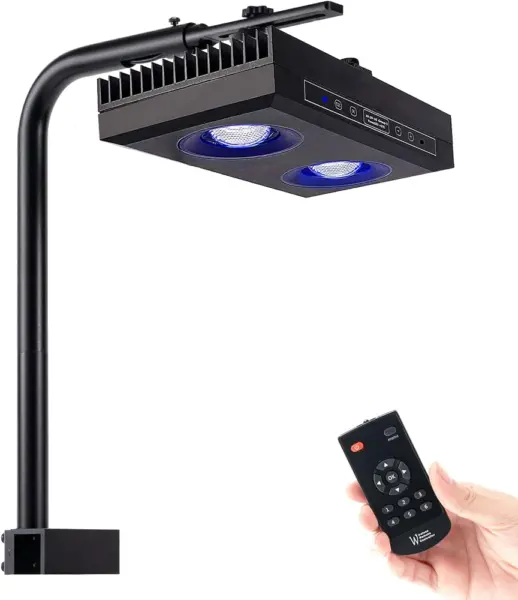
Set the schedule once and the G5 runs the day for you: a sunrise, a full-intensity midday, a fade to moonlight, all from the included remote with no controller to buy and no app to pair with your phone. It also sits on the tank, on an aluminum bracket that clamps glass up to about an inch and a half of plastic trim, so there are no ceiling hooks, no canopy drilling and nothing to undo when you move the aquarium.
Ninety-five watts across 24 LEDs behind a 120-degree lens makes a brighter fixture than the small housing suggests, and 9,500 lumens is the stated ceiling. What we appreciate most is how much color it pulls out of a tank: run the blues up and the whites back and the fluorescence reads clearly without the scene turning into a monochrome wash. Among the mid-priced lights here, it has the smallest gap between what it promises and what it delivers.
The bracket is both the reason to buy it and the part to think about. It is what makes the G5 a five-minute install, and it is where the design gets awkward: the arm can sag under the fixture when it is extended, and on a narrow tank the adjustment runs out before the light is centered over the rockwork. Wide, rimless tanks suit it best; a deep rimmed cube is better served by a hanging fixture.
Everything else is quietly competent. The fans are rated under 45 dB, the body stays out of the way, and the 2.4G group control links several units so a long tank runs one schedule from one remote. If you have been putting off a reef light because the controllers and apps sound like a second hobby, this is the one that makes it feel simple.
Pros
- Built-in sunrise-to-sunset schedule, no controller needed
- Bracket mount fits rimmed or rimless, no drilling
- Strong color and coral performance at mid price
- Group control links several units to one remote
Cons
- Schedule programming takes patience with the remote
Buy the G5 if you want a reef light that sets its own sunrise-to-sunset schedule and clamps straight onto the tank without a controller, an app or a ceiling hook.
VIPARSPECTRA V165 – Best for High Output
Key Features
- Control: Remote or dial
- Dimming: Two channels, 0-100%
- Coverage: 24 x 24 in
- Mounting: Hanging kit included
- Price: Midrange
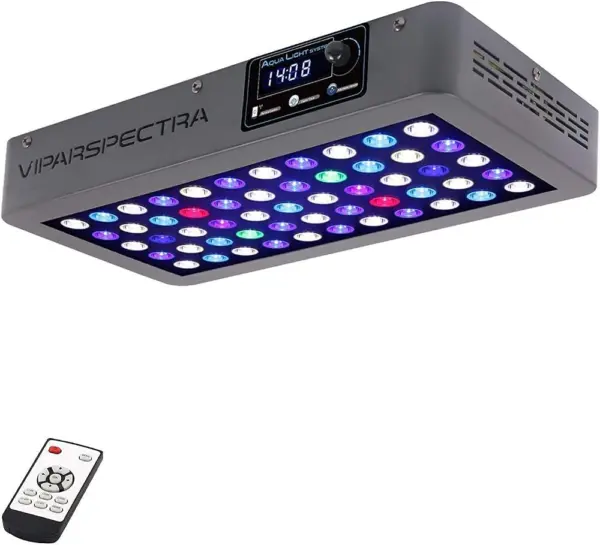
If the SMATFARM is the tidy choice, the V165 is the one for a tank that needs more punch: 55 LEDs in a wide layout, two channels you can wind from nothing to full, and enough spread to cover a 24-inch footprint on its own. Hang it over a mixed reef with the SPS near the top and it delivers the intensity those corals are asking for; the growth it drives is the most striking thing about it.
The fixture itself is reassuringly plain. Two dimming channels let you run a blue-heavy actinic phase and a whiter viewing period, the hanging kit comes in the box, and the aluminum body is the kind you mount once and forget about. Weight is 7.6 pounds, so plan on a stud or a proper ceiling anchor rather than a drywall plug.
The controls are where it shows its age. There is no app and no gradual ramp, so the tank goes from dark to full output in one step, and the built-in timer is the least dependable part of the package — it can leave the channels on the wrong schedule, which is why a plain outlet timer or a smart plug is the usual fix. If you are at the tank every day and would rather turn a dial than open an app, that simplicity is a feature rather than a fault.
The one-year warranty is standard for this group rather than generous, and there is nothing here that needs updating or connecting. Over a canopy or in a fish room, that is exactly the point.
Pros
- Reef-grade intensity over a 24-inch footprint
- Two dimmable channels for actinic and viewing phases
- Hanging kit included in the box
Cons
- Hanging only; no tank bracket included
Choose the V165 when a mixed reef needs real intensity over a two-foot footprint and you can hang it — it is the most output per dollar here.
NICREW NavaReef 65W – Best for Deeper Tanks
Key Features
- Output: 65W
- Mounting: Tank mount included; hanging kit optional
- Beam angle: 90 degrees
- Spectrum focus: 440-480 nm
- Price: Midrange
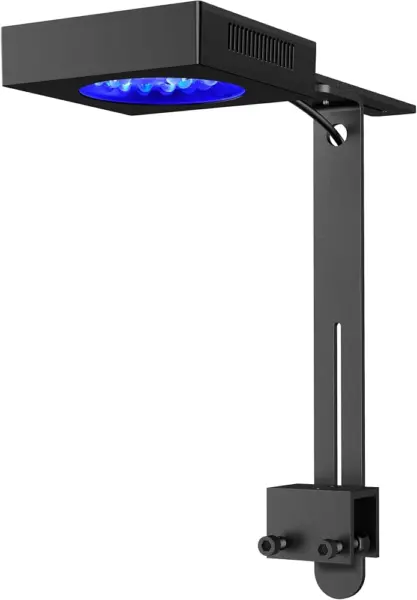
Ninety degrees is a narrow beam for a reef light, and it is the whole point of the NavaReef: the lens optics push light down into the water instead of scattering it across the room. On a tank that is deeper than it is wide, that is the difference between usable light at the sandbed and a bright top six inches.
The spectrum is built around the 440 to 480 nm band, which is where coral fluorescence lives, and the beam is loaded with it. Sixty-five watts through those optics is concentrated rather than gentle, and it shows in the colors: blues and greens pop under this fixture in a way they do not under the whiter, wider lights here. Cooling runs through a fan under a removable dust mesh, and the tank mount comes in the box with a hanging kit as the optional extra.
Where it earns its place is depth. It does more with 65 watts than the wider fixtures here do with more, and it does it without turning the room blue. The narrow beam is the trade: on a long, shallow tank you want two of them, or a wider fixture that reaches the corners.
Pros
- 90-degree optics drive light into deep tanks
- Blue-heavy spectrum tuned for fluorescence
- Tank mount included; hanging kit optional
Cons
- Ramps and full schedules need a separate controller
Pick the NavaReef for a tank that is deeper than it is wide — its narrow beam puts usable light where a wide fixture wastes it.
Fluval Sea Marine Nano – Best for Nano Tanks
Key Features
- Output: 20W, 100 LEDs
- Control: Bluetooth app
- Mounting: Adjustable over-the-glass
- Light cycle: Programmable 24-hour
- Price: Midrange
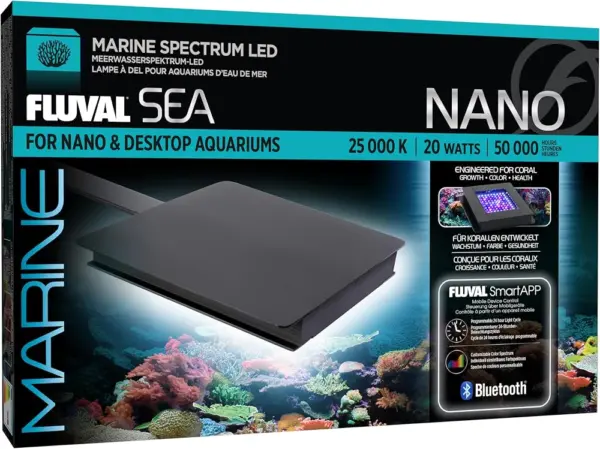
Twenty watts sounds like a desk lamp until it is over a ten-gallon nano and the whole aquascape comes up. A hundred LEDs behind 120-degree lenses, a fully encased aluminum shell, and a mount that slides over the glass and adjusts up and down, side to side and front to back: this is a light designed around small tanks rather than shrunk down from a big one.
The app is the reason to choose it over the cheaper nanos here. You build a 24-hour cycle — sunrise, midday, sunset, night — and set each color channel independently, which matters on a small tank where one flat white setting turns everything beige. Setup took us a few minutes, and the schedule then runs without a phone anywhere near the tank. Add the low, black frame and you have the most polished small-tank light in this guide.
Check the grip before you order. The over-glass mount is built for thin glass and trim, so measure the frame rather than the tank — a chunky plastic rim is not what it is made for. Within those limits it is the fixture that makes a nano look planned rather than assembled.
Pros
- App builds a full 24-hour light cycle
- Independent color control per channel
- Mount adjusts in three directions over the glass
- Low-profile body suits open-top nanos
Cons
- 20 watts will not carry SPS in a deep tank
For a rimless nano on a desk, the Fluval is the small-tank light to buy — the app cycle and the adjustable mount make everything else feel improvised.
Current USA Orbit Marine – Best for Fish-Only Tanks
Key Features
- Extras: Runs eFlux wave pumps
- Output: 27W, 104 LEDs
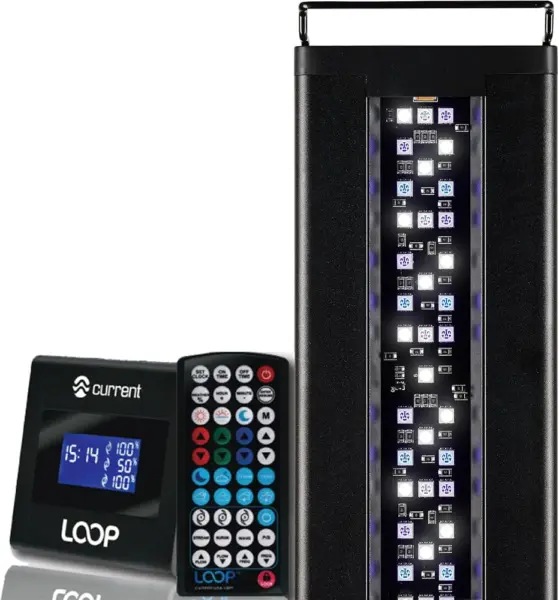
- Control: IR remote with LOOP controller
- Profile: 0.45 in high
- Price: Midrange
Fish, live rock and a few soft corals: that is the tank the Orbit Marine is built for, and it is a bigger slice of the saltwater hobby than the SPS showpieces suggest. This is the light we recommend for it, because it is the only fixture here that disappears — at less than half an inch tall, sitting on sliding docking legs over the glass, it leaves the top of the tank looking open.
Presets do the heavy lifting. Sunrise, daylight, sunset and moonlight run on their own schedule, there are cloud and storm modes with lightning for when someone asks to see the tank, and the LOOP controller also drives eFlux wave pumps, so light and flow sit on one remote. That integration is genuinely useful and nothing else here offers it.
The trade-off is output. Twenty-seven watts across 104 LEDs is fish-and-softie lighting: keep SPS off the stocking list, or plan on two fixtures over a shallow tank. Where it suits, it makes a modest tank look far more expensive than it is.
Pros
- 0.45-inch body all but vanishes over the tank
- Preset sunrise, sunset, moonlight and storm modes
- LOOP controller also runs eFlux wave pumps
Cons
- IR remote needs a clear line of sight
Buy the Orbit Marine for a saltwater tank with fish and soft corals, where a light that disappears and runs itself beats raw output.
PopBloom RL60 – Entry Wifi Reef
Key Features
- PAR: Above 130 at 20 in, above 100 at 24 in
- Output: 65W
- Control: WiFi app
- Tank fit: 20-36 in long, 24 in wide, 24 in deep
- Price: Midrange
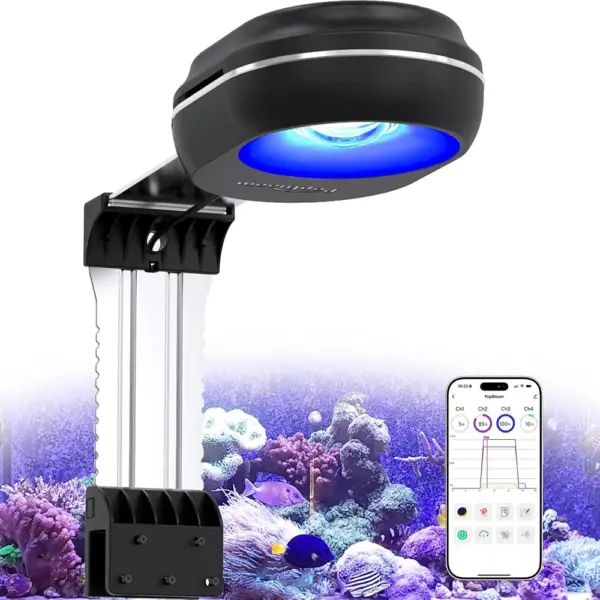
The arms slide back rather than clamping forward, so the RL60 sits behind the tank and reaches over it. That is why it fits rimmed and rimless glass without a bracket hanging off the front pane, and why it takes up almost no visual space on a small tank.
Sixty-five watts, a projector-style glass lens at 110 degrees, and stated PAR above 130 at 20 inches and above 100 at 24 inches — that is real reef territory for a nano or an entry-level mixed tank rather than a fish-only glow. The WiFi app carries a full 24-hour cycle with sunrise, sunset and a lunar phase, and there are preset schedules for people who do not want to build one.
Two years of warranty is the longest of anything in this guide, and on a light that runs ten hours a day that counts for more than an extra channel. It is also the least expensive way into app-controlled reef lighting in this group.
Control is app-only, with no remote in the box, so a flaky WiFi connection is your problem to solve, and the fan runs continuously, which you notice in a silent room. Neither is disqualifying on a desk tank. Buy it if you want a smart, low-profile fixture over a small tank and you are happy doing everything from a phone.
Pros
- Stated PAR holds up at 20 and 24 inches
- WiFi app with 24-hour and lunar cycles
- Two-year warranty, longest in this group
- Rear-sliding arms fit rimmed or rimless tanks
Cons
- App-only control; no remote in the box
The RL60 is the smart pick for a 20-to-36-inch nano or entry reef if you want app control, real PAR at depth and the longest warranty here.
hygger 30W Reef Light – Best for Budget Pico Tanks
Key Features
- Output: 30W, 448 lumens
- Dimming: 5 levels
- Mounting: 17.7 in gooseneck
- Beam angle: 60 degrees
- Price: Budget
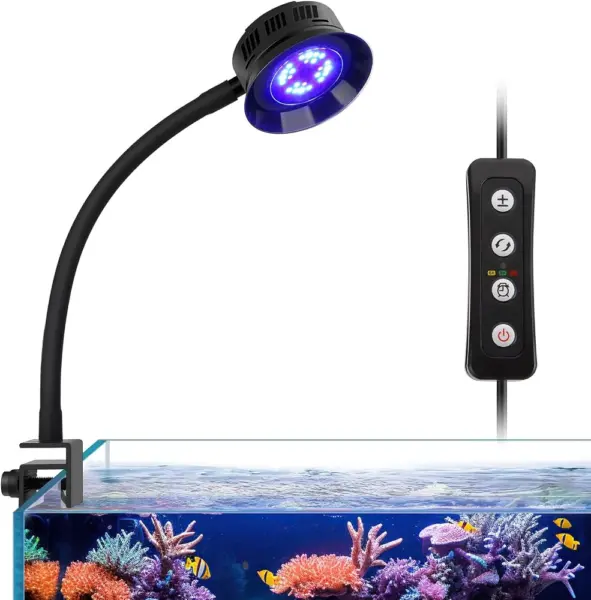
Thirty watts and a bending gooseneck: the hygger is the smallest and the least expensive light in this guide, and on a pico or a five- to ten-gallon nano it is enough to grow soft corals and keep fish colors up. That is the whole pitch — a small tank does not need a controller, an app or a six-channel spectrum.
The 60-degree lens does the useful work. Rather than washing light across the room, it concentrates the output into a narrow cone, so a modest fixture still reaches the bottom of a small, deep tank. Three color modes — all blue, blue and white, all white — cover the evening actinic look and the daytime viewing look, and the gooseneck holds position wherever you bend it.
The controller lives on the cord: brightness, mode and a built-in timer, all on a small inline unit. It is plug-and-play, with no pairing and nothing to update, which is the right amount of technology for a desk tank.
Where it lands is simple. If the tank is small, the corals are forgiving and you want light on it this afternoon, the hygger does the job for less than anything else in this guide. If the tank is bigger, deeper or headed toward SPS, put the money into one of the 65-watt fixtures instead — this is a nano light by design, not by accident.
Pros
- 60-degree lens reaches the bottom of a deep nano
- Gooseneck aims light where the rockwork is
- Full spectrum with three selectable modes
Cons
- Five brightness steps, no smooth ramp
For a pico or a small nano with forgiving corals, the hygger puts reef spectrum over the tank for less than anything else here.
SMATFARM G6 140W – Best for Large Reef Tanks
Key Features
- Output: 140W, 52 LEDs
- Control: Touch, remote, 2.4G group
- Channels: Six, dimmable
- Mounting: Bracket for 0.2-1.5 in glass or hanging
- Price: Premium
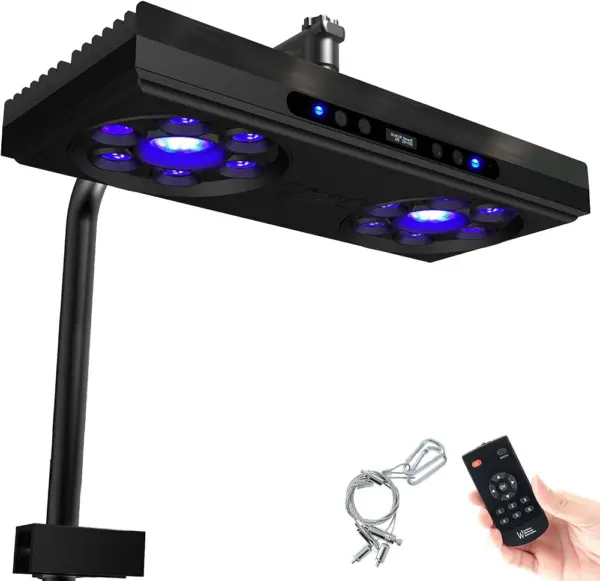
Fourteen inches wide, 52 LEDs and six dimmable channels: the G6 is the biggest fixture in this group, built for a tank where one small light will not reach the ends. White, blue, violet, ultraviolet, green and red each get their own dial, which is more color control than most keepers need and exactly what some of them want.
The bracket handles glass from 0.2 to 1.5 inches, hanging hardware is an option, and the heatsink is enlarged to cope with the output. At 13.9 inches across it covers a footprint the smaller units here need two of, which is the real argument for it.
It also runs the same 2.4G control system as the G5, so a G6 and a G5 can be grouped on one remote and one schedule — the most useful thing about this fixture if you are lighting a long tank in stages or upgrading from the smaller unit.
What we cannot tell you is how it ages. This is the newest configuration here and we have not lived with one long enough to talk about a couple of years of salt creep and heat, which makes the one-year warranty do more work in this recommendation than it does on the cheaper picks. Buy it for coverage and channel count on a big tank; if you want the surest thing here, the G5 is that.
Pros
- 140 watts across a 13.9-inch body
- Six independently dimmable channels
- Groups with a G5 on one 2.4G remote
- Bracket or hanging installation
Cons
- Only a one-year warranty at the top of this price range
Reach for the G6 when one small fixture cannot cover the tank — six channels and 140 watts, with a warranty you should weigh carefully.
How We Tested These Reef Lights
We started by narrowing the market to fixtures that could realistically light a 24- to 48-inch reef tank, comparing published specs, channel counts, included mounting hardware, and price. Anything that needed a separate controller just to run a basic on/off schedule got cut early. That left eight fixtures, which we ran over three tanks — a nano softie setup, a mixed reef, and a frag tank — for nine months, through weekly water changes, a summer heat spell, and one unplanned power outage.
Brightness got measured, not eyeballed: we took PAR readings on a grid at the surface, mid-tank, and the sandbed, then moved the same three frags under each light for six weeks to see how color held. Appearance was its own test — we photographed the same corals under every fixture at matched intensity and noted which ones made them look like themselves and which pushed everything blue. We also listened for fan noise during evening viewing and wiped salt creep off every lens once a week.
Then the controls. We timed how long it took, from unboxing a fixture, to have a full ramp-up and ramp-down schedule running — on the unit’s own screen where it had one, in the app, and by remote. We pulled the plug on each light mid-schedule to see whether it remembered the time and settings, and checked whether intensity could be stepped down finely enough to acclimate new corals without shocking them. Mounting was tried on a rimmed tank, a hanging kit, and under a mesh lid, and we noted where an arm or bracket got in the way of a net or a scraper.
How to Choose Saltwater Aquarium Lighting
The right light is the one that matches the corals you keep and the tank you keep them in, not the one with the biggest number on the box.
Start with the corals, not the gallons
Soft corals, mushrooms, zoas and most LPS do well under a modest fixture. SPS — acropora, montipora, stylophora — want intensity that a small strip light cannot deliver over anything but a shallow tank. Decide which you are keeping before you look at output, because a fish-and-softie light on an SPS tank is money spent twice.
Depth matters as much as footprint. Light falls off quickly through salt water, so a deep cube needs a concentrated fixture or a higher mounting height, while a long shallow frag tank is easier to light than its length suggests. Buy for the corals you want in a year, not only the ones in the tank now.
Beam angle is a statement about spread
A 120-degree lens washes light widely and suits shallow tanks and mixed reefs. A 90-degree lens concentrates the same watts into a smaller circle, which is the better tool for a deep tank or for pushing light to a sandbed. Neither is better in the abstract — they are two different shapes of the same output.
Mounting height is your other lever. Bracket and gooseneck lights sit a few inches off the water with very little adjustment; a hanging kit lets you raise the fixture to soften intensity without dimming, which is the cleaner way to acclimate new corals.
Timers, ramps and where the schedule lives
Almost every light here dims; far fewer fade. A timer that switches on at full output is a jarring start for fish and corals, while a fixture that ramps between levels is worth paying for on a tank you sit in front of every evening.
Then check where the schedule actually lives. Some fixtures build it in and give you a remote, some want a phone app, and at least one here keeps full programming in a controller sold separately. A plain outlet timer is the cheapest fix for a light you already own, but it cannot give you a gradual sunrise.
Measure the mount before you buy the light
Bracket mounts are the easiest installation and the fussiest fit. Most clamp glass or plastic trim up to a stated thickness, and a chunky rimmed frame can be past that limit. Measure the trim rather than the glass, and check the arm can reach the middle of the tank once it is clamped on.
Hanging suits a canopy or a heavy fixture, but anything around seven pounds wants a stud or a proper ceiling anchor. Open-top rimless tanks usually look better with a bracket or a rear arm anyway.
Heat, noise and salt air
A reef light lives in a hostile place. A glass or acrylic canopy slows the corrosion that ends these fixtures early, and anything listed as not water resistant needs one. Fans pull humid air through the housing, so a removable dust mesh is a maintenance feature, not a marketing one.
Fan noise is the specification most often left off the listing. Anything with an active fan will be audible in a quiet room, and small fans run fast. If the tank sits in a living room or bedroom, weight quiet cooling above an extra channel you will never touch.
Frequently Asked Questions
How long should I run my reef light each day?
Eight to ten hours at full output, with a ramp on either side, covers most soft, LPS and SPS tanks, and consistency matters more than the exact number. Set the schedule once and leave it.
If algae takes off, shorten the photoperiod before you cut intensity — the corals need the peak, not the extra hour.
Can I use a freshwater aquarium light on a saltwater tank?
Not happily. Planted-tank lighting is built around reds and whites, while marine corals want a blue-heavy spectrum in the 440 to 480 nm band. A freshwater fixture over a reef looks yellow and leaves fluorescence flat.
If you are converting a tank, budget for a marine fixture rather than reusing the old strip.
Do I need two lights for a four-foot tank?
Usually, yes. Most of the single fixtures here are built around a roughly two-foot spread, so a four-foot tank wants two of them — or one long strip at lower output. Two smaller units also let you stagger intensity across the rockwork.
Models with group control, like the SMATFARM fixtures, run both units from one remote and one schedule.
What does it cost to run a reef light?
Less than the corals. A 95-watt fixture run nine hours a day burns a little under a kilowatt-hour daily, which is roughly 25 to 30 kWh a month.
That is a small line next to the heater and return pump, and far below what the same tank would draw under metal halide.
Final Verdict
Buy the SMATFARM G5 if you want one fixture that mounts on the tank, runs its own sunrise-to-sunset schedule and puts out enough light for a mixed reef of soft corals, LPS and the easier SPS. It is the best balance of control, mounting and output in this group, and it needs neither a controller nor an app to work.
If the tank needs real punch and there is a ceiling above it, the VIPARSPECTRA V165 gives you more spread for less money than the G6. And if the tank is a nano on a desk, the Fluval Sea Marine Nano is the one to buy — the app, the low profile and the adjustable mount are built for exactly that job.