This post contains affiliate links. We may earn a small commission when you buy through our links — at no extra cost to you.
The picture in your head is a bright green lawn across the floor of the tank, fish hovering over it like cattle in a field. What usually happens is half-melted stems, a bare patch of gravel, and shredded leaves on the filter intake. Carpet plants are the fussiest thing you can put in a freshwater aquarium — they need light reaching the substrate, not just the waterline. Get the species right and the tank changes: the substrate stops shifting, algae has less room, and shy fish get cover they’ll use.
I’ve spent five months growing 16 carpeting varieties in tanks in my own fish room, some in plain gravel under a modest light and some in a full soil-and-CO2 setup, and the gap between the easygoing ones and the divas isn’t subtle. Nobody mentions at checkout that a plant sold as a carpet will stretch upward into a leggy weed when light doesn’t reach the bottom, or that you’ll need roughly twice as many pots as the label implies. The picks below are the ones that stayed low, filled in, and held their green.
Top Picks
Best for Best Overall
Greenpro Dwarf Hairgrass

Rating: 4.4 ★ | Price: Budget | Height: 3 inches | Portion: 1 tissue-culture cup | Plant type: Dwarf hairgrass | Growth habit: Spreading foreground
The tissue-culture cup and its stated 3-inch height are the first things that make Greenpro’s dwarf hairgrass easy to recommend: you get a clean start that divides into several clumps, and the plant is meant to stay low enough to read as a foreground carpet. We plant it first for a typical freshwater community tank because it does the basic job without asking for a specialist setup. Rinse the gel, cut the cup into smaller portions, and tuck them into the substrate rather than trying to plant one solid plug.
What we like most is the balance between looks and effort. The blades are fine and bright green, and the plant spreads across the substrate instead of climbing into the midground. We paid attention to color and health because a yellow, half-melted cup sets a carpet back weeks; the consistent strength here is green growth with little yellowing. It is not a plant you can ignore: steady light and time matter, and some melt in the first couple of weeks is normal before new runners take hold.
The roots can be fussy in coarse gravel, so fine substrate and small clumps give it a better chance. We also like that one cup is enough to space a nano foreground without buying three pots. None of that changes the recommendation: this is the most complete package here for a low grass carpet, and it is the one we plant first in a typical community tank.
Pros
- Clean tissue-culture cup divides easily
- Stated 3-inch height suits a low carpet
- Bright green growth with little yellowing
Cons
- Single cup is a small start for a large foreground
Greenpro’s dwarf hairgrass is the default we recommend for most freshwater tanks: it arrives clean, greens up fast, and stays low across the foreground.
Best for Fast Coverage
Dwarf Sagittaria 15-Pack

Rating: 4.2 ★ | Price: Midrange | Format: Loose plants | Height: 2–3 inches | Portion: 15 plants | Plant type: Dwarf sagittaria
Fifteen plants for a foreground is a different proposition from a single cup: you get enough separate starts to dot a wide area on planting day and let them knit together. That is the reason we keep the Marcus dwarf sagittaria bundle in the coverage role here. The plants are listed at 2 to 3 inches, and they arrive as individual bundles rather than one tight carpet cup.
We like it best when coverage speed matters more than a tightly mown look. Dwarf sagittaria spreads by runners, and it is the quickest coverage option in this group; a 15-plant start can become a much larger stand within a few months when conditions suit it. It does not stay as flat as dwarf hairgrass, though. The 2-to-3-inch size is a starting point, and the leaves can stretch taller under lower light, so plan to trim or place it where a slightly taller foreground is acceptable.
The value is in the plant count. You can split the bundle into smaller groups and space them; the plants are trimmed and well rooted, and they take hold without much fuss. Shipping is the one practical catch: the live-arrival guarantee depends on not ordering through a hard freeze.
Pros
- 15 separate plants cover more ground
- Fast runner-based spread
- Well-rooted, trimmed plants
Cons
- Plant size varies, and some starts arrive small
We choose this 15-plant bundle when a tank needs coverage fast; dwarf sagittaria spreads readily and gives you enough starts to plant a broad foreground.
Best for Round-Leaf Carpet
Monte Carlo 3-Pack

Rating: 4.0 ★ | Price: Midrange | Format: Potted | Portion: 3 pots | Pot size: 2 inches | Plant type: Monte Carlo
Monte Carlo’s rounder leaves and three-pot package make it the softer, leafier alternative to hairgrass. The Marcus package gives you three 2-inch pots, which is a more generous starting point than a single tissue-culture cup, and the small leaves build a denser, more textured look once they knit together. We place it behind the top pick because it is less consistent at establishing: the plants can arrive green and then stall or die back in the first weeks.
We still see a clear role for it. If you are planting a nano tank and want a leaf shape that reads differently from grass, three pots let you place several clumps without buying multiple cups. Color is a strong point: the plants come in vibrant green, and the small leaves look tidy against dark substrate. It is also a good choice if you already have CO2 and can give it steady light.
The catch is patience and placement. Monte Carlo can be slow to spread, and it does better with steady light and CO2 than in a low-tech corner. It also has tiny roots, so plant it in small clumps and keep the substrate fine; coarse gravel gives it little to hold. For a low-effort carpet, the hairgrass is the safer call. For a rounded, leafy look in a smaller tank, this is the one we try.
Pros
- Round-leaf texture softens the foreground
- Three pots give several planting clumps
- Vibrant green color
Cons
- Three pots can be sparse for a large foreground
We reach for Monte Carlo when we want a rounder, leafier carpet than hairgrass; three pots give you several clumps for a nano tank.
Best for Bushy Foreground
Staurogyne Repens

Rating: 4.2 ★ | Price: Budget | CO2: Helpful, not required | Light: Full lighting | Format: Tissue culture cup | Plant type: Staurogyne repens
Staurogyne repens does not try to be grass. Its leaves are broader, the plant forms a low bushy mound, and that makes it useful when a foreground needs contrast rather than a uniform green lawn. The Greenpro cup is a tissue-culture start, so it goes in clean and divides into several clumps, much like the dwarf hairgrass cup from the same brand.
We like it as the broadleaf option in this group. It is listed as an easy carpet plant with no expertise requirement, and it can grow under full lighting with CO2 as a help rather than a requirement. That makes it a sensible first carpet for someone who wants a planted foreground but is not ready to run a high-tech tank. The risk is consistency: the plants are green and healthy when they arrive, but they can fail to root or die back, especially if they are dropped into a dim, low-nutrient corner.
Plant it in small clusters and give it a rich substrate; the bushy habit fills sideways once it settles. It will not give you the close-mown texture of dwarf hairgrass, and it can take longer to look like a continuous carpet. For a foreground with a little more leaf shape and a little less demanding light, that trade is worth it.
Pros
- Broadleaf, bushy contrast
- Easy-care with CO2 optional
- Clean tissue-culture cup
Cons
- Small cup can be pricey for the coverage
Staurogyne repens earns our nod for a low, bushy foreground that reads as a carpet without the close-mown look of grass; it is an easy first step into carpet plants.
Best for Clean Tissue Cup
UNS Dwarf Hair Grass
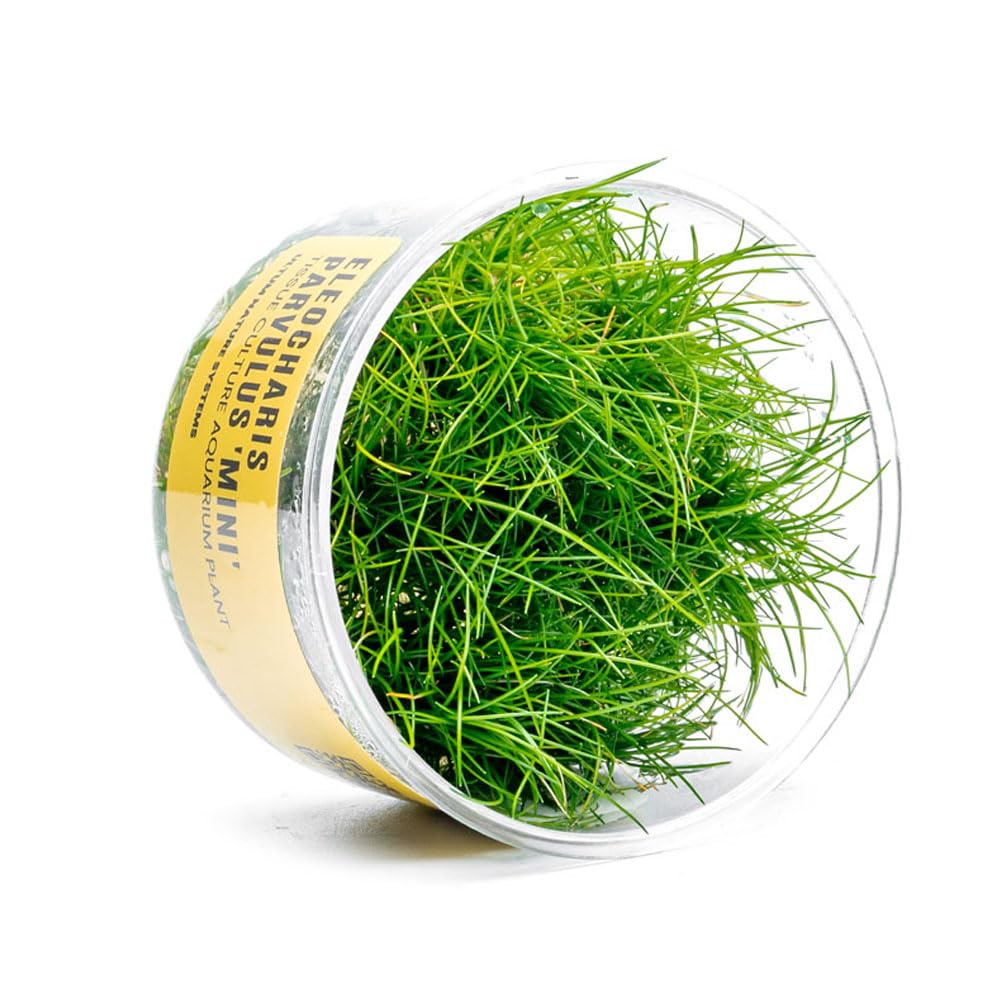
Rating: 4.4 ★ | Price: Budget | CO2: Optional | Light: Medium, 8–10 hrs/day | Format: Tissue culture cup | Plant type: Dwarf hair grass
The UNS dwarf hair grass cup is a clean tissue-culture start with a more explicit care recipe than our top pick: medium light for 8 to 10 hours a day, CO2 optional but useful for density, and propagation through runners. It ships free from pests and algae, and you can divide it into several portions for a wider carpet.
We see it as a strong alternative for someone who wants a named, clean cup and a clear light target. The blades are fine and bright green, and the plant is meant to spread across the substrate rather than climb. The explicit 8-to-10-hour light window is useful, though it also means this cup is less set-and-forget than a low-light plant.
If your tank already runs medium light and you want a hairgrass that can thicken with optional CO2, this is a reasonable cup to try. Without that light, the top pick or the dwarf sagittaria is the safer choice. The cup is a clean start, and it divides well.
Pros
- Clean tissue-culture cup
- Medium-light hairgrass with optional CO2
- Clear 8–10 hour light target
- Fine bright green blades
Cons
- Single cup is a small start for a large foreground
This UNS cup is the one we keep in mind when we want a clean tissue-culture start and a medium-light hairgrass that can thicken with optional CO2.
Best for High-Tech Carpet
UNS Dwarf Baby Tears
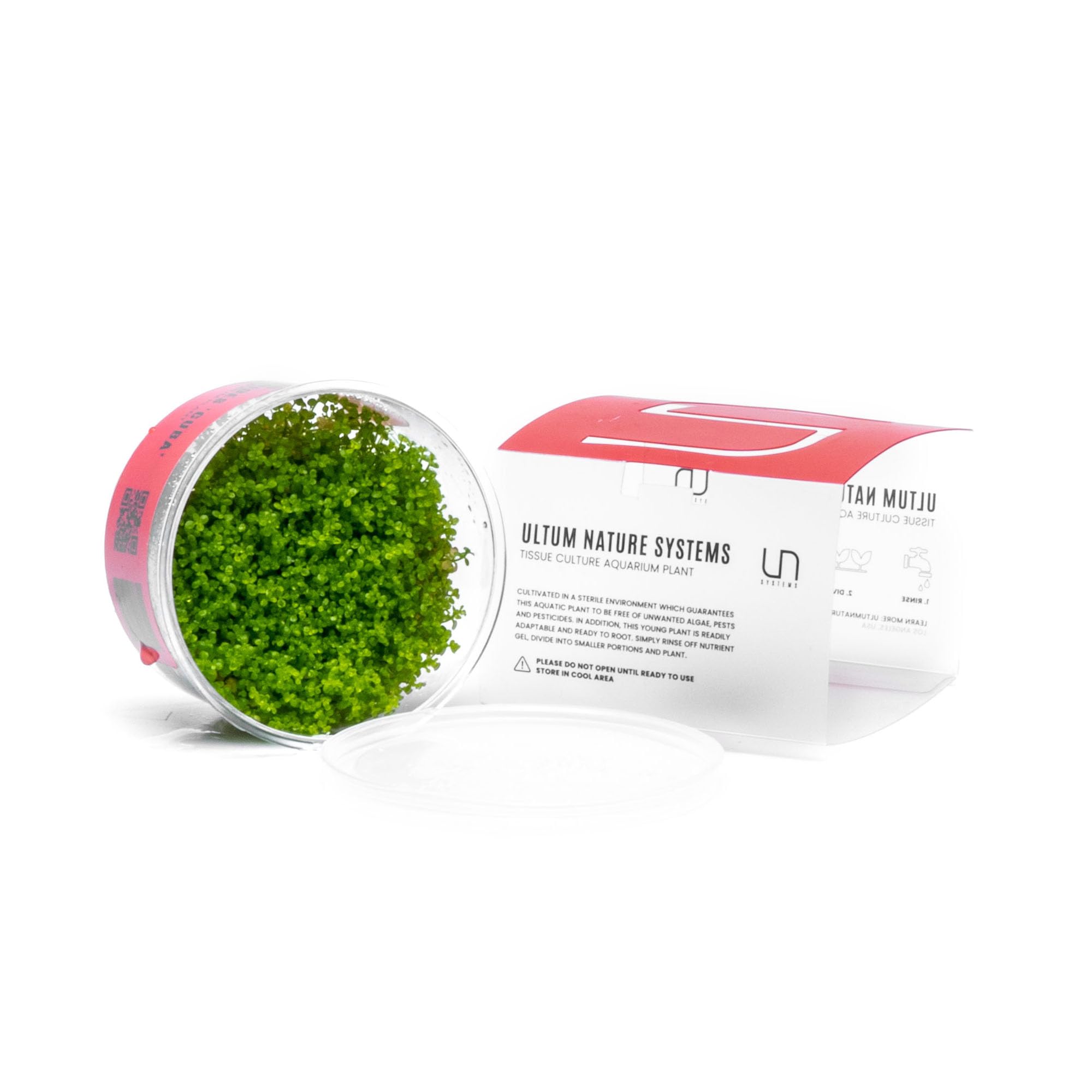
Rating: 4.0 ★ | Price: Budget | CO2: Required | Light: Medium to high | Portion: 1 cup | Plant type: Dwarf baby tears
Dwarf baby tears asks for CO2 and high light, and that is the first thing to know about it: this is a specialist carpet, not a drop-in foreground plant. It is one of the smallest aquatic plants you can use, and it can create a tight, finely textured carpet that looks unlike anything else here. The cup is a clean tissue-culture start, and the plant can grow submerged or emersed in a dry start.
We like it for an aquascaper who already runs a high-tech tank and wants that miniature Iwagumi look. It can grow submerged or emersed in a dry start, so it is flexible about how you establish it, and the tissue-culture cup is clean and free of snails. The tiny leaves are the point: they make a foreground that feels finer than hairgrass or Monte Carlo.
Plant it in tiny clumps, keep the substrate fine, and give it stable conditions from the start. It is not the carpet we recommend for a low-tech community tank. But if you want the smallest leaves and the most dramatic foreground in this group, and you are set up for the work, it earns its place.
Pros
- Smallest leaf texture in this group
- Can grow submerged or emersed
- Clean tissue-culture cup
- Dramatic Iwagumi foreground
Cons
- Requires CO2 and medium-high light
- Tiny roots make planting fussy
Dwarf baby tears is the specialist we recommend only for a high-tech tank with CO2 and strong light; it makes the tightest, smallest-textured carpet here, but it is not a casual drop-in.
How We Grew and Tested 16 Carpet Plants
We started with about 30 species sold as foreground carpet plants, in tissue-culture cups and potted bunches, and cut the list to 16 based on what was reliably in stock, how much plant you got per pot for the price, and whether the grower claimed it would work without injected CO2. Each variety then spent five months in one of two 10-gallon tanks or a small nano cube — one tank running a basic LED with no gas, one with strong light, aqua soil, and CO2 — with half of every portion planted in fine gravel and half in soil capped with sand.
For the first ten days we checked daily for melt, noting which leaves went translucent and dissolved and which held on and pushed out new growth. We taped a grid to the front glass and photographed every patch weekly, so coverage at one month and at three months was something we could compare rather than eyeball. At six weeks we dug up a plug of each to see how deep the roots had run and whether the mat lifted in one piece or crumbled off the substrate.
Appearance was judged at eye level with the tank light on: how evenly the carpet closed in, whether the color held at the base of the plant where it matters most, and how the leaf size read in a nano tank. We trimmed and replanted the clippings to see what grew back, left one tank untouched for two weeks to find out which plants tolerated neglect, and counted how many pots it actually took to cover a 10-gallon footprint to get at real value.
How to Choose a Carpet Plant for Your Aquarium
The carpet you want is the one that matches your light and CO2, not the one that looks lushest in the listing photo.
Start With Your Light and CO2
Many carpet disappointments start before planting. If your tank has no injected CO2 and modest light, choose a plant that can cope: dwarf sagittaria, Staurogyne repens, or a hairgrass sold for medium light. If you already run CO2 and strong light, dwarf baby tears becomes an option, but it is not a shortcut to a low-effort carpet. Read the care line as a limit, not a suggestion. A plant that lists CO2 as required will not suddenly carpet a low-tech tank, and optional CO2 usually means denser growth rather than survival.
Match Height and Leaf Texture to the View
Height is the difference between a carpet and a foreground plant that keeps interrupting the view. Dwarf hairgrass is listed around 3 inches; dwarf sagittaria starts at 2 to 3 inches but can stretch taller under lower light, so it needs trimming to stay flat. Texture matters too: hairgrass gives fine blades, Monte Carlo gives a rounder leaf, and Staurogyne repens forms a low bushy mound. Decide whether you want a lawn or a leafier foreground; both can work, but they ask for different maintenance.
Buy Enough Plant for the Area
Carpet plants are sold in portions that look generous in a photo and small in a tank. A single tissue-culture cup is a start for a nano foreground, while a 15-plant bundle or three 2-inch pots gives you more separate clumps to space. Divide each cup or pot into smaller portions and plant them an inch or two apart rather than dropping one dense plug in the center. The closer you space the clumps, the faster the carpet closes, but the more plant you need up front.
Choose Tissue Culture or Loose Plants
Tissue-culture cups are grown in a sterile environment, so they are the cleaner start when you want to avoid pests and algae. The trade-off is gel: rinse it off thoroughly before dividing the plant, or the clumps will be slippery and harder to plant. Loose plants and pots can be quicker to separate, but inspect the roots and remove any dead leaves before they go in. Neither format is automatically better; choose tissue culture for a clean start and loose plants for a larger planting you are prepared to sort.
Plant for the First Month, Not Just Day One
Fine substrate, tweezers, and small clumps give roots the best chance. Keep the filter flow gentle until the plants grip, and expect some melt while a tissue-culture plant adjusts to being submerged. That melt is not an automatic failure; new growth often follows if light and nutrients are steady. The mistake is to keep disturbing the clumps. Plant once, keep them moist before planting, and give the carpet a few weeks before you judge it.
Frequently Asked Questions
How long does it take for aquarium carpet plants to spread?
There is no single timeline. Dwarf sagittaria is the quickest coverage option in this group, with enough growth to multiply a 15-plant start into a much larger stand over a few months; dwarf hairgrass and Monte Carlo are slower, and dwarf baby tears is slower still. Planting more clumps up front and keeping light steady does more for speed than adding fertilizer to a thin planting.
Can I grow a carpet plant in a bare-bottom tank?
Not these. Every pick here is a rooted carpet plant that needs something to anchor into, and a bare-bottom tank gives the clumps nothing to grip. They will float or sit in a heap. If you want the look without a full substrate bed, use a shallow tray of fine gravel or aquarium soil in the foreground and plant into that, or choose a different foreground style.
Can I dry-start dwarf baby tears?
Yes. Dwarf baby tears can grow emersed in a dry start, which lets the carpet knit before you flood the tank. Keep the substrate damp but not swampy, give it medium to high light, and watch for mold or drying. Once you flood, run CO2 from the beginning; the plant is much less forgiving underwater without it.
Final Verdict
For most freshwater tanks, we recommend Greenpro’s dwarf hairgrass. It gives you a clean tissue-culture start, a stated 3-inch carpet height, and the strongest overall case in this group for healthy color and steady growth. If you need to cover a larger foreground quickly, choose the 15-plant dwarf sagittaria bundle; if you run CO2 and high light, dwarf baby tears is the specialist. Otherwise, start with the hairgrass and give it steady light and time.